
Minimals • Skin Science | 10 min read
The Real Reason Your Skin Looks Worse Before It Looks Better
Why your new skincare routine isn’t “purging” your skin it’s breaking your barrier, and how to actually fix it.
Your Skin Isn't Broken. Your Routine Is.
You’ve been told that good skin requires a “ritualistic journey.” A 12-step sequence of serums and essences stacked like a skincare lasagna. So you commit. You buy the regimen. And then, the ultimate betrayal happens: your skin gets worse. Suddenly you’re dealing with unexpected flaking, a sandpaper texture, or even hives. I see it all the time and honestly, I’ve been there too, staring in the mirror wondering why my hard work is backfiring.
Naturally, you assume it’s a “purge.” A detox. Your skin is just “healing itself,” right?
Wrong. You aren’t purging toxins. You are actively damaging your skin barrier, disrupting your microbiome, and triggering a low-grade inflammatory cascade. The problem isn’t that your skin is broken. It’s that your routine is breaking it.
The Biology of Getting Worse
Before we fix the damage, we need to look at what’s actually happening below the surface. Your skin barrier is a brick-and-mortar wall made of lipids ceramides, cholesterol, and fatty acids. When it’s intact, it keeps moisture in and irritants out, but most result-driven routines bash that wall down first. I’ve watched this exact chain reaction play out countless times on a microscopic level. It starts when you introduce a high-percentage active like retinol or $10\%$ niacinamide. Sure, cell turnover speeds up, but it strips your protective lipid matrix right along with it.
Once that matrix is disrupted, transepidermal water loss (TEWL) skyrockets, leaving your skin tight and dehydrated. Slapping on more hyaluronic acid won’t fix this either; without lipids to lock it in, the water just evaporates into thin air.
Next, your microbiome panics. Your skin is home to billions of microbes like C. acnes and S. epidermidis, and when you over-exfoliate, you wipe out the good bacteria, leaving an open field for the bad strains to take over.
This broken barrier and chaotic microbiome trigger a low-grade inflammatory cascade. Your skin panics, pumping out excess sebum to seal the leaks and throwing your texture into absolute chaos. Make no mistake: this isn’t a purge. It’s a wound.
The Worst Part? Your Skin Is Telling You It's Broken
And most people ignore it. The beauty industry practically invented the “purging” myth to trick you into buying more products while your skin actively screams for help. True purging is just temporary inflammation from accelerated cell turnover, and it clears up in a few weeks. If your skin has been a chaotic mess for months, it’s not a purge.
In my experience, what you’re actually dealing with is severe barrier damage. Rebuilding that lipid wall takes anywhere from 4 to 12 weeks, and during that timeline, everything feels worse because your skin is genuinely compromised just not in the neat, marketable way the bottle promised.
The absolute cruelty of this cycle is that our instinct is always to add more. We pile on hydrating serums to fix the dryness and use more actives to “push through” the texture. But you aren’t healing the skin. You’re just accelerating the damage.
The Actives Trap: Why "Results" Come With a Cost
Let’s talk about retinoids, vitamin C, and other powerhouse ingredients. They work that’s not the lie. They genuinely increase cell turnover, reduce fine lines, and improve texture, backed by pages of evidence in the Journal of Investigative Dermatology. But there’s a cost, and that cost is usually your barrier. Most people start retinol and feel validated when their skin gets red, flaky, and irritated, assuming it means the product is working. Except lingering redness and flaking are signs of barrier damage, not efficacy. You can achieve results and maintain a healthy barrier; the two are not mutually exclusive.
The breakdown usually happens because we start too strong, too fast. You buy a 1% retinol and use it three times a week because the internet told you it’s essential, but your skin hasn’t adapted, and your barrier hasn’t had time to upregulate protective proteins. By week two, you’re flaking like you’ve been freeze-dried. We confuse irritation with efficacy, forgetting that while redness means the skin is responding, it doesn’t mean it’s responding well. A smarter approach is starting at the lowest concentration like 0.025% retinol just once or twice a week to build tolerance slowly, letting the barrier heal between applications so you get results without the damage.
Then comes the cardinal sin: layering too many actives at once. Your skin suddenly faces an onslaught of low-pH Vitamin C, irritating high-percentage niacinamide, cellular-stressing retinol, and a physical scrub because you’re convinced exfoliation equals clarity. You’ve essentially created a chemical and physical assault on your skin’s surface.
Studies show that this kind of stacking drastically increases sensory irritation and tanks your barrier’s recovery time. Your skin isn’t purging; it’s in crisis mode. The smarter move is always one active per routine either a retinoid or an exfoliant, but never both, never in the same step, and never every single day.
The Cleanser You're Using Is Probably Too Stripping (Even If It Says "Gentle")
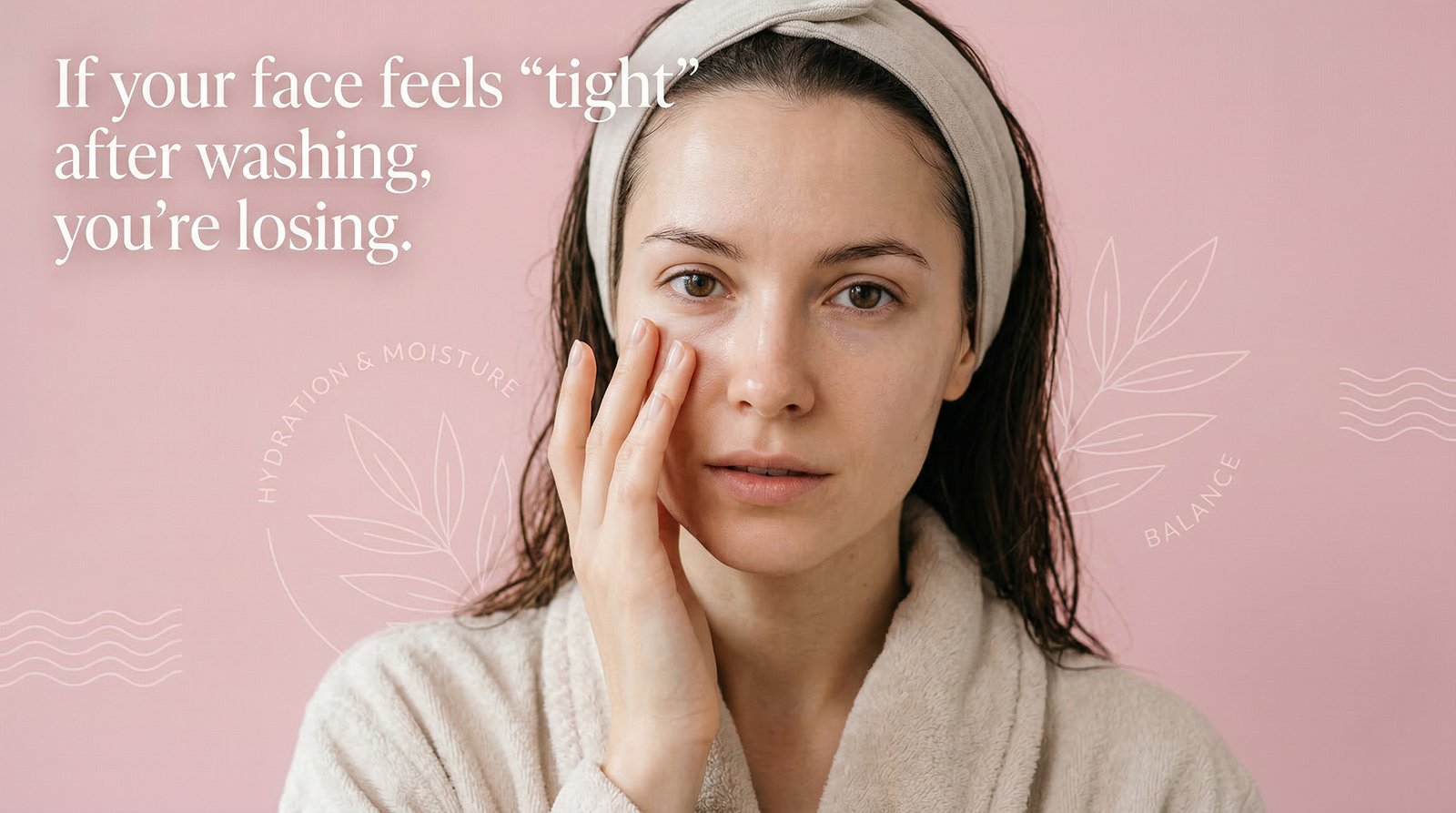
Here is something dermatologists know that the beauty industry explicitly hides: most people are violently over-cleansing. We’ve been conditioned to believe that “clean” skin should feel tight and squeaky, but I always tell people that the squeaky-clean feeling isn’t cleanliness it’s the sound of a damaged barrier. When you strip away that natural lipid layer, your skin immediately panics and overproduces oil to compensate. You feel greasy thirty minutes later, so you wash it again, harder and more often, trapping yourself in a vicious over-cleansing spiral.
Research published in the International Journal of Dermatology shows that harsh cleansing spikes transepidermal water loss and disrupts your microbiome for up to 24 hours after a single wash. You aren’t just damaging your barrier once; you’re dismantling it daily. Your skin hosts a complex, delicate ecosystem of microbes, including C. acnes, which lives peacefully when things are balanced. But harsh, high-pH surfactants act like a bomb, wiping out the good bacteria indiscriminately and creating a microbial vacuum. Pathogenic, inflammation-causing bacteria quickly move into the empty space, leaving you with breakouts, lingering redness, and sensitivity.
The solution isn’t just finding a “gentle” cleanser; it’s about smart cleansing. A proper formula must remove environmental debris and excess sebum without touching your underlying lipid architecture. That means ditching harsh sulfates like SLS, matching your skin’s natural acidic pH (around 4.5 to 5.5), and using a formula packed with barrier-respecting humectants once or twice a day max.
The Hydration Myth That's Quietly Drying Your Skin Out
This is the counterintuitive truth that changes everything, and it’s a distinction I find myself explaining constantly: hydration and moisture are not the same thing. Hydration is the water content inside your skin cells, while moisture is your skin’s ability to retain that water using an intact lipid barrier. You can flood your skin with hydrating serums, essences, and masks all day, but if your barrier is broken, all that water just evaporates into thin air. You aren’t fixing the problem; you’re just dehydrating your skin more efficiently. This is exactly why people buy six different hydrating products and still wake up feeling tight, uncomfortable, and defeated.
In fact, those very hydration products might actually be worsening your barrier function. High-molecular-weight hyaluronic acid sits on the surface and can ruthlessly pull water from the deeper layers of your skin if the barrier can’t retain it. Meanwhile, heavy glycerin serums can suffocate the skin, and trendy essences packed with ferments or plant extracts often introduce sneaky irritants that trigger more inflammation. You get a temporary, superficial plumpness as water hits the outer layer, followed by a harsh crash of dehydration the second it evaporates minutes later.
What actually works is a precise formula that hydrates and seals simultaneously. This requires an intentional sequence: a hydrating core of glycerin or hyaluronic acid in the right molecular weights, immediate lipid reinforcement from ceramides, cholesterol, or squalane to repair the wall, and a breathable occlusive layer like peptides or plant oils to lock it all in. Most serums only hydrate, while most moisturizers try to seal without infusing enough water. Until you combine both steps to protect that lipid architecture, your skin stays trapped in a state of constant dehydration.
Why Your Skin Gets Worse at 3 Weeks (And Better at 3 Months)
There is a strict biological timeline to this process, and misreading the signs is where most people completely derail. In my experience, weeks one and two actually bring a false sense of validation. Your skin is reacting it’s a little red, flaky, and congested so you assume progress is happening, but underneath the surface, your barrier is just entering early-stage damage. By weeks three and four, you hit peak confusion. The flaking, sensitivity, and texture all peak at once, tempting you to throw the whole routine in the trash. This is the ultimate inflection point where your barrier hits maximum distress before it can finally begin to turn the corner and heal.
If you survive that phase, weeks five through eight finally bring a sigh of relief as slow improvement kicks in, the flaking subsides, and barrier repair actively takes hold. By weeks eight to twelve, you start seeing the noticeable results you actually wanted better texture, clarity, and fine lines—coupled with skin that finally feels comfortable. Beyond week twelve, you achieve real, sustainable results, but only if you aren’t dismantling your barrier every single week. The tragedy is that most people quit at week three or four when they should be holding steady, or worse, they stay trapped in a destructive cycle because they’re stacking too many harsh actives, meaning they never reach the healing phase—they just plateau in a state of chronic irritation.
The Reality Check: If Your Routine Feels Complicated, That's the Problem
Complicated routines don’t work better; they work worse. Every single step you add to your counter exponentially increases the likelihood of severe barrier damage, microbiome disruption, and incompatible ingredient interactions. If you are juggling a 10-step routine with completely different product slates for morning and night, stacking active ingredients on top of each other, and mixing exfoliants, retinoids, and vitamin C all in the same week, your routine is the actual problem. I tell people all the time that if you don’t understand exactly why a product is in your lineup, it shouldn’t be on your face. A skin-healing routine needs to be simple enough that you can remember it without thinking, focusing entirely on biological respect rather than product accumulation. Here’s what actually works:
The Routine Your Skin Actually Asked For
This is what Minimals skinimalism actually looks like. Not a marketing slogan. An operational model.
Cleanse
A gentle, low-pH formula that removes the day without stripping the lipids underneath it. If your face feels “squeaky,” this step is working against you, not for you.
Treat
One active at a time. Give it weeks, not days, before judging whether it’s working most actives need four to six weeks before you can tell the difference between irritation and progress.
Seal
A ceramide-forward moisturizer that locks hydration in instead of letting it evaporate by morning. This is the step most routines skip or underdose, and it’s the one doing the most structural work.
Protect (AM only)
SPF. Not optional, not negotiable the one step no amount of minimalism gets to skip.
That’s it. Four steps (or three, depending on your needs). One active per day, at most. No confusion. No over-processing.
What You Need to Know About Barrier Repair
A damaged barrier doesn’t heal with a random assortment of trendy products; it heals with time and the exact environment it needs to rebuild. That environment requires a precise trifecta of skin-identical lipids ceramides (specifically AP, EOP, and NP), cholesterol, and free fatty acids like palmitic or linoleic acid which literally fill the microscopic gaps in your lipid mortar. Adding peptides to this mix acts as a cellular signal, prompting your skin to produce its own structural proteins and lipids. In my experience formulating and analyzing skin health, a truly effective moisturizer must contain all of these components working in synergy. If your product only checks one or two of these boxes, or if those critical ceramides are buried at the very bottom of the ingredient list rather than sitting comfortably in the top five, it simply isn’t present in a meaningful amount to fix the damage.
What You Need to Know About Barrier Repair
A damaged barrier doesn’t heal with a random assortment of trendy products; it heals with time and the exact biological environment it needs to rebuild. That environment requires a precise trifecta of skin-identical lipids ceramides (specifically AP, EOP, and NP), cholesterol, and free fatty acids like palmitic or linoleic acid which literally fill the microscopic gaps in your lipid mortar. Adding peptides to this mix acts as a cellular signal, prompting your skin to produce its own structural proteins and lipids. In my experience formulating and analyzing skin health, a truly effective moisturizer must contain all of these components working in synergy. If your product only checks one or two of these boxes, or if those critical ceramides are buried at the very bottom of the ingredient list rather than sitting comfortably in the top five, it simply isn’t present in a meaningful amount to fix the damage.
A simple ""Is It a Purge or a Wound?"" checklist
- Is it scaling like sandpaper?
- Does it sting or burn?
- Has it lasted past month?
- Does it feel squeaky clean?
- Your skin barrier is wounded.
Frequently Asked Questions
True purging only happens where you normally break out and clears up within a few weeks. If your skin feels tight, flaking, or irritated all over for months, your barrier is damaged.
Never layer them in the same step. Stacking low-pH Vitamin C with cellular-stressing retinoids creates a chemical assault on your skin. Use Vitamin C in the morning and Retinol at night.
Your cleanser is likely too harsh. When you strip away your natural oil layer to get that “squeaky clean” feel, your skin panics and overproduces sebum to compensate.
Expect it to take anywhere from 4 to 12 weeks. Biological repair takes time, and your skin will likely feel worse before it feels better as the lipid wall rebuilds.
Look for ceramides, cholesterol, and free fatty acids listed in the first five ingredients. If these skin-identical lipids are buried at the bottom, the formula is just marketing fluff.
Closing thought
Your next move is simple: stop buying more skincare and start listening to what your skin is actually trying to tell you. If your skin is a chaotic mess by week three, you need to hit pause and ask yourself a few brutally honest questions. Is your cleanser truly pH-balanced, or is it stripping you clean? Are you stacking more than one heavy active a day? Does your moisturizer actually list ceramides, cholesterol, and fatty acids in the first five ingredients, or are they just marketing fluff buried at the bottom? If you answer no to any of these, your routine is the problem, not your skin.
Real barrier repair takes four to twelve weeks, and true results take twelve to sixteen but only if you’re using a routine engineered to respect your biology rather than destroy it. I see people fall into the consumer trap every single day because the beauty industry constantly screams at you to buy more, layer deeper, and just wait it out. I’m telling you to do the exact opposite: use less, choose smarter, and give your skin the space to finally catch up.