
Minimals • Skin Science | 10 min read
The Ultimate Guide to Ceramides: Why Your Skin Needs Them for Better Skin
The invisible glue your skin barrier is starving for and the formulation flaws keeping it that way.
Your Moisturizer Has Ceramides. Your Skin Still Doesn't Have a Barrier.
You’ve been told that ceramides are the answer. The holy grail. The ingredient your skin desperately needs. So you bought a moisturizer that advertised ceramides on the front. Maybe three of them. Maybe five. Maybe it said “ceramide complex” and you felt smart for knowing that word. And your skin still feels tight. Still reactive. Still not actually repaired.
Here’s the brutal truth I discovered after years of treating my own face like a science experiment: most products with ceramides have them in the wrong concentration, the wrong ratio, and the wrong formulation structure to actually repair your barrier. It’s not that ceramides don’t work. It’s that brands are using them wrong and selling you the result.
What Ceramides Actually Are (And Why the Beauty Industry Lies About Them)
Ceramides aren’t magic they are simple, structural lipids making up 50% of your skin barrier (the stratum corneum).
Think of your barrier as a brick wall: dead skin cells are the bricks, and a precise ratio of ceramides, cholesterol, and fatty acids is the mortar. When this mortar is depleted by over-cleansing or harsh actives, moisture evaporates through the gaps. This is transepidermal water loss (TEWL), the root cause of dehydration and sensitivity.
The fix seems obvious: add them back. But it’s tricky. Your skin requires a specific composition of different ceramide types to heal. Most brands ignore this, dumping in cheap, single versions that make the product feel good without actually repairing the structural damage.
The Three Ceramides That Actually Matter (And What They Do)
Your skin requires three specific ceramides working together:
Ceramide AP: The structural workhorse doing the heavy lifting of cellular repair.
Ceramide EOP: The critical binder needed to fully seal a compromised barrier.
Ceramide NP: The waterproofing component that locks moisture into your skin.
An effective formula must include all three. Most products fail because they only contain one or two usually heavy on Ceramide AP because it is the cheapest to source. This is why a moisturizer can feel hydrating initially without actually fixing your barrier over time.
The Ratio That Changes Everything (And Your Brand Probably Doesn't Use It)
The exact lipid ratio matters far more than individual ingredient amounts. Your skin’s natural matrix demands a specific balance: 50% ceramides, 25% cholesterol, and 15% free fatty acids.
When your barrier breaks, piling on raw ceramides won’t fix it; you must restore this system. A landmark study in the Journal of Investigative Dermatology proved that a precise 3:1:1 ratio (3 parts ceramides, 1 part cholesterol, 1 part free fatty acids) is the undisputed gold standard for optimal repair.
Brands skip this biological blueprint because it is difficult to formulate. Cholesterol suffers from solubility issues, fatty acids oxidize rapidly, and the wrong pH destabilizes the entire batch. It is vastly cheaper for a manufacturer to toss a single ceramide into a basic cream, leaving your skin to suffer the consequences.
How Much Ceramide You Actually Need (Not the Amount Brands Use)
This is the moment where the beauty industry falls apart. Most moisturizers that advertise ceramides contain a meager 0.1 to 0.5% ceramides by weight. That sounds like a lot until you understand dosing.
Dermatological studies using tested, effective formulations use ceramide concentrations of 2 to 3%. That’s 4 to 30 times higher than what’s in your drugstore moisturizer.
Why the difference? Cost. Stability. Texture. Marketing. A moisturizer with 3% ceramides (in the right ratio) is denser, more expensive to make, and takes longer to absorb. Consumers expect moisturizers to feel light and luxurious, not heavy and medical.
So brands compromise: they use just enough ceramides to list them on the label, not enough to actually repair a barrier. Then they add hydrating ingredients like hyaluronic acid or glycerin to make the product feel effective. Your skin feels plumped for a few hours. The ceramides quietly do nothing. You feel like something is working. It isn’t.
The Ceramide + Cleanser Problem Nobody Talks About
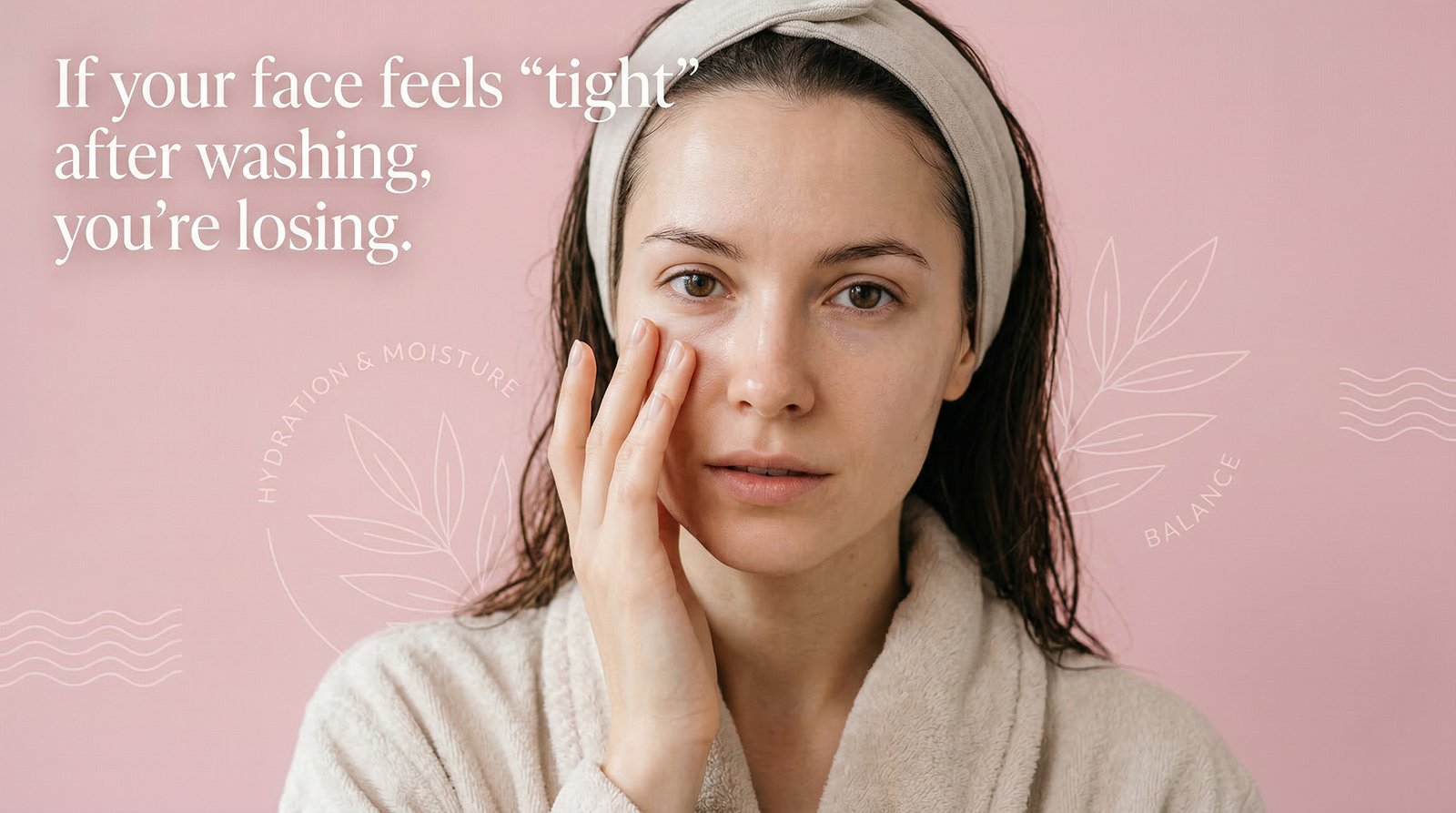
Here’s a frustrating reality: ceramides can’t repair your barrier if you’re destroying it daily with your cleanser. For a long time, I was trying to fill a bathtub while the drain was wide open.
Your skin’s natural pH is 4.5 to 5.5 (acidic). This acidity is crucial for barrier function it activates enzymes that help ceramides bind together and creates an environment where healthy bacteria thrive. Most cleansers are pH 7 to 9 (neutral to alkaline). When you wash with them, you disrupt the pH balance and chemically strip ceramides right from your skin’s surface.
Research shows that the pH of cleansing products directly impacts barrier recovery a neutral pH cleanser increases TEWL and ceramide depletion compared to a pH-balanced, acidic cleanser. If your cleanser is wrong, your ceramide moisturizer is fighting a losing battle.
Wait Ceramides Can Actually Get Worse If You Layer Them Wrong
Here’s the counterintuitive moment: more ceramides aren’t always better. When my own skin barrier was severely damaged, I made the mistake of using a high-concentration ceramide moisturizer directly on top of active ingredients like retinol, vitamin C, or AHA exfoliants.
By doing this, you’re creating an occlusive layer over actively stressed skin. The ceramides can’t migrate into the barrier to repair it because they’re trapped on the surface, blocking necessary oxygen exchange. Your skin feels sealed and smooth temporarily, but it’s actually getting more irritated underneath.
This is called “false repair” it looks and feels like your barrier is healing, but nothing is actually being fixed. A smarter approach: ceramides work best when your barrier already has baseline integrity. If your barrier is severely damaged (flaking, burning, reactive), start with a minimal routine for 2 to 3 weeks before layering in any actives again.
The Ceramide Myth: Vegetable vs. Synthetic Ceramides
The beauty industry loves a narrative, and this one is pure fiction: “Plant-derived ceramides are better than synthetic ones because they’re natural.”
Wrong. Your skin doesn’t care where the ceramide came from. It cares about the molecular structure. Ceramides derived from plants (phytoceramides) are chemically identical to ceramides synthesized in a lab. Your skin metabolizes them the exact same way.
The only difference is price. Plant-derived ceramides are expensive to extract and isolate. Synthetic ceramides are cheap to manufacture. Brands market plant-derived as “better” and charge 3x the price. Your barrier gets the same result either way. Ceramide AP is ceramide AP, whether it came from wheat germ oil or a chemical reactor.
Why Your Skin Needs Ceramides (Even If You Think You Don't)
You might think ceramides are just for “sensitive skin” people or those with eczema or rosacea. That’s not how this works. Everyone literally everyone needs ceramides because everyone has a barrier. Your barrier is degrading constantly from UV exposure, pollution, over-cleansing, and age (ceramide production naturally declines after 30). Even if your skin feels “normal,” ceramides are being lost. You’re just not noticing because you’re not severely depleted yet. A good ceramide-based moisturizer isn’t a treatment for broken skin. It’s standard maintenance for healthy skin.
You might think ceramides are just for “sensitive skin” people or those with eczema or rosacea. That’s not how this works. Everyone literally everyone needs ceramides because everyone has a barrier.
Your barrier is degrading constantly from UV exposure, pollution, over-cleansing, and age (ceramide production naturally declines after 30). Even if your skin feels “normal,” ceramides are being lost. You’re just not noticing because you’re not severely depleted yet. A good ceramide-based moisturizer isn’t a treatment for broken skin. It’s standard maintenance for healthy skin.
The Real Problem: Ceramides Alone Can't Fix Anything
This is the hard truth. Ceramides are critical for barrier function, but they’re not sufficient on their own.
Remember that 3:1:1 ratio? You need all three components: ceramides as the structural scaffolding, cholesterol as the gap-filler, and free fatty acids as the barrier seal. A ceramide-only moisturizer is like building a brick wall with only the bricks and no mortar. The structure is there, but it’s not actually sealed. Your skin also needs the right acidic pH environment, a healthy microbiome, and minimal active irritation while repair is happening. A complete barrier-repair approach addresses all of these.
The Routine Your Skin Actually Asked For
Stop looking for the perfect 10-step routine. When I stopped overcomplicating my skincare, my skin finally healed. Your barrier doesn’t need complexity; it needs consistency and the right components.
Cleanse
A gentle, low-pH formula that removes the day without stripping the lipids underneath it. If your face feels “squeaky,” this step is working against you, not for you.
Treat
One active at a time. Give it weeks, not days, before judging whether it’s working most actives need four to six weeks before you can tell the difference between irritation and progress.
Seal
A ceramide-forward moisturizer that locks hydration in instead of letting it evaporate by morning. This is the step most routines skip or underdose, and it’s the one doing the most structural work.
Protect (AM only)
SPF. Not optional, not negotiable the one step no amount of minimalism gets to skip.
The Timeline: How Long Until Ceramides Actually Repair Your Barrier
You’re not going to wake up with a repaired barrier in two weeks.
Here’s the realistic timeline:
Week 1 to 2: Your skin adjusts. If you’ve been using harsh products, you might feel less comfortable initially as your skin pH begins to stabilize and inflammation settles.
Week 3 to 4: Early signs of repair. Flaking may decrease. Redness might be less angry. Your skin starts feeling less reactive.
Week 5 to 8: Noticeable improvement. Texture is smoother. You can use other products (sunscreen, makeup) without irritation.
Week 8 to 12: Real barrier recovery. Your skin looks and feels fundamentally different plumper, more resilient, less reactive to environmental stress.
Week 12+: Maintenance. Your barrier is repaired. Now it’s about keeping it that way.
This isn’t quick. But it’s real. Most people abandon this timeline at week 3 because they’re “not seeing results.” Barrier repair doesn’t show up as dramatic before-and-afters on Instagram. It shows up as a quiet, sustained improvement in how your skin feels and performs.
The Reality Check: If Your Barrier Is Damaged, You Need to Stop Doing Other Things
This is the part where you need to be honest with yourself. If your skin is flaky, sensitive, or reactive, a new moisturizer won’t save you if you refuse to change the habits that broke your skin in the first place.
You have to put down the physical scrubs, stop using multiple actives a week, and completely pause your chemical exfoliants for at least 4 to 6 weeks. If you aren’t willing to simplify your routine down to 4 products or fewer, ceramides can’t help you. They’ll just be an expensive lotion sitting on top of a broken barrier.
The Minimals Ceramide Approach: Boring, but Effective
Most brands make ceramide moisturizers that are thick, occlusive, and feel fancy. They’re also usually overloaded with botanical extracts, essential oils, and other ingredients that sound good but complicate barrier repair. A real barrier-repair ceramide formula does one thing: repairs the barrier. It has ceramides (1 to 3%), cholesterol, free fatty acids, a pH that matches your skin, and minimal else. No fragrance. No botanical extracts. No “hero” ingredients that distract from the core function. It’s boring. It’s ugly. It’s unsexy. It also works.
This is the Minimals philosophy not the minimal amount of ceramides, but the minimal amount of everything else, so ceramides can do their job without interference.
A simple "Minimals" checklist
- Ceramides in top five ingredients.
- Lists AP, EOP, and NP.
- Contains cholesterol or plant cholesterol.
- Includes palmitic or linoleic acid.
- Formula is strictly fragrance free.
Frequently Asked Questions
No. Ceramides match your skin’s natural lipids. However, check that the product’s base oils are non-comedogenic if you are prone to breakouts.
Yes. Niacinamide actually triggers your skin to produce more of its own natural ceramides. They work perfectly together.
Yes. Hyaluronic acid pulls moisture into the skin, and ceramides lock it in so it cannot evaporate. Always layer the serum first.
Yes. Retinol causes irritation and barrier stress. Applying a 3:1:1 ceramide cream directly afterward helps prevent flaking and redness.
Your barrier is likely severely cracked, making it hypersensitive. Ensure your cream contains zero hidden fragrances, essential oils, or alcohols
Closing thought
Your Next Move
Ceramides aren’t a miracle. They’re a fundamental building block of your barrier. If your skin is struggling, ceramides alone won’t fix it. But a properly formulated ceramide moisturizer (3:1:1 ratio, pH-balanced cleanser, minimal routine) is the closest thing to a proven solution that exists. Stop waiting for the perfect active or the revolutionary ingredient. Start with ceramides. Give your barrier six weeks. Watch what happens. Your skin will tell you if you’re on the right track.