
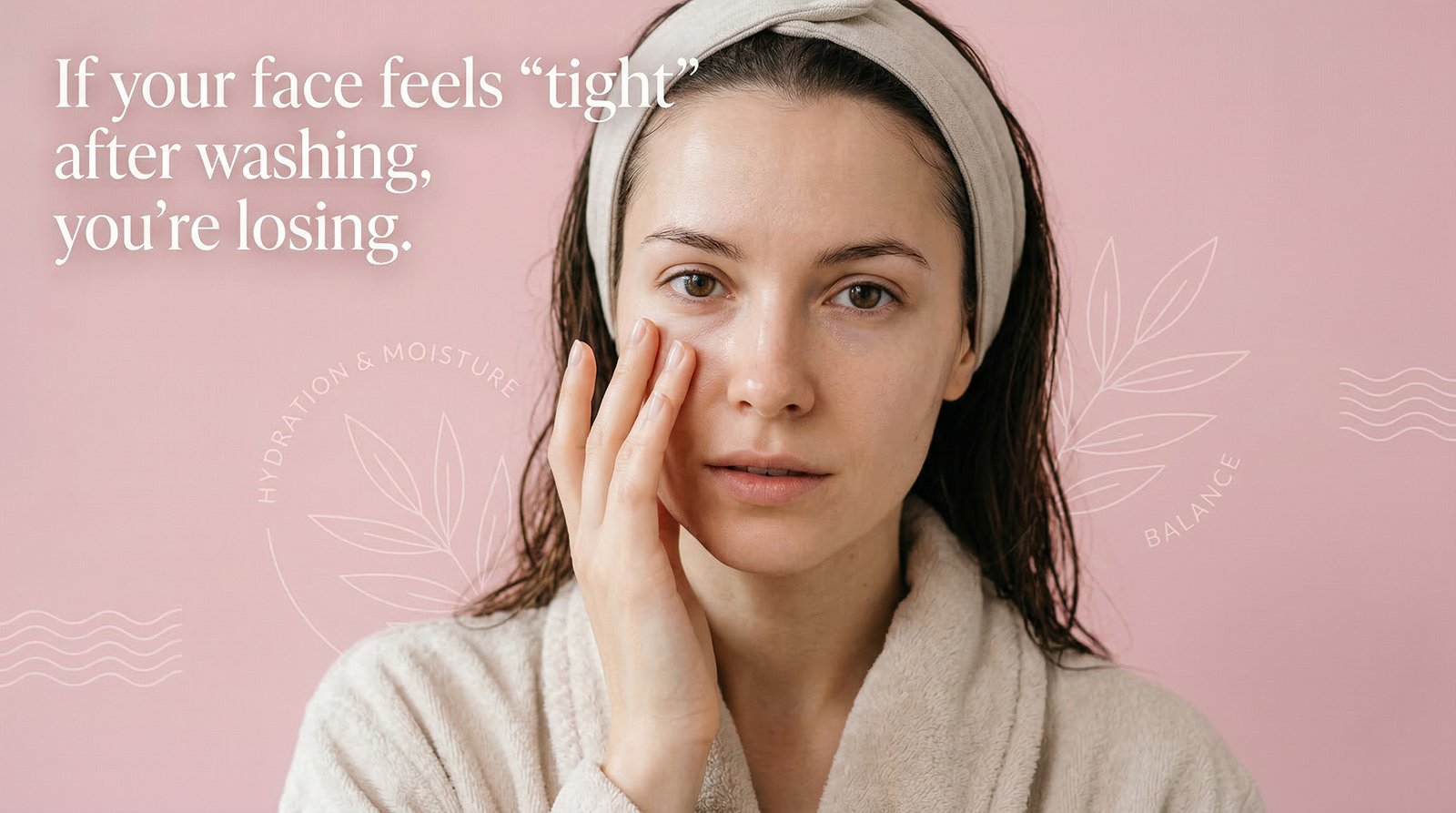
Are you accidentally drying out your skin? Here are the hidden hydration habits ruining your glow.
Why Your Skincare Routine Is Lying to You (and What to Do Instead)
You’ve been moisturizing your skin for years. And it’s still dry. Still tight. Still flaking in patches or breaking out in places it never used to. That’s not bad luck. That’s not your genetics. That’s a moisturizing habit that’s been working against your skin this whole time and nobody in the skincare industry has much incentive to tell you that, because the fix isn’t buying more. It’s buying smarter.
Here’s what’s actually going wrong.
The Moisturizer Isn't the Problem. The Timing Is.
Most people apply moisturizer all wrong.
They cleanse, pat dry, wait a few minutes, then slather it on. It feels logical, but it actually accelerates water loss. In the lab, we look at the mechanics: your skin needs water before it can seal water in. Most moisturizers work by trapping moisture that’s already sitting in your upper skin layers. Apply them to bone-dry, stripped skin, and you’re essentially locking in nothing.
The smarter move is “moisture sandwiching” applying your cream while your skin is still damp. That residual water gets trapped by the lipids in your moisturizer, causing transepidermal water loss (TEWL) to drop measurably.
Data published via the NIH confirms that applying an occlusive over hydrated skin dramatically outperforms applying it over dry skin.
Thirty seconds. That’s your window. Don’t let it close.
The Ingredient List That Looks Impressive and Does Almost Nothing
The marketing on most moisturizers is extraordinary.
Peptides. Stem cells. Snail mucin. They list fifteen hero ingredients in tiny font, each backed by a study that “proves” it works. But as a formulator, I look at what those studies leave out. Often, the ingredients were tested at concentrations way higher than what’s in your bottle. Or they were tested on isolated cells in a petri dish, not on a real human face. Sometimes that “clinical proof” is just a consumer survey where twelve people said their skin felt firmer. That’s not dermatology. That’s marketing with footnotes.
Decades of peer-reviewed research in the Journal of Investigative Dermatology show what your skin actually needs: a functional ratio of ceramides, cholesterol, and fatty acids. These ingredients aren’t glamorous. They don’t photograph well for social media. But they are the only things clinically validated to physically rebuild your skin barrier’s lipid matrix. Everything else is just noise until that barrier is intact.
Flip your bottle over. If ceramides are in the top half of the ingredient list and there’s no fragrance, you’re ahead of 80% of the market. If it leads with a rare floral extract and ceramides sit below the preservatives, you’ve been sold a story, not a formula.
Why Your "Rich" Night Cream Might Be Suffocating Your Skin
Heavier is not always better. This one surprises people.
There’s a category of ingredients called occlusives like petrolatum, mineral oil, and beeswax that sit on top of your skin to physically block water from escaping. Petrolatum is one of the most validated barrier-repair ingredients in existence, with PubMed data showing it cuts transepidermal water loss (TEWL) by up to 98%.
Used correctly, they are extraordinarily effective. But here is the problem with using heavy creams indiscriminately. Occlusives don’t discriminate. They trap whatever is underneath them.
If you slather a thick night cream over a face that still has microscopic makeup residue, sunscreen, or urban pollution particles maybe because your double-cleanse wasn’t quite thorough enough you are sealing all of that grime straight into your pores.
The result? Congestion. Closed comedones. Skin that looks worse in the morning despite feeling moisturized the night before.
The fix isn’t ditching the rich moisturizer. It’s earning it. Cleanse properly first, ensure you have a genuinely clean canvas, then seal. In that order, every time.
The SPF Moisturizer Trap Nobody Talks About
Combining your moisturizer and SPF sounds smart. One less step. A streamlined routine. Except it almost never works the way you think it does.
The issue comes down to simple math and formulation science: application volume. To achieve the SPF number on the label, you need to apply roughly a quarter teaspoon of product to your face. Most people apply a fraction of that when using a hybrid formula, because slathering on that much moisturizer feels heavy and excessive.
Data covered extensively by the Dermatology Times shows that real-world protection from combination products often delivers just 20% to 50% of the labeled SPF, simply because of under-application. You think you’re protected, but you’re not. And UV radiation is the absolute fastest way to degrade your barrier and trigger chronic inflammation.
I’m all for efficiency, but not at the expense of your skin.
The smartest move is to let your moisturizer be your moisturizer and your SPF be your SPF. Apply them separately, and in the right amounts. At this point, the one-product-does-it-all logic is costing your skin barrier more than it’s saving you.
Applying Moisturizer Over Active Ingredients You Haven't Let Absorb
Here’s a mistake that’s hiding inside what looks like a perfect routine. You apply your Vitamin C, then immediately follow with moisturizer. Or you layer niacinamide, hyaluronic acid, and cream in rapid succession each product barely settled before the next one goes on.
In formulation science, we call this dilution interference.
When you rush, the active ingredients in your serums get physically diluted and redistributed before they’ve had a chance to penetrate. Your moisturizer then forms a lipid film that traps that mixed, diluted mess right on top of the skin. You end up getting a fraction of the dosage you actually paid for.
PubMed literature on topical bioavailability consistently shows that compound penetration is highly sensitive to application order and timing. If you layer too fast, you’re essentially creating a weak, unintentional DIY cocktail on your face.
The fix is simple: give it 60 to 90 seconds.
You don’t need to wait five minutes or half an hour. Just give your active serum enough time to no longer feel wet on your skin before locking it in. That tiny pause ensures you actually get the full potency of the products you’re already using.
The Moisturizer You're Skipping Because Your Skin Is "Oily"
If you’ve been told that oily skin doesn’t need moisturizer, you’ve been given profoundly incorrect advice. I see this myth repeated everywhere, but oiliness is not the same thing as hydration. Sebum is oil produced by your glands; hydration is the actual water content in your cells. You can easily be oily and dehydrated at the same time.
If you skip moisturizer because your skin looks shiny, you’re likely making the oiliness worse.
When your skin barrier is water-depleted, it panics. It tries to compensate for that lost moisture by ramping up sebum production using the only thing it can create on its own. When you apply targeted hydration, your skin finally calms down, and sebum production often normalizes over several weeks.
It’s a counterintuitive truth documented in the Journal of Cosmetic Dermatology, but the industry ignores it. Selling you a stripping, mattifying toner is an easier pitch than explaining barrier mechanics.
If your skin is oily, you don’t need a heavy cream you need a lightweight formula applied consistently. Gel-based formulas with ceramides and niacinamide are the sweet spot, delivering crucial barrier support without adding weight or heavy occlusion.
We built the Minimals Lightweight Barrier Moisturizer for exactly this situation. It delivers just enough to restore deep hydration, without overwhelming skin that’s already producing its own oil.
You're Moisturizing Your Face and Completely Ignoring Your Skin Barrier
This sounds redundant. But stay with it.
Most people think moisturizing is just about surface comfort fixing that tight, uncomfortable feeling after cleansing. They pick a cream that makes their skin feel soft in the moment and assume the job is done. But as a formulator, I look past the surface. Your skin barrier isn’t about feel; it’s about function. Your outermost skin layer, the stratum corneum, is a precisely organized lipid matrix. When it’s intact, water stays in, while bacteria, allergens, and irritants stay out. But when this matrix is compromised, everything gets through. That’s exactly when sensitivity spikes, and your skin suddenly reacts to products it used to handle without complaint.
A moisturizer that only addresses surface softness isn’t restoring this function.
True barrier repair requires specific ingredients in precise ratios: ceramides (specifically NP, AP, and EOP the exact subtypes most depleted in compromised skin), cholesterol, and fatty acids. These are the literal building blocks of your skin.
Research in the Journal of Investigative Dermatology has mapped this lipid depletion pattern clearly. While studied heavily in extreme cases like eczema, this exact same lipid depletion happens on a spectrum to anyone experiencing “just a little sensitivity.”
Your moisturizer is either actively rebuilding this physical matrix, or it isn’t. If it isn’t, softer skin in the morning doesn’t mean healthier skin underneath.
If Your Moisturizer Has Fragrance, It's Working Against You
This is the one people push back on the most. Fragrant moisturizers smell good. They feel luxurious. They turn a routine into self-care. But they are also quietly, consistently degrading your barrier.
In the lab, we see the data clearly: fragrance whether synthetic or “natural” like essential oils and botanical extracts is the leading cause of contact sensitization in topical products. NIH research consistently identifies fragrance as the number one allergen in personal care, responsible for the vast majority of cosmetic dermatitis cases. But here is the part that matters even if you’ve never had a visible reaction. Fragrance compounds trigger low-grade, invisible inflammatory responses in your skin cells. You don’t see it, and you don’t feel it. But over months and years of daily application, this microinflammation actively contributes to barrier degradation and accelerates the breakdown of your lipid matrix.
Your moisturizer is supposed to be the safest product in your routine the one baseline formula you can trust when your skin is compromised. Fragrance has absolutely no business being in it.
If your moisturizer smells like a spa, it’s a liability. Flip the bottle and look for parfum, fragrance, linalool, limonene, geraniol, or citronellol. Those are the most common triggers hiding behind innocent-sounding names.
We formulated the Minimals Barrier Moisturizer with none of them. A product you apply twice a day to your skin should never introduce an inflammatory trigger into the equation.
The Reality Check: If Your Moisturizer Requires Three Other Products to Work, It's Not Working
Be honest about what your current routine actually looks like.
If you’re using a hydrating toner to prep, then a hyaluronic acid serum to hydrate, then a moisturizer to lock it in, then a face oil on top to seal the moisturizer you’ve built a four-step hydration routine where one good moisturizer should have done the job. That’s not skinimalism. That’s a skincare habit shaped entirely by product launches.
Each of those products was designed to feel necessary. And together, they create a situation where no single product is accountable for your skin’s condition because there are too many variables to know what’s actually working. The most intelligent thing you can do right now is simplify aggressively. Strip back to three steps. Use them consistently for six weeks. Then evaluate.
You’ll know what’s working. You’ll know what was just filling space.
The Routine Your Skin Actually Asked For
Here’s what a barrier-first, skinimalist routine actually looks like. No spreadsheet required.
A gentle, low-pH formula that removes the day without stripping the lipids underneath it. If your face feels “squeaky,” this step is working against you, not for you.
One active at a time. Give it weeks, not days, before judging whether it’s working most actives need four to six weeks before you can tell the difference between irritation and progress.
A ceramide-forward moisturizer that locks hydration in instead of letting it evaporate by morning. This is the step most routines skip or underdose, and it’s the one doing the most structural work.
SPF. Not optional, not negotiable the one step no amount of minimalism gets to skip.
That’s it. Four steps, each doing a job the others can’t replace. Notice what’s missing: no toner “just in case,” no seventh serum for a problem you don’t actually have, no extra exfoliant to compensate for a cleanser that wasn’t gentle enough in the first place.
Every step you add back into this should be answering a problem you can name not a fear of missing out on whatever’s trending this month.
Common mistakes we all make
Dry skin lacks oil. Dehydrated skin lacks water. If you slather a heavy, oil-rich cream onto dehydrated skin, you aren’t fixing the water shortage you’re just creating congestion and surface shine. You need humectants first, then lipids.
When your skin feels tight, the instinct is to apply a thicker layer. But skin can only absorb so much. Past a certain point, excess product just sits on top, clogging pores and pilling. If a normal amount doesn’t fix the tightness, your formula is wrong.
If you moisturize right after a steaming hot shower, you’re fighting a losing battle. Hot water strips the natural lipid matrix right out of your skin. You’re creating a massive barrier deficit, then asking your moisturizer to do 200% of the heavy lifting.
If your face feels tight or squeaky after washing, your cleanser already did the damage. Harsh surfactants strip away the very lipids your moisturizer is trying to replace. Your cream should maintain your barrier, not constantly rescue it from self-inflicted stripping.
The skin on your neck and chest is thinner, has fewer oil glands, and ages faster than your face. Yet most people stop right at the jaw. Whatever you do to your face damp application, barrier repair, and SPF needs to extend down to your collarbone.
A Simple "Smart Moisturizing" Checklist
Frequently Asked Questions
Yes. When you skip moisturizer, your skin gets dehydrated and panics. It compensates by producing more oil, which clogs pores and worsens acne. The fix isn’t skipping cream it’s using a lightweight, oil-free gel formula to calm the skin and balance oil production.
If you switch to a fragrance-free formula with the right ceramide-to-cholesterol ratio, you’ll feel surface relief in days. However, physically rebuilding the deep lipid matrix of your stratum corneum takes about 2 to 4 weeks, matching your skin’s natural cellular turnover cycle.
No, skin doesn’t have a feedback loop that tells it to stop producing moisture. However, if you constantly use heavy occlusives (like petrolatum) indiscriminately on normal skin, you can temporarily slow down natural lipid production. Use what your skin type actually needs.
Pilling happens for two reasons: you’re using too much product, or you’re layering too fast. If you don’t give your active serums 60 to 90 seconds to dry, your moisturizer’s lipids will mix with them on the surface, creating those annoying little roll-off balls instead of absorbing.
No. You need to look at the type. Simple alcohols (like alcohol denat or ethanol) are drying and strip the barrier. But fatty alcohols (like cetyl, stearyl, or cetearyl alcohol) are actually highly beneficial emollients that soften the skin and help give formulas a smooth texture.
Closing thought
Most skincare disappointment isn’t about the wrong products. It’s about the right products used in ways that undermine their function. Wrong timing. Wrong order. Wrong texture for your actual skin type. Fragrance that’s quietly inflaming what the ceramides are trying to repair. The skin is not complicated. It has clear, well-documented needs. It wants its lipid matrix intact. It wants adequate hydration sealed in. It wants to be left alone long enough to do its job. What it doesn’t need is a 10-product routine, a premium fragrance experience twice a day, and a combination SPF that’s delivering 40% of its labeled protection.
Give your skin what it actually needs. Everything else is just packaging.