
Minimals • Skin Science | 10 min read
How to Incorporate Ceramides into Your Skincare Routine
Learn how to incorporate ceramides into your skincare routine to strengthen your skin barrier, lock in hydration, and keep your skin healthy and protected.
How Your Skincare Routine Can Damage Your Skin Barrier
Healthy, glowing skin starts with a strong skin barrier, but many people unknowingly damage it by following complicated skincare routines and layering too many active ingredients. If you’re looking for the best way to use ceramides for skin barrier repair, this guide has everything you need to know. A damaged skin barrier can cause dryness, irritation, redness, and sensitivity, making even your favorite skincare products uncomfortable to use. The good news is that restoring your skin doesn’t require more products it requires the right ones. In this article, you’ll learn how ceramide skincare strengthens your moisture barrier, why a barrier repair moisturizer is essential, and how a minimal skincare routine can help keep your skin hydrated, healthy, and resilient over time.
What's Actually Happening Under Your Skin (And It's Not Your Hormones)
Your skin’s outer layer is more than a protective covering. Think of it as a brick wall. The skin cells act as the bricks, while a lipid matrix made of ceramides, cholesterol, and fatty acids works as the mortar that holds everything together. When this moisture barrier is healthy and intact, it locks in hydration and keeps irritants out. When it becomes damaged, water escapes through a process called transepidermal water loss (TEWL), leaving your skin dry, sensitive, and vulnerable to irritation.
Ceramides play a critical role in skin barrier repair because they are one of the main structural lipids that keep your skin strong and resilient. They do more than support the barrier. Research shows that ceramide skincare helps reduce inflammation and speeds up recovery when the skin barrier has been damaged. However, ceramide levels naturally decline due to over-cleansing, excessive exfoliation, harsh active ingredients, hot showers, and aging.
If your skin suddenly feels tight, flaky, or reacts to products that never caused problems before, a damaged skin barrier may be the real cause. Simply adding more hydrating products or soothing ingredients will not repair the underlying structure. Without restoring the missing lipids, especially ceramides, the moisture barrier remains weak, allowing the same irritation to return. This is why using a ceramide moisturizer or barrier repair moisturizer as part of a minimal skincare routine is essential for long-term skin barrier health, hydrated skin, and effective TEWL prevention.
The Cleanser You Think Is "Working" Is Probably the Problem
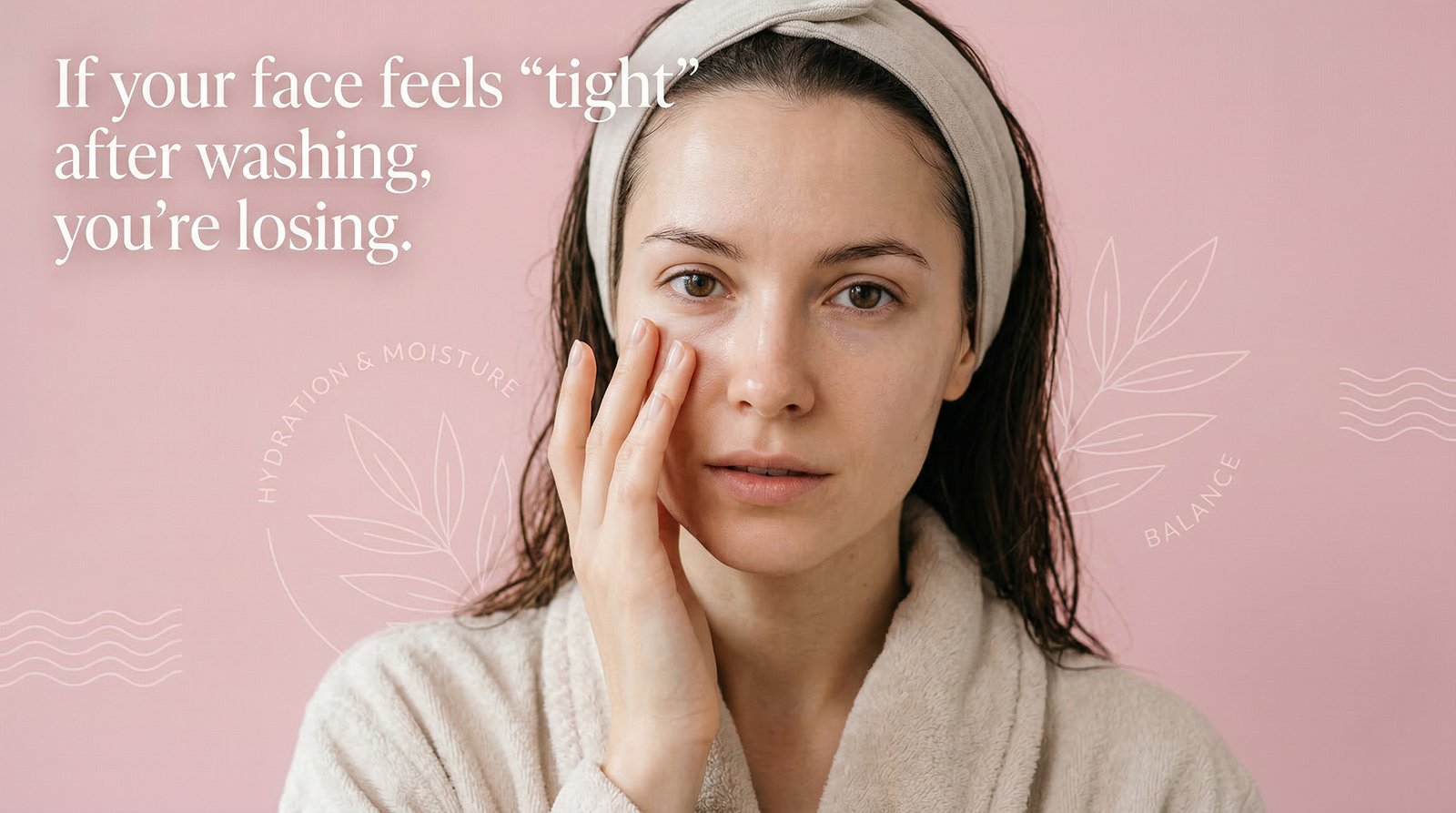
That tight, squeaky-clean feeling after washing your face may seem like a sign that your cleanser is working, but it often indicates the opposite. When your skin feels stripped, it has likely lost essential lipids that help maintain a healthy skin barrier. Research shows that harsh cleansing can remove both moisture and protective lipids, leading to barrier damage, irritation, and disruption of the skin’s natural microbiome.
Your skin microbiome is a community of beneficial microorganisms that helps regulate inflammation and defend against harmful bacteria. Over-cleansing can upset this delicate balance, weakening your moisture barrier and making your skin more prone to dryness, sensitivity, and irritation.
Instead of choosing a stronger cleanser, focus on one that effectively removes dirt, oil, and impurities while preserving your skin’s natural lipid matrix. A gentle cleanser paired with a ceramide skincare routine supports skin barrier repair, helps prevent transepidermal water loss (TEWL), and creates the foundation for healthy, hydrated skin.
"Hydrating" and "Moisturizing" Are Not the Same Thing And Confusing Them Is Why Your Skin Still Feels Dry
Many people assume that hydrated skin automatically means healthy skin, but that’s not always true. Your skin can contain plenty of water and still lose moisture throughout the day if your skin barrier is damaged. Hydration refers to the water content in your skin, while moisture retention is your skin’s ability to keep that water from evaporating.
This is why simply drinking more water or applying a hyaluronic acid serum may not solve dryness. Without a healthy moisture barrier, the water quickly escapes through transepidermal water loss (TEWL), leaving your skin feeling tight and flaky again.
The missing piece is often ceramides. While hyaluronic acid attracts water into the skin, ceramides strengthen the skin barrier and lock that moisture in place. Research shows that low ceramide levels are associated with increased TEWL, while restoring ceramides helps reduce water loss, improve hydration, and support long-term skin barrier repair. In other words, effective ceramide skincare does not just add hydration, it helps your skin hold onto it.
"Hydrating" and "Moisturizing" Are Not the Same Thing And Confusing Them Is Why Your Skin Still Feels Dry
Your skin can be well hydrated and still lose moisture throughout the day. While hydration refers to the amount of water in your skin, moisture retention depends on the strength of your skin barrier. If your moisture barrier is damaged, water escapes through transepidermal water loss (TEWL), leaving your skin feeling tight, dry, and flaky even after using hydrating products.
This is where many skincare routines fall short. People often focus on ingredients like hyaluronic acid, which attracts water into the skin, but overlook the lipids that keep that moisture locked in. Ceramides are essential for skin barrier repair because they strengthen the moisture barrier and help prevent water loss. Research has shown that low ceramide levels are associated with increased TEWL, while restoring ceramides improves moisture retention and supports long-term skin barrier health.
For truly hydrated skin, adding moisture is only half the solution. The other half is sealing it in with a healthy skin barrier. A ceramide moisturizer helps reinforce the skin’s natural defenses, making it an essential step in any ceramide skincare or minimal skincare routine for lasting hydration.
Layering Five Actives a Night Isn't "Advanced Skincare." It's a Slow-Motion Barrier Injury
Many skincare routines encourage layering multiple active ingredients, such as retinol, exfoliating acids, vitamin C, and peptides, in the hope of achieving faster results. However, using too many powerful ingredients at once can do more harm than good. While retinol speeds up skin cell turnover and acids remove dead skin cells, combining them excessively can overwhelm your skin and weaken its natural protective barrier.
Research suggests that overusing active ingredients may damage the skin barrier faster than it can repair itself, and a damaged skin barrier can take several weeks to fully recover. This often creates a cycle of redness, irritation, and sensitivity, leading people to add even more products in an attempt to fix the problem.
The solution is not necessarily to stop using active ingredients, but to support your skin with effective skin barrier repair. Incorporating ceramide skincare, especially a ceramide moisturizer or ceramide-rich serum, helps replenish essential lipids, strengthen the moisture barrier, reduce transepidermal water loss (TEWL), and keep your skin resilient. By balancing active ingredients with barrier-repairing products, you can maintain healthy skin while still enjoying the benefits of your skincare routine.
Your Skin Has a Microbiome. Your Skincare Routine Is Probably Wiping It Out
Your skin is home to a diverse community of beneficial microorganisms known as the skin microbiome. Like the gut microbiome, this ecosystem plays an important role in maintaining skin barrier health by helping regulate inflammation, defending against harmful bacteria, and supporting a healthy moisture barrier.
However, habits such as over-cleansing, excessive exfoliation, and frequent use of strong active ingredients can disrupt this delicate balance. When the skin microbiome and skin barrier are compromised, transepidermal water loss (TEWL) increases, leading to dryness, flaking, irritation, and a damaged skin barrier.
This is also why the same skincare product can produce different results for different people. A healthy skin barrier and balanced microbiome can better tolerate active ingredients, while an already weakened barrier is more likely to react with redness and sensitivity. Instead of assuming your skin is naturally sensitive, consider whether your skincare routine is over-exfoliating and weakening your barrier. Supporting your skin with ceramide skincare and a minimal skincare routine can help restore balance, strengthen the moisture barrier, and promote long-term hydrated skin.
If Your Routine Feels Complicated, That's the Problem Not a Sign You're Doing It Right
A complicated skincare routine is not always a better one. While using multiple products may seem like the key to healthy skin, layering too many active ingredients can overwhelm your skin and increase the risk of irritation, ingredient conflicts, and a damaged skin barrier. More steps often mean more opportunities to disrupt your skin’s natural ability to repair itself.
A healthy skincare routine should support, not challenge, your skin barrier. Instead of focusing on the number of products you use, prioritize ingredients that strengthen the moisture barrier and help maintain hydrated skin. A minimal skincare routine built around gentle cleansing, effective hydration, and ceramide skincare can provide everything your skin needs without unnecessary complexity.
By simplifying your routine and using products such as a ceramide moisturizer or barrier repair moisturizer, you can support long-term skin barrier health, reduce transepidermal water loss (TEWL), and give your skin the opportunity to recover and stay resilient.
Not All Ceramides Are Created Equal (And That's Why Your Old Moisturizer Didn't Work)
Not all ceramides are the same. Although many skincare products highlight ceramides as a key ingredient, they are actually a family of lipids, and different ceramide types contribute differently to skin barrier health. Research shows that certain ceramide subtypes are associated with a strong, healthy skin barrier, while imbalances in others are linked to a damaged skin barrier and increased transepidermal water loss (TEWL).
For effective skin barrier repair, ceramides should not work alone. They perform best when combined with cholesterol and fatty acids, the other essential lipids that make up your skin’s natural moisture barrier. Together, these ingredients help restore the lipid matrix, improve moisture retention, and support long-term hydrated skin rather than providing only temporary relief.
When choosing ceramide skincare, look beyond the label. A well-formulated ceramide moisturizer or barrier repair moisturizer that contains a balanced blend of ceramides, cholesterol, and fatty acids is far more effective at rebuilding a healthy skin barrier than a product that simply lists ceramides as a marketing claim.
"I Have Oily Skin, I Don't Need Ceramides" Is the Sentence Keeping Your Skin Inflamed
Oily skin does not always mean your skin barrier is healthy. In fact, excess oil production can sometimes be a sign of a damaged skin barrier. When the moisture barrier is weakened, your skin loses water through transepidermal water loss (TEWL). To compensate, it may produce more oil, leaving your skin feeling both greasy and tight at the same time.
This often leads to a frustrating cycle. In an effort to control oil, many people use stronger cleansers or harsh exfoliants, which strip away even more of the skin’s protective lipids and further weaken the barrier. As a result, irritation, congestion, and excess oil production can continue.
Ceramides are beneficial for all skin types, including oily skin. A well-formulated ceramide moisturizer helps strengthen the skin barrier by restoring essential lipids without leaving a heavy or greasy finish. As part of a balanced ceramide skincare or minimal skincare routine, ceramides support skin barrier repair, improve moisture retention, and help restore healthy, hydrated skin.
The "Moisture Sandwich" Isn't a TikTok Trend. It's Just How Lipids Actually Work
The idea of “moisture sandwiching” is not simply a skincare trend. It is a practical way to maximize hydration and support skin barrier repair. The concept is straightforward: apply water-based hydrating products to slightly damp skin first, then follow with a ceramide moisturizer or barrier repair moisturizer to lock that moisture into the skin. This approach helps strengthen the moisture barrier and reduces transepidermal water loss (TEWL).
Without a protective layer to seal in hydration, much of the water applied to your skin can evaporate, leaving your skin feeling dry again within hours. That is why many hydrating skincare routines fail to deliver long-lasting results. Hydration alone is not enough. Your skin also needs the lipids that prevent moisture from escaping.
Choosing a moisturizer that both hydrates and replenishes essential lipids, such as ceramides, can simplify your skincare routine while promoting healthy skin barrier function. A well-formulated ceramide moisturizer supports long-lasting hydrated skin, making it an essential step in a minimal skincare routine for maintaining skin barrier health.
The Shift: Skinimalism Isn't Doing Less. It's Doing Less Badly So You Can Do the Right Things Properly
A minimal skincare routine is often mistaken for doing less, but in reality, it is about giving your skin exactly what it needs without overwhelming it. Every product you apply has the potential to affect your skin barrier, and using too many products or active ingredients can increase the risk of irritation, ingredient conflicts, and a damaged skin barrier.
By simplifying your skincare routine, you reduce unnecessary stress on your moisture barrier and give your skin time to recover naturally. A well-designed routine focuses on essential, effective products that support skin barrier health rather than adding extra steps with little benefit.
Choosing products that strengthen the skin barrier, such as a ceramide moisturizer or barrier repair moisturizer, helps replenish essential lipids, reduce transepidermal water loss (TEWL), and maintain hydrated skin. Instead of following a lengthy routine, a minimal skincare routine built around ceramide skincare can promote healthier, stronger, and more resilient skin over time.
The Minimal Routine Blueprint: What Your Skin Actually Needs, In Order
Strip it down to this, and you’ve covered the parts that matter.
Cleanse
A gentle, low-pH formula that removes the day without stripping the lipids underneath it. If your face feels “squeaky,” this step is working against you, not for you.
Treat
One active at a time. Give it weeks, not days, before judging whether it’s working most actives need four to six weeks before you can tell the difference between irritation and progress.
Seal
A ceramide-forward moisturizer that locks hydration in instead of letting it evaporate by morning. This is the step most routines skip or underdose, and it’s the one doing the most structural work.
Protect (AM only)
SPF. Not optional, not negotiable the one step no amount of minimalism gets to skip.
That’s it. Four steps, most days fewer.
If a product can’t tell you specifically what it’s doing for your barrier, it doesn’t get a spot on this list.
Common mistakes we all make
Even a good skincare routine can weaken your skin barrier if you’re making these common mistakes:
- Using too many active ingredients can irritate your skin and slow skin barrier repair.
- Over-cleansing or over-exfoliating strips away the natural lipids that protect your moisture barrier.
- Skipping a ceramide moisturizer leaves your skin unable to lock in hydration and prevent TEWL.
- Changing products too often gives your skin little time to recover and adapt.
- Ignoring sunscreen exposes your skin barrier to daily UV damage.
A simple, consistent skincare routine with ceramides and other barrier-supporting ingredients is often the best way to maintain healthy, hydrated skin.
A simple "Healthy Skin Barrier" checklist
- Use a gentle, non-stripping cleanser.
- Avoid over-cleansing and over-exfoliating.
- Include a ceramide moisturizer in your daily skincare routine.
- Keep your routine simple and consistent.
- Pair active ingredients with barrier-supporting products.
Frequently Asked Questions
Common signs include dryness, tightness after cleansing, redness, flaking, stinging when applying products, and increased sensitivity.
A mildly damaged skin barrier may improve within a few weeks with a gentle skincare routine, while more severe damage can take longer depending on the cause.
Yes. Ceramides help strengthen the skin barrier without making the skin greasy. They are suitable for dry, oily, combination, and sensitive skin.
Yes. Ceramides pair well with active ingredients like retinol and vitamin C because they help reduce dryness and support skin barrier repair.
Keep it simple: use a gentle cleanser, a ceramide moisturizer or barrier repair moisturizer, sunscreen during the day, and avoid over-exfoliating until your skin recovers.
Closing thought
Healthy skin starts with a healthy skin barrier. While it’s tempting to add more products in search of better results, a simple routine focused on ceramides, gentle cleansing, and consistent hydration is often the most effective approach. By protecting your moisture barrier and reducing transepidermal water loss (TEWL), you give your skin the support it needs to stay strong, hydrated, and resilient. Remember, lasting results come from caring for your skin consistently, not from using more products. Prioritizing skin barrier repair today can lead to healthier-looking skin for years to come.