
Why your current multi-step routine is actually stripping your barrier, disrupting your microbiome, and fueling the inflammation loop.
Your Skincare Routine Is Exhausting Your Skin
Your 10-step routine isn’t helping your skin. It’s exhausting it.
Trust me, I know the feeling. I used to think that achieving glowing skin required an entire vanity full of potions stacking serums, alternating acids, and spraying “hydrating” mists every hour. But the more I threw at my skin, the angrier it got.
And the worst part? That’s exactly how the industry hooks you. You start thinking you just have bad genes, a bad diet, or that you need one more product to fix the mess. But here is the reality I had to learn the hard way: you’re likely dealing with a severely damaged skin barrier and a disrupted microbiome. Your current routine was designed to look pretty on a shelf and impress you with numbers, not actually work with your biology.
Let’s pull back the curtain and talk about what’s really happening to your face.
The Redness Isn't Random. Your Routine Is Breaking You Down.
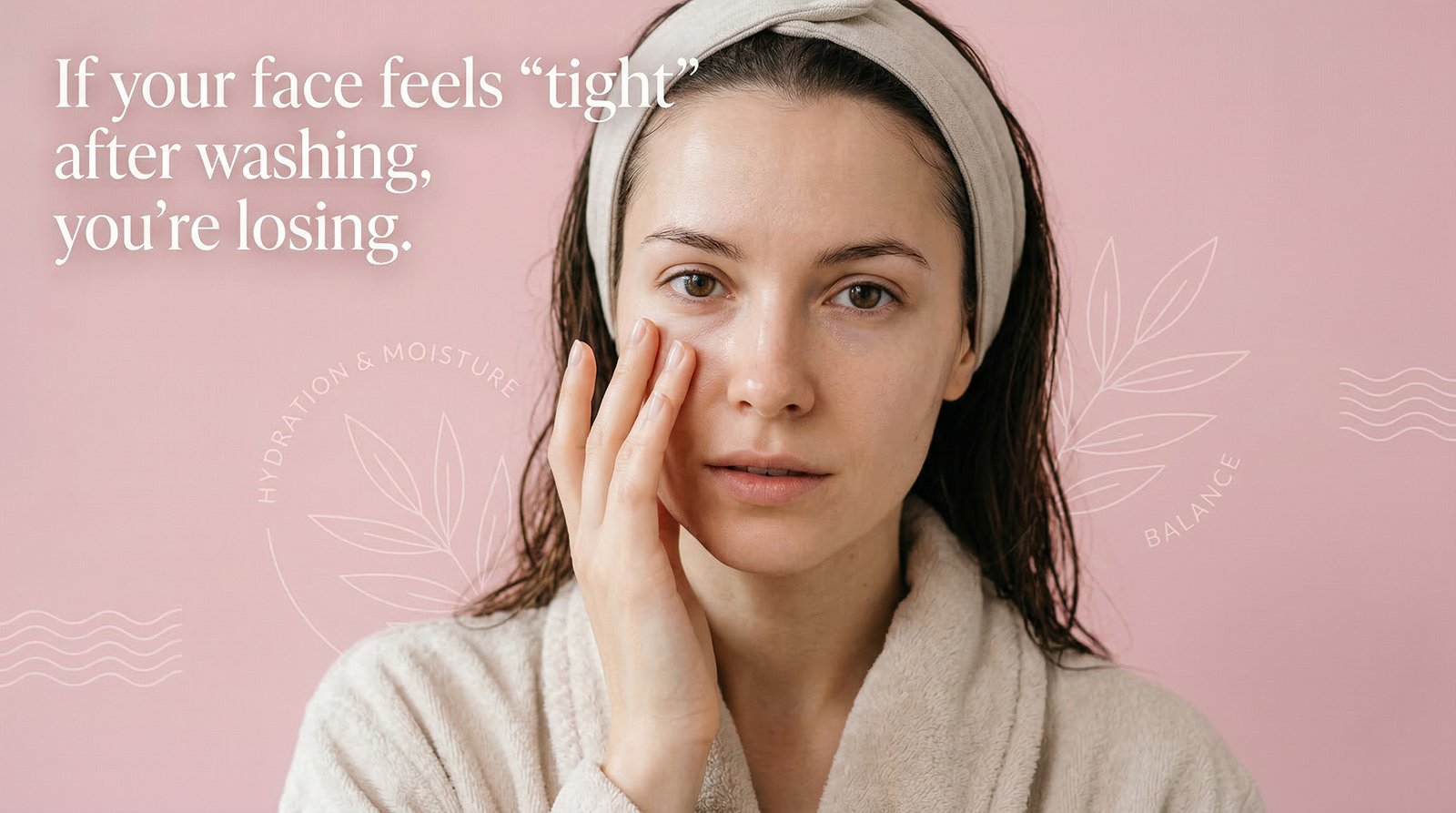
Sensitivity doesn’t just show up overnight. It builds quietly, over months of well-intentioned over-processing. I remember the exact moment my own skin finally ran out of patience. One day it was perfectly fine, and the next, absolutely everything stung. My face felt bone-dry and tight after washing, and just a brisk walk in the wind left me completely flushed and burning. When you reach this point, even your “safe” basics start to feel like too much.
That’s not a coincidence, and it’s not a sudden allergy. It is the unmistakable sound of a compromised skin barrier that has finally had enough
What the Skin Barrier Actually Does (and Why You Keep Wrecking It)
Think of your skin’s outermost layer like a brick wall where your cells are the bricks and a rich blend of ceramides, cholesterol, and fatty acids acts as the mortar. When that lipid mortar erodes, your skin loses its seal, allowing vital moisture to evaporate into thin air a process science calls transepidermal water loss (TEWL). Research published in the Journal of Investigative Dermatology directly links this moisture evaporation to chronic irritation and ongoing inflammation. The truth is, your skin isn’t naturally sensitive; it’s sensitive because that protective mortar has been completely stripped away.
I remember staring in the mirror wondering why my expensive routine was failing, only to realize I was the one washing my own skin’s defense system down the drain every single day. We do it without realizing through over-cleansing with harsh surfactants, over-exfoliating with daily acids, and using alcohol-based toners. Ironically, even layering too many heavy “barrier repair” products packed with hidden fragrances and essential oils keeps the skin in a constant state of panic. To fix the irritation, you don’t need a stronger treatment you just need to stop stripping the mortar.
Your Cleanser Might Be Causing the Breakouts You Blame on Hormones
Here is a truth the skincare industry loves to ignore: most cleansers, even the ones labeled “gentle,” are packed with harsh surfactants that strip away your skin’s vital lipids alongside the daily dirt. While sodium lauryl sulfate (SLS) is the classic villain, many modern alternatives are just as guilty of disrupting your skin’s natural, mildly acidic pH of 4.5 to 5.5. This acidity is your skin’s built-in shield, designed specifically to keep your microbiome thriving and prevent bad bacteria from taking over.
When you use a foaming cleanser with a pH of 7 or higher, you effectively roll out the welcome mat for C. acnes and S. aureus the exact culprits behind painful breakouts and chronic inflammation. I spent years blaming my diet and hormones for my sudden flare-ups, completely blind to the fact that my twice-daily cleansing routine was slowly dismantling my skin’s defenses. The fix isn’t a harsher acne treatment; it’s a smarter, low-pH, surfactant-balanced wash like Minimals Gentle Cleanser that cleanses without leaving that tight, “squeaky clean” feeling, which is actually just your barrier crying for help.
The "Hydration" Step That's Quietly Drying Your Skin Out
Hyaluronic acid has been marketed as the ultimate holy grail of hydration, but it can actually make your skin significantly drier if you use it wrong and most people do. As a humectant, its sole job is to pull water from its surroundings, ideally drawing moisture out of the air. However, if you are sitting in a dry, air-conditioned, or heated room, it reverses that pull and sucks moisture straight out of the deeper layers of your skin instead. I used to chase that temporary, dewy plumpness every morning, only to wonder why my face felt completely tight, parched, and stripped just ten minutes later.
Studies from the NIH confirm that applying humectants without an occlusive layer to trap them can paradoxially increase water loss ($TEWL$) in low-humidity environments. This highlights a crucial distinction: hydration is merely adding water content, while moisture is your skin’s ability to retain it. Without an emollient or occlusive moisturizer to physically lock that hydration down, you are simply cycling water through your skin and watching it evaporate into thin air. The fix is incredibly simple: never skip your moisturizer after a serum, because the seal isn’t just an extra step it is the entire point.
Why Layering Actives Is Backfiring (Even If Each One Is "Gentle")
You’ve probably meticulously organized your routine around traditional skincare rules—carefully separating your vitamin C, niacinamide, retinol, and AHAs into complex morning splits, alternating nights, and strict wait times. But what nobody is telling you loudly enough is that even individually gentle ingredients create massive, cumulative irritation when stacked together. Your skin doesn’t experience each serum in isolation; it experiences everything all at once, creating a synergistic effect where the irritation compounds far faster than you’d expect. I used to run myself ragged managing a complex product spreadsheet, yet my skin only rewarded my efforts by throwing constant, inflamed tantrums.
Research published in the British Journal of Dermatology confirms this clinical reality, showing that multi-active regimens cause statistically higher rates of barrier disruption than simpler routines. The problem isn’t your retinol, your niacinamide, or your chemical exfoliant on their own—the problem is forcing a struggling skin barrier to process all of them simultaneously. The most counterintuitive truth I had to learn is that dropping down to just one targeted active gets you vastly superior results compared to rotating five separate ones. Your skin doesn’t need another step to fix the damage.
Your Microbiome Is Not a Marketing Term. It's Why Your Skin Is Inflamed.
The skin microbiome isn’t just a trendy buzzword used to sell overpriced probiotic mists; it is a living, breathing ecosystem of bacteria, fungi, and viruses that actively regulates your immunity, inflammation, and barrier function. A healthy microbiome relies entirely on diversity, but when that ecosystem is disrupted, a few opportunistic species take over, triggering the chronic redness, sensitivity, and breakouts you see in the mirror. I used to think I was just dealing with naturally “reactive” skin, but the truth was much worse: I was actively washing away my skin’s natural defense system every single day through aggressive over-cleansing, alcohol-based formulas, and high-pH cleansers.
The science behind this is undeniable. A review in Frontiers in Microbiology found that even short-term use of harsh cleansers causes immediate, measurable shifts in microbial diversity, allowing aggressive Staphylococcus species to dominate within days. Specifically, Staphylococcus aureus has been heavily linked to worsening eczema, chronic barrier inflammation, and atopic dermatitis. When you over-process your face, you aren’t just cleaning it you are stripping the very shield that keeps inflammation at bay. The solution to a compromised microbiome isn’t adding another “probiotic” mist to your vanity; it is simply stopping the cycle of over-cleansing and giving your skin the peace it needs to heal itself.
The Inflammation Loop Nobody Warned You About
There is a hidden mechanism keeping your skin trapped in a frustrating cycle of sensitivity: barrier damage triggers inflammation, which further degrades your barrier, making it even more permeable to outside irritants that trigger more inflammation. It is a toxic, self-perpetuating loop, and if your daily routine keeps introducing new active ingredients, heavy fragrances, or aggressive brightening agents, you will never break free from it. I spent months caught in this exact trap, frantically adding new “soothing” lotions to calm my flare-ups, completely blind to the fact that every extra bottle I opened was just throwing more fuel onto the fire.
Dermatologists at the NIH’s National Institute of Arthritis and Musculoskeletal and Skin Diseases frequently document this exact pattern, and while it is highly visible in conditions like atopic dermatitis, it applies to anyone struggling with sudden, chronic sensitivity. The only genuine way out of this cycle is to stop adding fuel to the flames entirely. That means stepping away from the complex product rotations, cutting out synthetic fragrances, and eliminating unnecessary actives so you can focus entirely on sealing and rebuilding your lipid layer rather than treating and stripping it.
If Your Routine Feels Complicated, That Is the Problem
Let’s be completely honest with ourselves for a second: if you currently need a spreadsheet to track your nightly products, or if the phrase “layering order” causes you genuine stress, your routine has become entirely too complicated. I used to be that person, staring at a vanity full of bottles, debating for twenty minutes whether a new serum would fix the irritation my last serum caused, before finally realizing this level of complexity is biologically unsustainable. Your skin does not actually respond better to more; it thrives on consistency, compatible ingredients, and the absolute absence of chronic irritation.
The overwhelming complexity of the modern skincare routine isn’t driven by biological science it’s driven entirely by relentless beauty marketing cycles and product launches designed to make you feel like your routine is always missing something. Your skin was functioning perfectly fine before the industry decided we all needed a ten-step ritual, and it can absolutely thrive again with just three. Stripping back my own exhausting routine taught me that true skin health happens when you stop trying to micromanage your barrier and instead give it the minimal, focused support it actually needs to heal itself.
The Routine Your Skin Actually Asked For
This is what your skin actually needs. Morning and evening, no variation required.
A gentle, low-pH formula that removes the day without stripping the lipids underneath it. If your face feels “squeaky,” this step is working against you, not for you.
One active at a time. Give it weeks, not days, before judging whether it’s working most actives need four to six weeks before you can tell the difference between irritation and progress.
A ceramide-forward moisturizer that locks hydration in instead of letting it evaporate by morning. This is the step most routines skip or underdose, and it’s the one doing the most structural work.
SPF. Not optional, not negotiable the one step no amount of minimalism gets to skip.
That’s it. Four steps in the morning. Three at night. No layering debates. No wait times. No spreadsheet.
Common mistakes we all make
A simple "Am I Wrecking My Skin?" checklist
Frequently Asked Questions
If you strip your routine down to just a low-pH cleanser, moisturizer, and SPF, you’ll see relief from stinging in 3 to 7 days. Complete cellular repair of the lipid matrix takes 28 to 45 days (one full skin cell turnover cycle). Consistency is the only shortcut.
No. Active ingredients require a functioning barrier to work without causing injury. If your skin is flaking, stinging, or red, freeze all acids, retinoids, and vitamin C immediately. Let the barrier heal first; treat specific concerns later.
Yes, but it doesn’t need to be heavy. When your barrier loses its lipid mortar, it triggers transepidermal water loss (TEWL). Your skin often responds by producing excess oil to try and stop the evaporation. Sealing it with a lightweight, ceramide-rich formula actually calms overactive oil production.
Because your barrier is so depleted that your nerve endings are exposed to the environment. Even tap water has a pH of around 7 to 8, which is higher than your skin’s natural 4.5 to 5.5 acidic state. The stinging isn’t an allergy; it’s an open wound response.
The ultimate field test is how your face feels 5 minutes after drying. If your skin feels tight, stiff, or “squeaky clean,” the pH is too high and the surfactants are too harsh. A proper cleanser leaves your skin feeling exactly like skin supple and comfortable.
Closing thought
Your skin became sensitive because something or many somethings in your routine started working against your barrier instead of for it. The good news is that the barrier can repair itself. It does this naturally, given the right conditions: appropriate cleansing, basic hydration, a sealed lipid layer, and the absence of ongoing irritation. You don’t need a better active ingredient. You need to stop disrupting long enough to let repair happen. That means stripping your routine back, not adding to it. Choosing formulas that do more with less not products that require a 12-step choreography to use correctly. And accepting that the most sophisticated thing you can do for your skin right now is stop.
Less, but better. That’s the whole thing.