
Your Conditioner is Basically Plastic Wrap for Bacteria
You are treating your back like a breakout zone, but it’s actually a crime scene. You’ve swapped your soaps, bought the expensive “medicated” sprays, and scrubbed until your skin is raw. Yet, the cystic bumps on your shoulders and the clusters on your back refuse to budge. Here is the uncomfortable truth: You aren’t suffering from “bad genetics” or a lack of hygiene. You are likely poisoning your skin barrier every single morning with the very products meant to make your hair look good. The culprit isn’t your skin biology it’s the chemical runoff from your shower routine that you’ve been ignoring for years.
Why Your $50 Shampoo is Secretly Destroying Your Back Skin
Your hair is dead protein; your skin is a living, breathing organ. They have zero business sharing the same ingredients. Most high-end shampoos are loaded with heavy silicones, panthenol, and “nourishing” oils designed to coat the hair shaft. When you rinse that conditioner out, those same film-forming agents slide down your back and settle into your pores. Unlike your scalp, the skin on your back has a high density of sebaceous glands. When you trap hair-smoothing oils on top of active pores, you create an anaerobic environment where C. acnes bacteria thrives.
Research published in Dermatology Times suggests that “acne cosmetica” is a major driver of adult breakouts, often caused by comedogenic ingredients hiding in non-skincare products.
The Panthenol Paradox: How Hair "Repair" Triggers Skin Inflammation
We’re told panthenol (Pro-Vitamin B5) is a soothing superstar, and in the right dose, it is. But in hair care, it’s often used in massive concentrations to provide “slip” and shine. When this high-viscosity residue sits on your back, it doesn’t just hydrate; it disrupts the follicular lining. This leads to a localized “inflammation loop” where the skin tries to purge the heavy residue, resulting in those deep, painful bumps. It’s not a “detox.” It’s your skin barrier screaming because its delicate lipid matrix is being smothered by a plastic-like film. If you aren’t washing your body after you’ve rinsed every trace of hair product away, you’re essentially sealing a layer of glue onto your skin.
Your Microbiome is Being Suffocated by Synthetic Fragrances
The “Ocean Breeze” or “Vanilla Cupcake” scent of your hair mask is a biological nightmare for your back’s microbiome. Synthetic fragrances are notorious for causing sub-clinical inflammation the kind you can’t see but your skin definitely feels. This inflammation weakens the skin’s acid mantle, making it easier for opportunistic bacteria to colonize your pores.
According to the Journal of Investigative Dermatology, a compromised microbiome is the precursor to almost every inflammatory skin condition, including acne.
By the time you step out of the shower, your back is a war zone of disrupted pH levels and agitated microbes.
Stop Scrubbing: The Friction Myth That’s Making Your Bacne Worse
The instinct is to grab a loofah and go to town on those bumps. Please, for the love of your barrier, stop. Bacne is inflammatory, not just “clogged.” When you use physical force, you’re creating micro-tears in the stratum corneum. This triggers an emergency response: your skin sends more blood to the area (redness) and ramps up oil production to “protect” the wound. You aren’t scrubbing away the acne; you’re providing it with a fresh supply of sebum to feed on. Furthermore, loofahs are essentially bacterial sponges that live in a damp, dark bathroom. You’re literally scrubbing old bacteria into new wounds. Instead of force, your skin needs a formula that dissolves the hair-care residue without stripping the ceramides that keep your skin intact.
The Rinse-Off Routine That’s Quietly Drying Your Skin Out
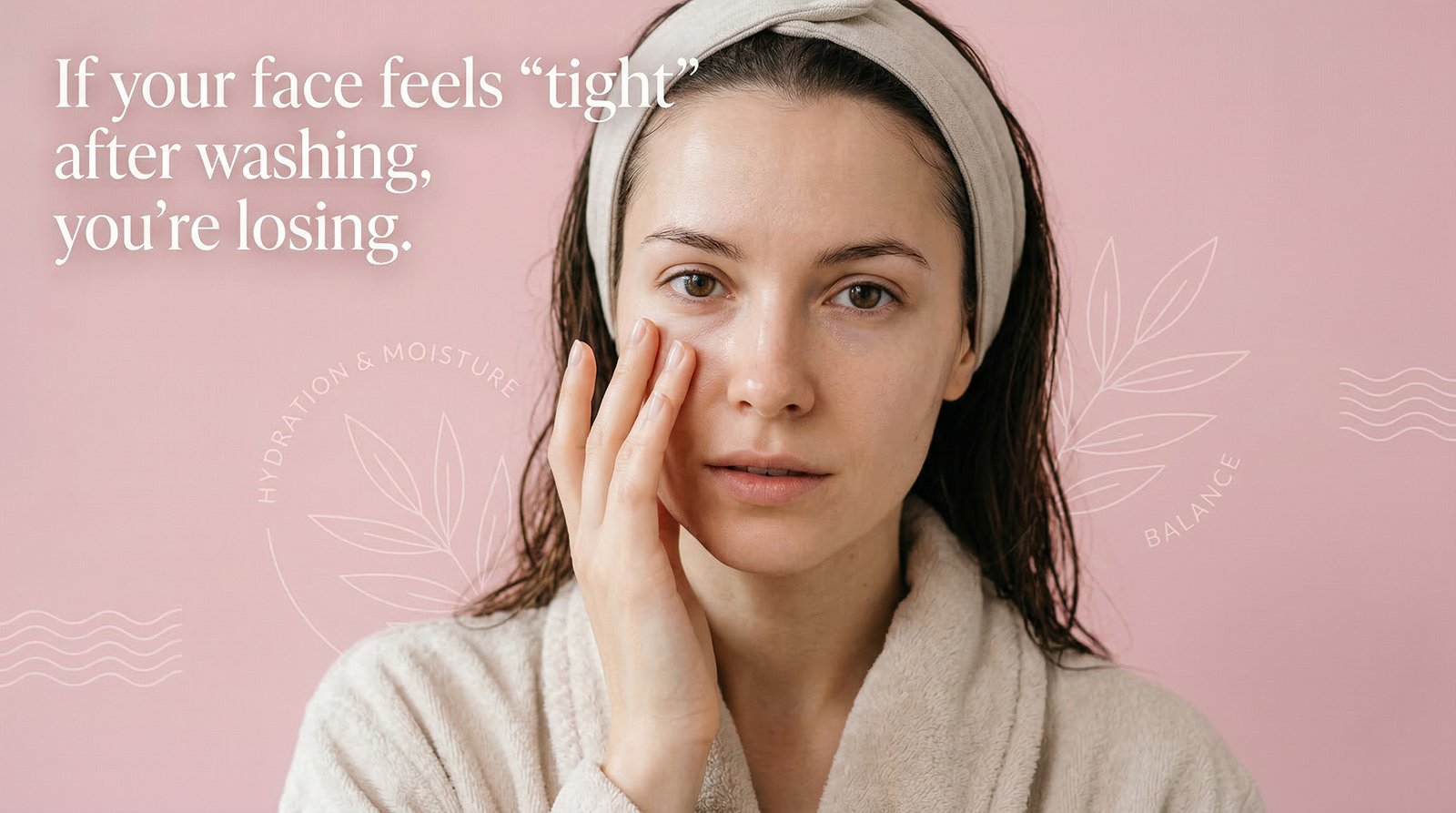
Many people try to “dry out” their back acne using harsh, foaming body washes that contain sulfates. This backfires spectacularly because of Transepidermal Water Loss (TEWL). When you strip away the natural lipids, your skin doesn’t just get dry it gets desperate. Desperate skin becomes “hyper-keratinized,” meaning dead skin cells stick together instead of shedding naturally. These sticky cells then fall into your pores, creating a plug (comedone).
At “Minimals”, we see this constantly: people over-cleansing their way into a breakout.
At this point, your skin doesn’t need another “acne” wash. It needs a cleanser that respects the moisture barrier while lifting away the hair-care film.
Hydration ≠ Moisture: The Layering Mistake You’re Making
If you think you don’t need to moisturize your back because it’s “oily,” you’ve been misinformed. Oily skin is often dehydrated skin in disguise. When your skin lacks water (hydration), it produces more oil (moisture/lipids) to prevent what’s left from evaporating. By skipping the “seal” step, you keep the cycle of overproduction going forever. The key is to use a lightweight, non-comedogenic seal that mimics the skin’s natural lipid matrix.
Our moisturizers are designed to provide that “barrier-first” protection without the heavy, pore-clogging waxes found in traditional body lotions.
The Reality Check: If Your Routine is a 10-Step Circus, Your Skin is the Clown
Let’s be brutally honest: the more products you apply, the more variables you introduce for failure. If you are using a shampoo, a conditioner, a hair oil, a body scrub, an acne wash, and a body spray you have no idea what’s actually working or what’s causing the flare-up. Modern skincare has become a game of “fix the problem the last product caused.”
It’s expensive, it’s exhausting, and it’s usually unnecessary.
Your skin is a self-regulating machine that has been functioning for millions of years. It doesn’t need “help” from fifty different chemicals. It needs a minimal, high-performance environment to do its job.
The Minimal Bacne Blueprint: 3 Steps to Clear Skin
You don’t need a “system.” You need a strategy.
Wash and rinse your hair first. Clip it up. Then, and only then, wash your body. Use a gentle, pH-balanced cleanser to ensure no silicone residue remains on your skin.
Wash and rinse your hair first. Clip it up. Then, and only then, wash your body. Use a gentle, pH-balanced cleanser to ensure no silicone residue remains on your skin.
Apply a thin layer of a minimalist moisturizer to damp skin. This locks in the hydration and tells your sebaceous glands they can stop overproducing oil.
You Don’t Need a Miracle, You Need a Reset
The industry wants you to believe that clear skin is a mystery you have to pay to solve.
It isn’t. It’s biology.
Stop the “everything” approach. Stop the heavy hair-care runoff. Stop the aggressive scrubbing.
When you simplify, your skin barrier can finally stop defending itself against your routine and start repairing itself.
You don’t need more products. You need fewer that actually work.
Start your skinimalist journey here.
Common mistakes we all make
You think you’re being thorough, but you’re actually just being efficient at destroying your skin. Most “bacne” isn’t a mystery; it’s the predictable result of three specific failures in your daily hygiene.
The “Hair-Last” Rinse Strategy: If you wash your body while your conditioner is still marinating, or rinse your hair after scrubbing your back, you’re leaving a layer of pore-clogging film behind. That “silkiness” on your hair is a death sentence for your pores.
The Scalding Water Obsession: Using heat to “open your pores” is a myth that won’t die. All you’re doing is melting your protective lipids and triggering an inflammation loop that makes cystic bumps more painful.
The Loofah Trap: Scrubbing an active breakout is just spreading bacteria and creating micro-tears. You can’t exfoliate your way out of a chemical irritation; you’re just adding a physical wound to a biological problem.
A simple "Bacne-Free Shower" checklist
Frequently Asked Questions
Yes, but you have to be tactical. Keep your hair clipped up while it’s marinating, and ensure your body is the very last thing you wash before stepping out. If you aren’t removing the conditioner residue from your skin with a proper cleanser, you’re essentially asking for a breakout.
Because you’re nuking your microbiome. Most medicated scrubs are too aggressive for a compromised barrier. You’re stripping your lipids, causing your skin to overproduce oil, and then scratching the surface with beads. It’s a recipe for more inflammation, not less.
Sweat itself is just water and salt. The problem is “clogged” sweat. If you have hair-product residue sitting on your skin, the sweat gets trapped underneath that film, creating a warm, damp buffet for bacteria. Wash immediately after working out, and always use a non-stripping cleanser.
It’s possible, but unlikely to be the only cause if you’re seeing cystic bumps. Heavy fragrances and fabric softeners can irritate the skin, but they usually cause a rash or “itch,” not the deep, follicular clogs caused by hair care silicones and panthenol.
Your skin cells take about 28 to 40 days to turn over. If you fix your shower order and simplify your products today, don’t expect a miracle by tomorrow. Give your barrier at least a month to rebuild its lipid matrix and find its balance.
Stop treating your back like a problem and start treating it like a barrier.
Closing thought
Stop fighting your body with more chemicals and start paying attention to the physics of your shower.
The beauty industry has spent decades convincing you that “back-acne” is a permanent condition that requires a dedicated fleet of harsh sprays and drying lotions. In reality, your skin is likely just a victim of gravity catching the heavy, pore-clogging fallout from your hair care routine.
Skinimalism is about more than just using fewer products; it’s about understanding the “why” behind the irritation. When you stop the cycle of stripping your barrier and then suffocating it with synthetic films, your skin finally gets a chance to do what it was designed to do: protect you.
The final reality check: If your skin is perpetually breaking out, it’s not “purging” it’s protesting.
Change your shower sequence. Drop the aggressive scrubs. Respect your microbiome. Clear skin isn’t found in the bottom of a ten-step routine; it’s found in the space where you stop over-treating and start listening.
Respect the barrier. Simplify the routine.