
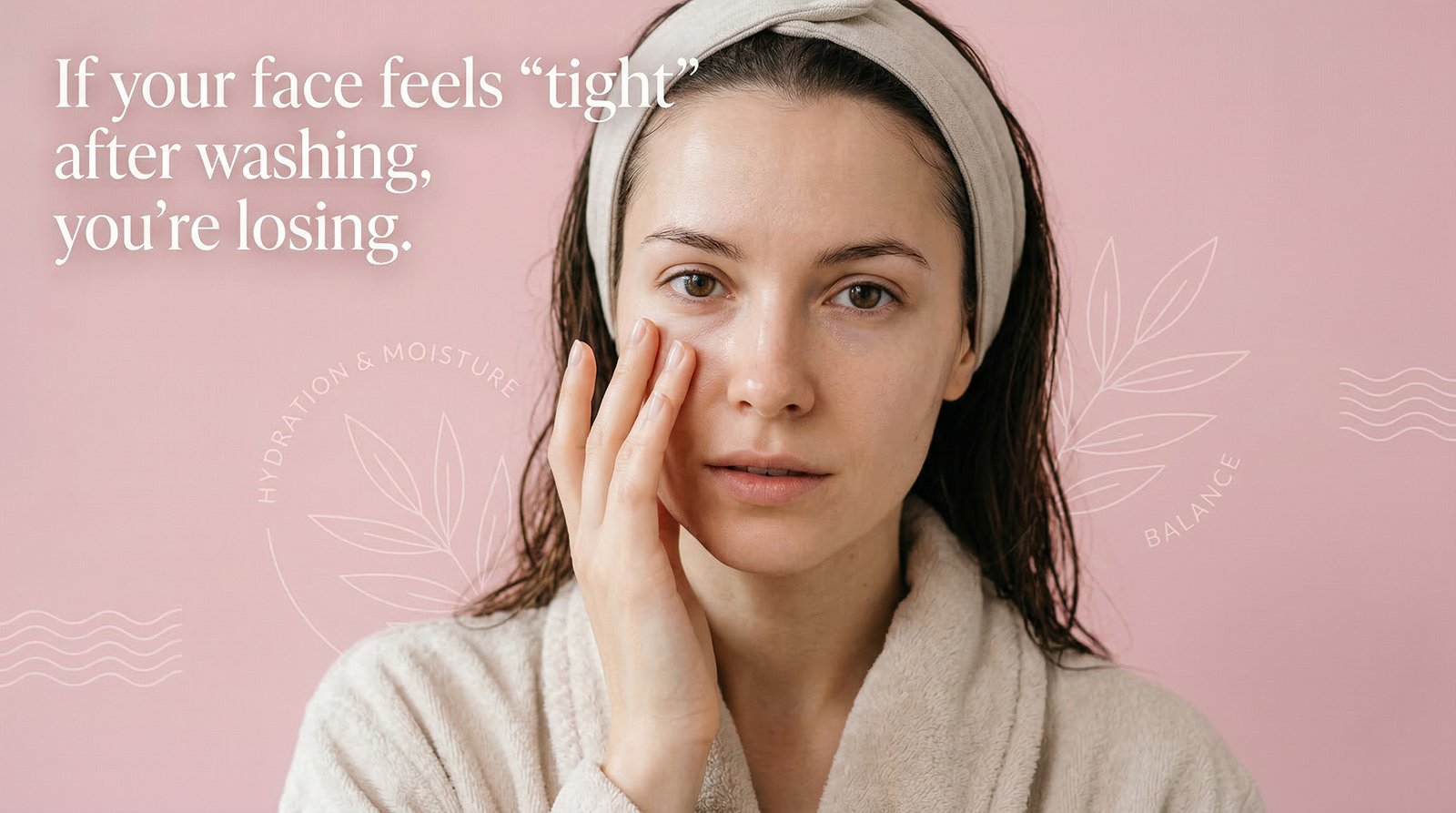
Learn how your skin barrier works, why it matters, and practical ways to strengthen and protect it for healthier, glowing skin.
The Skin Barrier Truth Nobody in the Industry Wants to Admit
Your 10-step routine isn’t helping your skin. It’s exhausting it.
Not because you’re lazy about skincare you’re clearly not. But because somewhere between the vitamin C, the niacinamide, the retinol, and the “hydrating” toner, your skin stopped being able to do the one thing it was built to do: protect itself. And that’s when everything went sideways.
You Don't Have Sensitive Skin. You Have a Damaged Barrier.
Here’s the uncomfortable part: most “sensitive skin” isn’t a skin type. It’s a symptom.
It shows up as redness that won’t quit, breakouts that appear out of nowhere, moisturizers that sting, and a general feeling that your skin hates everything you put on it including water. That’s not sensitivity. That’s a compromised barrier screaming at you to stop. The skin barrier technically the stratum corneum is a lipid-rich layer at the surface of your skin. Think of it as a brick wall: the skin cells are the bricks, and a cocktail of ceramides, fatty acids, and cholesterol forms the mortar between them.
When that mortar breaks down, water escapes (a process called transepidermal water loss, or TEWL) and irritants flood in. Your skin becomes simultaneously dehydrated and inflamed. And no serum in a pretty bottle is fixing that until you address the foundation.
Research published in the Journal of Investigative Dermatology links elevated TEWL directly to chronic skin conditions including eczema, acne, and rosacea conditions that millions of people are treating with more actives when they should be treating with less.
Your Cleanser Might Be Causing the Breakouts You Blame on Hormones
Let’s start at the beginning literally.
The average foaming cleanser has a pH between 9 and 11. Your skin’s natural pH? Around 4.5 to 5.5. Slightly acidic. That acidity isn’t a flaw it’s a defense mechanism. When you wash your face twice a day with a high-pH cleanser, you’re not just removing makeup and pollution. You’re disrupting your skin’s acid mantle, stripping the very lipids that keep your barrier intact, and wiping out the beneficial bacteria that keep pathogenic microbes in check. And then your skin tries to compensate by overproducing oil. Which you then try to control with more cleansing.
You see the loop.
Studies from dermatology research on the skin microbiome confirm that over-cleansing creates measurable microbiome imbalance, reducing populations of Staphylococcus epidermidis a beneficial bacterium that actively suppresses acne-causing bacteria. You’re not breaking out because of stress or your cycle (though those can contribute). You might be breaking out because your cleanser is starting a war your skin can’t win.
The fix isn’t complicated: use a low-pH, non-stripping cleanser with a short ingredient list. No sulfates. No fragrance. No skin “purification.” Your skin doesn’t need purification it needs its pH left alone.
If you’re looking for a starting point, Minimals’ Gentle Cleanser is formulated specifically around barrier-safe pH levels and skips every ingredient category known to cause microbiome disruption. It cleans. That’s the whole point.
"Hydration" and "Moisture" Are Not the Same Thing (And Confusing Them Is Wrecking Your Skin)
This is the one nobody explains clearly, so let’s fix that.
Hydration = water content in skin cells. Moisture = the barrier’s ability to keep that water from escaping.
When you layer a hydrating toner, an essence, a serum, and a water-based moisturizer you’re adding water. But if your lipid barrier is compromised, that water evaporates. You’ve just made your skin damp on the inside and dry by the time you finish your coffee.
This is why some people drink a litre of water a day and still have dry skin. Hydration without occlusion is a leaky bucket.
A smarter approach is what’s sometimes called “moisture sandwiching” applying a humectant (like hyaluronic acid or glycerin) to damp skin and immediately sealing it with a lipid-rich moisturizer or barrier cream. The humectant draws water; the lipid layer traps it. But here’s the counterintuitive part: if your barrier is already broken, hyaluronic acid can actually draw water out of your skin in dry environments particularly in low-humidity climates rather than pulling it in from outside.
More moisture steps don’t equal more moisture. A repaired barrier does.
The Serum Stack That's Quietly Inflaming Your Skin
Everyone has at least one serum they shouldn’t be using right now.
Retinol + exfoliating acids + vitamin C + niacinamide + peptides. Used together, daily, sometimes twice daily. Each one promising transformation. Together? They’re fighting each other and losing the fight on your face.
Here’s what’s actually happening:
When you over-exfoliate (AHAs, BHAs, retinol all count), you accelerate cell turnover faster than your skin can replenish its intercellular lipids. The result is what dermatologists call an “inflammation loop” your barrier is perpetually disrupted, your immune response is chronically activated, and your skin oscillates between dry flaking and reactive breakouts.
Research in the Journal of Dermatological Science demonstrates that repeated barrier disruption, even from individually well-tolerated actives, triggers a cumulative inflammatory cascade that’s distinctly harder to reverse than to prevent.
More actives don’t mean faster results. They mean more inflammation, slower healing, and a skin barrier that never has the quiet it needs to rebuild.
If your skin feels like it’s “reacting to everything lately,” the most effective thing you can do is strip your routine down for 4 to 6 weeks. No actives. No exfoliation. Just cleanse, repair, seal. Let the barrier close before you put it back to work.
The 'Barrier-First' Principle Nobody Taught You
Here’s the mindset shift worth making:
Before asking “what does my skin need to look better?”ask “what does my skin need to function properly?”
These are different questions. The first leads you toward serums. The second leads you toward a repaired foundation that makes everything else actually work. Barrier-first skincare isn’t about going minimal for the sake of simplicity. It’s about understanding that ceramides, cholesterol, and fatty acids in the right ratio don’t just prevent water loss they regulate how actives penetrate, how inflammation is managed, and how quickly skin cells regenerate.
The NIH’s National Library of Medicine has documented that topical ceramide application measurably reduces TEWL and visibly improves the structural integrity of compromised skin and that these effects compound over time, unlike most trending actives that plateau after weeks.
Ceramides aren’t a trend. They’re infrastructure.
When your barrier is working properly, your skin manages redness better, retains moisture on its own, tolerates actives without reactivity, and produces less compensatory oil. The expensive actives you’ve been using? They’ll finally start doing what they’re supposed to because now there’s a functional skin beneath them.
If Your Routine Feels Complicated, That Is the Problem
Say that slowly.
If you spend more than 10 minutes on your skincare routine, something has gone wrong not with your skin, but with your logic. Skincare complexity is sold to you as expertise. It’s not. It’s commerce. The more steps you believe you need, the more products you buy. And in the process, more points of potential irritation, more active ingredient conflicts, and a higher probability that your skin is reacting to your routine rather than external factors.
Here’s a simple audit question: If you took away every product except a cleanser, a moisturizer, and SPF would your skin fall apart?
If the honest answer is “yes,” your barrier is dependent on the routine to compensate for damage the routine is partly causing. That’s the loop. And you can step out of it.
The skin barrier is not fragile by nature. It becomes fragile when it’s constantly interfered with. Given the right building blocks lipids, a stable pH environment, minimal disruption it is remarkably good at repairing itself.
Microbiome Disruption Is the Conversation Skincare Still Isn't Having Loudly Enough
Your skin is home to roughly 1,000 species of bacteria, fungi, and mites. Most of them are your allies.
They produce antimicrobial peptides. They regulate inflammation. They help maintain the acid mantle. And they are extraordinarily sensitive to the products you put on your face.
Fragrance even “natural” fragrance alters microbial diversity. Alcohol in toners kills surface bacteria indiscriminately, beneficial and harmful alike. Antibacterial cleansers don’t just target acne bacteria they flatten the entire ecosystem.
And when your microbiome is disrupted, your skin loses its first line of defense. Pathogens colonize more easily. Inflammation becomes chronic. Sensitivity increases for reasons that look systemic but are actually topical.
Studies published via PubMed on cutaneous microbiome homeostasis show that inflammatory skin conditions are consistently associated with reduced microbial diversity not just in people with clinical conditions, but in people who simply over-cleanse or over-medicate their skin.
The solution? Treat your skin like an ecosystem, not a surface to be sanitized.
Use fragrance-free products. Avoid unnecessary antibacterial agents. Cleanse once not twice on days where the second cleanse isn’t earning its place. Let your skin have its own population back.
The Minimal Routine Blueprint (That Actually Works)
You don’t need five steps. You need the right four.
Morning:
If you cleansed last night and slept in a clean bed, water or a micellar rinse is enough in the morning. A full cleanse twice daily is the first habit worth questioning.
One active. One. Vitamin C in the morning is a solid, evidence-backed choice for photostability and antioxidant protection. If your skin is currently reactive, skip this until it settles.
A ceramide-forward moisturizer. Applied on slightly damp skin. Not ten seconds after the toner now, while the skin still has surface moisture to lock in.
SPF every morning, without exception. UV damage is the primary driver of barrier degradation, premature aging, and hyperpigmentation. This is the one non-negotiable step.
Evening:
This is the one time a thorough cleanse earns its place removing sunscreen, pollution, and makeup.
A ceramide serum or barrier-focused treatment. Evening is when your skin undergoes its repair cycle. Give it the materials it needs.
A richer moisturizer than you’d use in the morning. If your skin is very dry or disrupted, a thin layer of something occlusive petroleum jelly, squalane, a dedicated balm over your moisturizer traps everything in.
SPF every morning, without exception. UV damage is the primary driver of barrier degradation, premature aging, and hyperpigmentation. This is the one non-negotiable step.
A gentle way to cleanse
If your current cleanser is leaving you feeling like a drumhead, you might want to try our Triple Action Cleanser.
We made it specifically for people who are tired of that “stripped” feeling.
It doesn’t foam up into a giant mountain of bubbles, because honestly, bubbles are usually just harsh detergents (sulfates) that do more harm than good. Instead, it feels more like a soft, silky lotion. It lifts away the grime and the makeup, but it leaves your “moisture cape” exactly where it belongs.
When you rinse it off, your face feels like… well, skin. Not paper. Not plastic. Just soft, clean skin.
Common mistakes we all make
Here are the most common barrier-damaging habits almost everyone falls into even the most dedicated skincare enthusiasts:
The good news? These mistakes are incredibly common and completely reversible. Once you simplify, repair, and protect, your skin starts doing what it was designed to do.
A simple "Barrier Repair" checklist
Frequently Asked Questions
It’s the outermost layer of your skin (stratum corneum) made of lipids (ceramides, cholesterol, fatty acids). A healthy barrier locks in moisture and blocks irritants. When damaged, you get dryness, redness, breakouts, and “sensitive skin” symptoms.
Redness, stinging from products (even water), tightness, flakiness, random breakouts, or skin that reacts to everything. It’s often misdiagnosed as just “sensitive skin.”
Yes most foaming cleansers have high pH (9 to 11) while skin needs 4.5 to 5.5. Switch to a gentle, low-pH, sulfate-free, fragrance-free cleanser.
Once at night (thoroughly). In the morning, just rinse with water or use micellar water unless needed.
Hydration (water) and moisture (barrier locking it in) are different. Add water on damp skin, then immediately seal with a ceramide-rich moisturizer. Otherwise it evaporates.
Closing thought
You don’t need a new serum. You need the ones you have to stop competing. You don’t need to quit skincare you need to quit the version of it that’s been sold to you as more sophisticated because it’s more expensive and more complex. Your skin barrier is not broken beyond repair. It’s suppressed by fragrance, by over-exfoliation, by a cleanser that’s too harsh, by four actives that should never have met each other on your face.
Start with something that cleanses without stripping. Follow it with something that actually gives your barrier what it’s made of. And then this is the part nobody tells you leave your skin alone long enough to respond.
“Minimals” exists for this. Not to add to your routine, but to give you a reason to cut it in half.
Every formula is designed around barrier safety first, active performance second. Because skin that’s functioning doesn’t need rescuing and skin that’s been over-treated needs repair before it needs anything else.
You can find the full Minimals routine at minimals.com.co.
Your skin barrier knows what it’s doing. Give it the chance to prove it.