
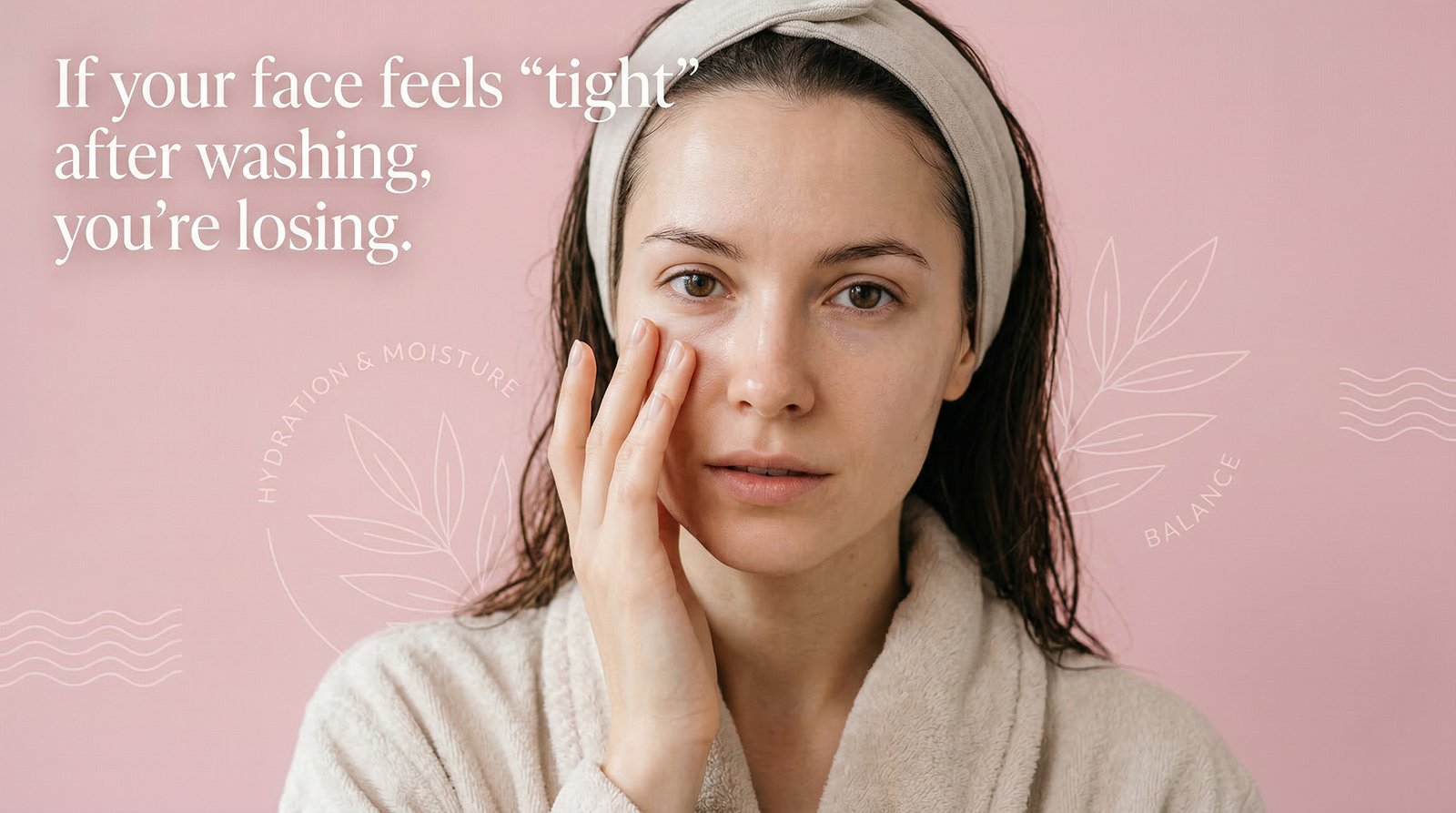
Everyone’s using it. Far fewer are using it correctly. The difference shows up on your skin literally.
Hyaluronic Acid: Everyone Recommends It, Almost Nobody Uses It Right
Hyaluronic acid has become the ingredient that everyone recommends and almost nobody explains properly.
It’s in nearly every moisturizer, serum, toner, and eye cream on the market. Brands treat it like a magic word. But if you’ve used an HA serum and felt tighter, flakier, or just the same you weren’t imagining things. The molecule works. The method is where most people fail.
This guide is not a product pitch. It’s a biology class you should have gotten at the drugstore but didn’t.
What Hyaluronic Acid Actually Is (And What It Isn't)
Hyaluronic acid is not an acid in the chemical-exfoliant sense. It doesn’t resurface, peel, or resurface anything. Calling it an “acid” is essentially a naming accident it refers to its chemical structure (a glycosaminoglycan), not its function on skin. What it actually does: it’s a humectant. It attracts and binds water molecules up to 1,000 times its own weight in water, according to widely cited research. Your body produces it naturally: it’s found in your connective tissue, joints, and crucially, your dermis the layer of skin beneath the surface. As you age, your skin’s natural HA levels decline. Sun exposure accelerates this. So does a compromised barrier. The result is the slow, structural loss of plumpness and elasticity that no amount of water-drinking can reverse because this isn’t about internal hydration, it’s about your skin’s ability to hold onto the water that’s already there.
Research published via PubMed confirms that hyaluronan (the scientific term for HA) is a major structural component of the extracellular matrix, and its degradation in aging skin is directly linked to decreased viscoelasticity and increased transepidermal water loss (TEWL). Topical HA doesn’t replace intradermal HA but it significantly reduces surface moisture loss when applied correctly.
The One Mistake That Makes Hyaluronic Acid Dry Your Skin Out
“Hyaluronic acid needs water to work. Apply it to dry skin in a dry room and it will find water by pulling it up from inside you.”
The counterintuitive truth about humectantsThis is the most important thing in this entire guide, and the thing most labels don’t tell you.
Humectants like HA attract water from their environment. In a humid climate or on damp skin, that means they draw moisture from the air into your skin cells which is exactly what you want. But in low-humidity conditions, or when applied to completely dry skin, HA turns inward. It draws moisture up from your dermis toward the surface, where it then evaporates.
The outcome: you use a “hydrating” serum and your skin feels drier an hour later. Not because the product is defective because no one told you the conditions under which it works.
The fix is simple and permanent once you know it: apply your HA serum to slightly damp skin immediately after cleansing, before patting fully dry then seal it immediately with a moisturizer that contains occlusives or emollients. The HA brings water in. The moisturizer traps it there.
This is moisture sandwiching. It costs nothing extra. It just requires understanding what the molecule is doing.
Applying HA serum, waiting for it to “absorb,” and then skipping moisturizer is one of the most common causes of reactive dryness in people who think their skin is “too oily for moisturizer.” Your skin may be oily and dehydrated simultaneously these are not mutually exclusive conditions.
Not All Hyaluronic Acid Is the Same. Molecular Weight Changes Everything.
The skincare industry has a habit of listing “hyaluronic acid” on an ingredient list without telling you what type. But the molecular weight of HA determines where it works, how fast it works, and whether it’s building long-term skin health or just creating a temporary surface effect.
Hyaluronic acid comes in different molecular weights, and each behaves differently on the skin. High molecular weight HA (>1,000 kDa) stays on the surface, creating an immediate plumping and film-forming effect for instant surface hydration. Medium molecular weight HA (100 to 1,000 kDa) penetrates into the epidermis, providing sustained hydration and improving skin texture. Low molecular weight HA (<100 kDa) goes deeper into the epidermis, supporting collagen production and offering anti-inflammatory benefits while strengthening the skin barrier. Sodium hyaluronate, the salt form most commonly used in products, is more stable and penetrates more readily, reaching from the epidermis down toward the dermis.
A serum with only high-MW HA gives immediate results that disappear within hours. A formula combining multiple molecular weights works at different depths simultaneously surface plumping, mid-level hydration retention, and deeper structural support. When you read an ingredient list and see “sodium hyaluronate” or “hydrolyzed hyaluronic acid,” those are the more penetrative, stable forms. “Hyaluronic acid” alone often means the larger molecule that works primarily at the surface. Neither is bad but knowing the difference tells you what to expect.
Research Reference
A study in the Journal of Investigative Dermatology demonstrated that low molecular weight HA fragments not only penetrate deeper into the epidermis, but also activate keratinocyte receptors that support barrier repair signaling making them functionally distinct from their high-MW counterparts, not just smaller versions of the same molecule.
Why Your "Hydrating" Toner Might Be Doing Almost Nothing
Toners and essences with HA listed toward the end of the ingredient list after water, alcohol, glycerin, and four preservatives are not HA products. They are watery products that happen to contain a trace of HA. At concentrations below 0.1%, hyaluronic acid is present as a label ingredient, not a functional one. The amount in contact with your skin for the seconds it takes to dry is not going to move the needle on dehydration.
This isn’t an indictment of affordable skincare. It’s an indictment of reading the label wrong. A genuine HA product will have sodium hyaluronate or hyaluronic acid in the first six to eight ingredients ideally appearing more than once at different molecular weights. That’s how you know you’re actually getting a dose.
The Skin Types That Need Hyaluronic Acid Most (And the One That Needs to Be Careful)
HA is largely safe for every skin type. But “safe” doesn’t mean “used identically.” How you apply it, what you put over it, and how much humidity you’re working with changes the outcome significantly depending on your skin’s baseline.
Dry skin: HA is essential, but you need a heavier occlusive seal afterward. Ceramide creams, shea butter-based moisturizers, or even a light facial oil on top will prevent the surface dehydration paradox.
Oily or combination skin: HA is your best friend precisely because it’s not oil-based. It delivers hydration without greasiness, which means your skin has less reason to compensate with excess sebum production. Use it, then seal with a lightweight gel-cream or non-comedogenic lotion.
Sensitive or reactive skin: Stick to high-MW HA in the beginning. Low-MW fragments, while effective, can temporarily activate skin immune receptors for most people this is harmless, but for very reactive skin it can cause brief redness. Start slow, start simple.
Acne-prone skin: HA itself doesn’t cause breakouts. But if your “hydrating serum” also contains silicones, heavy emollients, or comedogenic oils in the same formula, those are the culprits not the HA. Read the full ingredient list, not just the featured active.
According to research cited by the NIH National Library of Medicine, topical high molecular weight hyaluronic acid has demonstrated measurable improvements in skin hydration and elasticity across multiple skin types in controlled trials, with notably low incidence of adverse reactions even in subjects with self-reported sensitive skin.
What Happens When You Layer HA With the Wrong Actives
Hyaluronic acid is one of the most compatible actives in skincare. It doesn’t react negatively with most ingredients, doesn’t require pH-matching in the way AHAs or retinoids do, and doesn’t compete with niacinamide or peptides. For a skin-science reason: it’s a structural molecule, not a reactive one.
That said, there are two layering situations where HA stops working properly or where you accidentally neutralize everything you just applied.
HA + Vitamin C (L-ascorbic acid): L-ascorbic acid needs a pH below 3.5 to be effective. HA serums typically sit between pH 5 and 6. If you apply your HA first and it hasn’t fully absorbed, it can temporarily raise the pH environment when you apply vitamin C on top reducing the acid’s potency. The fix: vitamin C first on clean, dry skin; HA after.
HA + Alcohol-heavy toners: Some cheaper toners use SD alcohol or denatured alcohol as a delivery vehicle. Alcohol accelerates TEWL on its own. Using an HA product on top of an alcohol-heavy toner means HA is drawing moisture into skin that’s simultaneously losing it through another mechanism. You’re running up an escalator. Use your HA after genuinely hydrating, alcohol-free prep or skip the prep step entirely.
How to Actually Apply Hyaluronic Acid. Step by Step.
After cleansing, pat your face gently leave it slightly damp. Not dripping. Not squeaky dry. That residual moisture on the surface is exactly what your HA will bind to and pull inward. This single step makes the difference between a serum that works and one that doesn’t.
Don’t wait for your skin to air-dry. Apply your HA serum within thirty seconds of patting. Press it gently into skin rather than rubbing rubbing creates friction and can disrupt the lipid barrier you just finished not destroying with your cleanser. Two to three pumps, distributed evenly.
Apply your moisturizer while the serum is still slightly tacky. You don’t need to wait for “full absorption” that’s not how film-forming humectants work. The moisturizer is the second half of the mechanism. Together, they form a moisture sandwich: water drawn in, then locked in.
In the morning routine, SPF goes on last over your moisturizer. UV radiation is the primary accelerant of HA degradation in the dermis. You can apply perfect topical HA every day and undo much of it without sun protection. The SPF is not optional if you care about results.
The seal matters as much as the serum. A ceramide-forward moisturizer applied immediately after HA is the difference between temporary surface gloss and actual, lasting hydration. One step does nothing without the other.
If You've "Tried Hyaluronic Acid and It Didn't Work," Read This.
The ingredient works. The delivery almost certainly didn’t.
Either the product had HA in a concentration too low to matter. Or you applied it to dry skin. Or you didn’t follow it with an occlusive. Or the formula combined HA with irritants fragrance, alcohol, or actives that disrupted barrier function so the HA was fighting against its own environment. This is the problem with how skincare is sold. The ingredient gets the credit when something works, and the blame when it doesn’t when in almost every case of HA “failure,” the issue was formulation, application, or both.
Start again with the right method before you conclude an ingredient isn’t for you. Two weeks of correct HA application damp skin, immediate seal, no alcohol-adjacent products and you’ll have a genuinely useful data point. Not the data point from three years ago when you applied it wrong.
Common mistakes we all make
Most people apply HA serum on dry skin, expecting it to magically hydrate. In reality, without enough moisture in the air or a damp face, it can pull water from your skin and leave it tighter and flakier. Another big mistake is using only high molecular weight HA and skipping richer moisturizers or occlusives to lock it in. Many also overuse it daily without balancing it with barrier-repairing ingredients, leading to irritation and disappointment.
A simple "Hyaluronic Acid" checklist
Frequently Asked Questions
Hyaluronic acid (HA) is a powerful humectant that can hold up to 1000 times its weight in water. It helps keep your skin plump, hydrated, and smooth.
You can use it twice a day (morning and night) for best results.
Always on damp skin. This is very important applying on damp skin helps it pull moisture into your skin better.
Yes. It layers well with:
Rarely. Pure hyaluronic acid is non-comedogenic. However, if your product contains other ingredients (fragrance, essential oils, etc.), it might irritate sensitive skin.
Closing thought
Hyaluronic acid is one of the kindest, most effective ingredients you can add to your skincare routine. It doesn’t promise dramatic overnight transformations, but it delivers something even better consistent, healthy, glowing hydration that makes your skin look and feel noticeably better over time. Stay patient, apply it on damp skin, and pair it with a good moisturizer. Your skin will thank you.
Consistency beats complexity every single time.