
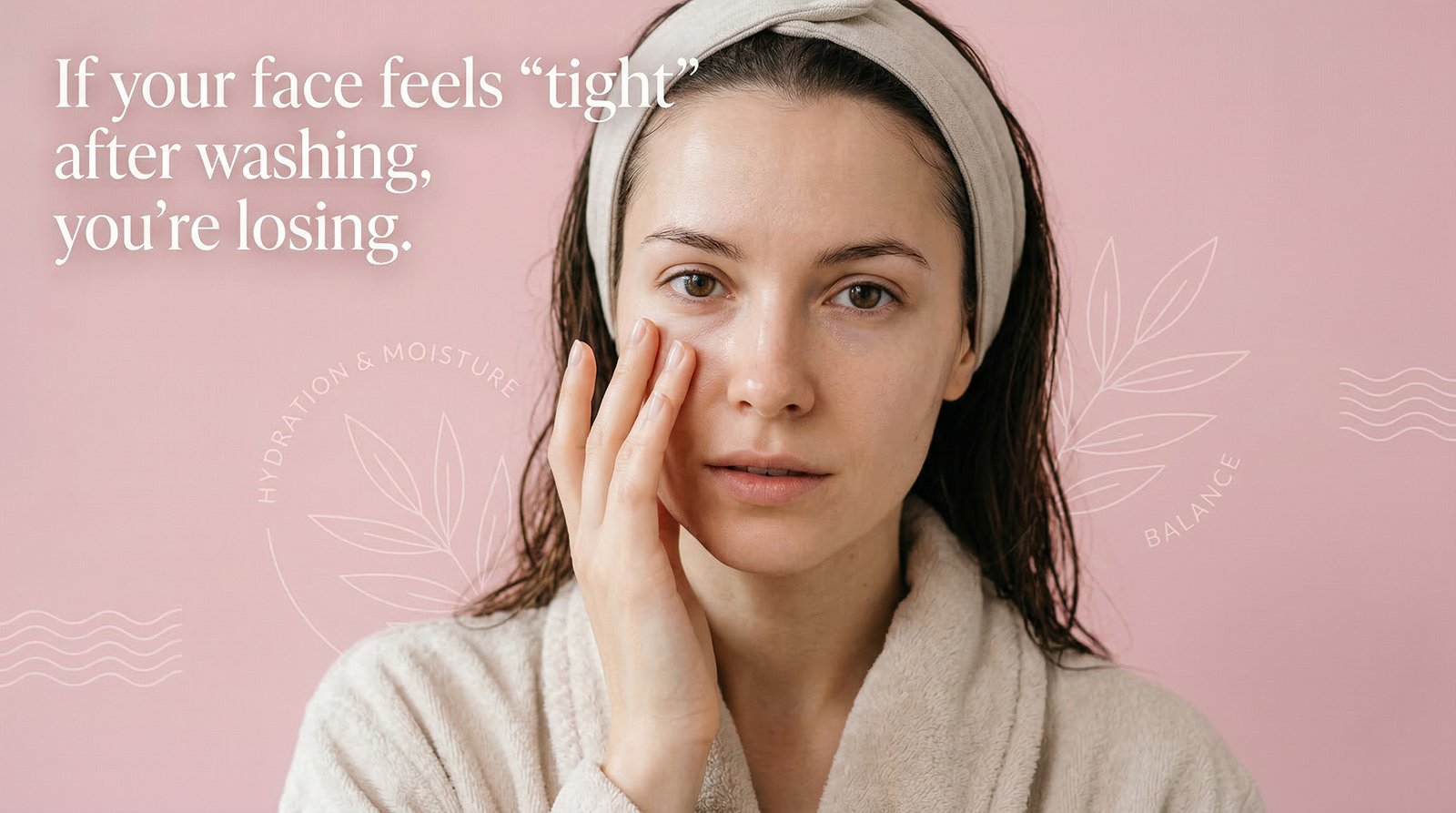
From temporary flushing to chronic irritation, learn what’s causing your skin redness and how to calm it effectively.
Your Skin Isn’t “Sensitive.” It’s Sending a Warning Signal.
That redness on your cheeks?The flushing around your nose?The irritation that appears after using products that promised to calm your skin?
It’s not random. And it’s probably not because your skin is naturally sensitive. Most redness is a message. A signal that something in your routine, environment, or skin biology is under stress. Yet the skincare industry keeps treating redness like a cosmetic problem.
Cover it. Conceal it. Neutralize it. Use a green-tinted cream and move on. But redness isn’t the problem. It’s evidence of a deeper one. Because when your skin turns red, inflammation is already happening. And inflammation has a habit of sticking around far longer than most people realize. If you’re constantly chasing calm skin but never quite getting there, this guide is for you.
We’re going to look at what’s actually causing your redness, why many popular solutions make it worse, and what your skin really needs to recover.
The Real Reason Your Skin Keeps Looking Angry
Most people assume redness starts on the surface.
It doesn’t. It starts deeper, where your skin barrier begins to lose its ability to protect you. Your skin barrier is made up of skin cells held together by a lipid matrix consisting primarily of ceramides, cholesterol, and fatty acids. Think of it as a brick wall. The cells are the bricks. The lipids are the mortar. When that mortar weakens, water escapes.
Dermatologists call this transepidermal water loss, or TEWL.
And once TEWL increases, irritation follows. The skin becomes more reactive. Blood vessels become more visible. Inflammatory signals increase. Suddenly products you’ve used for years start stinging. This isn’t your skin being difficult.
It’s your barrier asking for help. Research published through the NIH and PubMed has repeatedly linked impaired barrier function with increased inflammation and skin sensitivity.
When the barrier weakens, redness often becomes one of the first visible signs.
Your Cleanser Might Be Triggering the Redness You're Trying to Fix
Let’s start with the step almost nobody suspects. Cleansing. Most people believe a squeaky-clean face means a successful cleanse. It doesn’t.
That tight feeling after washing?
That’s not cleanliness. That’s dehydration. Many cleansers remove not only dirt and oil but also the lipids your barrier depends on.
Use them twice daily for months and the effects add up. The damage isn’t limited to the barrier either. Your skin hosts billions of microorganisms collectively known as the microbiome. A healthy microbiome helps regulate inflammation and defend against harmful bacteria. Aggressive cleansing disrupts that balance.
Studies published in the Journal of Investigative Dermatology suggest microbiome disruption can contribute to inflammatory skin conditions and increased sensitivity.
In other words, your cleanser may be creating the exact problem you’re buying soothing products to solve. A gentle cleanser should remove what doesn’t belong on your skin without stripping away what does. That’s why barrier-first formulations tend to outperform harsh foaming alternatives.
At this point, your skin doesn’t need a cleanser that feels powerful. It needs one that respects the work your barrier is already trying to do.
The More Products You Add, The Redder Your Skin Gets
The skincare industry loves one message: More products equal better results. Your skin disagrees. Layering acids, retinoids, vitamin C, exfoliating toners, treatment pads, masks, and spot treatments sounds productive. Biologically, it’s often chaos. Every active ingredient asks your skin to perform work. When multiple actives are layered without restraint, inflammation begins to accumulate. The problem isn’t necessarily one ingredient. It’s the combined burden. Your skin doesn’t always have enough recovery time between exposures.
Redness becomes chronic. Flaking appears. Stinging becomes normal. Then people assume they need even more calming products. The cycle continues.
This is what dermatologists often call an inflammation loop. You irritate the skin. The skin becomes reactive. You add more products to fix the reaction. Those products create additional stress. The reaction worsens. And around you go.
A smarter approach?
Use fewer actives. Use them intentionally. Allow recovery periods. Your skin heals during recovery, not during constant stimulation.
Hydration and Moisture Are Not the Same Thing
Wait, what?
Most people use these words interchangeably. They shouldn’t. Hydration refers to water. Moisture refers to oils and lipids that keep water from escaping. You can have hydrated skin that still feels dry. You can also have oily skin that is dehydrated.
This distinction matters because many redness-prone people focus exclusively on hydration. They buy hydrating serums. Hydrating mists. Hydrating masks. Hydrating essences. Yet their skin remains irritated.
Why?
Because the water isn’t staying where it needs to stay. Without barrier-supporting ingredients like ceramides, cholesterol, and fatty acids, hydration simply evaporates. This contributes to TEWL and continued irritation. That’s why a barrier-supportive moisturizer often does more for redness than an entire shelf of hydrating products. The goal isn’t adding endless moisture. The goal is helping your skin hold onto what it already has.
The “Gentle” Products That Aren't Actually Gentle
One of skincare’s strangest contradictions is that products marketed for sensitive skin frequently contain ingredients that sensitive skin doesn’t tolerate well.
Heavy fragrance. Excessive essential oils. Botanical extracts included more for marketing than function. Colorants. Alcohol-heavy formulas. The label says soothing. Your skin says otherwise. Redness-prone skin often benefits from shorter ingredient lists and formulations with a clear purpose. This is where skinimalism starts making sense.
Not because minimal routines are trendy. Because every additional ingredient is another variable. Another opportunity for irritation. Another thing your skin has to process. When your barrier is compromised, simplicity becomes a strength.
Not a compromise.
If Your Routine Feels Complicated, That's the Problem
This might be difficult to hear. But if you need a spreadsheet to track your skincare routine, something has gone wrong. Many people spend months trying to fix redness while unknowingly creating it.
Monday: exfoliation.
Tuesday: retinoid.
Wednesday: brightening treatment.
Thursday: recovery mask.
Friday: exfoliation again.
Your skin never gets a day off. Imagine trying to recover from a sprained ankle while running every day. That’s what many routines ask inflamed skin to do. Healing requires consistency. Not complexity. Your barrier doesn’t care how many products you own. It cares whether it has the resources to repair itself.
Ceramides. Lipids. Humectants. Protection. Time. That’s usually enough.
Barrier-First Skincare Works Because Biology Doesn't Care About Trends
The skincare industry changes every month.
Your skin biology doesn’t.
Barrier-first skincare focuses on restoring the conditions necessary for healthy function before chasing aggressive results. That means strengthening the lipid matrix. Reducing unnecessary inflammation. Supporting microbiome balance.
Minimizing TEWL.
When those pieces improve, redness often begins to settle naturally. Not overnight. But steadily. This is also why many redness-prone individuals find better results with multifunctional products. Instead of layering five different formulas, they rely on one product that delivers hydration, barrier support, and soothing ingredients simultaneously.
At this point, your skin doesn’t need another step. It needs a formula that already does both. A well-formulated serum can provide hydration while helping reduce inflammation. A moisturizer can support barrier repair instead of merely sitting on the surface. A cleanser can clean without triggering the cycle all over again.
Less work. Better outcomes.
The Minimal Routine Blueprint for Redness-Prone Skin
Forget the twelve-step routine.
Start here.
Use a gentle cleanser that removes debris while preserving barrier lipids. Your skin should feel comfortable afterward. Not tight. Not squeaky. Comfortable.
Choose one targeted serum. Not three. Not five. One. Focus on ingredients that support hydration and calm inflammation rather than constantly challenging the skin.
Apply a moisturizer rich in barrier-supportive ingredients. Look for ceramides, fatty acids, and skin-identical lipids. This is where long-term redness reduction often begins.
UV exposure is one of the most overlooked triggers of persistent redness. Even when you don’t burn. Even when it’s cloudy. Daily sunscreen helps reduce ongoing inflammatory stress. Think of it as protecting the repair work your skin is already doing.
The Mistakes That Keep Redness Stuck Around
Before you buy another product, ask yourself:
Are you over-cleansing?
Are you exfoliating more than once or twice weekly?
Are you layering multiple actives together?
Are you chasing hydration while ignoring barrier repair?
Are you switching products every few weeks?
Most persistent redness isn’t caused by a lack of products. It’s caused by too many. Your skin rarely needs more intervention. It usually needs less disruption.
The Truth About Calm Skin
Healthy skin is often boring.
That’s the secret nobody wants to tell you. It’s consistent. Predictable. Uneventful. It doesn’t need a new miracle ingredient every month. It doesn’t need seven acids and three serums before breakfast.
It needs support. It needs protection. It needs recovery. And most importantly, it needs you to stop treating redness like an enemy and start treating it like information. Because redness isn’t random. It’s communication. Your skin is showing you exactly where something isn’t working. The question is whether you’re listening.
A simple "Redness" checklist
Frequently Asked Questions
Sometimes. If redness is caused by temporary irritation, your skin may calm down once the trigger is removed. But persistent redness usually means something is continuing to stress your barrier, whether that’s over-exfoliation, harsh cleansing, UV exposure, or an inflammatory skin condition.
Redness doesn’t always come with discomfort. Damaged capillaries, chronic inflammation, sun exposure, or a weakened skin barrier can create visible redness long before you feel burning, itching, or sensitivity.
Actually, it’s worse for you. When you strip oily skin, you trigger “reactive seborrhea”, your skin overproduces oil to protect itself. A gentle wash will actually help balance your oil production over time.
Yes. UV exposure is a major source of ongoing inflammation. Daily sunscreen helps prevent redness from worsening and protects the progress your skin is making during recovery.
Mild barrier damage may improve within a few weeks. More significant irritation can take several months of consistent barrier-focused care. Recovery depends on how quickly you remove the triggers and support the skin’s natural repair process.
Closing thought
You Don’t Need More Products. You Need Fewer That Actually Work. If your skin is constantly red, reactive, or uncomfortable, resist the urge to add another calming cream to the pile. Start by removing what’s causing the stress. Protect your barrier. Support your microbiome. Reduce unnecessary actives.
Choose products that perform multiple jobs well instead of one job loudly. That’s the foundation of skinimalism. Not doing less for the sake of doing less. Doing only what your skin actually needs. And for redness-prone skin, that’s often the difference between temporary relief and genuine recovery.