
Discover what retinol percentages actually mean, which strengths deliver real results, and how to choose the right one for your skin without irritation.
The Truth About Retinol Percentages: What the Label Isn't Telling You
You bought the 1% retinol because it sounded serious.
Your skin freaked out. You pushed through. You peeled, you purged, and three months later you were left with a compromised barrier, chronic redness, and a tube you’re afraid to open. That’s not a retinol problem. That’s a percentage problem and nobody told you the full story.
The Number on the Label Is Almost Meaningless Without Context
Here’s the thing the skincare industry quietly glosses over: retinol percentage alone tells you almost nothing about how effective or how destructive a formula will actually be on your skin.
A 0.025% retinol in a poorly designed base can cause more irritation than a well-buffered 0.5% formula. The delivery vehicle, the surrounding ingredients, the pH of the formula, and your skin’s current barrier status all determine the outcome. So when you’re comparison shopping between a 0.1% and a 1%, you’re not comparing apples to apples. You’re comparing apples to a completely different fruit.
The percentage is a starting point. It is not the story.
Why Your Skin Barrier Changes Everything (And Most Brands Ignore This)
Let’s back up to something more important than percentages.
Your skin barrier the stratum corneum is a tightly organized lipid matrix made up of ceramides, fatty acids, and cholesterol. Think of it as brick-and-mortar: the skin cells are the bricks, and the lipids filling the gaps are the mortar. When this matrix is intact, your skin holds moisture, resists irritants, and recovers quickly.
When it’s compromised? Everything gets in. Including retinol, at levels your skin is not ready for.
Research published in the Journal of Investigative Dermatology consistently shows that disrupted barrier function dramatically increases transepidermal water loss (TEWL) the rate at which water evaporates from your skin. Elevated TEWL means your skin is already under physiological stress. Introducing a high-percentage retinol into a stressed barrier isn’t aggressive skincare. It’s just damage stacked on damage.
This is why two people can use the exact same 0.5% retinol serum and have completely opposite experiences. One has a healthy barrier. One doesn’t. The percentage didn’t change. The outcome did.
The Retinoid Conversion Nobody Talks About
Retinol doesn’t actually do anything to your skin in its original form.
Wait what?
It has to be converted. When you apply retinol, your skin converts it first to retinaldehyde, and then to retinoic acid the active form that actually communicates with your skin’s retinoid receptors to trigger cell turnover, collagen synthesis, and the other benefits you’re paying for.
According to NIH research on retinoid metabolism, this conversion process involves multiple enzymatic steps, and the efficiency varies significantly between individuals. Some people convert retinol efficiently. Some barely convert it at all.
This means a person using 0.3% retinol with efficient conversion pathways might be getting more active retinoic acid at the receptor level than someone using 1% who converts poorly. And retinaldehyde the intermediate form is significantly more bioavailable than retinol, which is why more formulators are quietly shifting toward it. It requires one less conversion step, meaning more of what you apply actually reaches the receptor. At equivalent percentages, retinaldehyde outperforms retinol in terms of efficacy with less irritation potential.
Your percentage obsession may be pointed at the wrong molecule entirely.
The "Start Low, Go Slow" Advice Is Right But Usually Given for the Wrong Reasons
You’ve heard “start with 0.025% or 0.1% and work your way up.” That’s solid advice. But the reason most people give is that your skin needs to “build tolerance.”
Tolerance isn’t quite the right word.
What’s actually happening is that your skin needs time to upregulate the enzymes and receptor expression required to handle increasing retinoid activity without triggering an inflammatory response. Studies in Dermatology Times describe this as retinization a period of cellular adaptation, not mere tolerance-building.
During retinization, your skin is also recalibrating its microbiome. And here’s where things get interesting.
Your skin hosts around 1.5 trillion microorganisms that help regulate pH, produce natural moisturizing factors, and signal your immune system. Rapid introduction of high-percentage retinol disrupts this ecosystem. The irritation, dryness, and sensitivity you experience in the first weeks of retinol use isn’t just physical barrier disruption it’s partly a microbiome imbalance that your skin has to recover from.
Starting low isn’t about being cautious. It’s about not torching your skin’s entire ecosystem in one move.
The Retinol Percentage Ladder and Where Most People Go Wrong
Let’s break down what different concentrations actually mean in practice.
0.025% to 0.1%: This is the appropriate range for retinol beginners, people with sensitive skin, or anyone with a compromised barrier. At this level, you’re introducing the molecule without overwhelming the conversion pathway. Expect minimal irritation if used correctly. Efficacy is real but gradual think 3 to 6 months to visible results.
0.2% to 0.3%: The mid-range. This is where most people with normal-to-resilient skin should land after a proper introduction phase. Strong enough to meaningfully address texture, mild hyperpigmentation, and early fine lines. Still manageable for most barrier types.
0.5%: This is a meaningful threshold. At 0.5%, retinol formulas start to earn serious clinical backing. Research published on PubMed shows that 0.5% retinol applied consistently over 24 weeks produced statistically significant reductions in wrinkle depth and improvements in skin texture in controlled trials. This is where results get measurable but this concentration also demands a functioning barrier and a solid hydration base underneath.
1% and above: Here’s the honest truth about 1% retinol: most people’s skin does not need it, and many cannot tolerate it without compromising their barrier in the process. Prescription tretinoin starts at 0.025% a fraction of the OTC retinol percentages being sold as desirable. The highest prescription strength is 0.1%. The OTC market selling 1% retinol as premium is, to put it plainly, misleading you.
At 1%, you’re likely causing more inflammation than you’re resolving. Chronic low-grade inflammation is one of the primary drivers of accelerated skin aging. You’re not anti-aging. You’re aging in a different direction.
The Layering Problem Nobody Wants to Admit
You’re using retinol. You’re also using niacinamide, a vitamin C serum, an AHA exfoliant, and maybe a BHA. Your routine looks impressive. Your skin looks reactive.
This isn’t a coincidence.
Every active ingredient you layer is an additional demand on your skin’s metabolic resources. Your barrier only has so much enzymatic capacity. Your microbiome can only absorb so much disruption. When you stack retinol with exfoliating acids, you’re not just adding effects you’re amplifying irritation and reducing the barrier’s ability to recover from any of it.
Research from the Journal of Investigative Dermatology on skin barrier repair mechanisms shows that barrier recovery is an active biological process requiring energy, time, and the absence of ongoing disruption. If you’re applying multiple actives nightly, you’re essentially reopening a wound before it can heal.
The result is an inflammation loop: your skin gets irritated, triggers inflammatory pathways, those inflammatory pathways degrade collagen and impair barrier function, you add more actives to address the resulting dullness and breakouts, and the loop continues Retinol works better when it’s the only significant active your skin is processing. That’s not a limitation. That’s how biology works.
The Hydration Layer You're Probably Skipping and Why It Matters More Than the Retinol
Here’s a counterintuitive truth: the moisturizer you apply after retinol is more important than the retinol itself.
This is the principle behind the “sandwich method” applying a barrier-supportive moisturizer before and after retinol and it’s one of the most clinically underrated retinol techniques available.
When you moisturize before retinol, you’re essentially diluting the point-of-contact concentration while allowing the molecule to absorb more gradually. Less irritation. Equivalent efficacy over time. When you moisturize after retinol, you’re sealing the barrier, reducing TEWL, and giving your skin the ceramide and fatty acid building blocks it needs to repair itself during the repair-phase your retinol is triggering. But and this is important hydration and moisture are not the same thing. Hydration refers to water content. Moisture refers to the lipid matrix that prevents that water from leaving. You can drench your skin in hyaluronic acid and still have a dehydrated, lipid-depleted barrier if you’re not also replenishing ceramides, squalane, and fatty acids.
Most “hydrating” products are just water-binding ingredients in a thin base. They hydrate without moisturizing, which means the water they attract evaporates faster in dry environments, leaving skin drier than before. What your skin needs post-retinol isn’t a hydrating serum. It’s a barrier-repairing moisturizer. The distinction is everything.
At this point, your skin doesn’t need another product layered on top. It needs a formula that already handles both one that combines humectants with actual lipid-matrix support. That’s exactly what the Minimals Barrier Repair Moisturizer was built around: ceramide-dominant, with the fatty acid ratio that mirrors your skin’s natural lipid profile, so recovery isn’t an uphill battle.
If Your Routine Feels Complicated, That Is the Problem
Let’s be direct about something.
If you need a spreadsheet to remember what not to layer with what, which nights are retinol nights, which nights are acid nights, and when your skin is “ready” for what your routine has stopped being skincare and started being a project. Complicated routines aren’t a sign of sophistication. They’re usually a sign of products compensating for each other’s damage. Real barrier-first skincare is boring by most people’s standards. Gentle cleanser. One targeted treatment. A real moisturizer. SPF in the morning. That’s the whole thing.
The retinol in that routine should be doing one job well not competing with three other actives for receptor access, enzymatic capacity, and your skin’s finite repair resources.
A Routine That Actually Works With Retinol, Not Against It
Here’s what a functional retinol routine looks like one your skin can actually recover from and adapt to over time.
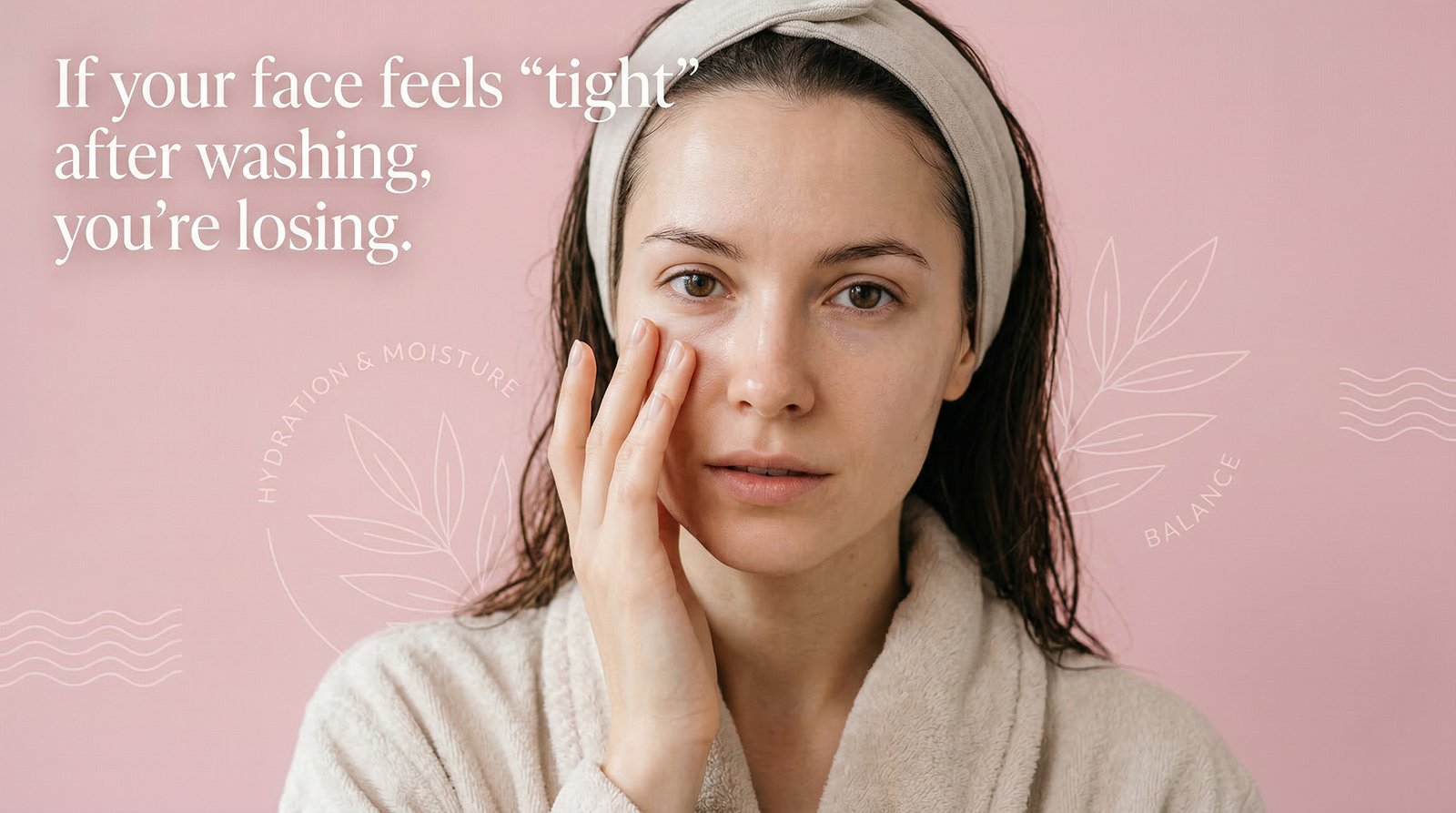
Your cleanser should remove the day without touching your lipid matrix. If your skin feels tight after cleansing, your cleanser is too harsh. That tightness is TEWL you’ve already started the night at a deficit before your retinol even touches your skin.
The Minimals Gentle Milk Cleanser is formulated specifically to maintain a pH of 5.5 the level at which your skin’s natural enzyme activity, microbiome balance, and barrier integrity are optimal.
A light, humectant-based serum applied to damp skin can prep the barrier to better receive retinol. This is optional. If your skin is healthy and well-moisturized, you may not need it.
Apply to dry skin. Not damp. Damp skin increases absorption rate, which increases irritation potential, especially at the start. Less is more a pea-sized amount for the entire face.
If you’re new to retinol, the Minimals 0.2% Retinol Serum starts at a functional yet manageable concentration, in a base that already includes ceramides so the formula itself reduces the barrier disruption that most retinol serums cause without one.
This is the step most people rush. A ceramide-rich, fatty acid-dense moisturizer applied over retinol is doing active recovery work replenishing the lipid matrix, reducing TEWL, and creating the environment retinol needs to work effectively without causing cascading inflammation.
Skip SPF at night. You don’t need it. You do need it every single morning, because retinol increases photosensitivity significantly and any sun exposure will directly counteract the cellular repair work you did the night before.
Common mistakes we all make
Here are the biggest mistakes that ruin retinol results for most people:
The biggest mistake? Treating retinol like a race instead of a long-term relationship with your skin.
A simple "Retinol Checklist" checklist
Frequently Asked Questions
start with 0.025% to 0.1%. These low strengths are effective while being gentle enough to build tolerance without destroying your skin barrier.
No. Higher percentages (0.5% to 1%) often cause more irritation and inflammation than actual anti-aging benefits. A well-formulated lower percentage usually gives better long-term results.
Visible improvements in texture, fine lines, and glow typically appear after 3 to 6 months of consistent use. Patience is key.
Not at the beginning. Start 2 to 3 times per week and increase slowly only if your skin feels comfortable.
Yes it’s essential. Apply moisturizer before and after retinol (sandwich method) to reduce irritation and support your skin barrier.
Closing thought
More retinol is not more effective. More steps are not more thorough.
A higher percentage on the label does not mean more results it means a higher likelihood of triggering retinization symptoms that most people interpret as progress when they’re actually just irritation.
The most effective retinol routine you can build is one your skin can tolerate consistently for 6 to 12 months without interruption. That means starting at a lower percentage, building slowly, prioritizing barrier support above everything else, and resisting the pull toward complexity. Your skin doesn’t need to suffer to improve. That’s not how biology works. That’s just how marketing works.
Don’t wait twenty minutes. Apply your moisturizer while your skin is still slightly damp to “lock in” that hydration.