
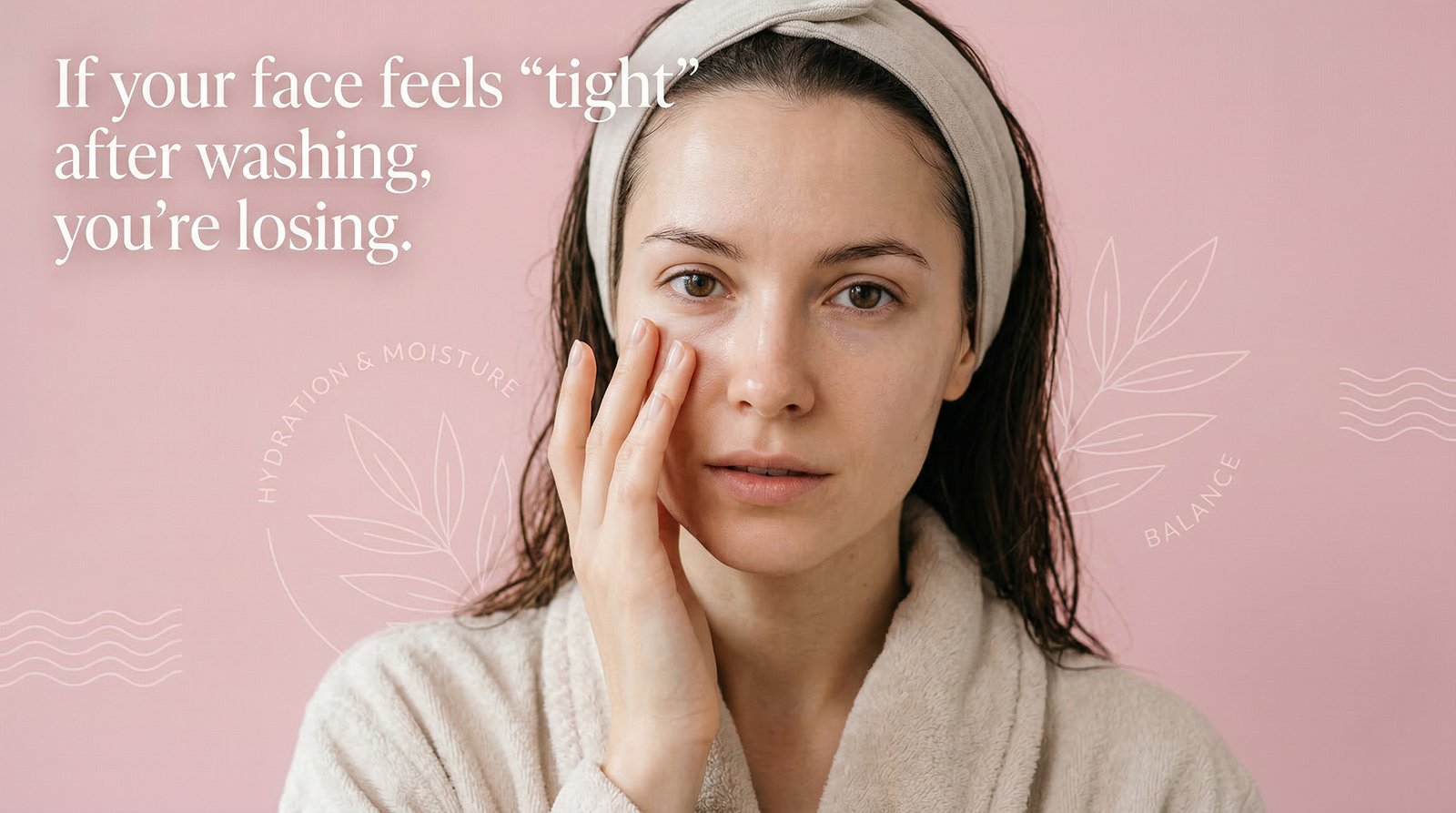
Fragrance is in nearly everything and it’s quietly dismantling the barrier you’re trying so hard to rebuild. Here’s what’s actually happening when you smell “clean.”
"You Did Everything Right… Except the Scent"
You spent forty minutes choosing a moisturizer. You checked for niacinamide, confirmed there was no alcohol, looked for ceramides. You did everything right. And then you chose the one that smelled like fresh linen and called it a day.
That scent? That’s the problem. And it’s been in your routine longer than you realize.
Fragrance is one of the most common ingredients in skincare and one of the least questioned. We’ve been conditioned to associate scent with cleanliness, quality, even luxury. If a product smells good, it feels like it’s working. It isn’t. In fact, in a significant number of cases, it’s working against you. This isn’t a minor ingredient quibble. Fragrance is one of the leading causes of contact dermatitis, one of the top triggers of barrier dysfunction, and one of the sneakiest reasons your skin never quite calms down no matter how many “soothing” products you add to your shelf.
Your Skin Barrier Isn't a Wall. It's a Living Ecosystem and Fragrance Treats It Like a Crime Scene.
Here’s what most people don’t understand about the skin barrier: it’s not a layer you can see or feel. It’s a lipid matrix a carefully organized structure of ceramides, cholesterol, and fatty acids that sits in the outermost layer of your skin (the stratum corneum) and does one critical job: keep water in and irritants out.
When that matrix is intact, your skin holds moisture without you doing anything special. When it’s compromised, water evaporates through the surface a process called transepidermal water loss (TEWL) and every irritant, bacteria, and allergen has an easier time getting in.
Fragrance compounds disrupt this lipid matrix directly. They dissolve into the skin’s surface layer, and some of the more reactive molecules linalool, limonene, cinnamal trigger an immune response that increases inflammation and reduces the barrier’s ability to self-repair. Your skin is constantly trying to rebuild its barrier overnight. Fragrance applied in the evening especially in your “calming” night cream can interfere with that process before it even starts.
The frustrating part: this doesn’t always look like a reaction. You won’t necessarily get hives or redness. You might just notice that your skin is persistently dull, perpetually “sensitive,” or that your moisturizer never really feels like enough. That’s barrier dysfunction low-grade, chronic, invisible to the eye but measurable in how your skin behaves.
"But I've Used This for Years and Never Reacted." The Fragrance Problem Nobody Talks About.
This is the one that catches people off guard.
Fragrance sensitivity is not like a peanut allergy. It doesn’t announce itself immediately. It builds. Research in contact dermatitis consistently shows that repeated low-level exposure to fragrance allergens can sensitize the immune system over months or years until one day, seemingly out of nowhere, the skin turns.
So when you say “I’ve used this forever and I’m fine,” what you might actually be describing is a countdown.
The clinical term is allergic contact dermatitis a delayed hypersensitivity reaction. But before it becomes full-blown, your skin is already responding in subtler ways: increased redness after application, a tight feeling that you’ve normalized, products “not working” the way they used to.
⚠ If your skin feels tight, reactive, or “sensitive” without explanation fragrance is the first ingredient to remove, not the last.
There are over 2,500 fragrance chemicals used in cosmetics, and manufacturers are not legally required to disclose which ones they use. “Fragrance” on an ingredient list is a blanket term a legal black box. That single word could represent 30 separate compounds, several of which are known sensitizers.
Fragrance Isn't Just "Parfum." It's Hiding in Things You'd Never Suspect.
Most people know to look for “parfum” or “fragrance” on a label. Fewer people know what to do with the rest. Fragrance hides under botanical names. “Essential oil of lavender” sounds like a wellness choice. It’s also a fragrance compound that contains linalool and linalool oxide both recognized contact allergens. Rose hip oil, bergamot, ylang-ylang, tea tree, peppermint, eucalyptus. All natural. All potentially destabilizing for a compromised barrier. The naturalistic fallacy runs deep in skincare. If it came from a plant, people assume it’s safe. But your skin’s immune system doesn’t care where a molecule originated. It cares whether that molecule triggers a response. And a surprising number of “clean beauty” botanical ingredients are significant sensitizers.
Fragrance-free doesn’t mean scent-free. It means no fragrance ingredients were added. Some naturally scented raw materials (like certain plant oils) can still cause reactions especially in barrier-compromised skin.
Other places fragrance hides: shampoos (which run down your face in the shower), body lotions (applied to areas near the face), laundry detergents (your pillowcase is a delivery mechanism for fragrance compounds all night), and “unscented” products that use masking fragrances to neutralize chemical smell. Yes, that’s a thing.
The Microbiome You Didn't Know Was Protecting You Until You Started Washing It Away
Your skin’s microbiome is a community of bacteria, fungi, and other microorganisms that live on your skin’s surface. They’re not a contamination problem. They’re a defense mechanism.
Studies published in the Journal of Investigative Dermatology have shown that a balanced skin microbiome particularly healthy populations of Staphylococcus epidermidis actively inhibits the overgrowth of harmful bacteria and helps regulate local immune responses. Disrupt that balance, and you create a window for inflammation, breakouts, and sensitization.
Fragrance disrupts the microbiome. So does over-cleansing. So does using harsh surfactants that strip the skin’s slightly acidic pH (ideally around 4.7 to 5.5). When you use a fragrant, high-pH foaming cleanser twice a day, you’re not just cleaning your skin. You’re methodically dismantling the environment that keeps it stable.
This is the inflammation loop nobody talks about: fragrance damages the barrier → barrier damage invites pathogenic bacteria → inflammatory response → more products to “soothe” the inflammation → many of those products contain fragrance → repeat.
If your breakouts don’t respond to acne treatments, if your redness comes and goes unpredictably, if your skin is “sensitive” but only sometimes look at your fragrance load before you add anything else. The answer is rarely more. It’s almost always less, chosen better.
If you’re rebuilding a disrupted barrier, your cleanser is the first place to audit. A gentle, fragrance-free formula that respects your skin’s pH means the recovery work you do after cleansing doesn’t get undone immediately.
Explore fragrance-free cleansers →Why Layering More "Barrier-Repair" Products Doesn't Work If They All Contain Fragrance
Here’s the counterintuitive part.
You’ve probably added ceramide products because you read that ceramides repair the barrier. You’ve added hyaluronic acid because you heard your skin needs hydration. Maybe niacinamide for redness, peptides for firmness. Your routine is targeting the right problems. But if five of those seven products contain fragrance, you’re applying the irritant and the fix in the same breath.
This is also where the hydration ≠ moisture distinction matters. Hydration refers to water content within skin cells. Moisture refers to the lipid barrier’s ability to hold that water in place. You can drink two litres of water a day and layer three hyaluronic acid serums and still have dehydrated skin if your barrier is too compromised to retain anything. Fragrance-containing products can actually create a short-term “plumped” sensation (mild inflammation causes temporary fluid retention) while quietly raising TEWL over time. So the product feels like it’s working. Your skin is, measurably, getting worse.
Wait, what? Yes. That tight, bouncy feeling after some serums can be mild inflammatory swelling, not barrier restoration. If the glow fades within hours, that’s not a product working. That’s your skin reacting. Layering actives especially in a fragrant vehicle also saturates the receptor sites on keratinocytes responsible for triggering repair. When the skin is constantly managing low-grade irritation, it can’t prioritize the slower, deeper work of ceramide synthesis and barrier rebuilding. You’re asking it to do too many things at once, in conditions that don’t support recovery.
The smarter layer
When your barrier is compromised, a serum shouldn’t be adding to the problem. A fragrance-free active that actually addresses what your skin needs without the inflammatory noise is the one worth keeping.
If Your Routine Feels Complicated, That's Not a Sign You're Taking Good Care of Your Skin. That's the Problem.
Skincare marketing has convinced you that complexity equals care. More steps, more ingredients, more targeted formulas. The industry profits from the belief that more is better, so the message keeps coming.
But a 2022 review in the NIH literature on cosmetic irritants identified fragrance as the single most prevalent cause of cosmetic-related skin reactions across all skin types and noted that the cumulative exposure across a multi-step routine compounds the risk significantly. Cumulative. Meaning each product adds to the fragrance load your barrier is dealing with. Even if any one product contains “safe” levels of fragrance, four to seven products with fragrance compounds applied morning and evening means your skin never gets a break from managing them.
Ask yourself honestly: is your routine designed around what your skin needs, or around the comfort and ritual of having a routine?
Both are valid human needs. But conflating them using scented products because they feel luxurious while telling yourself it’s “self-care” means your skin is paying for your experience. And it doesn’t get a say in that deal.
⚠ If you can’t explain why each product in your routine is there, half of them probably aren’t.
How to Actually Detox Your Routine From Fragrance (Without Throwing Everything Away)
You don’t have to start from scratch. You do have to audit.
Go through your current products and look for these on the ingredient list: parfum, fragrance, essential oil (any kind), linalool, limonene, citronellol, geraniol, eugenol, cinnamal, benzyl alcohol (in fragrance context), coumarin. These are the most common fragrance allergens flagged by the European Scientific Committee on Consumer Safety. Then apply the one-rule edit: if a product contains any of the above and isn’t doing something irreplaceable, remove it. Not swap it. Remove it. Your skin doesn’t need eight products. It needs three or four that actually do their jobs without creating side effects you then need more products to manage.
Give your barrier two weeks with a stripped-back, fragrance-free routine. Not because two weeks is a magic number but because barrier recovery is measurable in weeks, not days, and you need long enough to distinguish your skin’s actual baseline from the noise.
The Minimal Routine Blueprint
Fragrance-free, low-pH, gentle surfactant. Nothing that strips. Your cleanser should leave your skin feeling normal not tight, not squeaky, not “clean.” Normal is the goal.
One active, chosen for what your skin actually needs. Niacinamide for barrier support and redness. Azelaic acid for texture and tone. Peptides for repair. One thing. Applied in a fragrance-free vehicle.
A moisturizer with ceramides, cholesterol, and fatty acids in the right ratios the same building blocks your barrier actually uses. Not a “hydrating” cream that’s mostly water and a nice smell. A barrier-first formula that stays on the job overnight.
Fragrance-free SPF. UV damage accelerates barrier degradation faster than almost anything else. This step earns its place. Most of the other steps in elaborate routines don’t.
That’s it. Four steps in the morning. Three at night (skip SPF). Every product fragrance-free. Every product earning its place with a clear function. Your skin will tell you within a month whether this is working better than what you were doing before. Skin that’s recovering from fragrance overload tends to become less reactive, hold moisture better, and require less product overall because it’s actually doing its own job again.
When all four steps work together and none of them are fighting each other with fragrance this is what barrier-first skincare actually means in practice.
Find your fragrance-free moisturizer →One Last Thing Before You Go Buy a New Routine
Don’t. That’s not the point of this. The point is that you can stop adding and start subtracting. The skin you’re trying to get to calm, clear, not constantly reacting is probably closer than you think. It’s just buried under the cumulative load of a routine that was built by marketing, not biology. Fragrance is the clearest example of this: an ingredient that adds nothing therapeutic, creates measurable risk, and exists solely to improve the experience of buying and applying a product. It serves the brand. It does not serve your skin.
Dermatologists have been saying this for years. It just doesn’t make for a good marketing story, so it doesn’t get said loudly. You don’t need more products. You need fewer that actually work without the ingredients that quietly undo the work you’re doing.
That’s the whole idea behind “Minimals”. Not minimalism as aesthetic. As logic.
Common mistakes we all make
We spend hours researching actives like niacinamide and ceramides, yet pick the moisturizer that smells like fresh linen. We assume “natural” essential oils are gentle. We layer five “soothing” products, not realizing most contain fragrance. We normalize tightness, reactivity, or dullness as “my skin type.” We believe “I’ve used it for years” means it’s safe. And we keep adding products instead of removing the ones quietly breaking our barrier.
A simple "Fragrance-Free" checklist
Frequently Asked Questions
Not for everyone, but it is one of the most common irritants. Even if you don’t see redness, fragrance can quietly damage your skin barrier over time, increase sensitivity, and slow healing.
Fragrance-free means no fragrance ingredients were added. Unscented products may still contain masking fragrances to hide the natural smell of ingredients. Always check the full ingredient list.
Not really. Many essential oils (lavender, tea tree, rose, peppermint, citrus) contain known allergens like linalool and limonene that can trigger irritation, especially on compromised skin.
Many people don’t react visibly at first. Sensitivity often builds gradually. Removing fragrance is one of the fastest ways to calm reactive or “sensitive” skin.
Most people notice calmer, less reactive skin within 2 to 4 weeks. Full barrier repair can take 4 to 8 weeks depending on how damaged your barrier was.
Closing thought
Your skin doesn’t need more products. It needs fewer obstacles. By removing fragrance the one ingredient it never asked for you’re finally giving it the quiet space to heal. The calm, resilient skin you’ve been chasing isn’t found in another fancy jar. It’s revealed when you stop fighting it. Less fragrance. Less noise. More trust in your skin’s natural intelligence. That’s where real transformation begins.