
Your “everything shower” is a lie.
The "Clean" Feeling You Love is Actually a Biological Red Flag
You spend forty minutes under the water, scrubbing every inch of your body, exfoliating until you’re pink, and layering five different scents. You step out feeling “clean.” Ten minutes later, your skin feels tight. Dry. Itchy. By the next morning, you’re dealing with a random breakout or a patch of redness that wasn’t there before. The truth is simple: your ritual is actually a slow-motion demolition of your skin barrier.
You aren't "deep cleaning" your skin you’re stripping it of its identity
The “everything shower” has become a trend that prioritizes the aesthetic of cleanliness over the biology of the skin.
Your skin isn’t a dirty countertop that needs a heavy-duty degreaser. It is a living, breathing organ protected by a delicate lipid matrix. This matrix made of ceramides, cholesterol, and fatty acids is what keeps the bad stuff out and the hydration in. When you use scalding water and harsh physical scrubs, you aren’t just removing dead skin. You’re dissolving the “glue” that holds your skin cells together.
According to research in the Journal of Investigative Dermatology, disrupting this barrier leads to a spike in Transepidermal Water Loss (TEWL).
In plain English, the water inside your skin is evaporating into the air because you’ve destroyed the seal.
The squeaky-clean sound is actually your skin screaming
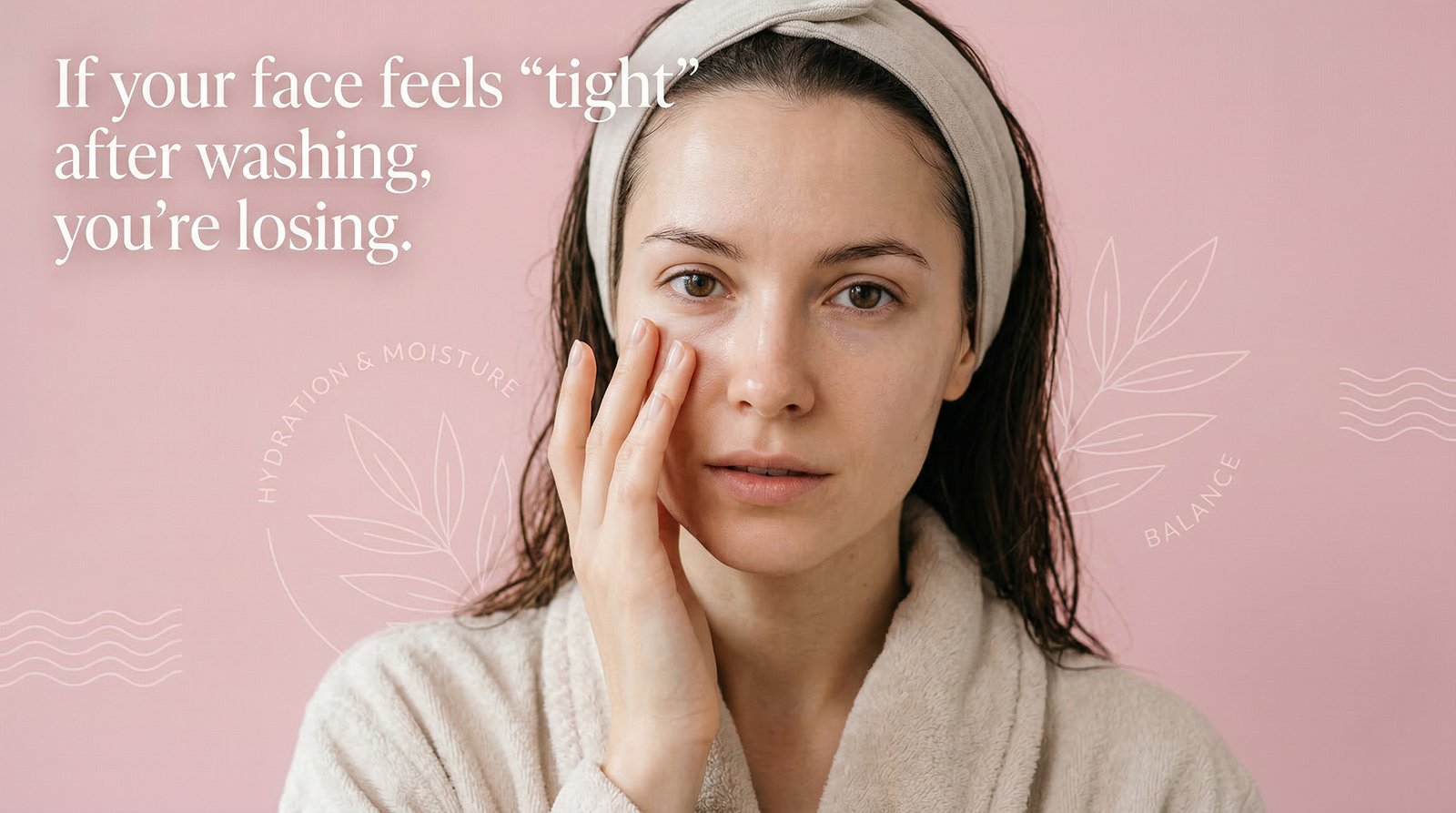
If your face feels “tight” after washing, you’ve already lost.
That sensation isn’t “firmness.” It’s the feeling of dehydrated cells shrinking and pulling against each other. Most mass-market cleansers use surfactants that are far too aggressive for human tissue. They don’t know the difference between the excess oil you want to remove and the essential lipids your barrier needs to survive. When you strip those lipids, your skin enters a state of panic. It tries to overcompensate by producing more oil, leading to that frustrating cycle of “dry but oily” skin.
At “Minimals”, we don’t believe in the “strip and replace” method.
You shouldn’t need a heavy balm to fix the damage your cleanser just did.
Our cleansers are formulated to respect the acid mantle, removing debris without touching the structural integrity of your skin.
Your "everything shower" is a biological war zone for your microbiome
We’ve been conditioned to think that bacteria is the enemy.
In reality, your skin is home to a diverse ecosystem of “good” bacteria that helps fight inflammation and pathogens. Over-cleansing especially with antibacterial soaps or harsh exfoliants is like dropping a nuclear bomb on a rainforest. Once the microbiome is out of balance, your skin becomes hyper-reactive. This is why products that used to work suddenly cause stinging or redness. It’s not that your skin “became” sensitive. It’s that you’ve removed its natural defense force.
Exfoliation is the most misunderstood tool in your bathroom
You’ve seen the videos.
People using coffee scrubs, walnut shells, or 30% AHA peels like they’re sanding down a piece of old furniture.
Here is a reality check, your skin is incredibly good at exfoliating itself. It’s called desquamation. When you force this process with aggressive acids or gritty scrubs, you’re creating micro-tears in the stratum corneum. This creates a doorway for pollutants and irritants to enter the deeper layers of the dermis.
Research from the NIH suggests that chronic inflammation even at a level you can’t see accelerates the breakdown of collagen.
In other words, your “glow” ritual is actually making you age faster. If you must exfoliate, do it with a scalpel, not a sledgehammer. Use formulas that encourage cell turnover while simultaneously feeding the barrier.
Our serums focus on high-performance actives that work with your skin’s natural rhythm, not against it.
Hydration is a feeling, moisture is a function
This is where the marketing machine usually gets you. You buy a “hydrating” mist or a watery toner and think you’re doing your skin a favor. But hydration (water) is useless if you don’t have the moisture (oil/lipids) to trap it there. If you apply a hyaluronic acid serum in a dry room without a proper occlusive on top, that serum will actually pull moisture out of your skin. It’s a moisture heist, and you’re the victim. This is why the “moisture sandwich” became popular the idea of layering water and oil to create a seal. But your routine shouldn’t require a civil engineering degree to execute. You need one solid formula that understands the ratio of humectants to emollients.
At this point, your skin doesn’t need another step. It needs a moisturizer that already does both.
The inflammation loop: why more products equal more problems
Every time you add a new “step” to your routine, you are adding potential irritants. Fragrances, preservatives, and stabilizers might be necessary for a product to sit on a shelf, but your skin doesn’t want them. When you layer ten products, you’re exposing your face to a cocktail of a hundred different chemicals. Your immune system eventually flags one of them as a threat.
The result? Chronic “inflammaging.”
Redness that never quite goes away. Texture that stays bumpy regardless of what you apply. A dullness that no “brightening” cream can fix. The solution isn’t to find the one magical product to fix the redness. The solution is to stop doing the five things that are causing it.
If your routine feels like a chore, it’s probably a mistake
Let’s be honest.
You don’t have the time or the skin resilience for a 10-step routine. The industry wants you to believe that more is better because more equals more profit for them. But as a cosmetic scientist, I can tell you that most of those steps are redundant. A “neck cream” is just a thicker moisturizer in a smaller jar. An “eye cream” is often just a diluted version of your face serum. You’re being sold the same five ingredients repackaged in ten different ways.
Skinimalism isn’t about being lazy. It’s about being precise.
It’s about choosing high-performance ingredients like niacinamide, ceramides, and stable Vitamin C in concentrations that actually matter.
As noted in Dermatology Times, the move toward “cleaner” and “simpler” formulations is a direct response to the rise in irritant contact dermatitis caused by over-complicated routines.
The Minimalist Blueprint: How to actually save your skin
If you want to stop the “sandpaper” feeling and actually see results, you need to strip your routine back to the essentials.
Use lukewarm water. Always. Choose a cleanser that leaves your skin feeling soft, not tight. If you’re wearing heavy makeup or SPF, double cleanse but make sure the second step is incredibly gentle.
This is where you target your specific concerns (pigmentation, fine lines, or breakouts). Pick one serum that covers multiple bases. Don’t mix five different actives in one night. Your skin isn’t a lab beaker.
Apply your moisturizer while your skin is still slightly damp. This traps the water on the surface and forces it into the cells. Look for ingredients that mimic your skin’s natural lipid profile.
SPF isn’t negotiable. The sun is the ultimate barrier-destroyer. Everything else you do is a waste of money if you skip this.
You don’t need more products. You need fewer that actually work.
The “everything shower” can still be your escape. But change the goal. Instead of trying to scrub your skin into submission, try to nurture it back to health. Stop looking for “miracles” in a bottle and start looking for physiological logic. Your skin is a masterpiece of evolution. It knows what to do. Your only job is to get out of its way. The goal isn’t “perfect” skin it’s healthy, resilient, and functional skin. And that usually happens when you stop doing so much.
Ready to simplify?
Explore the Minimals range.
A simple "No-Sandpaper" checklist
Frequently Asked Questions
That “squeaky clean” feeling is actually your skin’s lipid matrix being dissolved. If it feels tight, your cleanser is a degreaser, not a skincare product. You’ve just triggered immediate water loss.
No. Most “flakes” are actually your barrier crying for moisture, not dead skin needing a scrub. Scrubbing dry skin is like sanding a wound it just causes more inflammation and peeling.
Only if you want a compromised microbiome. Most viral products prioritize heavy fragrance and aesthetic textures over barrier health. If it’s neon blue and smells like candy, keep it off your face.
Three. A gentle cleanser, a high-performance treatment, and a barrier-sealing moisturizer. Anything else is usually just marketing filler designed to clutter your shelf and confuse your skin.
“Medical grade” is a marketing term, not a legal classification. Look for formulations backed by clinical data—like those focusing on ceramide ratios—rather than fancy labels and high price tags.
Closing thought
Stop treating your face like a problem to be solved and start treating it like a living shield. The beauty industry thrives on your insecurity, selling you a “fix” for the irritation their own 12-step routines created. It’s a profitable loop, but your barrier is the one paying the price. True “skinimalism” isn’t a trend; it’s biological common sense. When you strip away the fluff, the fragrances, and the aggressive acids, you give your skin the space to actually heal itself.
The reality check: If you need a dozen products to make your skin look “normal,” your routine is failing you. Go back to basics. Respect your lipids. Stop the forty-minute demolition sessions in the shower. Your skin will thank you by finally staying calm.
Less, but better. That’s the only way forward.