
Master safe exfoliation: choose the right method and frequency for your skin type glow without irritation.
The Over-Exfoliation Trap Why Your Skin Is Fighting Back
You’ve been exfoliating wrong. Not because you chose the wrong product. Because nobody told you what exfoliation is actually supposed to do and where it quietly starts working against you. Most people exfoliate to get that “smooth, glowing” skin they see in ads. What they end up with, after a few weeks of daily acids or weekly scrubs, is skin that’s red, reactive, weirdly oily in some spots and flaky in others and still not glowing. That’s not bad luck. That’s biology. And once you understand what’s actually happening at the skin barrier level, the fix becomes obvious.
Your Skin Is Not a Surface Problem
Here’s the thing the skincare industry doesn’t want you sitting with too long: most “dull,” “congested,” or “rough” skin isn’t a buildup problem. It’s a barrier problem. Your skin barrier technically called the stratum corneum is a tightly organized matrix of dead skin cells (corneocytes) held together by lipids: ceramides, fatty acids, and cholesterol. Think of it like a brick wall. The cells are the bricks. The lipid matrix is the mortar.
When that barrier is intact, it does two jobs: keeps irritants out, and keeps water in. When it’s damaged, you lose water faster (this is called transepidermal water loss, or TEWL), and everything gets in pollutants, bacteria, fragrance, actives that were never supposed to penetrate that deep.
Research published in the Journal of Investigative Dermatology confirms that barrier-impaired skin shows measurably elevated TEWL and inflammatory cytokine activity. Translation: a damaged barrier is an inflamed barrier even when it doesn’t look it.
That matters because most exfoliation, done too aggressively or too often, damages the barrier. You’re removing dead cells, yes. But you’re also stripping the lipids holding everything together.
The Exfoliation Myth Nobody Talks About
There’s a popular idea that exfoliating more frequently = faster cell turnover = younger, brighter skin. That’s not entirely wrong. It’s just dangerously incomplete. Your skin has its own natural desquamation process a self-regulating cycle where dead cells shed on their own schedule, roughly every 28 days (slower as you age). Exfoliation accelerates that. The problem is that “acceleration” has a ceiling. Push past it, and you’re not speeding up cell turnover. You’re disrupting the barrier and triggering an inflammatory response that actually slows healing.
This is what dermatologists call an inflammation loop. You exfoliate. The barrier gets disrupted. Skin becomes reactive and inflamed. You see “texture” or “congestion” and assume you need to exfoliate more. You exfoliate more. The barrier gets more disrupted.
You’ve been stuck in that loop for longer than you realize.
AHAs, BHAs, and Enzymes: What Each One Actually Does (And What It Doesn't)
Let’s break this down without the usual marketing softening.
AHAs (glycolic acid, lactic acid, mandelic acid) work on the skin’s surface. They dissolve the bonds holding dead cells together. Glycolic has the smallest molecular size deepest penetration, highest irritation risk. Lactic is gentler, also mildly hydrating. Mandelic is the most forgiving, good for sensitive and darker skin tones.
BHAs (salicylic acid, primarily) are oil-soluble. They go into the pore. They’re the right call for congestion, blackheads, and acne-prone skin. They’re not better than AHAs overall just better for different things.
Enzymes (papain from papaya, bromelain from pineapple) are the quiet underdog. They break down dead skin protein without chemical exfoliation. Lower risk, lower ceiling. Great for genuinely sensitive skin.
The mistake most people make? Layering these. AHA toner, then BHA serum, then a retinol at night. Every step individually seems logical. Together, they overwhelm the skin’s ability to repair itself.
A 2021 review in Dermatology and Therapy found that combining multiple exfoliating actives significantly increases the risk of barrier impairment compared to single-ingredient use. More actives ≠ more results. More actives = more damage with a longer recovery window.
The pH Problem Your Exfoliant Isn't Telling You
Here’s a counterintuitive one: the effectiveness of your AHA isn’t just about concentration. It’s about pH.
AHAs work best at a pH between 3.0 and 4.0. Above 4.5, they’re largely inactive you’re just applying acid-flavored water to your face. Most brand formulations hover around this range without telling you. You buy a “10% glycolic toner” and wonder why nothing’s happening. It’s not doing what you think it is. At the same time, your skin’s natural surface pH sits around 4.7 to 5.75 an acidic environment that supports the skin’s microbiome.
Your skin microbiome isn’t decorative. It’s functional. Research from the NIH Human Microbiome Project has established that the balance of microorganisms on the skin particularly Staphylococcus epidermidis actively contributes to immune defense and barrier integrity.
Disrupt the pH too dramatically, too often, and you don’t just strip dead cells. You disrupt the microbial ecosystem your skin relies on to regulate itself.
Over-cleansing accelerates this. Harsh foaming cleansers, particularly those with SLS (sodium lauryl sulfate), spike the skin’s pH and strip both lipids and beneficial bacteria in one move. A study in Skin Pharmacology and Physiology confirmed that even brief exposure to high-pH surfactants causes measurable changes in barrier function that can persist for hours.
You're Probably Exfoliating Too Often. Here's How to Know.
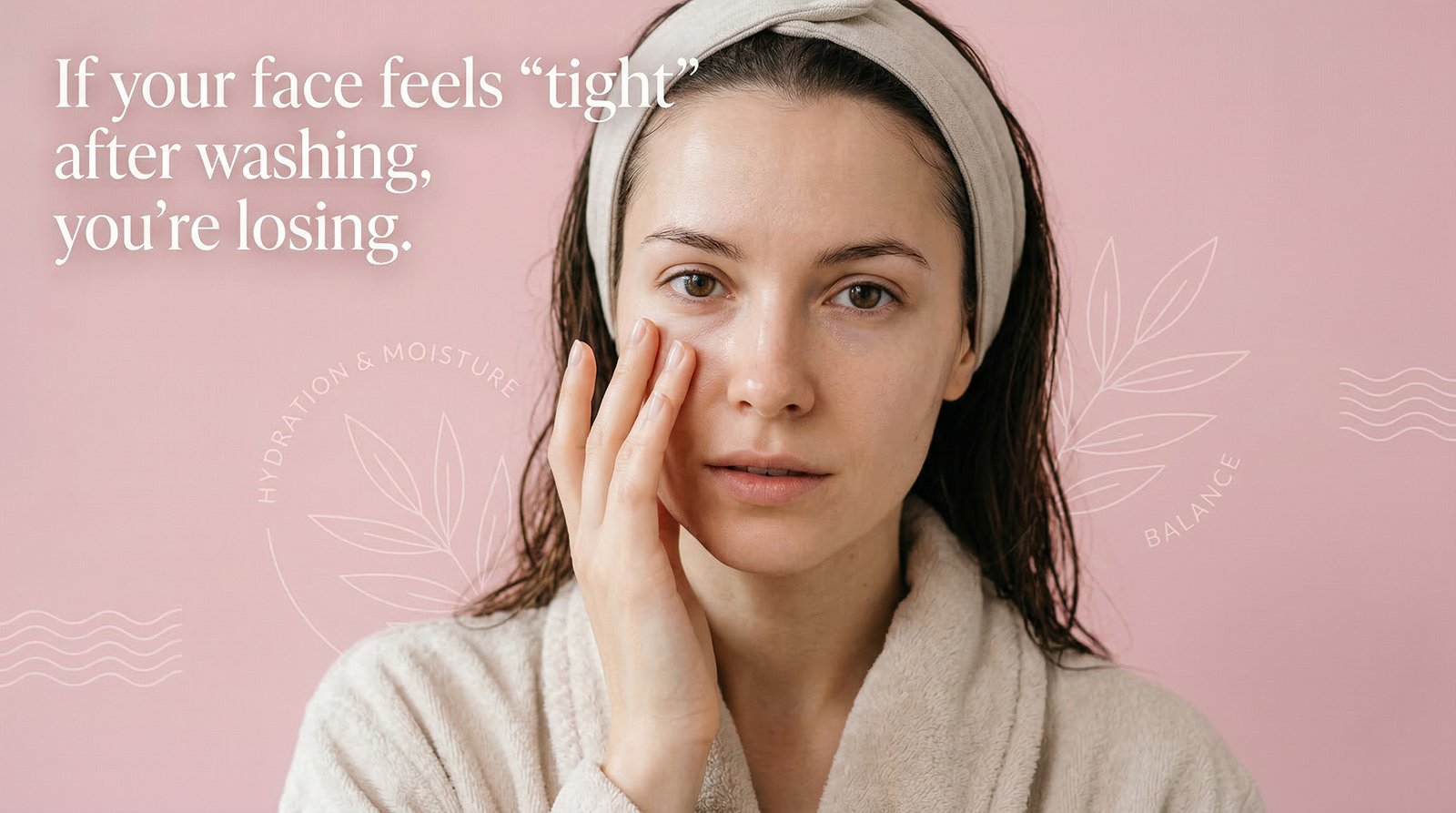
Signs your skin is over-exfoliated even if it doesn’t look irritated: Your skin feels tight after cleansing. You need moisturizer within 10 minutes or you feel uncomfortable. You have random dry patches that show up regardless of hydration. Breakouts appear in clusters a few days after exfoliating. Your skin looks shiny but feels dry underneath. That last one is the most confusing. Skin that’s lost barrier integrity ramps up sebum production to compensate. You look oily, but TEWL is high you’re losing more water than ever. This is why “hydration” and “moisture” are not the same thing.
Hydration is water content in the skin cells. Moisture is your skin’s ability to hold that water, which depends entirely on the lipid barrier. You can drink two liters of water a day, apply hyaluronic acid morning and night, and still have dehydrated skin if your barrier is compromised. The water goes in. It leaves fast.
This is the insight most skincare routines are built around ignoring because the fix (repair the barrier, reduce exfoliation) sells fewer products than “add more hydrating layers.”
The 'Glow' You're Chasing Is Actually Inflammation
This one stings a little.
That immediate brightness you see after a strong chemical peel or high-percentage acid treatment? Some of that is genuine cell turnover. But some of it especially the flush, the plumpness that lasts 12 hours is mild inflammation. Inflamed skin looks temporarily brighter because increased blood flow brings more circulation to the surface. You’re not glowing. You’re mildly irritated in a way that photographs well.
This is why the “glow” fades fast after aggressive exfoliation, and why people end up chasing it with more frequent treatments. The skin adapts. The irritation becomes the baseline. The real brightness the calm, even-toned kind that holds through the day comes from a skin barrier that’s actually functional.
It comes from not over-exfoliating, not from doing it better.
What Barrier-First Exfoliation Actually Looks Like
Here’s the thing about fixing your routine: it’s not about adding a barrier repair step after exfoliating. It’s about choosing exfoliation that doesn’t destroy the barrier in the first place.
That means:
Frequency matters more than concentration. A 5% lactic acid used twice a week will outperform a 15% glycolic used daily, in terms of cumulative skin health over months. Aggressive exfoliation creates results followed by regression. Gentle, consistent exfoliation compounds.
Vehicle matters. An acid in a hydrating base (hyaluronic acid, glycerin, panthenol) delivers less irritation than the same acid in an alcohol-heavy toner. The formula around the active does more work than most people realize.
Exfoliate at night, always. Freshly exfoliated skin is photosensitive. Morning exfoliation followed by sun exposure even with SPF accelerates the barrier damage you’re trying to avoid.
Sequence correctly. Exfoliant before serums, before moisturizer. Never layer another active directly on freshly exfoliated skin without a barrier between them. And if you’re using a retinoid, do not exfoliate the same night.
At this point, most people don’t need a more powerful exfoliant. They need a gentler one used consistently, inside a routine that’s actually designed to maintain what it removes.
A Routine That Doesn't Fight Itself
This is what a functional exfoliation routine looks like. No drama, no ten steps, no actives competing with each other.
Cleanse with something that doesn’t strip a low-pH, fragrance-free cleanser that leaves skin feeling comfortable, not squeaky. Squeaky is not clean. Squeaky is damaged.
Follow with a hydrating serum (niacinamide or hyaluronic acid, not another acid). Then moisturizer. Then SPF. That’s it.
The “Minimals” Gentle Foaming Cleanser is formulated at pH 5.5 to keep your microbiome intact while actually removing what needs to go. Nothing unnecessary.
Evening (exfoliation nights, 2 to 3x per week)
Cleanse. Apply your exfoliant. Wait a full 10 minutes. Apply a ceramide-rich moisturizer to seal everything back in. That’s it. No serum, no retinol, no essence on the same night. Let the acid do its one job and let the skin recover.
Cleanse. Treatment serum retinoid or niacinamide. Moisturizer. Done.
The “Minimals” Barrier Repair Moisturizer contains ceramides, fatty acids, and cholesterol in a ratio that mirrors the skin’s natural lipid matrix. Not just a cream that sits on top—a formula that actually replenishes what exfoliation costs.
If Your Routine Feels Complicated, That's the Problem
If you need a spreadsheet to track what you use on which night, something has gone wrong. Skincare doesn’t have to be complicated to work. The most effective routines are the boring ones a handful of well-formulated products used consistently, not a rotating cast of actives waiting their turn. The skincare industry profits from complexity. Every new ingredient, every new category, every “you need this plus this plus this to see results” is a revenue model dressed up as advice.
Real results come from skin that’s calm, barrier-intact, and not fighting your products. That happens when you stop exfoliating as often as you do, choose gentler acids, and give your skin a night off.
Common mistakes we all make
Even with good intentions, most of us fall into the same traps. Here are the biggest ones that quietly damage the skin barrier:
The fix for almost all of these mistakes is the same: slow down, listen to your skin, and prioritize barrier health over aggressive turnover. Less exfoliation, done smarter, almost always beats more.
A simple "Over-Exfoliating (" checklist
Frequently Asked Questions
2 to 3 times per week maximum. Most people get better long-term results with fewer, gentler sessions that allow the skin barrier to recover rather than daily exfoliation.
Exfoliating too frequently and layering multiple actives (AHA + BHA + retinol). This quietly damages the skin barrier and creates an inflammation loop.
Common signs: tight skin after cleansing, random dry patches, shiny but dehydrated feel, increased sensitivity, clustered breakouts, or redness. If you notice these, pause exfoliation and focus on repair.
Usually not recommended. Even gentle daily use can impair your barrier over time. Your skin needs more recovery nights than treatment nights.
Closing thought
Exfoliation is useful. It’s not optional if you want clear, even-toned skin long-term. But it’s a tool, not a foundation. Your barrier comes first. Always. Exfoliate twice a week. Use a pH-appropriate acid in a gentle base. Follow with ceramides. Don’t layer actives. Give your skin more recovery nights than treatment nights.
Clinical evidence from PubMed-indexed dermatology studies consistently shows that barrier-supportive skincare reduces sensitivity, inflammation, and long-term skin aging more effectively than high-frequency exfoliation even at lower overall active concentrations.
You don’t need to exfoliate more. You need to do it in a way your skin can actually benefit from. Less. But better. That’s the whole philosophy.