
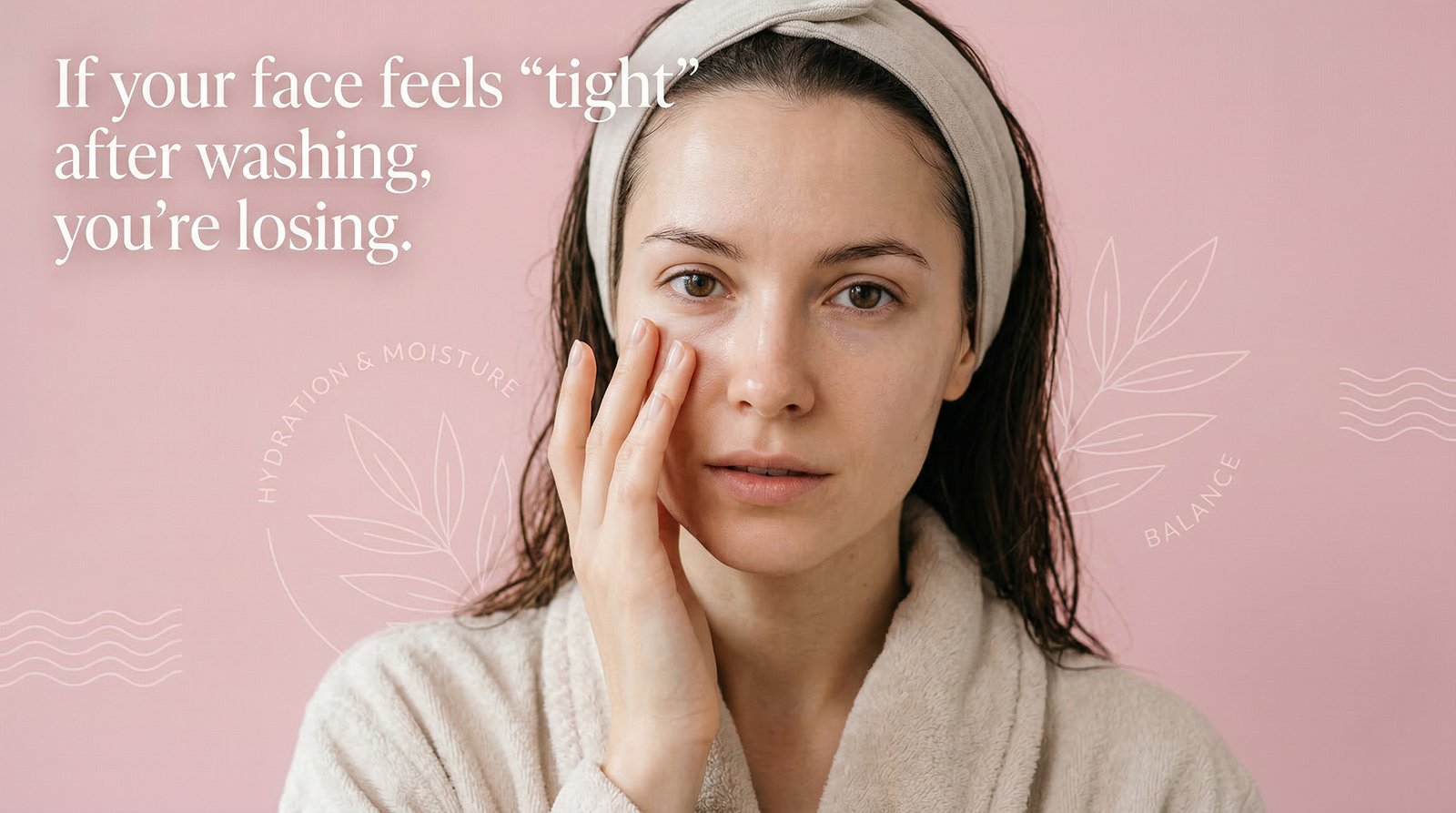
That tight, squeaky-clean feeling after showering isn’t cleanliness it’s your skin barrier being stripped away. Harsh body washes dissolve your skin’s natural defence, leaving it dry, irritated, and vulnerable.
Why That Tight, Squeaky-Clean Feeling Is Actually Damaging Your Skin
That squeaky feeling after a shower?
That’s not clean. That’s damage.
The squeaking you hear when you run your fingers across your skin is friction the sound of a surface stripped of its natural oils, ceramides, and lipid barrier. It means your skin has lost the very things it needs to protect itself. The body wash industry spent decades convincing you that squeaky meant effective. That lather meant clean. That if your skin didn’t feel tight after washing, you hadn’t really washed. All of it was backwards. And your skin dry, reactive, itchy after every shower, needing lotion just to feel normal has been paying the price.
"Squeaky Clean" Is a Marketing Invention, Not a Biology Term
No dermatologist has ever looked at a patient’s skin and said: “Good. Nice and squeaky.”
The squeaky-clean sensation was engineered. It’s what happens when surfactants the cleansing agents in body washes strip your skin so thoroughly that there’s nothing left between your fingers and the surface cells. No lipids. No oils. No barrier. For decades, soap brands ran ads where women rubbed their skin and smiled at that sound. The association got wired in: squeak equals effective. Silky equals not clean enough.
The biology says the opposite.
Your skin is not a kitchen counter. You are not trying to remove grease from a pan. The oils on your skin aren’t dirt they’re structural. They’re part of a lipid matrix that holds your barrier together and keeps everything working.
When you strip them, you don’t get clean skin. You get compromised skin.
What's Actually Happening to Your Skin in the Shower
Here’s the biology most body wash brands hope you never think about.
Your outermost skin layer the stratum corneum is made up of flattened cells held together by a matrix of ceramides, cholesterol, and fatty acids. This isn’t just a metaphor: research in the Journal of Investigative Dermatology describes it as a “brick and mortar” structure, where the lipids are the mortar that seals everything in place. When that mortar degrades, water escapes. This is transepidermal water loss TEWL and it’s the mechanism behind every symptom you’ve been blaming on dry weather, hard water, or just “sensitive skin.”
Tight after showering? TEWL.
Flaky patches on your shins and arms? TEWL.
Needing lotion within twenty minutes of getting out of the shower just to feel comfortable? That’s a damaged barrier, not a dry climate. Most conventional body washes especially foaming ones use sulfate-based surfactants like sodium lauryl sulfate (SLS) or sodium laureth sulfate (SLES). These are powerful detergents. They’re good at removing oil. Too good.
A study published on PubMed measuring skin barrier recovery after surfactant exposure found that SLS caused measurable disruption to the stratum corneum even at low concentrations, with recovery taking hours sometimes longer with repeated daily exposure. You’re showering every day. Your barrier never fully recovers.
The Microbiome Problem Nobody Talks About
Here’s the part that should genuinely stop you.
Your skin has a microbiome billions of bacteria, fungi, and microorganisms living on its surface. This isn’t something to be scrubbed away. It’s a functional part of your immune defence. Your skin microbiome helps regulate inflammation, crowd out pathogens, and signal barrier repair.
It’s also pH-dependent.
Healthy skin sits at a pH of roughly 4.5 to 5.5 mildly acidic. Most conventional body washes sit between 6 and 10. Every time you use one, you’re temporarily alkalising your skin’s surface.
Research supported by the NIH’s National Institute of Allergy and Infectious Diseases has linked disrupted skin pH to microbiome imbalance specifically, a reduction in beneficial bacteria like Staphylococcus epidermidis and an opening for opportunistic bacteria to colonise.
This isn’t abstract. Disrupted microbiome means slower barrier repair, more inflammation, and more reactive skin over time. It’s one reason people who shower aggressively find their skin becomes more sensitive the more they try to “clean” it.
You’re not fighting bacteria. You’re washing away the ones that were working for you.
The Lather Myth Is Costing You More Than Comfort
Here’s a “wait, what?” moment: lather does nothing.
Foam has no cleansing function. The lather from your body wash is produced by added foaming agents primarily SLS or cocamidopropyl betaine. They create the visual experience of cleaning. They are not the mechanism of cleaning. You’ve been judging efficacy by foam. Surfactant chemistry works through a process called micelle formation the surfactant molecules surround oil and dirt particles and allow them to be rinsed away. This happens whether the formula foams dramatically or barely at all. Low-lather body washes can cleanse just as effectively. The difference is that they can do it with gentler surfactants ones that don’t strip the barrier the same way. Glucoside-based or amino acid-derived surfactants clean effectively at lower concentrations and with less barrier disruption. They’re not as cheap to formulate with. That’s why most mainstream body washes don’t use them.
The Minimals Body Cleanser is built around this principle pH-balanced, low-irritation surfactant system that removes what needs removing without treating your skin like a contaminated surface. No foam theatrics. Just clean.
Why Your Moisturiser Can't Save You If You Keep Washing Like This
This is the part of the routine most people don’t connect.
You shower. Skin feels tight. You apply body lotion. Skin feels better temporarily. A few hours later, tight again. You reapply. Repeat indefinitely. That loop isn’t a moisturiser deficiency. It’s a barrier problem that moisturiser alone can’t fix. Here’s why: most body lotions work primarily with humectants ingredients like glycerin and hyaluronic acid that attract water to the skin. Hydration and moisture are not the same thing. Hydration is water content in the skin cells. Moisture is the barrier’s ability to hold that water in. If your lipid matrix is depleted from daily surfactant exposure, your skin can be loaded with water-binding ingredients and still lose moisture rapidly. You’re filling a bucket with holes. Effective repair requires occlusive ingredients petrolatum, shea butter, squalane that physically seal the surface, combined with barrier-identical lipids ceramides, cholesterol, fatty acids in the correct ratio that actually rebuild the mortar between cells.
Most body lotions contain neither in meaningful concentrations. They’re mostly water, a small amount of glycerin, and emulsifiers.
The Minimals Barrier Repair Moisturiser was formulated to address both sides: humectants to draw water in, the right lipid profile to seal it, and no fragrance to trigger the inflammation you’re trying to calm. It’s not a lotion. It’s repair.
The "Inflammation Loop" Your Shower Habit Created
Once barrier damage becomes habitual, your skin gets caught in something dermatologists call an inflammation loop.
Damaged barrier → inflammatory response → further TEWL → more barrier damage → more inflammation.
The cycle feeds itself. And the longer it runs, the more your skin’s ability to self-repair degrades. Chronic inflammation even low-grade, subclinical inflammation breaks down collagen over time. It accelerates the visible signs of ageing on your body, not just your face.
A review in Dermatology Times noted that chronic subclinical inflammation driven by barrier disruption is increasingly recognised as a driver of premature skin ageing particularly on areas with thinner skin or frequent washing exposure.
Your legs, arms, and torso are ageing partly because of how you shower. Breaking the loop doesn’t require a dramatic overhaul. It requires stopping the primary cause the stripping and giving your skin the conditions to repair.
If Your Skin Feels "Normal" Immediately After Showering, Read This
Most people think tight, slightly uncomfortable skin after washing is just their skin type.
It isn’t.
Intact, healthy skin with a functional barrier feels comfortable after gentle cleansing. It doesn’t need lotion within minutes to feel normal. It doesn’t itch under clothing. It doesn’t feel parched by mid-afternoon. If you’ve had reactive, dry, or tight post-shower skin for years, you may have normalised barrier dysfunction. It’s become your baseline. Here’s the reality check: your skin should be able to stay comfortable for a few hours after washing without intervention. If it can’t, your cleanser is the most likely culprit not your genetics, not your climate, not the hardness of your water. Switching your body wash is the single highest-leverage change most people with reactive skin can make. Not a new serum. Not an SPF upgrade. The thing that’s disrupting your barrier twice a day, every day.
The Body Routine Your Skin Has Been Waiting For
This is not a twelve-step programme. That’s the whole point.
Use a pH-balanced, sulfate-free body cleanser with gentle surfactants. Apply it only where you actually need it not necessarily head to toe every time. Areas with fewer sebaceous glands (shins, forearms) don’t produce much oil; they may not need active cleansing every day. Shower in warm water, not hot. Hot water accelerates TEWL and disrupts your lipid matrix faster than any surfactant.
Keep showers short. Ten minutes is enough. Fifteen is starting to work against you.
Pat dry. Don’t rub.
Apply your moisturiser while your skin is still slightly damp within two to three minutes of stepping out. This is moisture sandwiching: you’re sealing water in before it evaporates. A barrier-repair formula applied at this stage does significantly more work than the same product applied to dry skin twenty minutes later.
If you exfoliate your body, use chemical exfoliation over physical scrubs. A low-concentration lactic acid or urea-based product will smooth texture without the micro-tears that harsh scrubs cause. Once a week is usually enough. More frequent exfoliation on an already-disrupted barrier is one of the fastest ways to drive yourself into an inflammation loop.
The Minimals Gentle Cleanser and Barrier Repair Moisturiser cover both ends of this: clean without stripping, repair without overcomplicating.
The Only Question Worth Asking About Your Body Wash
Not: does it lather well?
Not: does it smell good?
Not: is it “dermatologist-tested” (a phrase with no regulatory meaning)?
The question is: what does my skin feel like two hours after using this?
If the answer is tight, itchy, or dependent on lotion just to function you have your answer. The product is doing more harm than good, regardless of what the front of the bottle says. You’ve been sold a sensation. The industry called it clean. Your skin calls it damage. The fix is simple. Not because skincare should always be simple but because in this case, doing less is the smarter, more evidence-based choice. You don’t need a richer lotion to compensate. You need a cleanser that doesn’t make compensation necessary.
A simple "Fix Your Skin Barrier" checklist
Frequently Asked Questions
“Squeaky clean” is not a sign of good cleaning. It means your body wash has stripped away the natural oils, ceramides, and lipids that form your skin’s protective barrier. The tight, squeaky feeling is friction caused by a damaged barrier, not true cleanliness.
.
Yes. Most foaming body washes contain harsh surfactants like SLS and SLES that excessively strip the skin. Daily use prevents your skin barrier from recovering, leading to dryness, irritation, increased sensitivity, and higher water loss (TEWL).
This tightness is a classic sign of barrier damage. Your skin has lost its natural lipids, causing rapid transepidermal water loss. It’s not normal healthy skin should feel comfortable after gentle cleansing, not tight or itchy.
Moisturiser helps temporarily, but if you continue using stripping body washes, you’re applying lotion on a leaky barrier. It’s like filling a bucket with holes. You need to stop the damage first by switching to a gentler cleanser.
No. Lather has no actual cleansing power it’s just for show. Gentle, low-lather cleansers can remove dirt and sweat effectively using milder surfactants without destroying your skin barrier.
Closing thought
The “squeaky clean” feeling you’ve been chasing? It’s not cleanliness. It’s damage in disguise. Your skin barrier isn’t optional it’s your first line of defence. Treat it like one.
Switch to gentle cleansing, respect your skin’s biology, and watch how quickly dryness, itchiness, and sensitivity fade away. Because healthy skin doesn’t scream for moisture. It stays calm, comfortable, and quietly strong.