
Your skin isn’t a science experiment.
Stop Ghosting Science Because of a TikTok Trend
Your skin isn’t a science experiment. Yet, you treat it like one every single morning. You’re layering four different serums, a “barrier-repairing” cream that’s actually mostly wax, and then topping it off with a sunscreen you hate because a TikToker told you chemical filters are toxic. Here is the uncomfortable truth: your skin is exhausted. It’s not “purging.” It’s inflamed. And that fear you have of “chemical” sunscreens? It’s the biggest distraction in your routine.
Your Fear of "Chemicals" Is Aging You Faster Than the Sun
Let’s get the terminology straight because the marketing fluff has failed you.
Every single thing you put on your face is a chemical. Water is a chemical. That “organic” face oil is a complex mixture of chemicals. The divide between “physical” (mineral) and “chemical” (organic) sunscreens is a false binary designed to make you buy expensive, chalky pastes. While you’re busy worrying about whether your sunscreen is “natural,” the UVA rays are busy degrading your collagen and shattering your elastic fibers. If you aren’t wearing SPF because you’re afraid of the formula, you’re losing the war.
The "Heat Trap" Myth Is Ruining Your Complexion
You’ve probably heard that chemical sunscreens work by converting UV into heat, and that this “heat” causes melasma or sensitivity.
This is a fundamental misunderstanding of thermodynamics. The temperature increase on the skin from the UV-to-heat conversion is negligible we’re talking fractions of a degree.
The real inflammation isn’t coming from the chemical reaction; it’s coming from the disruption of your skin’s lipid matrix caused by the 12 other products you used before the SPF. When your barrier is compromised, everything feels like it’s burning. Don’t blame the filter for the damage your 15% Vitamin C serum already did.
Why "Mineral Only" Might Be Throttling Your Barrier
Zinc Oxide and Titanium Dioxide are great. We use them. We like them.
But they are solids. They are literally crushed rocks suspended in a liquid. To make them wearable, brands often pack formulas with heavy silicones or drying alcohols to keep the minerals from clumping.
If you have a dry or compromised barrier, these “clean” minerals can act like a sponge, soaking up your skin’s natural oils and increasing Transepidermal Water Loss (TEWL).
The result? You end up with “sandpaper skin” by 3:00 PM. Modern organic filters (the ones people call “chemical”) are often more lipophilic. They play nicer with your skin’s natural oils. They don’t sit on top like a mask; they integrate.
Your "Hydration" Step is Actually Drying You Out
This is the counterintuitive part most people miss: hydration is not moisture.
If you are applying a Hyaluronic Acid serum to dry skin in a dry room, you are essentially creating a vacuum that pulls water out of your dermis and into the air.
You don’t need a dedicated “hydration” step.
You need a formula that manages your skin’s microbiome while preventing that water from escaping in the first place. Most people are over-cleansing, stripping their natural ceramides, and then trying to “buy back” their barrier with a $80 serum. It’s like poking a hole in a bucket and trying to keep it full by running the faucet faster. At this point, your skin doesn’t need another step. It needs a formula that already does both.
Our Barrier Support approach is designed to stop the leak, not just add more water.
The "Active" Loop: Why More Is Actually Less
Stop me if this sounds familiar:
This is an inflammation loop.
Every time you layer a new active, you increase the chance of a pH conflict or a preservative overload. Your skin’s microbiome the trillions of bacteria that keep you healthy thrives on stability, not “innovation.” When you use five different products, you’re hitting your face with five different preservative systems. That’s a lot of work for a barrier that just wants to be left alone.
Stop Treating Your Face Like a Kitchen Counter
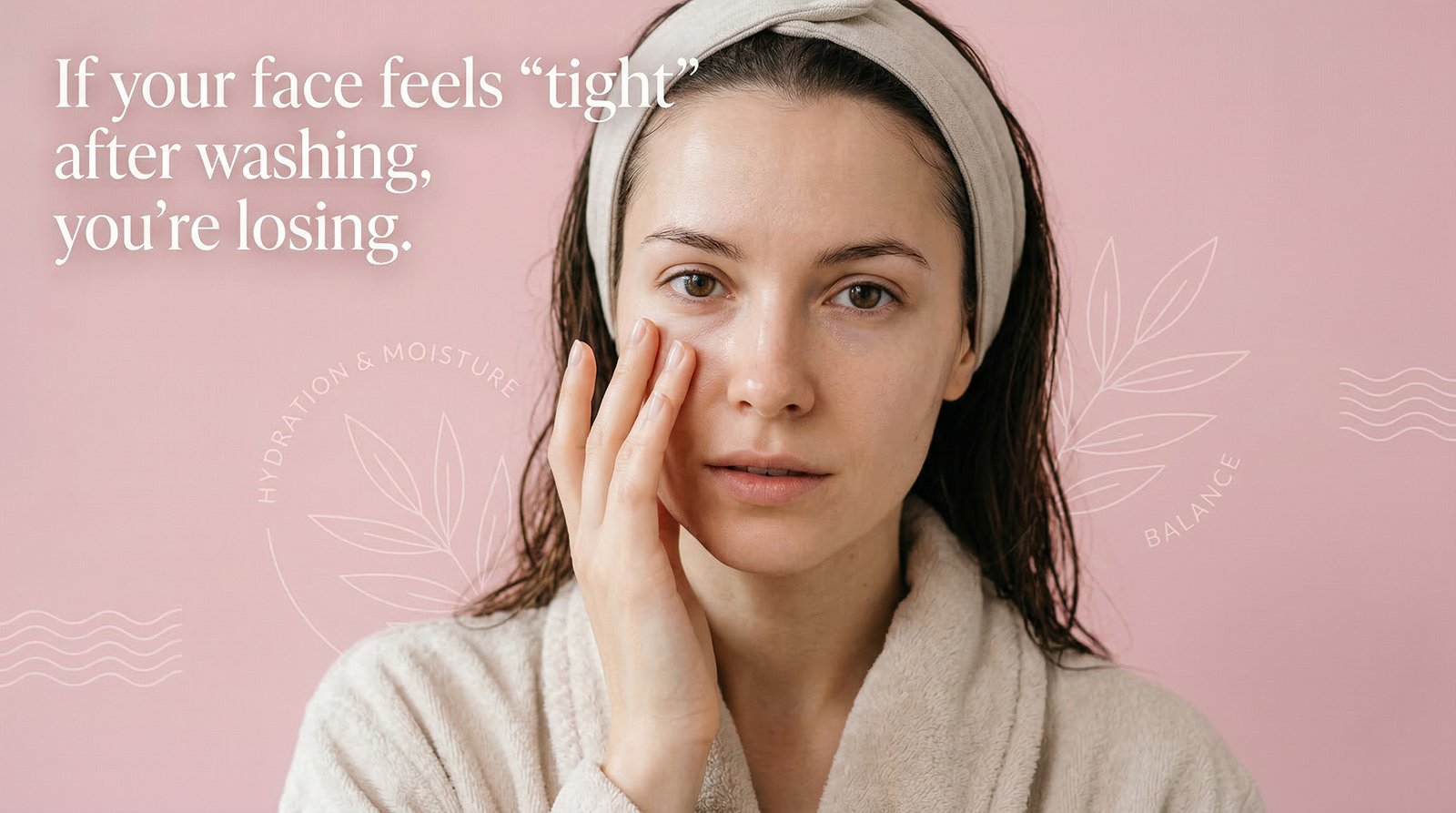
You don’t need to “scrub” your skin. Over-cleansing is the primary cause of the “sensitivity” most people claim to have. If your face feels tight after washing, you’ve just committed a crime against your lipid matrix.
That “squeaky clean” feeling is the sound of your skin’s protective oils being flushed down the drain.
Once those lipids are gone, your skin is defenseless against the sun, pollution, and even your own “chemical” sunscreen.
A minimalist cleanser should do one thing: remove the day without taking your skin with it.
If Your Routine Feels Complicated, That’s the Problem
Let’s have a reality check.
If you have to wait 10 minutes between steps for things to “absorb,” you have too many steps. Skincare shouldn’t be a hobby. It should be a utility. The industry wants you to believe that “complexity equals efficacy.”
It doesn’t. Complexity just equals more margin for the brand and more irritation for you. True high-performance skincare is about the synergy of the ingredients in one bottle, not the number of bottles on your shelf. If you’re overthinking whether your sunscreen is “chemical” or “physical,” you’ve already lost the plot.
The best sunscreen is the one you actually enjoy wearing every single day. Full stop
The Minimalist Blueprint (The Only 3 Steps You Need)
You can achieve better skin with three products than most people do with thirteen.
Here is the logic-based routine for a healthy barrier:
Use a non-stripping, pH-balanced cleanser. No beads. No “active” exfoliating acids. Just a formula that respects your acid mantle. Explore Minimals Cleansers
A single, high-performance serum or lightweight cream that combines barrier-mimicking lipids (ceramides, fatty acids) with a proven antioxidant. This replaces your “hydration,” “soothing,” and “anti-aging” steps in one go. Explore Minimals Treatment
This is your protection layer. Whether it uses organic or inorganic filters doesn’t matter as much as the texture. It should feel like a moisturizer. If it feels like a chore, you won’t use enough of it to reach the SPF on the label anyway
You Don't Need More Products. You Need Fewer That Actually Work.
The “skinimalism” movement isn’t about being lazy.
It’s about being precise.
It’s about understanding that your skin is a living organ with its own built-in repair mechanisms. Your job isn’t to replace those mechanisms; it’s to support them and then get out of the way. Stop overthinking the filters. Stop layering the acids. Stop listening to the hype. Your skin knows what to do. You just need to let it.
The 5-Sign Barrier Burnout Checklist
Frequently Asked Questions
No. They are regulated organic compounds. The “toxic” narrative is mostly marketing noise used to sell chalky mineral pastes.
Your barrier has microscopic cracks. When the lipid matrix is broken, ingredients sink too deep and irritate your nerve endings.
Not necessarily. The heavy silicones or alcohols used to make minerals “wearable” often cause more dryness than modern organic filters do.
Unlikely. A well-built moisturizer already contains humectants. Adding a serum is often just paying extra for water you don’t need.
Roughly 2–4 weeks. You have to stop the “actives” and let your skin’s natural 28-day cycle rebuild its own shield.
Closing thought
Stop buying into the idea that more is better.
Your skin is a self-regulating organ, not a puzzle that needs a dozen pieces to be “complete.” Every time you add a redundant step or avoid a safe, effective sunscreen because of a viral video, you’re just making your skin work harder. The goal isn’t a complex ritual; it’s a quiet, healthy barrier that does its job so you can forget about it. Strip back the noise. Put on your SPF. And let your skin breathe for once.