
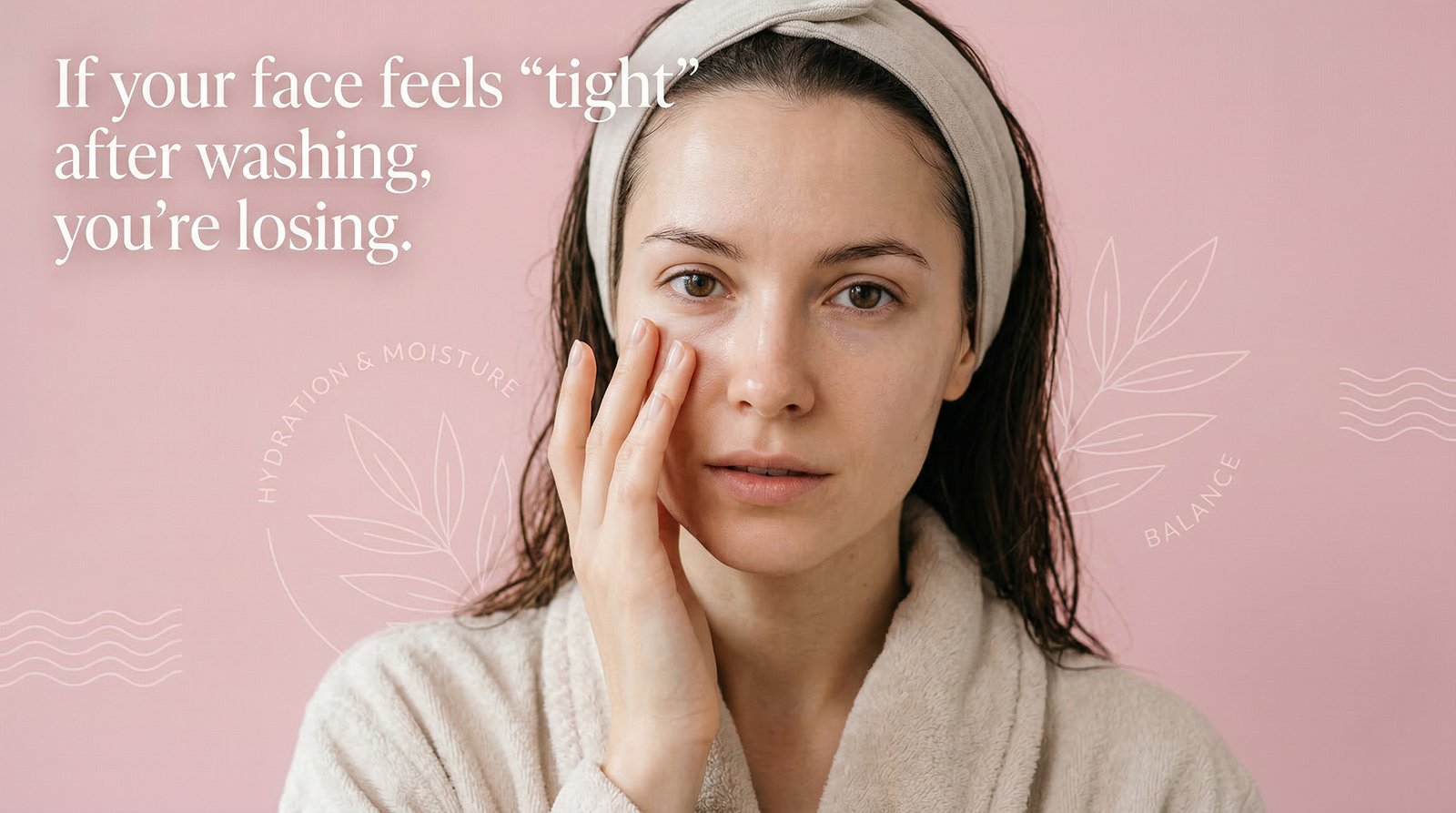
You didn’t choose the wrong moisturizer because you didn’t try hard enough. You chose it because no one told you the formula itself changes based on where you live and what it does to your barrier when it’s wrong.
Texture Is a Function, Not a Feeling
Your moisturizer might be working against you.
Not because you bought a bad product. Not because your skin is “difficult.” But because texture is not a preference it’s a function. And if your lotion or cream is fighting your environment instead of working with it, your skin loses every single time.
Here’s the uncomfortable part: most people pick their moisturizer based on how it feels in the first 30 seconds. That tells you almost nothing about what it’s doing to your barrier over the next 12 hours.
This is the part no one explains. Let’s fix that.
Your Skin Is Not Dry. It's Losing Water Faster Than It Can Hold It.
There’s a difference between skin that lacks hydration and skin that can’t retain it. Most people conflate the two and that’s exactly why their moisturizer never feels like enough.
The process you want to understand is called transepidermal water loss, or TEWL. It’s the rate at which water evaporates out of your skin into the surrounding air. A healthy barrier keeps TEWL low. A compromised one lets water escape freely no matter how much you apply on top.
Research published in the International Journal of Molecular Sciences confirms that TEWL is directly tied to the integrity of your lipid matrix the mortar between your skin cells made up of ceramides, cholesterol, and fatty acids. When that matrix is disrupted, even well-formulated moisturizers become a temporary fix rather than a real solution.
The counterintuitive truth: Hydration (water content) and moisture (the ability to retain that water) are not the same thing. Misting your face adds hydration. A functional barrier keeps it there. Without the second part, you’re filling a leaky bucket. This is where texture enters. Because whether you reach for a lotion or a cream determines not just how your skin feels but how well it holds onto what’s already inside it.
The Actual Difference Between a Lotion and a Cream (It's Not What the Label Says)
Lotions and creams are both emulsions oil mixed into water (or vice versa) with the help of an emulsifier. The difference is the ratio. Lotions are water-heavy. More water, less oil, lighter finish, faster absorption. Creams are oil-heavy. More lipids, more occlusion, slower absorption, stronger barrier effect.
That distinction matters enormously because your climate dictates which one your skin actually needs.
Here’s the mistake most people make: they choose based on feel, not function. They avoid creams because they seem “heavy” or “clog pores.” They stay with a lotion because it’s comfortable on application. But what’s comfortable at 9 AM in your bathroom might be quietly allowing moisture to evaporate out of your skin all day.
If your skin feels tight or dry by midday even after moisturizing in the morning your formula isn’t providing enough occlusion for your environment. That’s not a skin type problem. That’s a texture mismatch.
How Your Climate Is Quietly Dictating Which Formula You Need
Humidity is the invisible variable in every moisturizer decision. And most people never account for it.
In high-humidity environments think Karachi in July, Bangkok, Miami, Lagos ambient moisture is actually available for your skin to absorb. Humectants like glycerin and hyaluronic acid work by pulling water from the air into your skin. When there’s moisture in the air, this works brilliantly. A lighter lotion formula is often all you need.
But in low-humidity environments dry winters, air-conditioned offices, desert climates, high-altitude cities there is almost no ambient moisture for humectants to draw from. They’ll pull from deeper layers of your skin instead. That’s the situation where a standalone lotion can actively dehydrate you.
Climate Condition | TEWL Risk | Better Texture | Why |
|---|---|---|---|
| High humidity (70%+) | Low | Lotion | Air assists moisture retention; heavy occlusion causes congestion |
| Moderate humidity (40–70%) | Medium | Light cream | Seasonal switching may be needed; balance occlusion with lightness |
| Low humidity (<40%) | High | Rich cream | Barrier film essential to prevent rapid TEWL; humectants alone backfire |
| Indoor heating/AC (year-round) | High | Cream or richer lotion | HVAC reduces ambient humidity regardless of outdoor climate |
Studies in the Journal of Dermatological Science have confirmed that low relative humidity accelerates TEWL and degrades ceramide-mediated barrier function even in people without pre-existing skin conditions. This isn’t just for people with dry or sensitive skin. It happens to everyone.
Why Layering More Products Doesn't Compensate for the Wrong Texture
This one is going to challenge the part of your routine you’re most proud of.
Adding a hydrating toner, then an essence, then a serum, then a moisturizer sounds thorough. And it might feel like you’re really doing something. But if the final step the one that seals everything in doesn’t have enough occlusive power for your climate, the whole stack slowly evaporates anyway.
There’s also the activation problem. When you layer multiple actives (vitamin C, niacinamide, AHAs, retinol, peptides), you create a higher-than-intended combined exfoliation load on your skin surface. Even gentle actives, stacked daily, can erode the lipid matrix that makes moisture retention possible in the first place.
Research in Clinical, Cosmetic and Investigational Dermatology shows that over-exfoliation doesn’t just cause visible peeling it disrupts the tight junction proteins and ceramide synthesis responsible for long-term barrier integrity. The damage often isn’t visible until it’s significant.
Fewer, better-chosen products create better barrier outcomes than a maximalist routine with the wrong foundation. Your skin isn’t asking for more steps. It’s asking for the right seal.
This is the core of skinimalism. Not “do less” for the sake of simplicity. But “do less” because the biology actually supports it.
The Microbiome Angle Nobody's Talking About in the Lotion vs. Cream Debate
Your skin hosts roughly 1.8 million microorganisms per square centimeter. That’s not a problem it’s the plan. A balanced skin microbiome actively supports barrier function, suppresses pathogenic bacteria, and regulates inflammation.
But the pH of your skin surface matters for keeping that balance intact. Healthy skin sits at around pH 4.5 to 5.5. Many moisturizers especially lightweight, water-heavy lotions formulated for “freshness” sit closer to pH 6 to 7. Applied repeatedly, they nudge your skin surface toward alkalinity.
Research from the NIH on skin microbiome and pH confirms that an elevated skin surface pH promotes the growth of Staphylococcus aureus and diminishes the naturally protective Cutibacterium acnes variants. Ironically, the same people treating breakouts aggressively are often the ones disrupting the very ecosystem that keeps skin calm.
A cream with a more lipid-rich, slightly acidic formulation one that complements rather than dilutes the acid mantle does a better job of protecting the microbiome alongside the barrier.
At this point, your skin doesn’t need another layer. It needs a formula that already does the barrier work and microbiome work in one step. Our Barrier Repair Cream is built around a ceramide-cholesterol-fatty acid ratio that mirrors the skin’s own lipid structure so it seals, supports, and doesn’t interfere.
The Season-Switch You're Probably Not Doing But Should Be
Your skin is not a fixed entity. It changes with the air around it. But most people pick one moisturizer and use it year-round.
In summer especially in humid climates a rich cream can sit on the surface, mix with sweat and sebum, and contribute to congestion and breakouts. This isn’t because your skin is oily or sensitive. It’s because you’re giving it more occlusion than the environment requires.
In winter, or during extended periods in air-conditioned spaces, the reverse is true. The ambient humidity drops, TEWL accelerates, and a lotion is simply not a strong enough barrier reinforcer to keep pace. The solution is not complicated: two moisturizers. One for higher-humidity months. One for lower-humidity conditions. You don’t switch your wardrobe for the season and call it excessive. Don’t apply a different standard to your skin.
If your skin feels comfortable by the end of the day without any tightness or excess shine, your texture is calibrated correctly for your current climate. Adjust when the season or your environment changes.
If Your Routine Feels Complicated, That's the Problem
Stop for a second. Count your current steps. Count your active ingredients. Now ask yourself honestly: do you actually know what each one is doing and whether it’s compatible with everything else in your routine?
If the answer is anything other than a clear yes, you’ve built a routine based on accumulation, not logic. And your skin is absorbing the consequences of that every day. The skinimalism approach isn’t about restriction. It’s about understanding that your barrier is a biological structure not a wall you throw products at until something sticks. It needs specific inputs, in the right quantities, in the right sequence. When your foundation step (your moisturizer) is wrong for your climate, no serum, essence, or treatment layer above it can fully compensate. You’re building on sand.
The Minimal Routine Blueprint: Climate-Calibrated
Here’s what an effective, stripped-back routine looks like one that actually accounts for your environment.
Use a low-pH, gentle cleanser that doesn’t strip your lipid matrix. If your skin feels “squeaky clean” after washing, your cleanser is too alkaline and you’re starting every routine from a barrier deficit. See gentle cleansers →
One active at a time. If you’re using a vitamin C serum in the morning, you don’t need an exfoliating acid on top of it. One treatment step, chosen based on your primary concern, applied to clean skin. That’s it.
This is the step that requires actual thought. In humid climates: a lighter lotion or gel-cream. In dry or AC-heavy environments: a richer cream with ceramides, squalane, or shea-derived fatty acids. Your seal is the whole point. See moisturizers →
SPF is non-negotiable in the morning, full stop. Choose one with a finish that works for your skin type and doesn’t pill over your moisturizer. Broad-spectrum SPF 30 minimum. Everything else is optional; this isn’t.
One More Thing Before You Go Reformulate Your Entire Routine
Transition slowly. If you’ve been using a lightweight lotion for years and your barrier is compromised, switching to a rich cream overnight might cause temporary congestion as your skin adjusts. Give it two to four weeks before drawing conclusions.
Also don’t conflate richness with heaviness. Some of the most effective barrier creams absorb without a greasy residue. What you’re looking for in the formula is ceramide content, fatty acid profile, and occlusive agents like squalane or petrolatum not just how it feels on first touch.
And if you’re ever unsure whether your skin is barrier-compromised or simply dehydrated, start with the basics: is it stinging when you apply things that shouldn’t sting? Is it reacting to products it previously tolerated? Is it simultaneously oily and tight? That’s barrier damage. Start there. Not with another serum.
Our Gentle Cleansing Milk and Barrier Repair Cream were built specifically as a two-step foundation for compromised or reactive skin. No actives. No fragrance. No unnecessary chemistry. Just the inputs your barrier needs to start doing its job again.
Common mistakes we all make
Common skincare mistakes (especially with moisturizers) that most people make:
A simple "Barrier Checklist" checklist
Frequently Asked Questions
Lotion is light and watery. Cream is richer and more occlusive.
Your moisturizer is too light for the humidity. Switch to cream.
No. Change texture when humidity changes.
Not bad, just wrong in dry or AC environments.
No. One good moisturizer seal works better.
Closing thought
Your skin doesn’t need more products. It needs the right one. The biggest mistake isn’t using a bad moisturizer it’s using the wrong texture for your climate. Fix that single decision and most skin problems become easier to solve.
Choose by function, not feel. Listen to your skin at the end of the day. Adjust with the seasons.
Master your moisturizer, and everything else falls into place.
Simple. Effective. Done.