
That crusty bottle of SPF at the bottom of your beach bag isn’t a “find.” It’s a liability
That "Vintage" Sunscreen Is Actually a Biological Hazard in a Bottle
If you’re looking at a half-separated, slightly yellowish cream and wondering if it’s “better than nothing,” let me be blunt: It’s probably worse than nothing. You aren’t just risking a sunburn; you’re smearing oxidized chemicals and potential bacteria onto a barrier you’ve already spent too much money trying to fix.
The truth? Your skincare has an expiration date, but your skin’s memory of the damage you do to it lasts much longer.
Your Sunscreen Is a Chemical Reaction, Not a Fine Wine
Sunscreen is arguably the most complex formulation in your bathroom. Whether it uses mineral filters like Zinc Oxide or chemical ones like Avobenzone, those molecules are suspended in a precise emulsion designed to create a uniform film on your skin. When that bottle sits in a hot car or a humid bathroom for a year, the emulsion breaks.
According to reports in Dermatology Times, heat accelerates the degradation of active filters.
If the oil and water have separated, the “shield” you’re applying is full of holes. You’re applying a sieve, not a suit of armor.
The Invisible War on Your Skin Barrier
Every time you use an expired or “off” product, you are declaring war on your stratum corneum. Your skin barrier is a delicate lipid matrix a mix of ceramides, cholesterol, and fatty acids that keep your hydration in and the world out. When products oxidize, they develop free radicals. Instead of protecting you, that old serum or cream is now actively stealing electrons from your healthy skin cells.
This triggers an inflammation loop. You’ll notice redness, a slight sting, or “random” breakouts that you’ll probably blame on chocolate or hormones.
In reality, you just poisoned your barrier with a moisturizer that should have been in the trash months ago.
Why "Hydration" is the Industry's Favorite Distraction
You’ve been trained to chase “hydration” as if it’s the cure-all for every skin woe. But here is the counterintuitive truth your skin doesn’t just need water. It needs to hold water. If you are piling on watery, expired “hydrating” toners, you are likely increasing Transepidermal Water Loss (TEWL). As that excess water evaporates off your face, it takes your skin’s natural moisture with it. The result? You’re bone dry by noon despite your “8-step hydration routine.”
According to the Journal of Investigative Dermatology, a healthy barrier isn’t about how much water you put on; it’s about the integrity of the lipid seal.
At “Minimals”, we don’t make you buy a separate “hydration” step.
We build the hydration into a serum that actually repairs the barrier so the water stays where it belongs.
Your Microbiome Doesn't Like "Old Friends"
Your skin is a living ecosystem. It’s covered in a microbiome of “good” bacteria that act as your frontline defense against pathogens. When you use a product that’s past its prime, the preservative system has likely failed.
Preservatives don’t last forever.
Once they quit, that bottle becomes a petri dish for mold and bacteria you can’t see with the naked eye. Applying that to your face is like throwing a grenade into your microbiome. You’re killing off the good flora and inviting inflammation, sensitivity, and chronic redness.
The NIH has shown that microbiome dysbiosis is a leading factor in conditions like acne and eczema.
If you want clear skin, stop feeding it bacteria from 2024.
The "Active" Trap: Why More Isn't Better
We live in an era of “percentage wars.” Brands are racing to give you the highest concentration of Vitamin C, Retinol, or AHA. But here’s what they don’t tell you your skin can only process so much. When you layer a high-strength active on top of another, you aren’t “optimizing” you’re over-exfoliating. Over-exfoliation thins the barrier, making you more susceptible to UV damage and environmental pollutants. It’s a cycle of destruction. You use an active to fix a problem, the active breaks your barrier, so you buy another product to fix the barrier. The industry loves this. Your skin hates it.
The smarter approach is a cleanser that respects your pH and a single, well-formulated treatment that does the work of four.
Reality Check: The Glove Box Discovery
You found a half-used bottle in your car’s glove box. It smells like a mix of old plastic and crayons, but you’re at the park and it’s better than nothing, right?
Wrong.
The heat inside a car can reach 140°F. At that temperature, the chemical bonds in your skincare don’t just “weaken” they change. You are no longer applying skincare; you are applying a mystery chemical soup. If it’s separated, if it smells “off,” or if it’s been exposed to extreme heat, it belongs in the bin.
No exceptions
The Minimal Routine Blueprint
You don’t need a shelf full of “crusty” options. You need three or four products that are fresh, potent, and biologically compatible.
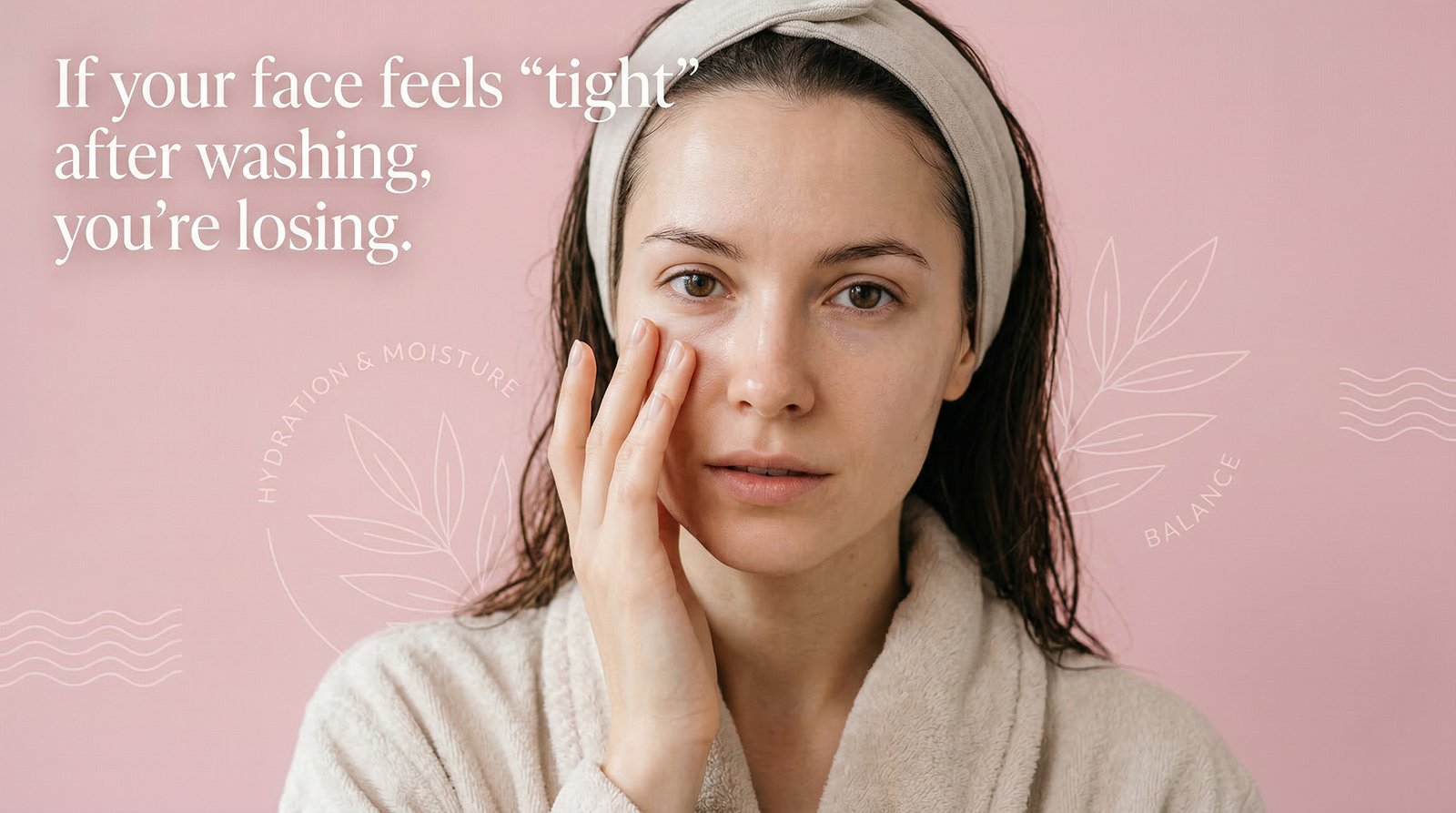
Stop scrubbing. You need to remove the day without removing your skin’s natural oils. If your skin feels tight after washing, your cleanser is the first thing you need to change. Explore Cleansers
One high-performance serum. It should address your concerns texture, tone, or fine lines while feeding your barrier with what it actually needs to stay strong. Explore Serums
A moisturizer that mimics your skin’s natural lipid structure. This isn’t about “feeling” greasy; it’s about creating an invisible shield that prevents TEWL. Explore Moisturizers
Fresh, unexpired SPF. Every single morning.
You Don’t Need More Products. You Need Fewer That Actually Work.
The “skinimalism” movement isn’t a trend; it’s a return to biological common sense. Your skin is an organ, not a hobby.
It doesn’t want to be “elevated” or “unlocked.”
It wants to be protected, respected, and left alone to do its job.
Check your dates. Smell your creams. Look at the texture.
If it’s old, let it go.
Your skin is waiting for you to stop the noise and start the repair.
The "Bin It" Checklist
Frequently Asked Questions
No. Even if you don’t turn red, the filters have degraded. You’re still getting deep cellular DNA damage without the “warning” of a burn.
Yes. Most formulas are only stable for 2–3 years on a shelf. After that, the active ingredients lose their punch and the emulsion falls apart.
That’s the smell of oxidation. Your serum has turned into a free-radical factory that causes the exact premature aging you bought it to fix.
Nice try, but no. Separation means the chemical bonds have snapped. Shaking it won’t redistribute the active ingredients evenly enough to protect your skin.
Get a permanent marker. Write the date you cracked the seal directly on the bottle. If it’s been open longer than 12 months, let it go.
Closing thought
Your skin has a long memory for the shortcuts you take.
Keeping an old bottle because it was expensive is a sunk-cost fallacy that your barrier pays for in inflammation and breakouts.
Clean out the graveyard under your sink. Your routine shouldn’t be a collection of “maybe” products; it should be a fresh, functional foundation that actually works.
Stop hoarding chemicals. Start prioritizing your skin’s health.