
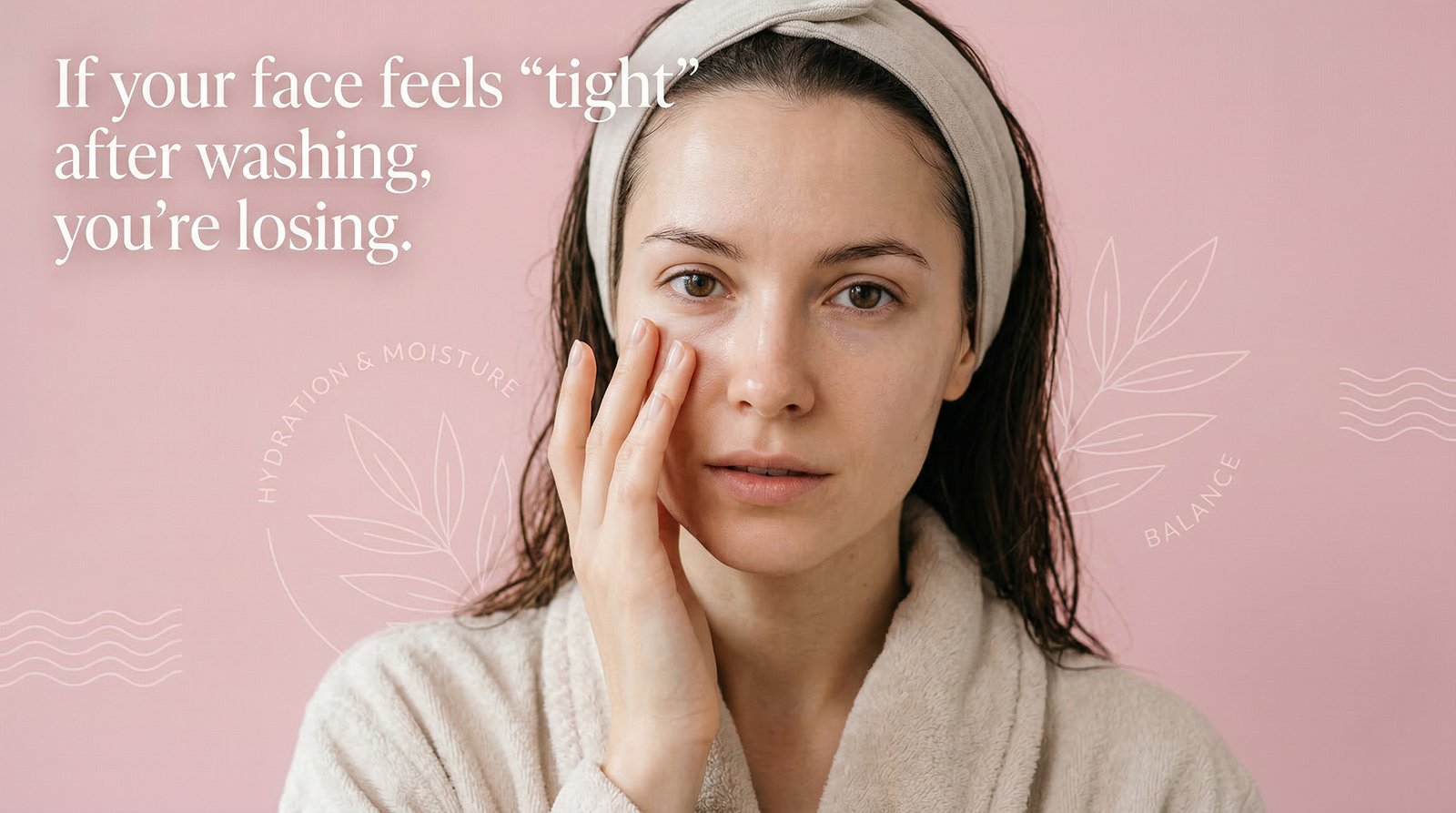
Over-cleansing strips your skin’s natural oils and damages the moisture barrier, leading to dryness, irritation, and breakouts.
Your 10-Step Routine Is Exhausting Skin
Your 10-step routine isn’t helping your skin. It’s exhausting it.
If you’ve been cleansing twice a day, toning, exfoliating three times a week, layering acids, and still waking up to tight, dull, or irritated skin your routine isn’t the solution. It’s the problem. The skincare industry has spent years convincing you that more steps equal better results. More cleansing. More actives. More “hydration.” What it hasn’t told you is that the single most important structure in your skin your moisture barrier breaks down a little more with every unnecessary step you add.
This isn’t about doing less because it’s trendy. It’s about understanding what your skin actually needs, and stopping the cycle of damage that most people mistake for “purging” or “adjustment.”
You’re not adjusting. You’re breaking your skin down and then trying to repair it with the same products causing the damage.
What's Actually Happening Under Your Skin Right Now
Your skin has a built-in defense structure called the stratum corneum—the outermost layer of your epidermis. Think of it like a brick wall: skin cells are the bricks, and a carefully balanced mix of ceramides, cholesterol, and fatty acids forms the mortar holding everything together.
This lipid matrix does two things: it keeps moisture in, and it keeps irritants, bacteria, and environmental aggressors out. When it’s healthy, your skin looks plump, feels soft, and isn’t reactive to much. When it’s compromised through over-cleansing, aggressive exfoliation, or stripping actives that mortar starts to crumble.
The result? Transepidermal water loss (TEWL). Water literally evaporates out of your skin faster than it can be replenished. Your skin feels tight after washing. It gets “dehydrated” even when you’re drinking enough water. Products that never used to sting now burn on contact. This isn’t your skin being sensitive. It’s your skin having no functional defense left.
“A compromised barrier doesn’t just let moisture out it lets everything else in. Pollution, bacteria, allergens. Your skin becomes a bad bouncer.”
Research published in the Journal of Investigative Dermatology has shown that even short-term exposure to harsh surfactants measurably increases TEWL and disrupts the skin’s natural lipid structure. Not in a theoretical way. In a clinically observable way.
Most people doing double-cleanse routines with foaming cleansers are doing this to their skin every single day.
Your Cleanser Might Be Causing the Breakouts You Blame on Hormones
Here’s the part most skincare content skips over: your skin isn’t sterile. It hosts a complex ecosystem of microorganisms bacteria, fungi, mites that live in balance and actively support your barrier function.
This is your skin microbiome, and it is not your enemy.
When you cleanse aggressively, you don’t just remove dirt. You wipe out the beneficial bacteria that compete with pathogenic strains, help regulate inflammation, and support the skin’s natural pH. What’s left is an environment where acne-causing bacteria can overgrow, inflammation spikes, and your skin becomes more reactive to everything.
Studies from the NIH on cutaneous microbiome research have linked disrupted skin microbiota to increased incidence of inflammatory skin conditions including acne, eczema, and rosacea. Over-cleansing doesn’t just dry you out. It can actively trigger the breakouts you’re trying to prevent.
So, if you’ve been cleansing more to control breakouts, you may be feeding the exact cycle you’re trying to escape.
Your skin’s natural pH is mildly acidic around 4.5 to 5.5. Most foaming, lather-heavy cleansers sit at a pH of 9 to 11. Every time you use one, you’re temporarily alkalizing your skin’s surface, disrupting the acid mantle, and giving opportunistic bacteria a window to cause problems. Tight skin after washing isn’t clean skin. It’s disrupted skin.
Why Layering More Actives Is Making Your Skin Worse, Not Better
The current skincare culture has a stacking problem. Niacinamide on top of Vitamin C on top of a retinoid on top of AHA on top of BHA and somehow people are surprised their skin is angry.
Here’s what’s actually happening: each active you apply requires your skin to metabolize it, respond to it, or both. Your barrier has a finite capacity to handle chemical stress. When you exceed that threshold, the response isn’t absorption and results it’s inflammation. And not just temporary, surface-level inflammation. Chronic, low-grade skin inflammation that keeps your barrier in a perpetual state of repair, never actually healing. Dermatologists call this an inflammation loop and most overloaded routines are stuck in one.
Dermatology Times has covered barrier-repair approaches that consistently show the same finding: in disrupted skin, reducing active ingredient load and prioritizing barrier restoration leads to better long-term outcomes than continuing to treat through damage.
Put simply: your skin cannot absorb and benefit from actives it doesn’t have the structural integrity to process. Repair first. Treat second.
“Using actives on a compromised barrier is like trying to paint a wall that’s still wet. It won’t stick. And you’re making the underlying problem worse.”
The "Hydration" Step That's Quietly Drying Your Skin Out
Here’s the counterintuitive one: hydration and moisture are not the same thing. Most people know humectants hyaluronic acid, glycerin, urea. These draw water into the skin. Applied correctly, they’re valuable. Applied incorrectly, they actively dehydrate you. When you apply a humectant without an occlusive layer over the top especially in low-humidity environments, like air-conditioned offices or winter air it pulls water out of your skin and into the air. The humectant needs water to work. If the atmosphere can’t provide it, your tissue does. This is why people with “dehydrated skin” who are religiously using hyaluronic acid serums are often still dehydrated. The serum is working exactly as designed. The routine isn’t.
This is where moisture sandwiching matters: humectant first, then seal with something occlusive. Not optional. The sealing step is what makes everything else work.
PubMed research on TEWL and occlusive agents demonstraes clearly that barrier-supportive ingredients petrolatum, squalane, ceramide-rich emollients significantly reduce water loss in compromised skin, while humectant-only applications show minimal lasting benefit without occlusion.
The Case for Barrier-First Skincare (And Why "Less" Isn't Lazy)
Skinimalism isn’t a trend. It’s not about owning fewer products because your bathroom is cluttered. It’s a philosophy grounded in what we know about how skin actually heals.
When your barrier is intact, your skin does most of the work itself. It regulates sebum. It manages hydration. It filters out microbes. It turns over cells on its own schedule. The job of your routine isn’t to override these functions it’s to support them.
A barrier-first approach means every product you use has a clear, non-disruptive purpose. You’re not layering things because they’re trending. You’re choosing ingredients that either support the lipid matrix, hydrate without stripping, or protect what’s already there.
The complexity of your routine should be inverse to the health of your barrier. When your skin is compromised, go simpler. When it’s healed and resilient, you can thoughtfully reintroduce actives one at a time, with intention.
What your skin needs right now almost certainly isn’t another product. It’s fewer, better ones and some breathing room to repair.
If Your Routine Feels Complicated, That's the Problem
Count the steps in your routine. Now ask: does each one have a specific, non-duplicated purpose?
If you can’t answer that for every single product, you have your answer. You’re not building a routine. You’re accumulating one and your skin is paying the price. Healthy skin isn’t complicated to maintain. Only damaged skin demands constant management.
The Minimal Routine Blueprint Four Steps, No Filler
This isn’t about stripping your routine down for the sake of minimalism. It’s about identifying the four functions your skin actually needs covered and covering them with intention.
Common mistakes we all make
Here’s a clear list of the most frequent mistakes that damage your moisture barrier (even when you think you’re doing everything right):
These mistakes are extremely common because the skincare industry pushes “more is better.” The fix is usually simplifying, gentler cleansing, and focusing on barrier repair first.
A simple "Barrier Repair" checklist
Frequently Asked Questions
Tight, dry, or flaky skin after cleansing, redness, stinging/burning from regular products, dullness, increased sensitivity, and unexpected breakouts are the most common signs.
You can see visible improvement in 7 to 14 days with a simplified routine. Complete repair usually takes 2 to 4 weeks, depending on the severity of the damage.
Yes. For most people, morning cleansing is unnecessary. Just rinse with water unless you have heavy sunscreen, makeup, or work in a very polluted environment.
Hyaluronic acid pulls water into the skin but doesn’t lock it in. Without an occlusive moisturizer on top, it can pull moisture from your skin into the air especially in dry or AC rooms.
Absolutely. Aggressive cleansing disrupts your skin microbiome and pH balance, which can trigger inflammation and allow acne-causing bacteria to overgrow.
Closing thought
Your skin doesn’t need more products. It needs more respect.
The most powerful thing you can do right now is simple: stop over-cleansing, strip away the unnecessary steps, and give your skin the space and support it needs to heal itself. When you repair your moisture barrier first, everything else clarity, glow, resilience follows naturally.
Less isn’t giving up. It’s finally listening.
Start with the four-step blueprint tonight. Be patient. Be consistent. Your skin will thank you.