
Stop the product merry-go-round. Repair your barrier instead.
Your skin isn’t bored. It’s burned out.
You’ve tried the new acid, the trending retinoid, the “must-have” serum everyone swears by. For a week or two, things look better. Then the glow fades. Texture returns. That dull, flat look settles in again. So you switch products. Again.
Your 10-step routine isn’t helping your skin. It’s exhausting it.
Most people chase excitement for their skin the same way they chase it in life new ingredients, new textures, new promises. The result? Skin that stops responding. Not because it’s “bored,” but because you’ve quietly damaged the very thing that keeps it healthy.
Let’s talk about what’s really happening.
The Real Reason Your Skin Stopped Responding
Your skin has a barrier a smart, lipid-rich structure in the outermost layer made of ceramides, cholesterol, and fatty acids arranged like a brick-and-mortar wall. Those ceramides are the mortar. When they’re intact, they lock in moisture and keep irritants out. When they’re depleted, transepidermal water loss (TEWL) climbs, inflammation simmers, and your skin looks tired no matter what you throw at it. Over time, constant product switching and layering do the opposite of repair. Harsh cleansers strip lipids. Too many actives trigger micro-inflammation. Your microbiome the community of bacteria that helps regulate immunity and barrier function gets thrown off balance.
The skin doesn’t get “used to” products in the way people claim. It just gets overwhelmed.
Over-cleansing quietly destroys your microbiome. Gentle is relative. Many “foaming” or “refreshing” cleansers use surfactants that remove more than dirt they remove protective oils and shift the bacterial balance that keeps skin calm.
Layering too many actives creates inflammation loops. One exfoliant signals repair. Five create chronic low-grade stress. Your skin spends all its energy defending itself instead of renewing.
“Hydration” and moisture are not the same thing. You can flood the upper layers with humectants and still lose water fast if the lipid barrier is broken. Hydration without repair is temporary. Moisture that supports the barrier lasts.
This is why your skin feels flat. It’s not lazy. It’s injured.
Why Constantly Switching Products Makes Everything Worse
Every new launch promises to fix what the last one didn’t. Your skin pays the price. Each switch introduces new preservatives, fragrances (even “natural” ones), or pH levels. The barrier never gets a consistent environment to rebuild. Ceramide production slows. TEWL stays high. You chase brightness that never sticks. Studies show that restoring the right balance of ceramides directly improves barrier function and reduces dryness. Yet most routines focus on stripping first, then trying to patch later.
The industry hates this truth: your skin wants stability more than novelty.
The Skinimalism Shift That Actually Works
Skinimalism isn’t about doing nothing. It’s about doing the few things that matter, with formulas that respect biology instead of fighting it. Fewer steps. Better compatibility. Real repair. Your skin stops reacting and starts recovering. You don’t need ten products to look like you have glowing skin. You need a barrier that functions like it should.
Your Cleanser Is Probably Making Dullness Worse
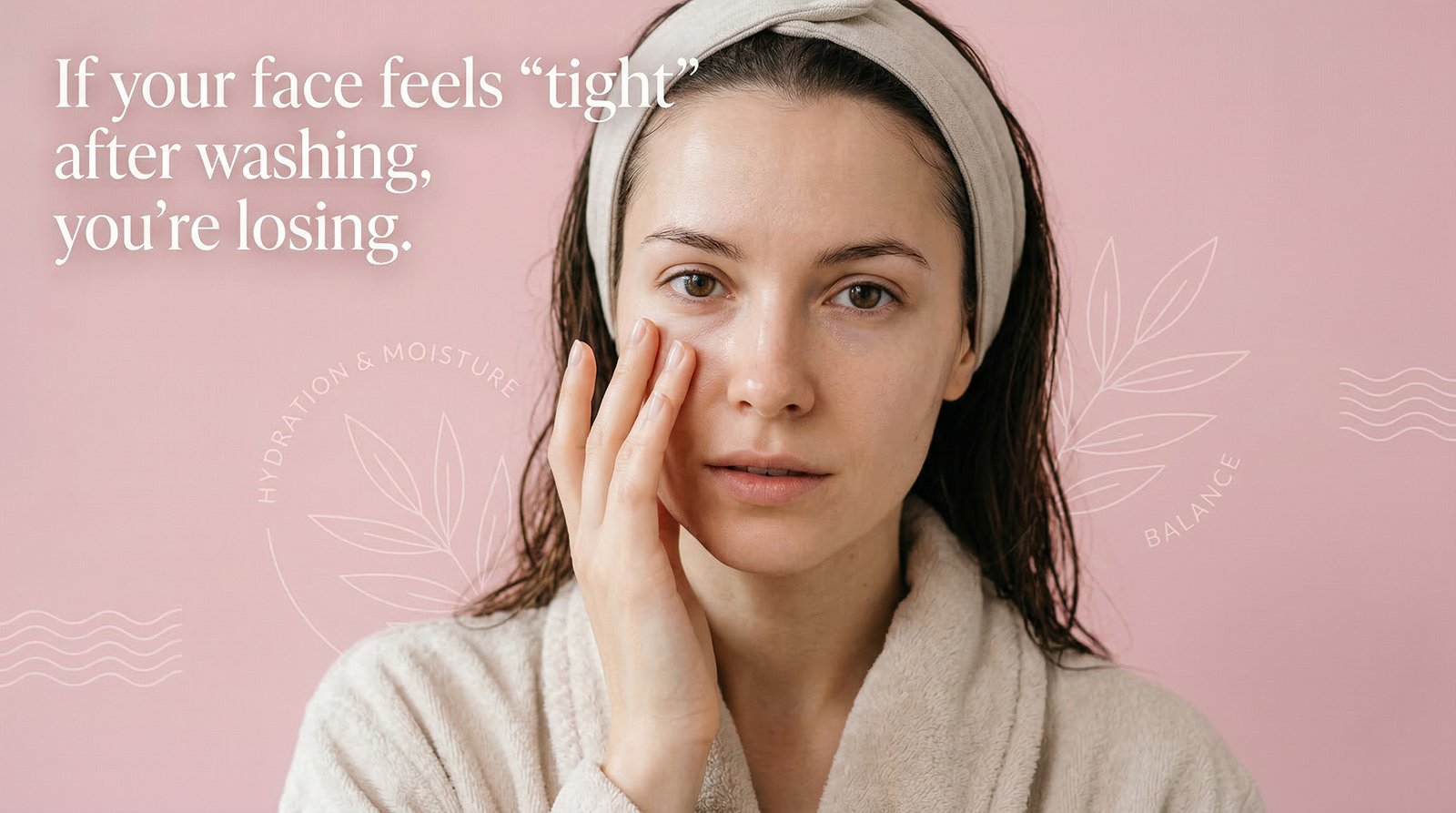
Most cleansers prioritize squeaky clean over everything else. That tight feeling after washing? That’s your barrier protesting.
When you strip the oils, your skin ramps up oil production to compensate. Microbiome diversity drops. Inflammation creeps up. The dullness you blame on “tired skin” often traces back here.
Smarter move: A gentle, non-foaming cleanser that removes what it needs to without collateral damage. At “Minimals”, the cleanser is designed for barrier respect first effective but never harsh. You use it, rinse, and your skin doesn’t feel stripped. That alone changes how the rest of your routine performs.
Why Exfoliating More Won’t Bring Back the Glow
Over-exfoliation is one of the fastest ways to bored-looking skin. You remove dead cells, sure. But you also compromise the lipid matrix and trigger repair signals that, when constant, lead to sensitivity and rebound dullness. Your skin naturally turns over. Help it when needed. Don’t force it daily.
A targeted treatment serum that supports renewal without constant abrasion gives better long-term texture than aggressive acids ever will.
The Layering Trap Most People Fall Into
Serum after serum after serum. Each one competing for space on your face. Actives can cancel each other out or amplify irritation. pH conflicts. Ingredient interactions. Your barrier never knows what to expect.
Barrier-first thinking changes this. One lightweight serum with proven repair ingredients works better than a cocktail. It absorbs cleanly. It plays well with the moisturizer that follows. No guessing games.
The Moisturizer That Does the Heavy Lifting
This is where repair actually happens for most people.
A good moisturizer doesn’t just sit on top. It helps replenish ceramides, reduces TEWL, and creates an environment where your microbiome can thrive. It seals in the hydration you’ve added and stops the loss that makes skin look flat. Look for formulas with the right lipid profile not just any oil, but ones that mimic what your skin makes. When the mortar is rebuilt, everything else looks better.
“Minimals” moisturizers are built exactly for this: quiet, effective support that lets your skin do its job instead of relying on constant external fixes.
If Your Routine Feels Complicated, That’s the Problem
Be honest. How many steps do you have right now? How many times have you changed products in the last year?
Complicated routines create decision fatigue for you and your skin. They increase the chance of irritation and inconsistency. The skin that looks best long-term usually belongs to people with boring, reliable routines. Not the ones rotating 12 products.
Simplicity forces better choices. You can’t hide behind trends when you only have three or four things to work with.
Your Minimal Routine Blueprint
Morning and night, keep it consistent:
Gentle, pH-balanced, non-stripping. Once at night is often enough. In the morning, a quick rinse with water works for many.
One targeted serum something that supports barrier lipids or gentle renewal depending on your main concern. No stacking actives daily unless your skin is very tolerant.
Moisturizer with barrier-supporting ingredients. This is your main event. Apply it while skin is still damp for better absorption (“moisture sandwiching”).
A solid mineral sunscreen. Reapply as needed. This prevents further damage that makes repair harder. That’s it. Four steps max. Some days even less.
Your skin doesn’t need more. It needs consistency and the right support.
What to Expect When You Stop Chasing
Week 1 to 2: Skin might feel different as it adjusts. Less reactive, maybe a bit drier before it balances.
Week 3 to 4: Barrier starts repairing. TEWL drops. Texture improves. That dull look fades because water stays where it belongs.
Month 2+: Products you use actually work again. You don’t need to switch. Your skin responds because it’s no longer in survival mode.
This isn’t overnight magic. It’s biology working the way it’s supposed to.
You Don’t Need More Products. You Need Fewer That Actually Work.
Bored skin isn’t a marketing problem to solve with another launch. It’s a signal that your approach needs resetting.
Stop the cycle of damage and repair. Give your barrier what it’s been missing: stability, the right lipids, and space to function.
At “Minimals”, every formula is built for this exact philosophy skinimalism that prioritizes repair over hype. The cleanser that doesn’t strip. The serum that supports without overwhelming. The moisturizer that rebuilds instead of just sitting there. Your skin already knows how to look healthy. It just needs the right conditions.
Start simple. Stay consistent. Watch it wake up.
No more bored skin. Just skin that works.
Common mistakes we all make
We treat symptoms instead of the damage underneath. You see dullness, so you reach for a brighter acid. Skin feels rough, so you exfoliate harder. Breakouts appear, so you strip it more. All while quietly destroying the barrier that actually controls how your skin looks and behaves.
That’s the trap. We chase visible fixes and ignore the biology that creates the glow in the first place.
A simple "Minimals Barrier-First" checklist
Frequently Asked Questions
Actually, the opposite is often true. Chronic micro-inflammationcaused by over-exfoliating or stacking too many actives is a leading cause of “inflammaging,” which breaks down collagen and elastin. By prioritizing barrier health and consistent sun protection, you are giving your skin the stability it needs to repair itself effectively.
Look for these “burnout” signals:
Products that used to be fine now sting or tingle upon application.
Your skin feels tight and dry, yet looks shiny or oily (a sign of rebound oil production).
Persistent redness or “texture” that doesn’t resolve with exfoliation.
A dull, flat appearance that doesn’t improve even after applying heavy creams.
Yes, but with intentionality. Instead of using multiple serums, choose one high-quality “Treatment” step (Step 2 in the blueprint).
Tip: If your barrier is compromised, pause your retinoid for 2 to 4 weeks until the stinging stops, then reintroduce it slowly (2x per week) over a healthy, moisturized base.
When you stop over-cleansing, your skin’s acid mantle and microbiome need time to recalibrate. It often takes 28 days (one full skin cell cycle) for your skin to adjust to a new, gentler physiological baseline. This isn’t usually a “purge” in the chemical sense, but rather a rebalancing phase.
For most people, yes. Unless you have very oily skin or use a heavy occlusive (like petrolatum) at night, your skin doesn’t accumulate “dirt” while you sleep only sweat and natural sebum. Rinsing with water preserves the lipids your skin worked hard to produce overnight, preventing that mid-morning tightness.
Closing thought
The shift toward Skinimalism isn’t just a trend; it is a return to biological common sense. For years, the industry has convinced us that our skin is a problem to be solved with more chemistry, more steps, and more friction.
But as the science of the microbiome and the lipid matrix evolves, the truth becomes undeniable: Your skin is not an adversary. It is a sophisticated, self-regulating organ that performs best when its natural boundaries are respected.
Trust the Process: When you strip back your routine, you aren’t “losing” benefits; you are gaining resilience. A healthy barrier is the ultimate anti-aging and anti-acne tool.
Consistency over Intensity: A 10% acid used once a week is often more effective than a 2% acid used daily if the latter keeps your skin in a state of constant low-grade trauma.
Listen to the “Tightness”: That post-wash “squeaky clean” feeling is the single most important signal your skin sends. If you ignore it, you’re fighting an uphill battle against dullness and dehydration.
In a month or two, you’ll likely notice that your skin looks better on the days you do the least. You’ll find that the “glow” everyone chases isn’t something you can buy in a bottle it is the natural light-reflecting quality of a smooth, intact, and hydrated stratum corneum.
Stop chasing the “new” and start cherishing the stable. Your skin doesn’t need a miracle; it just needs a break.
Final Reflection: The most beautiful skin is often the most “boring” one the one that isn’t red, isn’t reacting, and isn’t thirsty. Give your barrier the lead role, and it will handle the rest.