
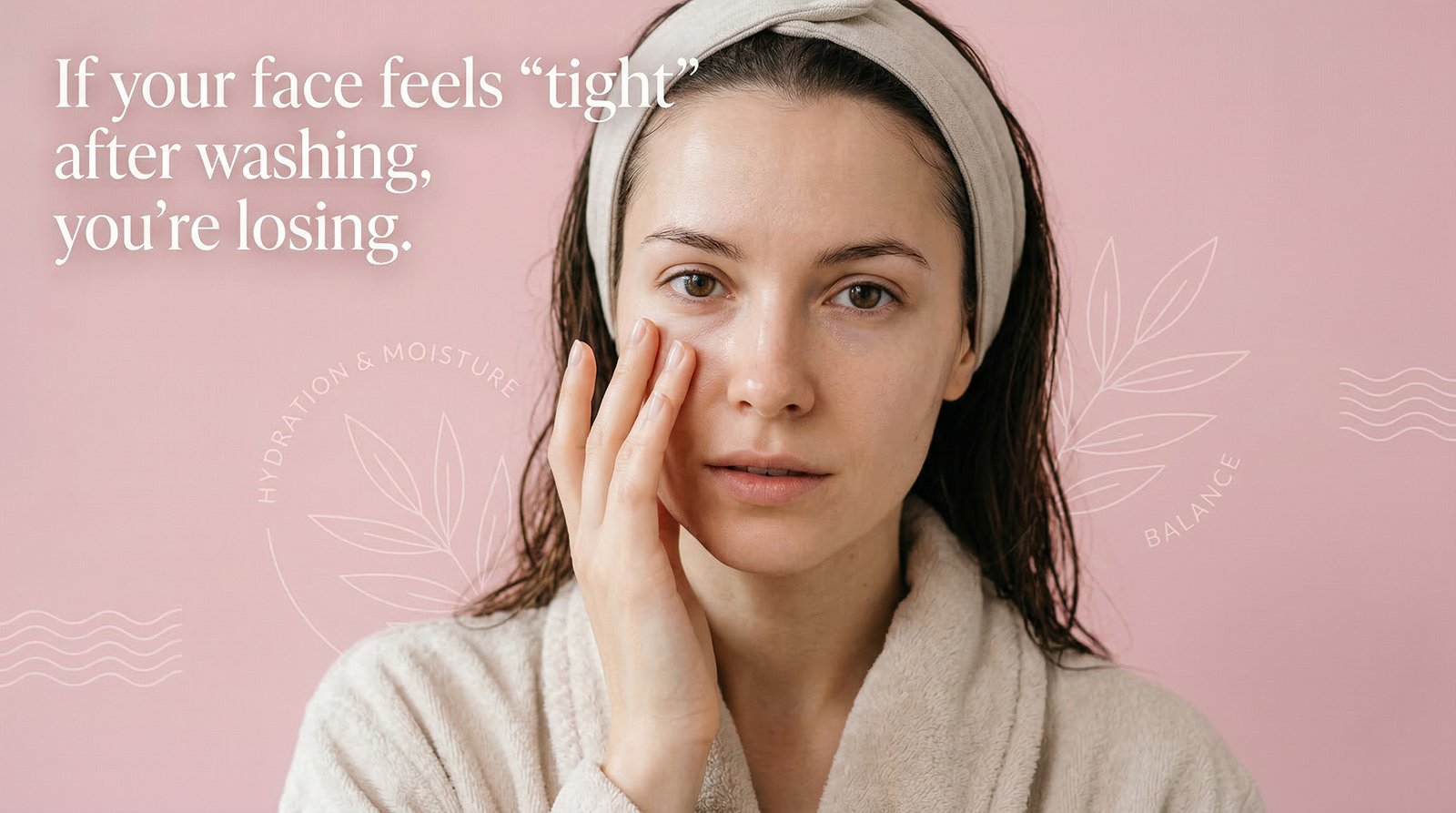
A damaged skin barrier can leave your skin dry, reactive, and constantly struggling here’s how to rebuild it with a simpler, science-backed approach that supports long-term skin health.
The Real Reason Your Skin Won't Heal
You’ve been treating the symptoms.
The redness. The breakouts. The dry patches that won’t quit. The sensitivity that appeared out of nowhere, somewhere between your third serum and your second exfoliating acid. You added products to fix what other products broke. And your skin kept getting worse.
Here’s what no one in the skincare industry wants to say out loud: most people with “problem skin” don’t have a skin problem. They have a barrier problem. And the fix isn’t another active ingredient. It’s stopping, resetting, and rebuilding the one structure that makes everything else possible.
This is how you actually do that.
What's Happening Under the Surface (And Why It Matters More Than Your Skin Type)
Before anything else, you need to understand what you’re trying to restore.
Your skin barrier the stratum corneum is the outermost layer of skin. It’s made up of dead skin cells packed tightly together, held in place by a lipid matrix built from ceramides, cholesterol, and free fatty acids. That matrix is what keeps water in and irritants out.
When the lipid matrix breaks down, water escapes through the skin surface continuously. This is called transepidermal water loss TEWL and elevated TEWL is the clinical benchmark for barrier dysfunction. Research in the Journal of Investigative Dermatology has consistently shown that TEWL increases not just with eczema or psoriasis, but with routine skincare habits: harsh cleansers, over-exfoliation, fragrance exposure, and excessive product layering.
The damage is often invisible at first.
Your skin compensates producing more oil, triggering low-grade inflammation, sensitizing nerve endings. By the time you see redness or feel stinging, the barrier has been compromised for a while.
You weren’t born with reactive skin. Your routine made it reactive.
Restoration Doesn't Start With What You Add It Starts With What You Stop
This is the part most people skip.
They read about ceramides, buy a ceramide moisturizer, layer it over the same stripping cleanser and four actives, and wonder why nothing improves. Barrier restoration isn’t additive. It’s subtractive first. Every product in your routine right now is either supporting your barrier or working against it. Most routines contain at least two or three that are quietly doing damage and until you remove those, nothing you add will hold.
So before we talk about what to use, let’s talk about what to stop.
The Cleanser You Trust Might Be the First Thing Destroying Your Barrier
Most people never question their cleanser.
It’s just the thing you use to wash your face. Neutral, functional, unremarkable. But your cleanser sets the pH of your skin for the hours that follow and if it’s alkalizing your skin even slightly, every other step in your routine starts at a disadvantage.
Healthy skin sits at a pH of roughly 4.5 to 5.5. This mild acidity maintains the lipid matrix and supports the microbiome the living community of bacteria, fungi, and microorganisms that actively defend your skin. Most foaming cleansers sit at pH 7 to 10. Every use nudges your skin into alkaline territory, which disrupts the acid mantle and destabilizes the microbial balance.
And here’s where the inflammation loop starts.
When the microbiome is disrupted, research from the NIH’s Human Microbiome Project shows that pro-inflammatory pathways activate not in response to infection or injury, but simply due to the absence of the bacterial balance that normally suppresses them. Your skin gets inflamed not because something bad got in, but because something protective got stripped away. Over-cleansing is also the most common cause of “oily” skin that never gets less oily. Strip sebum aggressively enough and the skin reads it as an emergency and ramps up sebum production to compensate. You clean more, your skin produces more oil, you clean more. That cycle doesn’t end until the cleanser changes.
If your skin feels tight, dry, or “squeaky” after washing, your cleanser is stripping your barrier. That feeling isn’t clean. It’s damage.
“Minimals” Gentle Gel Cleanser is pH-balanced to sit within the skin’s natural acid mantle range. It removes what needs to go SPF, pollution, excess sebum without alkalizing the surface or disrupting the microbiome that’s trying to protect you.
Ceramides Are the Repair Material But Most Products Deliver Them Wrong
Once you’ve stopped the stripping, you can actually start rebuilding.
The lipid matrix the mortar between your skin cells is primarily made of three things: ceramides, cholesterol, and free fatty acids. When this matrix is depleted, the barrier becomes porous. Water escapes. Irritants penetrate. Inflammation follows.
Ceramides are the dominant component, making up roughly 50% of the lipid matrix by weight. A study published in the Journal of the American Academy of Dermatology confirmed that topical ceramide application measurably reduces TEWL and improves barrier function but the ratio matters. Ceramides delivered without cholesterol and fatty acids in appropriate proportions don’t integrate into the lipid matrix as effectively as the full trio.
A product with ceramides on the label isn’t automatically a barrier-repairing product. If ceramides are listed low on the ingredient deck, or if they’re floating in a base full of fragrance, alcohol, or silicones that prevent penetration, they’re largely decorative. The formulation architecture matters as much as the ingredient itself.
What you want is a moisturizer where ceramides, cholesterol, and fatty acids are delivered in a vehicle that actually allows them to integrate ideally applied immediately after cleansing, when skin is still slightly damp and absorption is highest. This is what moisture sandwiching actually means at a functional level: humectants pulling water to the surface, a lipid-rich formula sealing it in before it can evaporate.
Minimals’ barrier moisturizer is built around this ratio ceramides, cholesterol, and fatty acids in a fragrance-free base designed for absorption, not just surface feel.
Actives Are Not the Enemy But Timing Them Wrong Is
Here’s something the skincare content machine never says clearly: actives work better on a healthy barrier than a damaged one.
Retinol on intact skin gently accelerates cell turnover. Retinol on a compromised barrier penetrates too deep, too fast, and causes irritation that gets attributed to “purging” or “adjustment periods” when really it’s just the wrong tool at the wrong time.
AHAs on healthy skin dissolve dead cell buildup and improve texture. AHAs on a stripped barrier bypass the surface entirely and start acting on live cells. That burning sensation isn’t the product working. It’s your skin telling you to stop.
Research from the International Journal of Dermatology has documented that low-concentration retinoids significantly increase TEWL in barrier-compromised skin, worsening underlying damage before any regenerative benefit appears.
The sequencing is: repair first, treat second.
This isn’t forever. Most people see meaningful barrier improvement within four to six weeks of stripping back their routine. Once the barrier is stable no stinging from gentle products, no tightness after cleansing, no reactive redness you can reintroduce actives slowly, one at a time, at low concentrations.
During the repair phase, your serum slot shouldn’t be doing chemical work. It should be doing structural work. Ingredients like panthenol, madecassoside, centella asiatica, and beta-glucan calm the inflammation loop without adding stress. Niacinamide at 4 to 5% strengthens the barrier by increasing ceramide synthesis without the irritation risk of exfoliating acids or retinoids.
Hydration and Moisture Are Not the Same Thing And Confusing Them Is Keeping Your Skin Dry
Wait actually sit with this one.
If you’ve ever layered multiple hydrating products and still felt dry an hour later, this is why. Hydration refers to water content in the skin. Moisture refers to the barrier’s ability to retain that water. These are different mechanisms requiring different ingredients and one doesn’t substitute for the other.
Hyaluronic acid is a humectant. It draws water to the skin and holds it temporarily. In a humid environment, with an intact barrier and a lipid-rich moisturizer on top, it works beautifully. But applied alone to damaged skin in a dry environment, it can pull moisture from the dermis upward and when that moisture hits the surface and evaporates, you lose more than you started with.
This is why people with compromised barriers sometimes feel drier after their “hydrating” routine.
More toner layers. More essence. More hyaluronic acid serum. None of it helps if the lipid seal isn’t there to hold it in. You’re filling a broken container.
The fix is always lipids first, humectants second or layered beneath an occlusive that prevents evaporation. Sequence: slightly damp skin, humectant serum, ceramide-rich moisturizer on top. Seal it before it escapes.
A 2018 analysis in Dermatology and Therapy confirmed this: ceramide-containing moisturizers outperformed humectant-only formulas on both TEWL reduction and sustained hydration in compromised skin not because ceramides are more hydrating, but because they’re better at keeping hydration where you put it.
The Ingredient Lists That Are Quietly Keeping Your Barrier Broken
You can do everything right and still make no progress if the products you’re using contain ingredients that undo the repair. Fragrance is the biggest offender and the hardest to spot because it hides.
“Natural fragrance,” “parfum,” “essential oil blend,” lavender extract, bergamot, eucalyptus, rose: these are all fragrance. The American Contact Dermatitis Society has placed fragrance among the most common contact allergens in skincare year after year. On a damaged barrier, where the protective layer is already compromised, fragrance compounds penetrate more easily and trigger immune responses even in people who’ve never had fragrance sensitivity before.
The cruel irony is that fragrance appears most often in products marketed for sensitive or compromised skin. Products that smell like calm are often causing inflammation.
Denatured alcohol (alcohol denat.) is another. At high concentrations, it disrupts the lipid matrix directly and it’s present in an enormous number of serums, toners, and “lightweight” moisturizers because it improves texture and spreadability.
Witch hazel, menthol, peppermint, and synthetic cooling agents: all marketed as refreshing or clarifying, all genuinely disruptive to barrier integrity when used regularly.
Read ingredient lists like someone who understands that “natural” and “gentle” are marketing categories, not formulation standards.
If Your Skin Has Gotten Worse Since You Got Serious About Skincare, That's the Answer You Needed
Take a moment with that.
If you were introduced to skincare in your teens with a basic drugstore moisturizer and SPF and your skin was actually fine and then you started “building a proper routine” in your twenties, and now you have redness and sensitivity and breakouts you never had before?
Your routine is the variable that changed. Not your hormones. Not your age. Not some mysterious skin shift. Barrier-first skincare isn’t a new philosophy. Dermatologists have recommended minimal, gentle routines for decades particularly for reactive and compromised skin. The 10-step era was driven by marketing, not evidence. The idea that more steps equals better results has no clinical backing and considerable evidence against it.
Simplification is not giving up. It’s the intelligent response to a feedback loop that isn’t working.
The Barrier Restoration Routine Four Steps, Nothing Extra
Here’s what six to eight weeks of genuine barrier repair actually looks like.
Cleanse once daily, gently. One cleanse per day at night is enough for most people during the repair phase. In the morning, rinse with water or use a micellar water on a cotton pad if needed. The goal is removing the day without stripping the acid mantle. A low-pH, fragrance-free cleanser. Nothing that foams aggressively. Minimals’ Gentle Gel Cleanser does this job without compromising the microbiome you’re trying to rebuild.
Treat structurally, not chemically. Pause the exfoliating acids. Pause the retinol. Your serum in this phase should be delivering barrier-supportive ingredients: niacinamide, centella asiatica, panthenol, beta-glucan, madecassoside. Calm the inflammation loop. Support ceramide synthesis. Give compromised skin something it can actually use right now. Minimals’ barrier serum is built for exactly this window not to do too much, but to do the right things.
Apply your ceramide-rich moisturizer while skin is still slightly damp. This is where the structural rebuild happens lipids integrating into the matrix, TEWL dropping, the brick wall getting its mortar back. Fragrance-free, cholesterol and fatty acid ratios that actually mirror the skin’s own lipid profile. One layer is enough. Minimals’ barrier moisturizer is formulated to seal, not just sit on top.
SPF isn’t optional. UV radiation degrades ceramides directly research published in Photochemistry and Photobiology has documented measurable ceramide depletion after UV exposure even at sub-erythemic doses, meaning before you see any redness. A mineral SPF 30 to 50, applied as the last step in the morning, is not skincare extra credit. It’s the thing that keeps the repair you did last night from being undone by noon.
Four steps. Both routines done in under five minutes. That’s not a shortcut that’s the point.
Your Skin Already Knows How to Heal It Just Needs You to Stop Interrupting It
The skin barrier is not passive. It’s actively regenerating, re-synthesizing lipids, re-balancing its microbiome, rebuilding what was lost. You don’t have to make that happen. It’s already happening. What you have to do is create the conditions that allow it and stop creating conditions that prevent it. The inflammation loop breaks when the irritants are removed. Ceramide levels rebuild when you stop stripping them. The microbiome re-establishes when you stop alkalizing the environment it lives in.
This takes time. Six to eight weeks of a stripped-back routine before you see the full change. Some people see it faster. Chronically over-processed skin sometimes takes longer.
But it does happen.
You don’t need a new routine. You need a better understanding of the one you’re running and the willingness to make it smaller.
The skin that comes out the other side won’t need managing. It’ll just work.
Common mistakes we all make
The biggest mistake of all? Thinking your skin needs more intervention when it may simply need less disruption.
A simple "Healthy Skin" checklist
Frequently Asked Questions
Common signs include tightness after cleansing, redness, dryness, stinging from skincare products, increased sensitivity, and breakouts that seem to appear without a clear cause.
Over-cleansing, excessive exfoliation, layering too many active ingredients, using harsh products, and skipping moisturizer can all weaken the skin barrier over time.
Yes. Your skin naturally repairs itself, but it needs the right conditions less irritation, barrier-supportive ingredients, and a consistent routine.
Most people notice improvements within a few weeks, but significant barrier restoration can take anywhere from 4 to 8 weeks depending on the severity of the damage.
If your barrier is compromised, it’s often best to pause strong actives temporarily and focus on repair before reintroducing them gradually.
Closing thought
Your skin barrier doesn’t need constant correction it needs consistent support. If your skin has been stuck in a cycle of redness, breakouts, dryness, or sensitivity, the answer may not be another treatment product. It may be giving your skin the time, ingredients, and simplicity it needs to recover. Healthy skin starts with a healthy barrier, and sometimes the most effective skincare decision is choosing to do less, not more. Trust the process, stay consistent, and let your skin do what it was designed to do: heal itself.