
Discover the 3 barrier-friendly products most people swear by and why they actually work long-term.
Why Those 3 Cult Products Aren’t Working for You
Someone in your life has three products they won’t shut up about. Maybe it’s your coworker with the glass skin. Maybe it’s a Reddit thread you bookmarked at 1am. Maybe it’s a creator whose skin looks so calm and even-toned you screenshot their routine twice. So you bought the products. You used them. And your skin did… not that.
Here’s what nobody tells you about “products people swear by”: they’re swearing by how those products made their skin behave. Not yours. Their skin type, their barrier health, their diet, their city’s water hardness none of which applies to you. But there’s a smarter way to look at this. Because buried underneath the cult-favorite noise, there are three product categories that actually move the needle for most skin you choose the right formula and use them correctly.
The problem is almost nobody does both.
The Cult Product Trap: Why Other People's Routines Keep Failing You
When a product has 40,000 five-star reviews, it’s easy to assume the formula is universally good. It’s not. It’s just universally popular. Those two things are very different. Popularity in skincare is driven by sensory payoff how a product feels going on, how skin looks immediately after, whether it photographs well. None of that is a reliable indicator of long-term skin health. A thick, occlusive moisturizer might feel incredible on dry, cold-climate skin and clog every pore on oily, humid-climate skin. A high-percentage niacinamide serum might fade hyperpigmentation on one person and cause flushing in another, depending on barrier integrity and skin sensitivity at the time of use.
The product isn’t lying. The review isn’t lying. Your skin just has different requirements and “swear by” culture never accounts for that.
What Your Skin Actually Needs (Before Any Product Conversation Starts)
Before you buy anything else, understand this: your skin has three jobs running constantly beneath the surface. It’s regulating water loss through the lipid matrix the ceramide, fatty acid, and cholesterol structure that holds the outer barrier layer together. It’s managing a resident microbial community that actively protects against pathogens and keeps inflammation in check. And it’s cycling through its own natural cell renewal process, shedding and replacing itself roughly every four weeks.
Everything your skin needs from a routine is to support those three processes. Not override them. Not speed them up aggressively. Support them.
Research published in the Journal of Investigative Dermatology has consistently shown that barrier-disrupted skin skin with compromised ceramide content and elevated transepidermal water loss (TEWL) is not just “dry.” It’s biologically inflamed, immunologically reactive, and structurally less capable of tolerating actives.
Which means if your barrier is already damaged, layering in a cult-favorite acid serum isn’t going to give you the results you saw in that review. It’s going to make things worse. That’s the starting point nobody on TikTok mentions.
Category One: The Cleanser That's Quietly Wrecking Everything Else
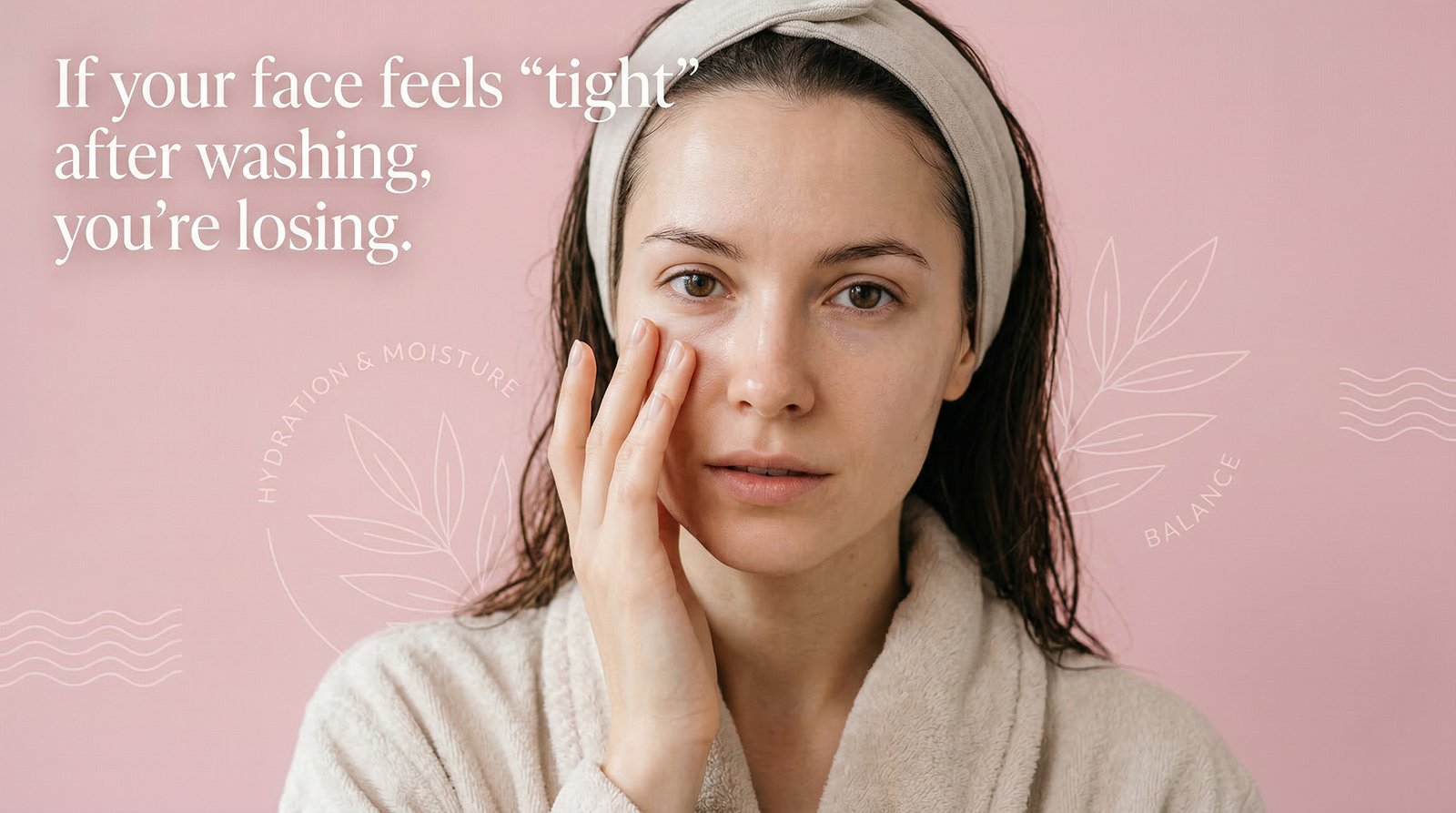
The most underestimated product in any routine is the one you use twice a day, every day, often without thinking about it. Your cleanser. Most people pick a cleanser based on how it feels the satisfying foam, the squeaky-clean finish. But that squeaky feeling? That’s your skin barrier telling you it’s been stripped. Ceramides gone. Fatty acids gone. The acidic pH that keeps your microbiome balanced disrupted. The skin’s surface naturally sits at a pH of about 4.7 to 5.75. This slightly acidic environment isn’t incidental it’s the condition under which your microbiome functions and your barrier enzymes operate correctly. Most foaming cleansers, particularly those using sodium lauryl sulfate, push skin pH up toward 7 or higher.
A study in Skin Pharmacology and Physiology found that high-pH surfactant exposure causes measurable barrier disruption that persists for hours after rinsing not just in the moment of cleansing.
Do that twice a day, every day, for years, and you’re not cleansing your skin. You’re slowly eroding its ability to function. The smarter alternative: a low-pH cleanser that removes what needs removing sunscreen residue, sebum, environmental particulate without touching the barrier beneath it. No fragrance. No sulfates. No sensation-based payoff that signals damage.
The “Minimals” Gentle Foaming Cleanser is formulated at pH 5.5 close enough to your skin’s natural environment that your microbiome barely registers it. No stripping. No post-cleanse tightness. Just a clean baseline for whatever comes next.
Category Two: The Serum Everyone Buys and Almost Nobody Uses Correctly
Serums are where most routines get complicated and complicated is where results stop happening. Walk into any beauty retailer and you’ll find serums promising to do seven things simultaneously. Brighten, firm, hydrate, smooth, minimize pores, fade spots, and “visibly reduce signs of aging in 28 days.” That’s not a serum. That’s a wish list with a dropper.
Here’s the biological reality: your skin’s absorption capacity isn’t unlimited. The stratum corneum the outermost barrier layer is specifically designed to keep things out. For an active ingredient to actually work, it needs to reach its target layer at a functional concentration, in a vehicle that allows penetration, at the right pH. Most multi-benefit serums dilute every active below the threshold needed for real results. You’re getting a little bit of eight things, none of them enough to change anything. The other mistake? Layering serums. Vitamin C serum, then niacinamide serum, then hyaluronic acid serum. Three separate products, applied sequentially, on top of each other.
A 2021 review in Dermatology and Therapy found that layering multiple actives dramatically increases the risk of barrier impairment even when each individual ingredient is considered gentle. The cumulative effect on barrier function is greater than any single product would suggest.
More isn’t more. More is just more damage with a longer recovery window. What actually works: one serum, chosen for your skin’s primary concern right now, with a clinically relevant concentration of a single active or a small set of complementary ones.
If your main concern is uneven tone and texture, niacinamide at 5 to 10% is one of the most evidence-backed options available supported by NIH-indexed research showing measurable improvements in hyperpigmentation, barrier function, and sebum regulation with consistent use over 8 weeks.
If your concern is dehydration and dullness, a well-formulated hyaluronic acid serum at multiple molecular weights not just the large surface molecules will actually reach the layers where hydration matters. But here’s the counterintuitive part about hyaluronic acid that most brands quietly skip over: it draws moisture from its environment. In a dry climate, without an occlusive layer on top to trap it, HA can actually pull water out of your skin. Hydration without moisture the water goes in, and then straight back out. This is why “moisture sandwiching” exists apply your water-binding serum, then immediately seal it with a moisturizer that contains barrier-repairing lipids. One without the other is incomplete.
Category Three: The Moisturizer That's Hydrating Your Face and Nothing Else
The most overhyped category in skincare. And the one where most products fail quietly, over months, without you ever connecting the dots. The moisturizer that “everyone swears by” is usually thick, richly textured, and feels immediately satisfying. It often sells itself on hyaluronic acid, peptides, or some proprietary “complex” that sounds scientific without specifying what it actually does.
Here’s what a moisturizer actually needs to do: repair and reinforce the barrier.
That means delivering ceramides, fatty acids, and cholesterol the three lipid components that make up the mortar between your skin cells. Not just sitting on top and making your skin feel plump for a few hours. Actually restoring what your skin loses through cleansing, exfoliation, environmental stress, and natural aging.
Research from the NIH shows that the ratio of ceramides to fatty acids to cholesterol in a moisturizer matters as much as the concentration. Get the ratio wrong and you’re applying lipids that don’t integrate well with your barrier’s natural matrix. Get it right and you’re actively rebuilding structural integrity with every application.
Most moisturizers including expensive ones get this wrong. They include some ceramides for label copy, but not in a ratio that meaningfully mimics the skin’s own lipid profile. The second thing a moisturizer needs to do: work as an occlusive to prevent TEWL. This doesn’t require petrolatum or a heavy film. A well-chosen combination of fatty alcohols and emollients can reduce water loss significantly without clogging pores or leaving skin feeling coated. A lightweight moisturizer that does both repairs the lipid matrix and reduces water loss is almost always more effective than a heavy cream that only does one.
The “Minimals” Barrier Repair Moisturizer uses ceramides, squalane, and fatty acids in a dermatologist-benchmarked ratio. It’s light enough to use under SPF in the morning. Enough to use alone at night. One product. Two contexts. No skin type exceptions.
The Routine People Swear By Is Usually Somebody Else's Accident
There’s a version of this that’s almost funny: the cult product someone swears by often isn’t doing what they think it’s doing. A person with naturally good skin uses a mid-range vitamin C serum for six months. Their skin looks great. They attribute it to the serum. In reality, they were also sleeping eight hours, eating vegetables, managing stress reasonably well, and had a genetic predisposition toward strong barrier function. The serum was fine. But it was a passenger, not a driver.
Meanwhile, someone with compromised barrier skin, chronic stress, and a history of over-exfoliating tries the same serum and breaks out within two weeks. Same product. Completely different result. This isn’t cynicism. It’s just biology being honest with you. Before you try the next product someone swears by, ask what their starting point was. What’s their skin type? Their environment? Their full routine? What else changed when they started using it?
If you don’t know the answers to those questions, you’re not following a routine. You’re buying lottery tickets.
If You Need to Think This Hard About Your Routine, It's Too Complicated
Here’s the reality check.
If your nighttime routine takes more than five minutes, something in it is redundant. If you’re switching products seasonally because your skin keeps “changing,” your barrier is probably just reacting to whatever you damaged last month. If you’re on your fourth “holy grail” moisturizer in two years, the product isn’t the problem.
The problem is the model: the idea that there’s a perfect product out there that will finally fix your skin, if you just find it. That’s not how skin works. Skin health is cumulative. It’s the result of consistent inputs over time adequate barrier support, minimal disruption, appropriate actives used patiently. No single product no matter how many people swear by it overrides the fundamentals. And the fundamentals are boring. They’re also the only thing that actually works long-term.
The 3-Product Blueprint That Actually Earns the "Swear By" Label
This is what a functional minimal routine looks like. Not aspirational. Not complicated. Just effective.
Cleanse with something pH-balanced and non-stripping. The Minimals Gentle Foaming Cleanser handles this without drama.
Apply your treatment serum while skin is still slightly damp 7better absorption, less product needed.
Seal with a barrier-supportive moisturizer. Then SPF. Non-negotiable. The American Academy of Dermatology is unambiguous: daily broad-spectrum SPF 30+ is the single highest-impact anti-aging intervention available without a prescription.
Cleanse again. Apply your treatment serum. Seal with moisturizer.
On evenings after exfoliation (2 to 3 times a week maximum), skip the active serum and just repair: moisturizer with ceramides, directly on clean skin. Let the barrier do its job without additional input. That’s four products. Five if you count SPF as a separate step. Every one of them earns its place. None of them are there because they feel good or because someone online swore by them.
They’re there because they do exactly one important thing—and do it well.
Common mistakes we all make
Quick Fix: Focus on one gentle cleanser, one targeted serum, and one true barrier moisturizer chosen for your skin.
A simple "Cult Product Trap" checklist
Frequently Asked Questions
Because those products worked for their skin type, barrier health, climate, and lifestyle not yours. What gives one person “glass skin” can damage another person’s barrier.
These three, when chosen and used correctly, deliver better results than a complicated 10-step routine.
If your skin feels tight, dry, or squeaky-clean after washing, it’s stripping your barrier. Switch to a low-pH (5.0 to 5.5), fragrance-free, non-stripping cleanser.
.
No. Layering multiple serums dilutes results and increases barrier damage. Stick to one targeted serum at a time.
It should contain ceramides, fatty acids, and cholesterol in the right ratio to actually repair your barrier not just sit on top and feel hydrating for a few hours.
Closing thought
You don’t need a longer list of products to try. You need a shorter, smarter one. The cleanser that respects your barrier. The serum that addresses your actual primary concern at a functional concentration. The moisturizer that repairs your lipid matrix instead of just coating your face. Those three things, used consistently, will do more for your skin in six months than a rotating cast of cult favorites has done in the last six years. Less. Chosen better. Used longer. That’s the whole thing.