
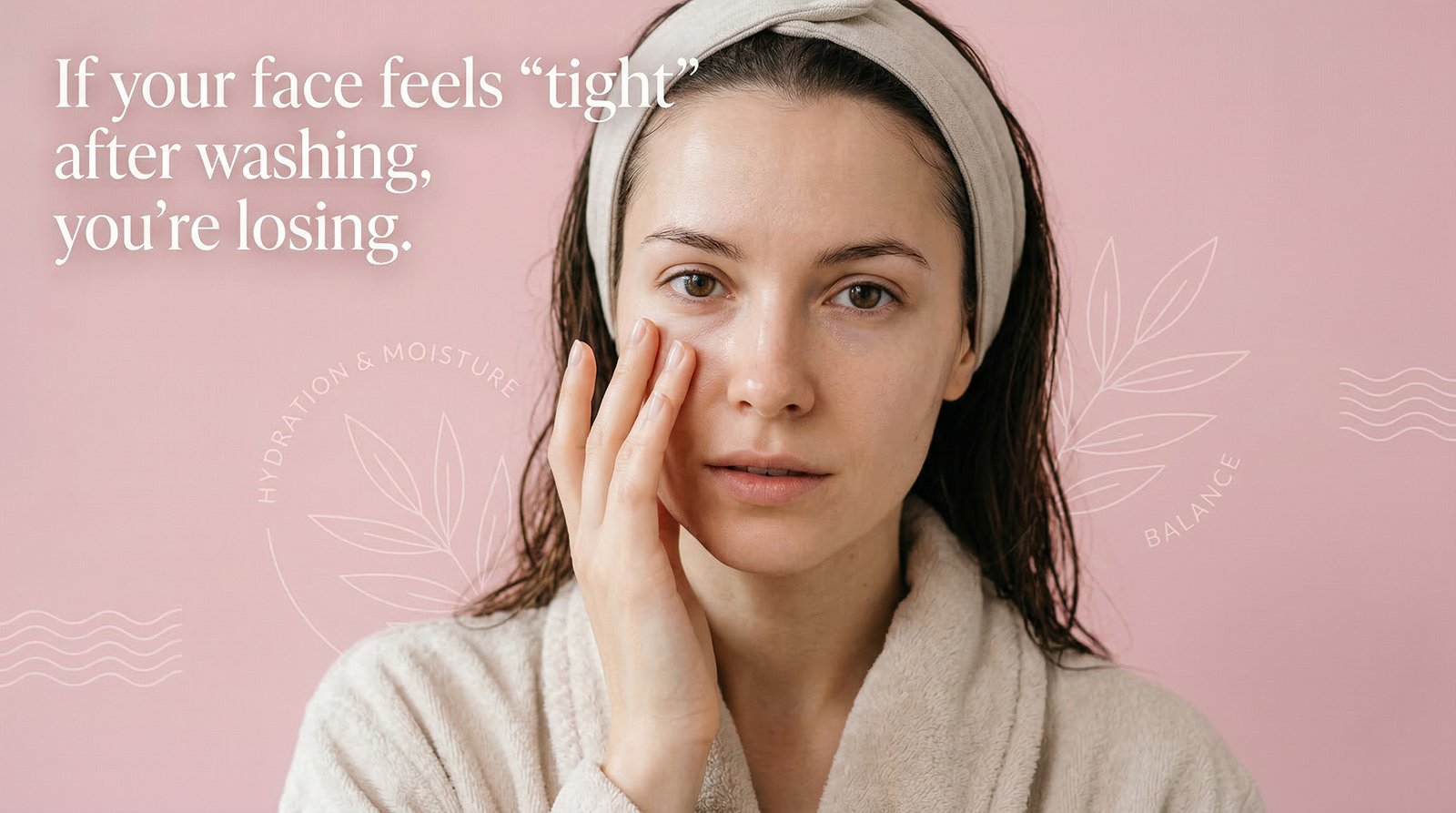
Urban pollution and heavy SPF create a stubborn, invisible seal that a single wash simply cannot break. You need a strategic two-step process to dissolve the day’s grime before you can actually treat the skin.
City Skin: Why One Wash Isn’t Enough for Urban Grime
The air you walked through today is sitting on your face right now.
Not metaphorically. Literally. Fine particulate matter combustion particles from vehicle exhaust, diesel fumes, and industrial emissions is small enough to lodge in your pores and bind to your sebum layer. Your standard face wash is not built to remove it. And your SPF? The sunscreen you applied faithfully this morning is still partially sitting on your skin, mixed with oil and everything you absorbed during the day. One rinse-off cleanser, no matter how expensive, cannot fully clear both of those things at once.
That’s not an opinion. That’s chemistry.
Double cleansing didn’t get popular because skincare brands needed to sell you two products. It got popular because it’s the logical response to what modern city air actually does to your skin every single day. The problem is most people are doing it wrong or using the wrong products and wondering why their barrier is still struggling.
What city air is depositing on your skin that your cleanser can't reach
Let’s get specific, because “pollution” is too vague a word for what your skin is actually absorbing.
Fine particulate matter PM2.5 consists of particles smaller than 2.5 micrometres in diameter. They come from vehicle exhaust, industrial combustion, cigarette smoke, and road dust. These particles are small enough to penetrate your stratum corneum and trigger cellular damage below the surface level.
Research published in PubMed found that PM2.5 directly induces oxidative stress in human keratinocytes, generating reactive oxygen species that cause DNA damage, lipid peroxidation, and protein carbonylation. In plain terms: these particles are activating inflammatory pathways inside your skin cells before your cleanser even touches them.
And the long-term picture is worse. Epidemiological research in Current Environmental Health Reports established a clear association between traffic-related air pollution particulate matter, soot, and nitrogen dioxide and premature skin aging across multiple independent cohorts. More pigmentation. Coarser texture. Deeper wrinkles. Not from UV alone. From the air you’re breathing.
That’s the skin you’re washing every night. It’s not just dirty. It’s carrying a daily inflammatory load that a 30-second face wash with a foaming cleanser was never designed to address.
The invisible residue layer your single cleanser is leaving behind right now
Here’s what’s actually on your face at the end of a city day.
Sebum. Sweat. Dead skin cells at the surface. Pollution particles embedded in that sebum layer. Residual SPF mineral or chemical that has been mixing with your skin’s own oils for eight or twelve hours. Possibly makeup or tinted moisturiser on top of everything.
These are not the same type of substance, and that’s the whole problem.
A water-based cleanser works through surfactant action it emulsifies water-soluble impurities and rinses them away. What it struggles with is the oil-soluble layer: the SPF film, the pollution-saturated sebum, the waxy components of what you applied. Surfactants can partially break these down. But “partially” isn’t the same as “removed.”
What you’re left with after one rinse-off cleanser is residue that sits between your skin and everything you apply afterward. Your serum isn’t penetrating clean skin. It’s sitting on an incomplete cleanse. Your retinoid is pressing through leftover SPF. Your barrier-repair moisturiser is sealing that incomplete layer in. And that residue isn’t neutral. It keeps inflammatory particles in prolonged contact with your skin cells, blocks absorption, and slowly congests your pores in ways that don’t announce themselves until weeks later.
Why "like dissolves like" is the actual science behind the first cleanse
The logic of double cleansing is grounded in a basic chemistry principle: like dissolves like.
Oil dissolves oil. An oil-based or milk-based first cleanser is chemically matched to the oil-soluble layer sitting on your skin the SPF, the pollution-embedded sebum, the lipid-soluble residue of everything you applied and everything that settled on you through the day. It emulsifies that layer completely, without requiring aggressive surfactant force.
Your water-based second cleanser then does exactly what it was designed to do remove water-soluble impurities and any remaining residue from a surface that’s now genuinely prepared for it.
Two steps. Two different problems. Two formulas matched to the chemistry of what they’re actually removing.
What doesn’t work: using micellar water and calling it double cleansing. Or using a balm and skipping the second step. Or foaming twice with the same surfactant. These are not double cleansing. They are the same type of action repeated, which doubles barrier disruption and delivers the same incomplete result.
The counterintuitive part: double cleansing done wrong strips your barrier faster than one cleanser
Here’s where most people accidentally make things worse.
You’ve heard that double cleansing is good. You buy an oil cleanser. Then you follow it with your regular foaming face wash the one with sodium lauryl sulphate, maybe a fragrance because that’s what you already own and you want a “deep clean” after the oil step.
Your skin ends up drier, tighter, and more reactive than it was before. You decide double cleansing “isn’t for your skin type.” You go back to one cleanser. Your barrier keeps struggling.
The problem wasn’t the method. It was the second product.
Research tracking microbiome shifts after cleansing found that microbial composition changes within hours of washing and that surfactant strength and pH determine whether those shifts disrupt or simply refresh your skin’s bacterial ecosystem. An aggressive, alkaline second cleanser after an oil step doesn’t clean more thoroughly. It strips an already prepped surface unnecessarily and it does it at a moment when your barrier has the least resistance to the disruption.
Your second cleanser needs to be mild. Formulated at a pH that respects your skin’s natural 4.5-5.5 acid mantle. Built to complete the cleanse without triggering the inflammation loop that makes your whole routine feel like it’s working against you.
Your microbiome is repairing overnight. Your second cleanser is either helping or sabotaging it.
This part of the double cleansing conversation gets skipped almost entirely.
Your skin hosts trillions of microorganisms that regulate inflammation, maintain pH balance, and suppress pathogenic bacteria. These don’t clock out at the end of the day. They’re part of your skin’s overnight repair cycle rebuilding the lipid matrix, moderating immune response, doing the quiet maintenance work that healthy skin depends on.
Over-cleansing with the wrong formula doesn’t just disrupt the lipid layer. It disrupts the bacterial landscape that the lipid layer supports. Studies on mild cleansers and microbiome diversity show that properly formulated gentle cleansers low surfactant, appropriate pH maintain microbial balance during regular daily use. Harsh formulas don’t, even when used once.
Use an aggressive second cleanser every night, and you’re not just stripping oil. You’re resetting a microbial community that takes time to restabilise, nightly, in a way that eventually expresses as chronic sensitivity, reactive flare-ups, and a barrier that never quite recovers between washes.
The goal of double cleansing is to remove the environmental layer PM2.5, SPF residue, pollution-embedded sebum while leaving the microbial and lipid infrastructure underneath it intact. That’s the difference between doing it intelligently and doing it for the ritual of it.
Sunscreen removal isn't a bonus benefit. It's the entire reason to double cleanse.
You wore SPF today. That’s not the problem. Leaving it on overnight is.
Mineral sunscreens zinc oxide, titanium dioxide sit on the surface as a physical barrier. They don’t metabolise or disappear when you go indoors. By 10pm, they’re still there, merged with sebum, pollution particles, and the day’s oxidative debris, pressed against your skin cells for the entirety of your sleep cycle.
Chemical sunscreens penetrate slightly into the stratum corneum to absorb UV. By the end of the day, they’ve partially mixed with your skin’s own lipid matrix they’re not rinsing off with water and a standard surfactant cleanser alone.
Data on PM2.5 exposure and skin pigmentation found that increased pollution exposure was associated with a 22% increase in pigmentation on the forehead and cheeks. That number compounds over years of incomplete nightly cleansing where residual SPF, pollution particles, and oxidative stress products remain in contact with skin cells through the night, driving the melanogenic and inflammatory pathways that result in hyperpigmentation and premature texture changes.
SPF in the morning protects your skin from what’s coming. The double cleanse at night removes what your SPF already captured. You need both. The morning step and the evening removal are a pair, not a sequence where one is optional.
If your actives aren't working, question your cleanse before you question your actives
Here’s the reality check your current routine needs.
If you’re using three serums, a prescription retinoid, and a dedicated brightening treatment and your skin is still congested, dull, or unresponsive stop adding. Start questioning the foundation.
Your actives are going onto a surface that hasn’t been fully cleared of the day’s environmental load. Your niacinamide is trying to work through residual SPF. Your hyaluronic acid is applying itself to skin that still has pollution-embedded sebum sitting in the upper layers of the stratum corneum.
More actives don’t fix an incomplete cleanse. They accumulate on top of it. You spend more. Your skin doesn’t move. You conclude you need a stronger formula or a different brand.
You don’t. You need a clean surface.
A complete, properly executed double cleanse changes how everything else in your routine performs not because it’s a magic step, but because it removes the physical and chemical barrier between your skin and the products designed to treat it.
The double cleanse routine — done in a way that doesn't wreck your barrier
Apply to dry skin. Always dry skin. The reason is chemistry: oil-based formulas emulsify with the oil-soluble layer on your face before water gets involved. Wet skin dilutes the first cleanser immediately and reduces its effectiveness.
Massage gently for about 60 seconds focusing on the nose, jaw, and T-zone where SPF and pollution accumulate most. Add a small amount of water to help it emulsify, then rinse.
The Pure Cleanse Cleansing Milk from “Minimals” handles this step without the heavy residue that some oil cleansers leave the kind that then requires aggressive surfactant force in the second step to remove. It lifts the environmental load cleanly so what comes next can be mild rather than compensatory.
Your skin is now actually ready for a water-based clean. The SPF and pollution layer is gone. Your second cleanser can do its job efficiently without overworking.
What it must not be: alkaline, fragrant, or high in harsh surfactants. The Nourish Calm Face Wash works here because it’s formulated to operate at a pH that doesn’t push your skin’s acid mantle into disruption. It finishes the cleanse without starting a new problem. Your skin should feel clean not tight. If it’s tight, the second cleanser is still wrong.
Now you have a properly cleared surface. One active, chosen for your primary concern.
The Ultra-Hydration HA Lotion applied after a proper double cleanse absorbs differently than it does on skin that hasn’t been fully cleared. Hyaluronic acid at the right molecular weight needs actual access to the stratum corneum to bind water effectively. Give it that access by giving it a clean surface first.
This is what most double-cleansing routines skip or underestimate.
You just removed the day’s oil-soluble layer. That includes some of your skin’s own ceramides and lipids, removed as collateral during a necessary and correct process. The seal step replenishes what needs to be there overnight the occlusive barrier that keeps TEWL low and gives your skin the uninterrupted repair window it actually needs.
The Calm & Soothe Soothing Lotion earns its place at this step because it’s built to calm the low-grade inflammation your skin accumulates from daily pollution exposure, then seal so your barrier isn’t starting overnight repair in a state of active irritation.
Morning: SPF. Again. Every day. The whole point of the double cleanse was to remove yesterday’s load so today’s protection has clean, intact skin to work on.
You don't need more. You need two cleansers that understand the problem they're actually solving.
Double cleansing is not a complicated routine. It’s two steps that address two chemically different problems in the right order, with the right formulas.
One oil or milk cleanser. One gentle water cleanser. Applied every evening, after any day that involved city air, SPF, or both.
Everything you layer after that serum, treatment, moisturiser will reach your skin the way it was formulated to. Not because you did more. Because you finally started from a surface that’s actually clean.
Browse the Minimals cleansers and find the pair that fits your skin type. Build from the foundation. The rest takes care of itself.
Common mistakes we all make
Here is the “short and sweet” version of where we usually go wrong:
Wet Hands/Face: Applying the first cleanser to wet skin ruins the chemistry. Dry skin, dry hands is the rule for step one.
The “Squeaky Clean” Myth: If your face feels tight after step two, your second cleanser is too harsh. It should feel soft, not stripped.
Rushing the Rinse: Not “emulsifying” (massaging with a little water until it turns milky) leaves a film of dirty oil on your skin.
AM Overkill: You don’t need a double cleanse in the morning. A single gentle wash (or just water) is plenty.
The Hairline Trap: Oil cleansers migrate. If you don’t rinse the edges of your face thoroughly, you’ll get breakouts along your hairline and jaw.
Temperature Extremes: Hot water irritates; cold water won’t melt the oils. Lukewarm is the sweet spot.
A simple "City-Clean" checklist
Frequently Asked Questions
Standard washes can’t fully remove the oily layer of SPF and city pollution trapped in your pores.
No, true double cleansing requires an oil-based step followed by a water-based step to respect skin chemistry.
Only if your second cleanser is too harsh; always use a mild, pH-balanced formula to protect your microbiome.
No, save the double cleanse for the evening to remove the day’s environmental load and SPF.
No, the second wash is essential to remove the “dirty” oil residue and prep your skin for treatments.
Closing thought
Double cleansing is more than a beauty ritual; it is a vital chemical process for anyone living in a modern environment. By using a “like dissolves like” approach, you effectively neutralize the inflammatory impact of PM2.5 particles and SPF residue without compromising your skin’s delicate microbiome. This foundational step ensures that your barrier remains resilient and that your active treatments can actually penetrate, turning your nightly routine into a true recovery phase for your skin.