
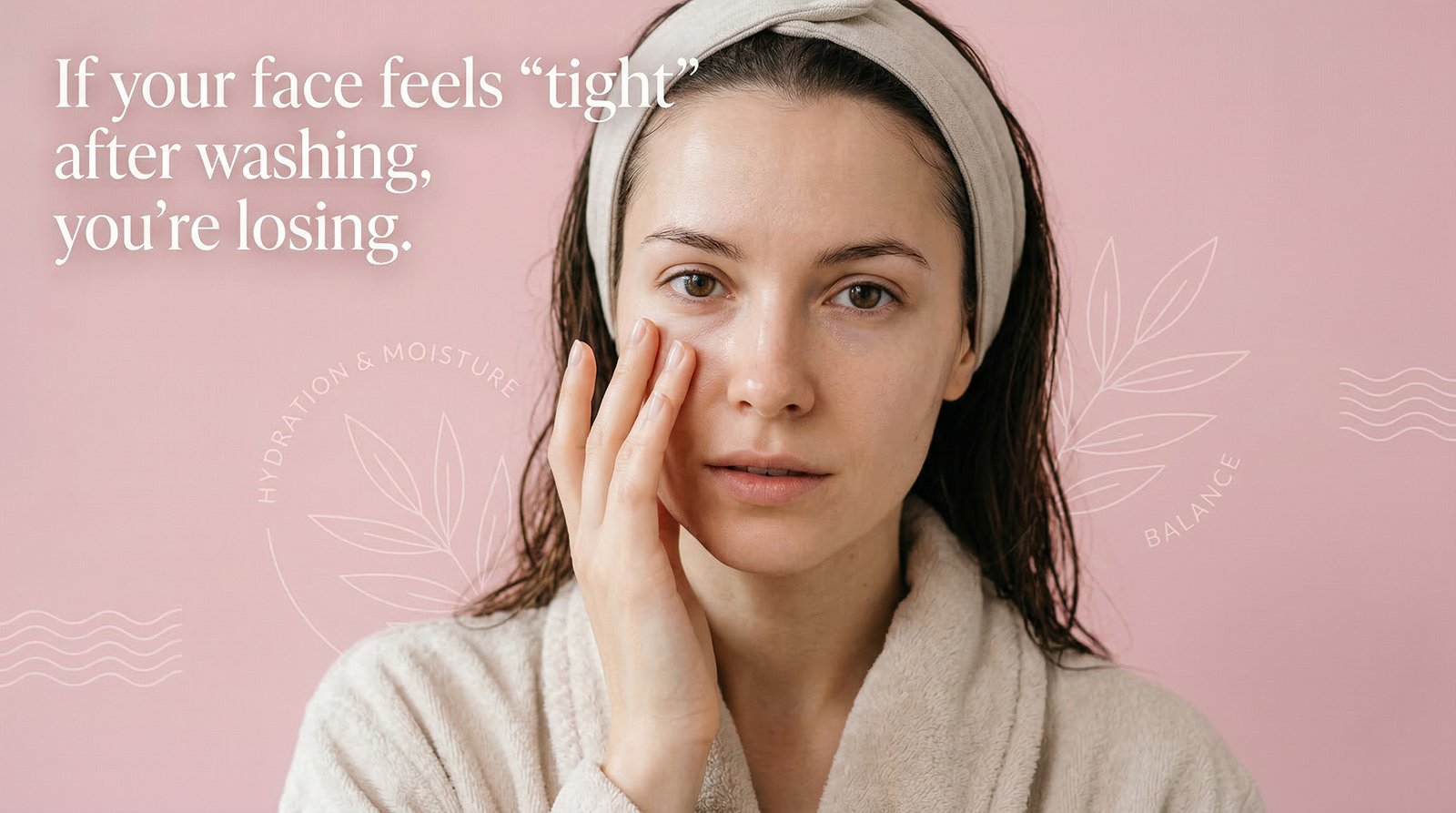
Smart ingredient choices and simple routines deliver salon-worthy results without the luxury price tag.
Inexpensive Skincare, Without Compromise
Your 10-step routine isn’t helping your skin. It’s exhausting it.
And the cruel irony? The more you spend the more you layer, the more you treat, the more you “target” the further your skin gets from the one thing it actually wants: to function on its own.
This isn’t a minimalism lecture. It’s a biology one.
What you put on your face in the next 30 days will either rebuild your skin’s natural defence or quietly dismantle it. And based on the average modern routine, most people are without knowing it doing the latter.
Here’s what’s actually happening. And here’s how to stop.
The Real Reason Your Skin Never Feels "Fixed"
Your skin barrier the outermost layer of your epidermis is a lipid matrix made up of ceramides, cholesterol, and fatty acids. Think of it as a brick wall, where skin cells are the bricks and those lipids are the mortar.
When that mortar is intact, moisture stays in. Irritants stay out. Your skin looks calm, plump, and crucially doesn’t need much help.
When it’s not intact, you get what dermatologists call increased transepidermal water loss (TEWL): water evaporating out of your skin faster than your body can replenish it. The result is that tight, dry, reactive feeling that most people mistake for dehydration and try to solve by adding more products.
More products that, nine times out of ten, make it worse.
“The real problem was never your skin type. It was the routine telling your skin it couldn’t function without intervention.”
The research is clear: barrier dysfunction is the root cause of most common skin complaints sensitivity, persistent dryness, breakouts, redness. And most of the time, that dysfunction isn’t genetic. It’s induced. By your routine.
Your Cleanser Might Be Causing the Breakouts You Blame on Hormones
Let’s talk about cleansers, because this is where most skin damage begins and where most people never think to look.
Foaming cleansers. “Deep clean” cleansers. Anything that claims to strip oil and leave skin feeling “squeaky clean.” That squeaky feeling? It’s not clean. That’s the sound of your acid mantle being destroyed.
Your skin’s surface is naturally slightly acidic around pH 4.5 to 5.5. Most traditional foaming cleansers sit at a pH of 9 to 11. Every time you wash your face with one, you’re disrupting that acid mantle, which in turn disrupts the microbiome that lives on it.
And your skin’s microbiome isn’t a side note. Studies published in the Journal of Investigative Dermatology have found that disruption of the cutaneous microbiome particularly the balance between Staphylococcus epidermidis and Cutibacterium acnes is directly linked to acne, eczema, and inflammatory skin conditions.
So when you over-cleanse, you’re not just drying your skin out. You’re destabilising an entire ecosystem that was actively protecting you.
You need a cleanser with a pH that respects your skin’s natural environment gentle enough to remove what doesn’t belong without stripping what does.
The Minimals cleansers are formulated at skin-compatible pH levels, with no sulphates and no fragrance because your microbiome shouldn’t be collateral damage for a marketing claim.
The "Hydration" Step That's Quietly Drying Your Skin Out
Here’s one that surprises people: hydration and moisture are not the same thing.
Hydration refers to water content in the skin. Moisture refers to the lipid layer that seals that water in. You can pour water into a cracked container all day. If you don’t fix the crack, the water keeps leaving.
This is why hyaluronic acid the ingredient everyone swears by can actually dry your skin out further if you use it wrong.
Hyaluronic acid is a humectant. It pulls moisture from its environment. When applied in a dry climate, or without a sealing moisturiser on top, it pulls moisture from your deeper skin layers and releases it into the air.
Wait, what? Yes. The ingredient marketed as the holy grail of hydration can actively dehydrate your skin if used without the right follow-up.
This is where the concept of moisture sandwiching becomes critical: apply your humectant to damp skin, then immediately seal with an occlusive or emollient moisturiser. The humectant draws water up; the moisturiser prevents it from escaping.
Without that second layer, you’ve done half the job and your skin pays the difference.
Why Layering Actives Is Making Your Skin More Reactive, Not Less
Retinol. Vitamin C. AHAs. BHAs. Niacinamide. Peptides. Every one of these has legitimate research behind it. And every one of them becomes a liability the moment you stack them without thinking.
The problem isn’t the ingredients. It’s the inflammation loop they create when overused.
Every active you apply triggers a low-grade immune response in your skin. A little of that is fine it’s how retinol stimulates collagen, how AHAs encourage cell turnover. But when you’re running five actives in a single routine, your skin never gets the recovery window it needs to actually benefit from any of them.
The result is chronic subclinical inflammation: your skin never fully inflames, never fully heals, just sits in a state of constant low-level stress. Dull. Reactive. Never quite balanced.
Research from the NIH has shown that repeated barrier disruption from overuse of chemical exfoliants increases cytokine activity and can accelerate the very skin ageing you’re trying to prevent.
You don’t need to stop using actives. You need to use fewer, use them intentionally, and give your barrier the space to respond.
One active per routine. Rotate them across the week if needed. And always always flank them with barrier support: a gentle cleanser before, a ceramide-rich moisturiser after.
The Minimals serums are designed around this principle single-focus, high-integrity formulations that don’t need a supporting cast to work.
Ceramides Are Not Optional. They're Infrastructure.
You’ve heard of ceramides. But most people treat them as a nice-to-have something they’ll add when they remember, or when the budget allows.
This is a mistake.
Ceramides make up approximately 50% of the lipid composition of your stratum corneum the outermost layer of your skin. They’re not a trend ingredient. They’re structural. Without them, your barrier literally cannot hold itself together.
As we age and as we over-cleanse, over-exfoliate, or expose skin to UV and pollution ceramide levels drop. That drop is directly correlated with increased TEWL, sensitivity, and the kind of dull, crepe-textured skin that no serum can fix from the outside if the structure underneath is depleted.
The good news: topical ceramides work. Dermatology Times has covered the clinical evidence ceramide-containing moisturisers measurably reduce TEWL and restore barrier function within weeks of consistent use.
The better news: you don’t need an expensive product to get them. You need the right formula.
This is the principle at the core of Minimals: skin doesn’t need more; it needs the right things in the right concentration. The Minimals moisturisers pair ceramides with cholesterol and fatty acids the complete lipid triad that research shows repairs barrier function more effectively than ceramides alone.
Expensive Doesn't Mean Effective. And Cheap Doesn't Mean Safe.
This is the nuance that gets lost in every skincare conversation.
The assumption most people operate under is a sliding scale: the more you spend, the better the result. And when the budget is tight, the fear is that you’re compromising your skin.
Neither is reliably true.
The luxury skincare industry runs on packaging, brand story, and fragrance none of which your skin can process. A $180 moisturiser with a beautiful glass jar and a patented “bio-matrix delivery complex” may perform no better than a $22 ceramide formula with clean, minimal ingredients. The active ingredient concentrations matter. The vehicle how a formula is emulsified matters. The price tag does not.
At the same time, the budget end of the market has its own traps: fragrance added to mask cheap base materials, alcohol used as a low-cost preservative that’s also a known barrier disruptor, and filler-heavy formulas that feel good on application and do very little after.
The question to ask isn’t “how much does this cost?” It’s: What is this actually doing to my barrier?
Every product in your routine should either be rebuilding your barrier, treating a specific, evidence-backed concern, or protecting against external stressors. If it doesn’t do one of those three things, it doesn’t need to be there.
If Your Routine Feels Complicated, That's the Problem
Seriously. A functional skincare routine should take three minutes. It should feel effortless. If you’re consulting a colour-coded schedule, rationing pH windows, or setting timers between steps something has gone wrong. Not because you’re doing too much work. Because someone sold you the idea that skin is a problem to be solved with enough effort.
It’s not. Skin is a barrier system that, when supported rather than overwhelmed, largely handles itself.
The SPF Step Nobody Wants to Hear About (But Can't Skip)
All of this the ceramides, the barrier work, the carefully chosen actives gets quietly undone if you’re not protecting your skin from UV.
UV radiation is the single largest external driver of barrier degradation, ceramide depletion, and collagen breakdown. NIH research estimates that up to 80% of visible facial ageing is attributable to UV exposure not time, not genetics. UV.
You don’t need a complex SPF protocol. You need a broad-spectrum SPF 30 minimum, applied every morning, reapplied if you’re spending meaningful time outdoors.
That’s it. That’s the step. And it costs less than most serums.
The Minimal Routine Blueprint
Four steps. Every skin type. No colour-coded schedule required.
pH-balanced, sulphate-free, fragrance-free. Morning: rinse with water or use a gentle low-lather formula. Evening: actually cleanse. If you wear SPF or makeup, double cleanse oil first, then your gentle cleanser. Explore cleansers →
One active. Applied to still-damp skin if it’s a humectant or water-based serum. Retinol goes on dry skin, to buffer irritation. You don’t need three serums. You need one that’s right for what your skin actually needs right now.
Ceramide-led moisturiser. Applied while skin is still slightly damp from your serum. This is the moisture sandwich: humectants draw water up, ceramides lock it in. This step is non-negotiable whether your skin is dry, oily, or “combination.” Explore moisturisers →
Broad-spectrum SPF 30+. The last step in your morning routine. Nothing photoprotective goes under it. If your moisturiser already contains SPF, that counts as long as it’s a real SPF, not a trace of titanium dioxide for optics.
What "Inexpensive Without Compromise" Actually Means
It doesn’t mean cheap. It means ruthlessly prioritised.
Compromise happens when you buy a product because it was recommended by someone with a sponsored shelf, because the packaging convinced you it was worth £60, or because you panicked about an ingredient you read about at midnight.
No-compromise skincare means understanding what your skin’s barrier actually needs ceramides, compatible pH, no unnecessary irritants and spending exactly what it costs to get those things. Not a penny more for the brand equity. Not a penny less in ways that genuinely shortchange the formula. Most skin doesn’t need rescuing. It needs to be left alone with a small number of things that actually support it.
That’s skinimalism. Not a trend. A return to how skin was always meant to work.
Common mistakes we all make
Here are the 5 biggest mistakes most people make that quietly destroy the skin barrier:
Using foaming, sulphate-heavy, or “deep clean” cleansers that strip your skin’s natural oils and raise its pH. This damages the acid mantle, disrupts the microbiome, and often causes the breakouts and dryness you’re trying to fix.
Stacking too many actives (retinol, AHA, BHA, vitamin C, etc.) at once. It creates constant low-grade inflammation, weakens the barrier, and makes skin more reactive instead of healthier.
Applying hyaluronic acid or other humectants without sealing them in, especially in dry climates. This can actually pull moisture out of your skin, leaving it tighter and drier.
Treating ceramides as optional instead of essential. Without enough ceramides, cholesterol, and fatty acids, your skin barrier can’t hold moisture or protect itself, no matter how many serums you use.
Not using broad-spectrum SPF 30+ daily (or using too little). UV damage is the #1 cause of premature aging, barrier breakdown, and collagen loss and it undoes all your other efforts.
Fix these five, and most other skin issues improve dramatically. Less really is more.
A simple "Skincare Mistakes" checklist
Frequently Asked Questions
Using harsh foaming cleansers and layering too many actives. These two damage the skin barrier the most and create the problems (dryness, breakouts, sensitivity) they try to solve.
No but using it wrong is. Apply it on damp skin and always seal with a moisturiser. Without the seal, it can pull moisture out and make skin drier.
Just 4 steps: Gentle cleanser → One active → Ceramide moisturiser → SPF (morning). Most people do better with fewer products, not more.
Yes. They make up 50% of your skin’s natural barrier. Without them, no amount of hydration or actives will fix dryness or sensitivity long-term.
Not necessarily. Price doesn’t equal results. Focus on clean formulas with the right ingredients (ceramides, proper pH, no fragrance) instead of brand names.
Closing thought
Your skin doesn’t need to be fixed. It needs to be trusted.
Most skin problems today aren’t caused by aging, hormones, or genetics they’re caused by doing too much. The moment you stop attacking your skin and start supporting its natural barrier, it begins to heal itself. Less layering. Fewer actives. More respect for biology. Commit to a simple, barrier-first routine for the next 30 days. Gentle cleansing, smart treatment, proper sealing, and daily SPF. That’s it. You’ll likely spend less money, save time, and finally see the calm, healthy skin you’ve been chasing all along.
Your skin knows what to do. Give it the chance to prove it.
You’ve got this.