
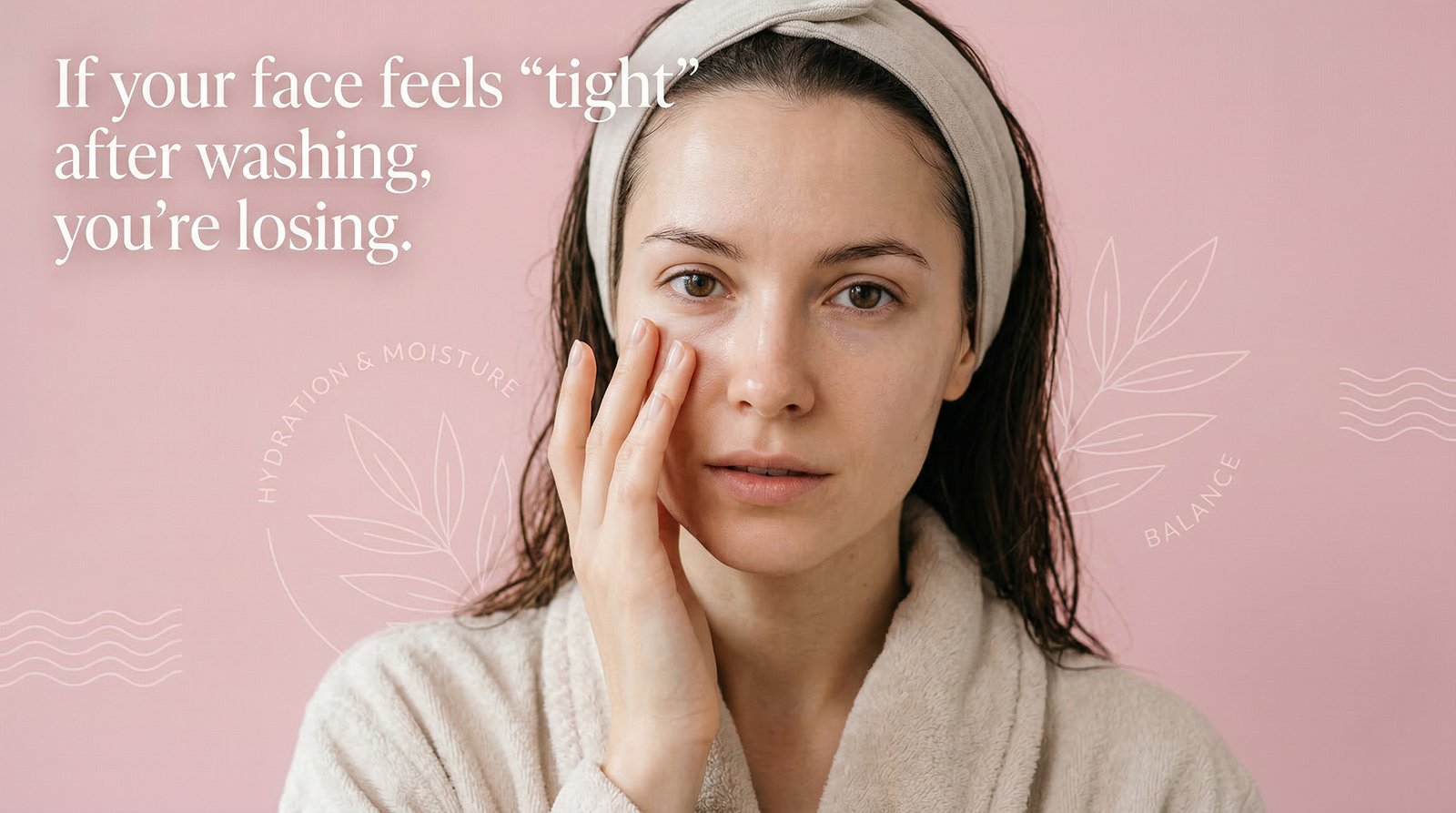
Because “Dermatologist Tested” doesn’t always mean safe, effective, or suitable for your skin.
The Empty Promise of “Dermatologist Tested”
Your expensive serum says “dermatologist tested.” Your cleanser promises the same. Yet your skin still feels tight, reactive, or somehow never quite right. That label isn’t lying. It’s just not telling you much.
“Dermatologist tested” can mean a doctor looked at the formula once. Or supervised a 20-person patch test. Or simply got paid to review ingredients. There’s no regulated standard, no required public data on results, and no guarantee it won’t irritate your skin after weeks of use.
You’ve been sold the illusion of medical oversight while your barrier quietly falls apart.
The Label That Quietly Lets Brands Off the Hook
Most “dermatologist tested” claims involve short-term irritation or sensitization tests. A dermatologist oversees patch testing on a small group. If few people react badly in 48 hours, the label goes on.
That tells you almost nothing about long-term barrier health, microbiome balance, or how the product performs on skin that’s already compromised which, let’s be honest, is most of us dealing with pollution, stress, and indoor heating.
Real skin problems show up after consistent use. Cumulative damage. Slow erosion of your lipid matrix. The kind of issues one quick test never catches.
What’s Actually Happening to Your Skin
Your stratum corneum the outermost layer acts like brick-and-mortar. Corneocytes are the bricks. The mortar is a precise mix of ceramides, cholesterol, and free fatty acids.
When that mortar thins or gets the wrong ratio, transepidermal water loss (TEWL) climbs. Your skin loses moisture faster than it can hold it. Inflammation kicks in. You reach for more “soothing” products. The cycle tightens.
Hydration ≠ moisture. This is the counterintuitive truth most routines ignore. Hydration pulls water in (humectants like glycerin or hyaluronic acid). Moisture seals it (lipids that rebuild the barrier). Flood your skin with humectants without a solid seal and you can actually increase TEWL on dry days.
Your skin ends up dehydrated and irritated.
Why Over-Cleansing Is Silently Destroying Your Progress
You double-cleanse because TikTok said so. Or you use a foaming “deep clean” wash twice daily.
Each time you strip the surface, you remove not just dirt but parts of the lipid matrix and beneficial microbes. The skin microbiome that ecosystem of bacteria, fungi, and viruses living on you gets disrupted. Commensal bacteria that help regulate inflammation and support barrier repair take a hit.
Result? More redness, more breakouts, more “sensitivity.” You blame hormones or diet. The real culprit is the routine that never gives your skin time to recover.
Harsh surfactants can elevate pH, further weakening the acid mantle that keeps bad bacteria in check.
The Myth of More Steps, More Results
Layering five actives every night sounds dedicated. Biologically, it’s often counterproductive.
Your skin has limited tolerance. Introduce too many exfoliants, retinoids, or acids at once and you trigger an inflammation loop. The barrier takes another hit. TEWL rises. You need even more soothing layers to calm what you just aggravated.
Less really is better when the few things you use are formulated to work with your biology instead of overriding it.
What “Dermatologist Tested” Should Actually Mean (But Rarely Does)
The best testing looks at:
Most labels skip all that. They test for safety in a narrow sense, then market it like a full endorsement.
A 2024 review on ceramides highlighted how poorly formulated lipids can sit on the skin without integrating into the lamellar structures they don’t repair, they just coat. Proper formulation matters far more than who signed off on the jar.
The Skinimalism Shift: Fewer Products, Deeper Repair
Skinimalism isn’t about minimal effort. It’s about maximal respect for your skin’s own processes. Focus on supporting the barrier first. Let your microbiome stabilize. Give actives room to work without constant interference.
When the foundation is solid, you need far less to see real change. No more chasing symptoms with another serum.
Your Cleanser Might Be the Biggest Barrier Offender
Many cleansers prioritize foam and “clean” feel over compatibility. They emulsify oils aggressively, pulling essential lipids with the sebum. At this point, your skin doesn’t need another stripping wash. It needs a cleanser that removes what shouldn’t be there while preserving what should.
“Minimal” cleansers are built around this gentle enough for daily use without triggering the rebound oil or tightness cycle. They let you cleanse without starting the damage clock over every morning and night.
Why Most Moisturizers Fail at Actual Repair
A good moisturizer doesn’t just sit on top. It delivers the right lipids in a form your skin can actually use to rebuild those lamellar structures. Look for properly formulated ceramides that mimic your natural ratios. Many products throw in cheap versions or wrong chain lengths that don’t integrate well.
“Minimal” moisturizers focus on this repair-first approach. They’re not adding another layer of temporary comfort. They’re giving your skin the materials it’s missing so it can eventually need less from you.
The Treat Step That Doesn’t Fight Your Skin
Actives have their place. But they work best on skin that can tolerate them meaning a functioning barrier. Instead of loading up on multiple exfoliants or brighteners, choose one targeted treatment that addresses your main concern without torching everything else. Then support it with barrier care.
This prevents the inflammation loops that make sensitive skin worse over time.
If Your Routine Feels Complicated, That’s the Problem
Be brutally honest for a second.
How many products are you using because you’re scared to drop them? How many steps exist because the internet convinced you one wasn’t enough?
Complicated routines create dependency. Your skin stops functioning optimally on its own because it’s constantly being prodded and coated. The goal of good skincare is to need less of it over time, not more.
Your Minimal Routine Blueprint
Keep it to 3 to 4 steps that actually pull their weight.
Same as above, plus broad-spectrum sunscreen.
That’s it.
No 10-step sandwich. No nightly acid parade. Just consistent support for what your skin already knows how to do when not interfered with. “Moisture sandwiching” only becomes necessary when your base layers are wrong. Get the fundamentals right and you simplify everything.
What Real Progress Looks Like
Less tightness after cleansing. Fewer random breakouts. Skin that bounces back instead of staying red or flaky. The quiet confidence that comes from a barrier that’s actually working. You won’t see overnight miracles because that’s rarely how biology works. You’ll see steady, sustainable improvement as your skin stops fighting the routine.
You Don’t Need More Products. You Need Fewer That Actually Work.
The “dermatologist tested” label distracted you long enough. Real skin health comes from understanding the barrier, respecting the microbiome, and refusing to overcomplicate what doesn’t need to be complicated. Start there. Strip back to basics done right. Your skin will tell you when it’s grateful usually by needing less intervention, not more.
Explore the “Minimal” essentials at minimals.com.co formulas built for barrier repair, not marketing claims.
Your skin has been through enough experiments. Time to give it what it actually needs.
Common mistakes we all make
You see “dermatologist tested” and think you’re safe. Six weeks later your skin is tight, flaky, or breaking out. That label is the mistake. Most tests are quick patch trials on healthy skin. No long-term barrier studies. No microbiome data. It’s legal marketing, not real protection. Your lipid mortar thins. TEWL rises. Inflammation starts. You blame your skin instead of the routine.
Hydration without repair backfires. Humectants pull water in, but without proper ceramides it leaks right back out leaving you drier. Stop trusting vague claims. Listen to your skin. Switch to formulas that actually repair gentle cleansers that don’t strip, and moisturizers with skin-identical lipids.
“Minimals” was built for exactly this fewer steps that fix the foundation instead of fighting it.
Drop what’s not working. Keep only what respects your barrier. Your skin calms down when you finally stop making this mistake.
A simple "Skin Health Essential" checklist
Frequently Asked Questions
No. It usually just means a doctor confirmed it didn’t cause an immediate reaction on a small group. It is a safety check, not a performance guarantee.
You likely have a damaged barrier. If your moisturizer lacks the proper lipid ratio (ceramides, cholesterol, fatty acids), water evaporates through “cracks” in your skin, leaving it dehydrated.
Not necessarily, but it is often overkill. If you aren’t wearing heavy waterproof makeup or thick zinc sunscreen, a single gentle cleanser is better for preserving your microbiome.
Signs include persistent redness, stinging when you apply basic moisturizer, or “random” breakouts. If your skin stays reactive, you’re likely in an inflammation loop.
Biology takes time. While some irritation may subside in days, it generally takes 28 to 45 days for your skin cycle to renew and the barrier to truly stabilize.
Closing thought
The “dermatologist tested” seal is often more of a marketing shield than a medical guarantee. Real skin health isn’t found in a logo or a complex 10-step regimen; it’s found in the quiet, consistent support of your skin’s natural biology. Your barrier is a sophisticated ecosystem that knows how to protect and repair itself, provided you stop interfering with harsh surfactants and an overload of competing actives.
True progress is signaled not by the number of products on your vanity, but by how little your skin demands from you daily. When you prioritize lipid-rich moisture and gentle cleansing, you break the cycle of chronic inflammation and “rebound” sensitivity. Skinimalism isn’t about doing the bare minimum it’s about doing the most effective work with fewer, better ingredients. Respect your microbiome, protect your lipid matrix, and trust that when it comes to long-term radiance, less intervention almost always leads to more resilience.