
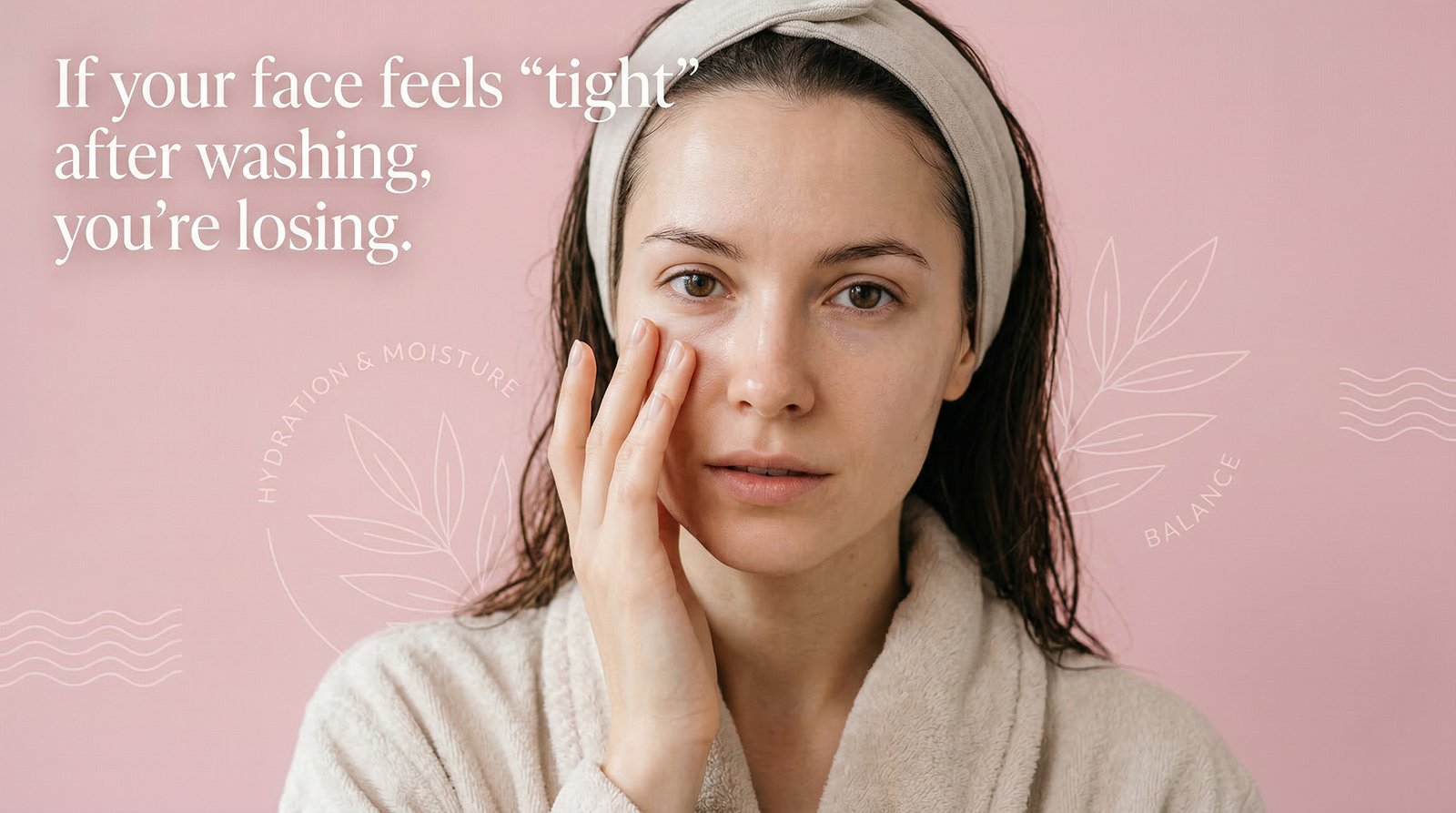
Ditch the 10-step routine and repair your skin barrier with a minimalist, dermatologist-backed approach to healthier skin.
Why Your 10-Step Skincare Routine Is Doing More Harm Than Good
You’re not under-treating your skin. You’re overwhelming it.
Every redness flare-up, every breakout you blame on “hormones” or “stress,” and every patch of skin that feels tight no matter how much you moisturize there’s a decent chance your routine is the reason, not the rescue. Here is the uncomfortable truth: more products usually mean a less functional skin barrier. It’s not because the individual formulas are bad, but because your skin needs consistency and recovery time far more than it needs a multi-step cocktail of ingredients.
Let’s talk about why stripping back your routine is the ultimate strategy for healthier skin.
The Skin Barrier Doesn't Care How Many Steps You Did
Here is a shorter, punchier version that keeps the scientific facts but reads like a conversation with a friend: Your skin has one main job: keep the outside world out and your moisture in.
It does this using a protective shield called the lipid matrix a blend of ceramides, cholesterol, and fatty acids that act like mortar holding your skin cells together like bricks. When that mortar is healthy, your skin stays hydrated. When it’s damaged, moisture evaporates straight out into the air. Scientists call this transepidermal water loss (TEWL), and it’s a clear sign your barrier is failing.
Every time you scrub too hard, layer multiple strong treatments, or over-exfoliate, you chip away at that protective mortar. Your skin doesn’t see this as self-care; it sees it as an attack.
The trickiest part? This damage builds up slowly. It doesn’t show up overnight. It hits you weeks later as “sensitive skin” that seemingly appeared out of nowhere. But you didn’t suddenly develop sensitive skin you built it, one unnecessary step at a time.
Six Signs Your Barrier Is Already Compromised
Most of us don’t notice a damaged skin barrier until it’s already crying for help. Here is how to tell if your skin is secretly struggling:
Sudden Stinging: Your go-to products suddenly burn.
Instant Tightness: Your face feels shrunk right after washing it.
Stubborn Redness: Patchy dry spots that ignore your moisturizer.
Ghost Breakouts: Acne that keeps popping up in the exact same spots.
Fake Dullness: Your skin looks tired, no matter how much you scrub.
The Film Effect: Skincare just sits on top of your face instead of soaking in.
If you’re nodding along to two or more of these, stop buying new products. Your skin doesn’t need a new miracle cure it just needs a break.
Less Isn't a Compromise. It's the Smarter Strategy.
The beauty industry sells skincare the way fast fashion sells clothes: convincing you that you need a different item for every single occasion just to keep you buying.
Skinimalism is the exact opposite. It’s about using fewer, high-quality products that actually do what your skin needs. This isn’t just a minimalist aesthetic it’s a biological fact that your skin can only process so much at once. Every extra bottle you open just crowds its capacity to heal.
In fact, a simple 3-step routine will outperform a chaotic 10-step routine almost immediately, simply because your skin can stop fighting off a dozen ingredients and finally rest.
Stop asking, “What else should I add?” and start asking, “What can I take away?” You’ll be surprised by how much your skin didn’t need in the first place.
Wait, What? Hydration and Moisture Aren't the Same Thing
This is the big distinction that trips almost everyone up: hydration is about putting water into your skin, while moisture is about locking that water in.
Think of it this way: you can slather on hyaluronic acid serum all day for hydration, but if you don’t seal it with a moisturizer, that water evaporates right into the air. Even worse, it can actually pull extra water out from the deeper layers of your skin on its way out, leaving you drier than before.
That’s exactly why a multi-step “hydrating” routine can leave your face feeling tighter after just a couple of weeks. You don’t need another hydrating serum. You just need a healthy barrier to lock in what’s already there.
Your Cleanser Might Be Wiping Out the Bacteria Protecting You
Your skin isn’t meant to be sterile. It’s home to a thriving community of good bacteria your microbiome that fights off inflammation and keeps bad bacteria in check.
When you double-cleanse, use harsh foaming washes, or scrub daily, you aren’t just washing away dirt. You are wiping out this entire ecosystem. Harsh cleansers can’t tell the difference between makeup and the natural lipids your skin needs to survive.
The result? Your skin isn’t actually cleaner it’s destabilized. That “squeaky clean” feeling is actually the sound of a stripped, defenseless barrier that will likely break out or flare up in a few days.
This is where most routines fail at step one. You don’t need a cleanser that fights your skin; you need one that respects it. That is exactly why we created the Minimals cleanse to clear away the day’s grime without stripping the protective layer your skin relies on.
Your Skin Has a pH, and Most Cleansers Ignore It
Healthy skin is naturally slightly acidic, sitting at a pH around 4.5 to 5.5. Dermatologists call this your acid mantle, and it acts like an invisible shield to keep bad bacteria out and help your skin repair itself.
The problem? Most traditional soaps and cleansers are highly alkaline, sitting at a harsh pH of 9 or 10.
Every time you wash with something that alkaline, you throw your skin’s natural chemistry out of whack. Your skin’s repair system slows down, giving acne-causing bacteria a perfect window to take over. Do this twice a day, and your skin never gets a chance to recover.
A product’s pH is rarely printed clearly on the label, but it is the ultimate test of whether a “gentle” cleanser is actually gentle, or just has good marketing.
"Natural" and "Gentle" Aren't the Same Word
Here is a short, human-friendly version that busts the “natural is always better” myth:
A lot of people switch to “natural” skincare assuming it’s automatically safer for sensitive skin. It isn’t.
Essential oils, citrus extracts, and plant-derived ingredients can crush your skin barrier just as fast as synthetic chemicals. In fact, raw plant extracts often skip the strict pH and stability testing that lab-formulated ingredients go through. Plus, whether a fragrance comes from a flower or a lab, it remains one of the top causes of skin irritation and allergic reactions in dermatology clinics.
This isn’t to say natural ingredients are bad. It just means you shouldn’t let a “green” label trick you into thinking a product is gentle. What matters is how the product is formulated, not the marketing buzzwords on the bottle.
Layering Five Actives Doesn't Multiply Results. It Multiplies Inflammation.
Retinol on Monday, Vitamin C in the morning, niacinamide and an exfoliating acid at night plus a new serum every time your skin looks slightly dull.
While each ingredient might be great on its own, mixing them all together daily is a recipe for disaster. Active ingredients work by creating a tiny, controlled amount of stress to trigger a skin response. Your skin can easily handle one active, but when you layer three or four at once, you trap your skin in a constant state of inflammation.
This triggers a vicious loop: irritation breaks your skin barrier, a weaker barrier makes your skin react even worse to the next product, and you try to fix that new reaction with more products.
You can’t fix inflamed skin by adding more steps. You fix it by stripping your routine down and giving your skin room to breathe. One well-formulated product that does its job precisely will always beat a five-product stack that overwhelms your skin.
"Brightening" Isn't a Skin Goal. It's a Symptom You're Chasing the Wrong Way
Most of the time, dull skin isn’t a pigment problem it’s a damaged barrier problem.
When your skin’s protective shield is cracked, it can’t reflect light smoothly. Instead, it looks tired, uneven, and lackluster. Our instant reaction is usually to reach for a harsh brightening serum or a stronger scrub. But if your barrier is already broken, more exfoliation just deepens the wound. You end up chasing a symptom with the exact thing that caused it.
Before you buy another brightening product, ask yourself: is your skin actually hyperpigmented, or is it just exhausted, inflamed, and dehydrated? More often than not, it’s the second one. The real fix isn’t another active ingredient; it’s simply giving your barrier the tools to repair itself.
Over-Exfoliation Doesn't Make Skin "Renew Faster." It Makes It Defensive.
Here is a short, human-friendly version that makes the reality of over-exfoliation perfectly clear:
Exfoliation has its place, but that place is rarely every single day.
Each time you scrub or use an acid, you pull away skin cells before they are actually ready to shed. Do this too often, and your skin won’t get smoother it just gets thinner, highly reactive, and terrible at holding onto moisture. Aggressive exfoliation literally strips away the natural ceramides your barrier needs to stay healthy.
If your skin has felt “sensitive” for months and nothing seems to calm it down, look at how often you are exfoliating before you reach for a new soothing serum. Otherwise, you’re just trying to bandage a wound you are still creating.
If Your Routine Feels Complicated, That's the Problem
The real enemy isn’t the dryness or the breakouts it is the complexity of your routine itself.
Healthy skin doesn’t require eight separate decisions every morning; it just needs consistency with a few things that actually work. If you are constantly cycling through products, troubleshooting random reactions, and guessing what is helping versus what is hurting, your skin isn’t confused. It’s just overloaded. And honestly, so are you.
Be real about your current lineup: the random serum you added during a breakout week, the toner you aren’t sure does anything, the mask a video told you to buy. If you can’t explain exactly what a step is doing for your skin, you probably don’t need it.
“Routine fatigue” is real. When you force your skin to process five to ten different formulas every single day, it never gets a quiet moment to actually heal. Recovery doesn’t need more input it just needs some peace and quiet.
The Routine Your Skin Actually Asked For
Here’s what a barrier-first, skinimalist routine actually looks like. No spreadsheet required.
A gentle, low-pH formula that removes the day without stripping the lipids underneath it. If your face feels “squeaky,” this step is working against you, not for you.
One active at a time. Give it weeks, not days, before judging whether it’s working most actives need four to six weeks before you can tell the difference between irritation and progress.
A ceramide-forward moisturizer that locks hydration in instead of letting it evaporate by morning. This is the step most routines skip or underdose, and it’s the one doing the most structural work.
SPF. Not optional, not negotiable the one step no amount of minimalism gets to skip.
That’s it. Four steps, each doing a job the others can’t replace. Notice what’s missing: no toner “just in case,” no seventh serum for a problem you don’t actually have, no extra exfoliant to compensate for a cleanser that wasn’t gentle enough in the first place.
Every step you add back into this should be answering a problem you can name not a fear of missing out on whatever’s trending this month.
At This Point, Your Skin Doesn't Need Another Step
It needs fewer steps that already do two jobs at once.
A cleanser that clears without disrupting your microbiome. A serum concentrated enough that you don’t need three more next to it. A moisturizer that’s actually rebuilding your barrier instead of just sitting on top of it. That’s the whole bet behind skinimalism: less interference, more recovery.
Common mistakes we all make
Here are the biggest skincare mistakes we all make, stripped of the jargon and written like a quick reality check:
If your skin feels tight after washing, it isn’t clean it’s stripped. That squeak means you’ve washed away the good bacteria and natural oils your skin needs to stay healthy.
Slathering on hydrating serums (like hyaluronic acid) without a good moisturizer on top is useless. Without that seal, the water just evaporates into the air, pulling your skin’s deep moisture out with it.
Mixing retinol, vitamin C, and acids in the same week traps your skin in a constant state of irritation. Your skin can recover from one strong ingredient, but three or four at once feels like an attack.
When your skin looks tired, your instinct is to exfoliate. But dullness is usually a sign of a damaged, dehydrated skin barrier, not dead skin. Scrubbing a damaged barrier just makes it worse.
“Natural” doesn’t automatically mean gentle. Ingredients like essential oils and citrus extracts can irritate your face just as fast as any synthetic chemical.
When your skin flares up, you probably buy a new “calming” serum to fix it. Usually, the breakout happened because your routine is too complicated. Your skin doesn’t need another product it needs a break.
A simple "Skincare Detox" checklist
Frequently Asked Questions
If products suddenly sting, your face feels tight right after washing, or you have random red patches that won’t go away, your barrier is likely broken.
Hydration adds water into your skin cells. Moisture acts like a blanket that locks that water in so it cannot evaporate into the air.
Not at the same time. Stacking them daily overloads your skin and causes constant irritation. Stick to one active at a time, or use Vitamin C in the morning and Retinol at night.
Because over-exfoliating strips your skin’s protective lipid layer. A damaged barrier reflects light unevenly, making your skin look tired and dull instead of smooth.
Not automatically. Plant extracts, essential oils, and citrus can be highly irritating. What matters is a product’s lab testing and pH level, not the “natural” marketing label.
Closing thought
You can keep buying. The industry is built on you doing that. Or you can simplify, let your barrier recover, and watch most of the issues you’ve been “treating” for months quietly disappear on their own.
Start with the cleanser. Add the serum when your skin is ready for it. Seal it with the moisturizer.
That’s a routine. Everything else was noise.