
A “base tan” is just a down payment on a face you won’t recognize in ten years.
Your Biological "Shield" Is Actually a Structural Collapse
It’s pre-ordered wrinkles, delivered with a side of DNA fragmentation. If you’re sitting on a beach trying to “prepare” your skin for a vacation, you aren’t building a shield.
You are watching your collagen snap in real-time.
The "Base Tan" is a Biological SOS
Let’s be clear a tan is not a sign of health. In the world of dermatology, a tan is technically a scar. When UV radiation hits your skin, it causes direct damage to your cellular DNA. Your skin responds by pumping out melanin to try and usually fail to prevent further mutation. By the time you see a “glow,” the damage is already done. You’ve triggered an inflammatory cascade that eats your protein matrix for breakfast.
Your Skin Doesn't Have a Memory, It Has a Ledger
Every minute you spend “building” that base tan is recorded in your dermal layer.
UVB rays hit the surface (burn), but UVA rays go deep. UVA is the silent destroyer of the lipid matrix.
It generates reactive oxygen species (ROS) that degrade your ceramide levels. When those ceramides drop, your barrier leaks. You aren’t getting “sun-kissed”; you’re inducing Transepidermal Water Loss (TEWL).
Why Your "Preventative" Tanning is Actually Aging You Faster
The logic usually goes: “If I get a little color now, I won’t burn later.”
This is like saying, “If I set my kitchen on fire now, the rest of the house won’t burn down. A base tan provides an SPF of roughly 3 to 4. That is effectively useless. While you think you’re protecting yourself, you’re actually thinning your dermis.
The Collagen Debt You Can't Repay
UV exposure triggers an enzyme called Matrix Metalloproteinases (MMPs). Think of MMPs as tiny molecular scissors.
Their only job is to shred collagen and elastin fibers. Once those fibers are cut, they don’t just “spring back.”
This is how you end up with “leather face” in your 40s while wondering why your expensive night cream isn’t working. It’s not working because you’re trying to fix a structural collapse with a topical band-aid.
The "Healthy Glow" is Just Inflammation in Disguise
We’ve been conditioned to think a slightly pink or bronzed cheek looks vibrant. In reality, that color is the result of vasodilation. Your body is rushing blood to the surface to repair the oxidative stress you just handed it. This constant state of low-grade inflammation is what we call “Inflammaging.” It’s a loop.
The sun damages the barrier -> the barrier becomes permeable -> irritants get in -> more inflammation.
The Myth of the "Sun-Cured" Acne
Many people seek the sun because it “dries out” their breakouts. It’s a trap. The UV rays might temporarily kill some surface bacteria, but they also thicken the outer layer of your skin (hyperkeratosis). This traps sebum deeper in the pore. Two weeks after your “healing” vacation, you’ll face a massive breakout of solar comedones. Instead of chasing the sun, you should be focused on a high-performance cleanser that removes debris without stripping the acid mantle.
Your Barrier is the Only Defense That Matters
If you want skin that looks good at 50, stop looking for “actives” and start looking at your barrier. Your skin is a brick-and-mortar structure. The cells are the bricks; the lipids (ceramides, cholesterol, fatty acids) are the mortar. Sun exposure dissolves the mortar. When the mortar is gone, your skin can’t hold onto hydration. This is the “counterintuitive” part: Most people think they have dry skin. They don’t. They have a compromised barrier that is allowing all their internal moisture to evaporate.
Hydration is Not Moisture
You can drink a gallon of water and apply hyaluronic acid all day. If your barrier is broken from “base tanning,” that water will just leave. Hydration is the water inside the cells. Moisture is the oil that keeps it there. You need a formula that mimics your skin’s natural lipid composition, not a 12-step routine that confuses your microbiome.
The Microbiome Disruption Nobody Talks About
Your skin is a living ecosystem of bacteria, fungi, and viruses. This microbiome is your first line of defense against pathogens and environmental stress. UV radiation acts like a broad-spectrum antibiotic. It wipes out the “good” bacteria that keep your skin’s pH balanced. When the microbiome is skewed, you develop sensitivity, redness, and “random” reactions to products you used to love. Stop nuking your face for the sake of a temporary tint. Your bacteria deserve better.
If Your Routine Feels Complicated, That’s the Problem
The skincare industry thrives on your insecurity. They want you to believe you need a cabinet full of glass bottles to “undo” the damage of the sun.
You don’t.
In fact, layering ten different products often creates new problems. Cross-reactions between ingredients can lead to contact dermatitis or “product acne.” Most “brightening” serums are just harsh acids that further sensitize skin already reeling from UV stress.
The Skinimalist Reality Check
How many of your products are actually doing something?
If you are using an exfoliant, a Vitamin C, a retinol, and three different “boosters,” you aren’t treating your skin.
You’re bullying it. Skin doesn’t need to be “resurfaced” every 24 hours. It needs to be supported so it can resurface itself.
The 3-Step Blueprint for Actual Skin Health
Forget the “base tan.” Forget the 10-step exhaustion.
If you want to repair the damage and prevent the “pre-ordered wrinkles,” you only need three things.
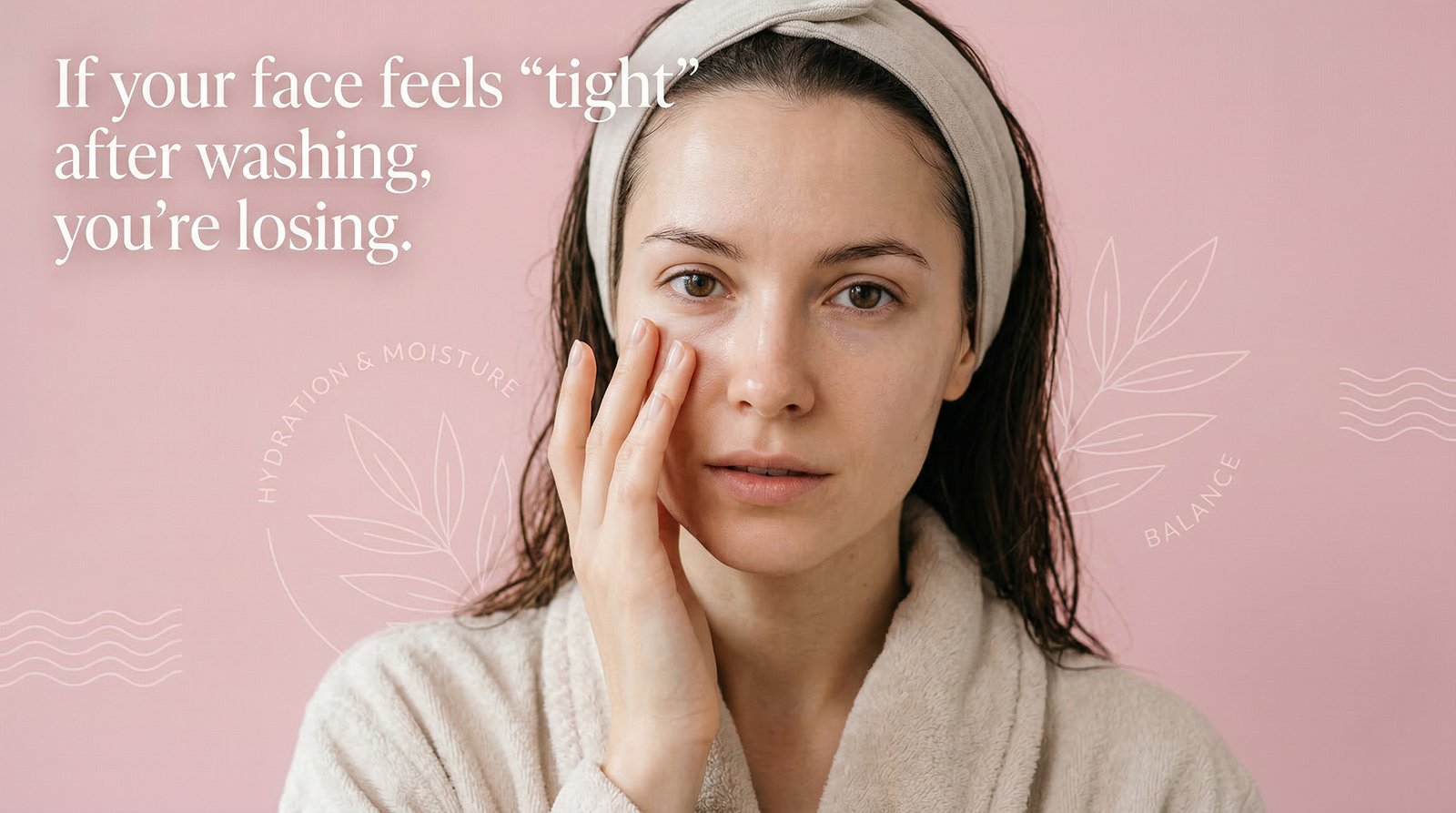
You need to remove pollution and sweat without disrupting the pH. If your skin feels “tight” after washing, you’ve just stripped your acid mantle. Use a gentle, barrier-respecting cleanser.
Stop buying five serums. Find one high-performance formula that addresses inflammation and supports the lipid matrix. A minimalist serum should do the heavy lifting so you don’t have to.
You need to prevent TEWL. A moisturizer isn’t just a cream; it’s a structural reinforcement. It should act as a second skin while your real skin repairs the DNA damage from that “base tan” mistake.
The Hard Truth About "Reversing" Damage
Can you fix the wrinkles you’ve already ordered?
To an extent, yes.
According to the Journal of Investigative Dermatology, consistent barrier repair can improve the appearance of fine lines by restoring turgor to the skin.
But you can’t out-run the sun. Every time you skip SPF or chase a tan, you’re resetting the clock on your progress.
Stop Paying for Future Problems
The skincare market is worth billions because it sells “solutions” to problems we create for ourselves.
We burn our skin, then buy “after-sun” repair.
We strip our oils, then buy “deeply hydrating” masks.
We ignore the barrier, then buy “firming” creams.
Break the cycle.
Invest in your barrier now, and you won’t have to pay for expensive lasers later.
You Don’t Need More Products. You Need Fewer That Actually Work.
The “Minimals” philosophy isn’t about doing less because we’re lazy. It’s about doing less because it’s biologically superior. Your skin is a self-regulating organ, not a chemistry project.When you stop interfering with its natural processes like its ability to produce ceramides and maintain its microbiome it thrives. The “base tan” is a lie sold by an era that didn’t understand the molecular mechanics of photoaging.
We know better now. It’s time to stop chasing the “glow” and start building the barrier. Your future self will thank you for the lack of wrinkles.
Ready to stop over-complicating your face?
Here is your "Pre-Ordered Wrinkle" Cancellation Checklist
Frequently Asked Questions
It’s like choosing between a slow leak and a flood. Both end with your house underwater. A tan is just slow-motion DNA damage that eventually leads to the same structural collapse as a burn.
You can’t un-burn a piece of toast. You can soften the appearance of damage by healing your barrier, but the best “repair” is stopping the daily destruction of your remaining protein matrix.
Mature skin is usually just exhausted skin. By stripping away the 10-step clutter and focusing on moisture retention, you stop the chronic dehydration that makes every fine line look like a deep crater.
Yes. Your skin is currently in a state of trauma. Adding harsh acids or retinols to sun-damaged skin is like throwing gasoline on a biological fire. Focus on lipids and rest.
It might be your water. If you live in an area with “hard water” (lots of minerals), those minerals can stay on your skin and feel stiff. Try using a gentle, alcohol-free toner or just a high-quality moisturizer on damp skin.
Closing thought
Your skin isn’t a canvas to be bronzed; it’s a living shield that’s currently tired of being ignored.
The industry wants you to buy into the complexity because complexity is profitable. But your cells don’t care about “rituals” or “luxury.” They care about the lipid matrix, pH balance, and DNA protection.
If you want to recognize the face in the mirror ten years from now, stop looking for a “glow” that comes from a trauma response. Stick to the basics, protect the barrier, and let your skin breathe.
In a world of 10-step noise, the most effective thing you can be is a minimalist.