
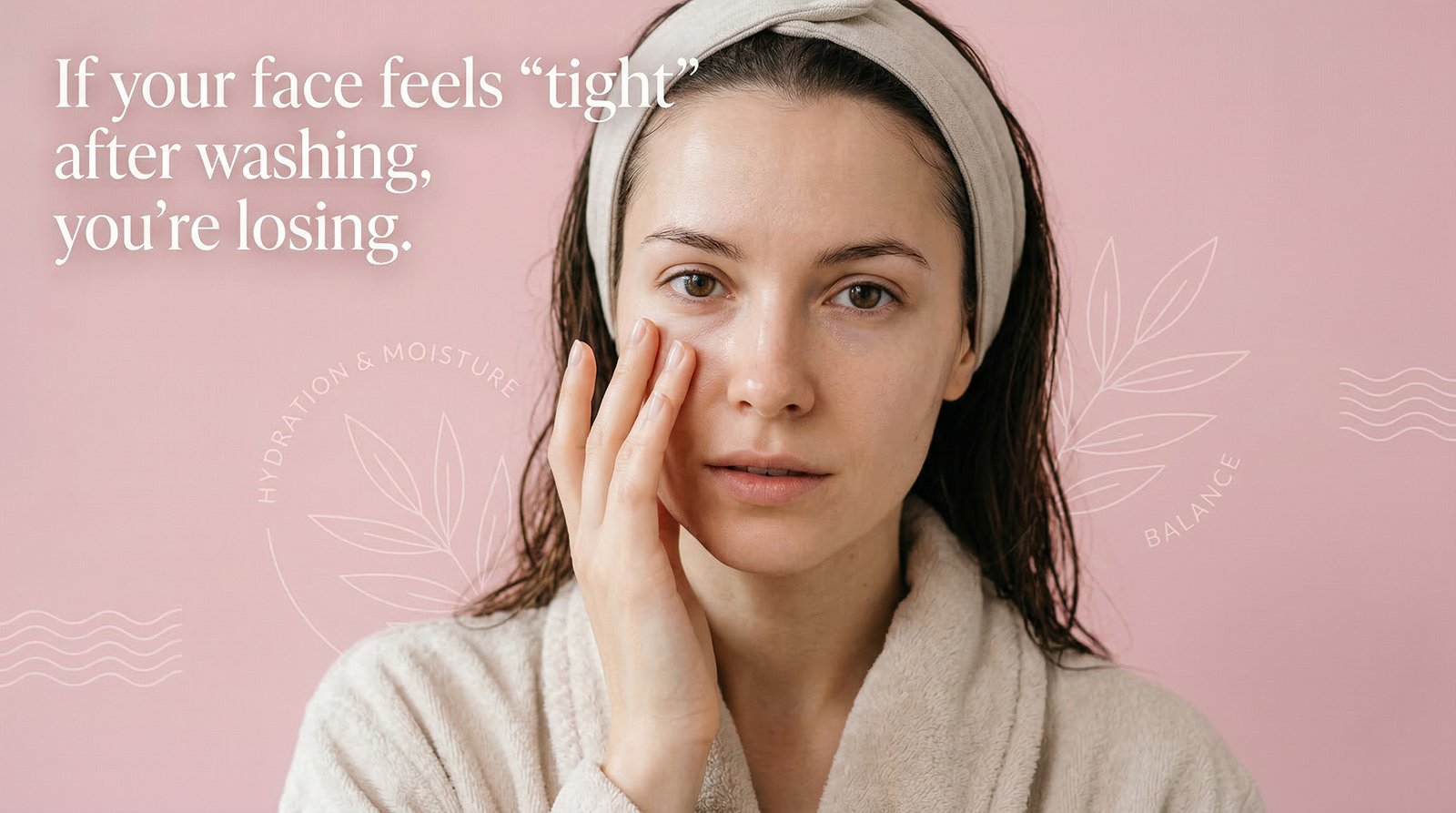
Why stripping back your skincare routine prevents barrier damage and lets your skin heal itself.
Your Skin is a Living Organ, Not a Chemistry Experiment
Your skin doesn’t know how many products you used this morning. It only knows what it had to process. Six serums, two toners, and a separate eye cream? To your skin, that’s not self-care. That’s a chaotic chemistry experiment happening on your face in real-time with absolutely no control group.
I learned this the hard way. I used to think a 10-step routine was the ultimate investment in myself. Instead, the results of my “maximalist” experiment were written all over my face within a week: sudden sensitivity, random breakouts, and a angry skin barrier.
It felt like it showed up out of nowhere. But it didn’t. It happened because nobody told me that more product doesn’t mean more results. Past a certain point, it just means more interference.
What's Actually Happening Under All Those Layers
Your skin isn’t absorbing everything you put on it equally. It’s filtering.
The outermost layer the stratum corneum is built like a brick-and-mortar wall. Corneocytes are the bricks, held together by a tight “mortar” of ceramides, cholesterol, and fatty acids. This lipid matrix controls Transepidermal Water Loss (TEWL), which is just a fancy way of measuring how fast moisture escapes your skin.
When that matrix is intact, TEWL stays low. Water stays in, and irritants stay out. But when you disrupt it with harsh cleansers or too many active ingredients, TEWL climbs. Suddenly, your skin starts losing the very moisture you’re desperately trying to give it back.
Here is where my obsession with a multi-step routine backfired, and where the science actually matters: penetration isn’t neutral.
Research shows that certain ingredients like surfactants and solvents actively change how deep and how fast other compounds travel through your skin. They increase penetration by temporarily breaking down the very barrier they are crossing. That third serum you layered on isn’t just minding its own business. It is changing how the first two serums behave, how deep they go, and how much irritation they collectively cause. You aren’t stacking benefits. You are stacking unknowns. This unpredictability isn’t just theoretical; it’s been measured in labs. Studies modeling how actives move through the skin show that penetration depends heavily on the “vehicle” the other compounds present and the current condition of your skin.
I used to treat my face like a passive canvas, assuming it woke up fresh and identical every morning.
It doesn’t. If you change just one variable by throwing another product on top or scrubbing too harshly you alter how every single ingredient behaves. Your skin after a week of layering five different actives is a completely different, highly unpredictable surface.
The Shift: Less Isn't a Trend, It's a Correction
Skinimalism constantly gets dismissed as just a visual aesthetic like it’s only about having a pretty, minimalist shelf for your social media feed. It’s not. It is a necessary response to a measurable problem: our skin is currently processing more chemical inputs than it can safely handle without paying a price.
I used to think minimalism meant sacrificing results. In reality, the “less, but better” approach is about giving your skin a small, targeted number of ingredients it can actually use, at concentrations that work, without competing signals drowning each other out. Fewer products simply means fewer interactions you cannot predict.
When you cut out the noise, you get fewer unpredictable side effects. Ultimately, fewer interactions mean your skin barrier finally gets to do its actual job instead of burning all its energy trying to manage what you put on it.
Your Routine Might Be Causing the "Sensitive Skin" You Think You Were Born With
Here’s an uncomfortable possibility: you might not have naturally sensitive skin.
You might have skin that’s reacting to chemical traffic. A disrupted barrier becomes more permeable than it should be letting irritants and allergens penetrate more easily, and amplifying your skin’s inflammatory response to things it used to tolerate just fine.
This is why people who “discover” a new sensitivity to their sunscreen, their usual moisturizer, or a product they’ve used for years are often not developing a new allergy. They’re watching a weakened barrier finally show its hand. Multiple actives layered together AHAs with retinoids, vitamin C stacked with exfoliating toners are a well-documented way this happens, increasing irritation risk specifically because the combination amplifies penetration and inflammation beyond what either ingredient causes alone.
“Sensitive skin” is sometimes a skin type. More often, it’s a skin state one your routine created and now has to manage.
At this point, your skin doesn’t need a “for sensitive skin” label. It needs fewer total inputs so it can stop reacting and start repairing which is the actual job a barrier-focused moisturizer is built to support.
Your Cleanser Is Doing More Damage Than Your Actives
Everyone blames the serum. Nobody blames the cleanser.
But cleansing happens twice a day, every day which makes it the single most repeated barrier stressor in your entire routine. A controlled study tracking the skin microbiome after cleansing found that washing can strip lipids and moisture from skin, leading to irritation, barrier impairment, and disturbance of the skin’s microbial balance and the shift in bacterial composition was detectable within just one hour of washing. Your microbiome isn’t a passive bystander. It’s an active layer of protection that helps keep pathogenic bacteria in check.
Disrupt it twice daily with a harsh, high-foaming cleanser, and you’re not starting your routine with a clean slate. You’re starting it with inflammation already in progress.
Worse: surfactant-induced irritation doesn’t just affect the surface. Research on sodium lauryl sulfate shows that surfactant-driven irritation can actually change how subsequent products penetrate the skin meaning a harsh cleanser doesn’t just strip your barrier, it can alter how the next four products you apply behave once they’re on it. Your cleanser isn’t a neutral first step. It’s setting the conditions for everything that comes after it.
This is why the formula matters more than the foam. A gentle, pH-balanced cleanser that removes buildup without disrupting the lipid matrix gives every product that follows a fair, undamaged surface to actually work on.
"Hydrating" Products Can Make Your Skin Drier Here's Why
Wait, what?
Yes, really. Hydration and moisture are not interchangeable, yet most routines treat them like they are identical twins. Hydration refers to the water content inside your skin cells. Moisture refers to sealing that water in with lipids so it can’t escape.
I made this exact mistake for months. I would slather on a hyaluronic acid serum to hydrate my skin, assuming that was enough. But because hyaluronic acid just pulls water to the surface, if there is nothing on top to seal it in, that water evaporates straight back into the air often faster than it came in.
This is the counterintuitive part: applying a hydrating serum without a proper seal can actually leave your skin drier by the end of the day than if you’d done nothing at all. You are essentially adding water to a leaky bucket. The fix isn’t buying more hydrating products. It’s all about sequencing: humectant first, then a lipid-rich layer on top, while your skin is still slightly damp.
Dermatologists call this “moisture sandwiching,” and it completely changed my skin. It’s less about how many products you own and entirely about the order you use them in.
A serum without a seal isn’t just incomplete hydration. It’s a wasted one.
Hydration ≠ Moisture and That Mix-Up Is Why You're Still Tight and Flaky
Wait, what? Aren’t those the same thing?
No. And this single confusion is probably why your skin still feels dry after a serum that promised “24-hour hydration.” Hydration is water content inside skin cells. Moisture is the oil-based seal that keeps that water from leaving. Humectants like hyaluronic acid pull water into the skin. But if there’s nothing to lock that water in, it evaporates even faster than before sometimes pulling environmental moisture in only to lose it minutes later.
This is exactly what ceramide research keeps confirming: stratum corneum lipids regulate water-holding capacity, and depleting them is what spikes transepidermal water loss in the first place.
A hydrating serum with zero sealing ingredients is, biologically, a half-finished sentence. That’s “moisture sandwiching” in one line: humectant first, occlusive lipid second. Skip the second half and you’re just refilling a bucket with a hole in it.
This is the exact gap most “hydrating” serums leave open water in, no way to keep it there.
Layering Five Actives Isn't Five Times the Results It's One Inflammation Loop
Vitamin C in the morning. Retinol, an AHA, and a niacinamide serum stacked at night, because more actives should mean faster results.
This is one of the fastest paths to a damaged barrier, and dermatology professionals are direct about why. It’s rarely a single ingredient causing the problem. It’s specific combinations AHAs paired with retinoids, vitamin C layered under exfoliating toners used together without giving skin any time to adjust between them. Each active alone might be perfectly fine at the right frequency. Stacked together, they compound faster than your skin can repair the resulting irritation. And once the barrier is compromised, you’re not just dealing with redness. You’re dealing with what’s sometimes called an inflammation loop: irritation weakens the barrier, the weaker barrier lets in more irritants, and the resulting inflammation makes the skin even more reactive to the next thing you apply.
Most people don’t recognize they’re in this loop. They just see “irritated skin” and assume they need something new and stronger to fix it so they add a calming serum, then a barrier cream, then a soothing mist, layering more products onto a problem that excess layering caused in the first place. The fix isn’t zero actives. It’s one job, one formula, used consistently not five competing for the same five minutes on your face.
This is the entire argument for a single, well-formulated serum over an active stack: less competition for your skin to mediate, more consistency for it to actually respond to.
Exfoliating More Doesn't Mean Smoother Skin It Means a Thinner Wall
Daily scrubs. Daily acid toners. The logic feels sound: more exfoliation, more glow.
The biology disagrees.
Skin naturally sheds its outer layer roughly every 28 to 40 days, depending on age and overall condition. Exfoliating doesn’t speed up healthy turnover so much as it interrupts the layer that’s currently forming. Used daily, exfoliation doesn’t just clear dead cells it gradually thins the skin, removing protective layers along with the buildup, which leaves skin more fragile and more reactive over time. Chemical exfoliants aren’t automatically gentler just because they’re not physical scrubs. Frequent acid exposure disrupts your skin’s natural pH, weakening its defenses against irritation and bacteria in the process. The “smoothness” you get from daily exfoliating is often the texture of a barrier that’s been worn down, not renewed.
Real improvement comes from exfoliating less often, with intention and giving the new layer underneath enough time to actually strengthen before you remove it again.
If Your Routine Feels Complicated, That's the Problem
Be honest for a second. If you need to remember the order of seven different steps, your skin isn’t being cared for. It’s being managed.
I used to be caught in this exact cycle. I would switch products every ten days because nothing seemed to “work.” What I didn’t realize was that my skin never had a stable baseline long enough to show me what was actually helping and what was making things worse.
Barrier repair isn’t instant. Even in clinical research, measurable improvement after barrier disruption typically takes two to four weeks of consistent, simplified care and sometimes longer for more established damage. If you aren’t giving your routine at least that long before changing it, you aren’t testing products. You’re just adding noise to skin that was never allowed to stabilize in the first place. There’s also a quieter cost to constant switching: every new bottle is a fresh round of “will this irritate me?” This keeps your skin in a perpetual, low-grade state of adjustment instead of actual recovery. Complexity feels like effort, but it isn’t the same as care. The calm, low-maintenance skin you’re chasing is usually the result of doing less, consistently not doing more, erratically.
The Routine Your Skin Actually Asked For
Here’s what a barrier-first, skinimalist routine actually looks like. No spreadsheet required.
A gentle, low-pH formula that removes the day without stripping the lipids underneath it. If your face feels “squeaky,” this step is working against you, not for you.
One active at a time. Give it weeks, not days, before judging whether it’s working most actives need four to six weeks before you can tell the difference between irritation and progress.
A ceramide-forward moisturizer that locks hydration in instead of letting it evaporate by morning. This is the step most routines skip or underdose, and it’s the one doing the most structural work.
SPF. Not optional, not negotiable the one step no amount of minimalism gets to skip.
That’s the entire routine. Four steps, max.
If your skin still needs more than this consistently, it’s usually asking for a better formula not an additional product.
Common mistakes we all make
A simple "Baseline" checklist
Frequently Asked Questions
If your skin burns when you apply basic, gentle moisturizers that used to feel fine, your barrier is compromised. Other major signs include persistent tightness, rough or flaky patches, and random redness or breakouts that don’t respond to acne treatments. When the stratum corneum the outermost layer loses its tight brick-and-mortar structure, it lets moisture out and irritants in.
Yes, but you shouldn’t use them all at once. The secret is alternating them rather than stacking them. For instance, use your retinoid on Monday night, stick to basic hydration on Tuesday night, and use an exfoliating acid on Wednesday night. This gives your skin barrier breathing room to process one signal at a time without getting overwhelmed by product traffic.
I expected my skin to magically heal in three days, but biology doesn’t work that fast. True cellular turnover and barrier repair take a minimum of two to four weeks of consistent, simplified care. If your skin is deeply damaged from over-exfoliation, it can take up to six weeks of doing nothing but cleansing, moisturizing, and protecting before your baseline fully stabilizes.
A core routine only requires three foundational steps: a gentle, non-stripping cleanser; a reliable moisturizer that mimics your skin’s natural lipids (look for ceramides, fatty acids, and cholesterol); and a broad-spectrum sunscreen for the daytime. Anything else you choose to add should target a specific, singular concern rather than just filling a slot on your shelf.
Closing thought
Your skin was never asking for ten steps and a shelf full of competing actives.
It was asking for an intact barrier, an undisturbed microbiome, and ingredients that don’t spend their time interfering with each other. That’s not brand philosophy. That’s just what the biology has been telling us all along. You can keep adding products, hoping one of them quietly cancels out the damage the other four are causing. Or you can simplify cleanse gently, treat with one intention, seal properly, protect daily and give your skin the chance to actually stabilize.
See what a smaller, smarter routine looks like built around what your skin can use, not how many steps a routine can have.