
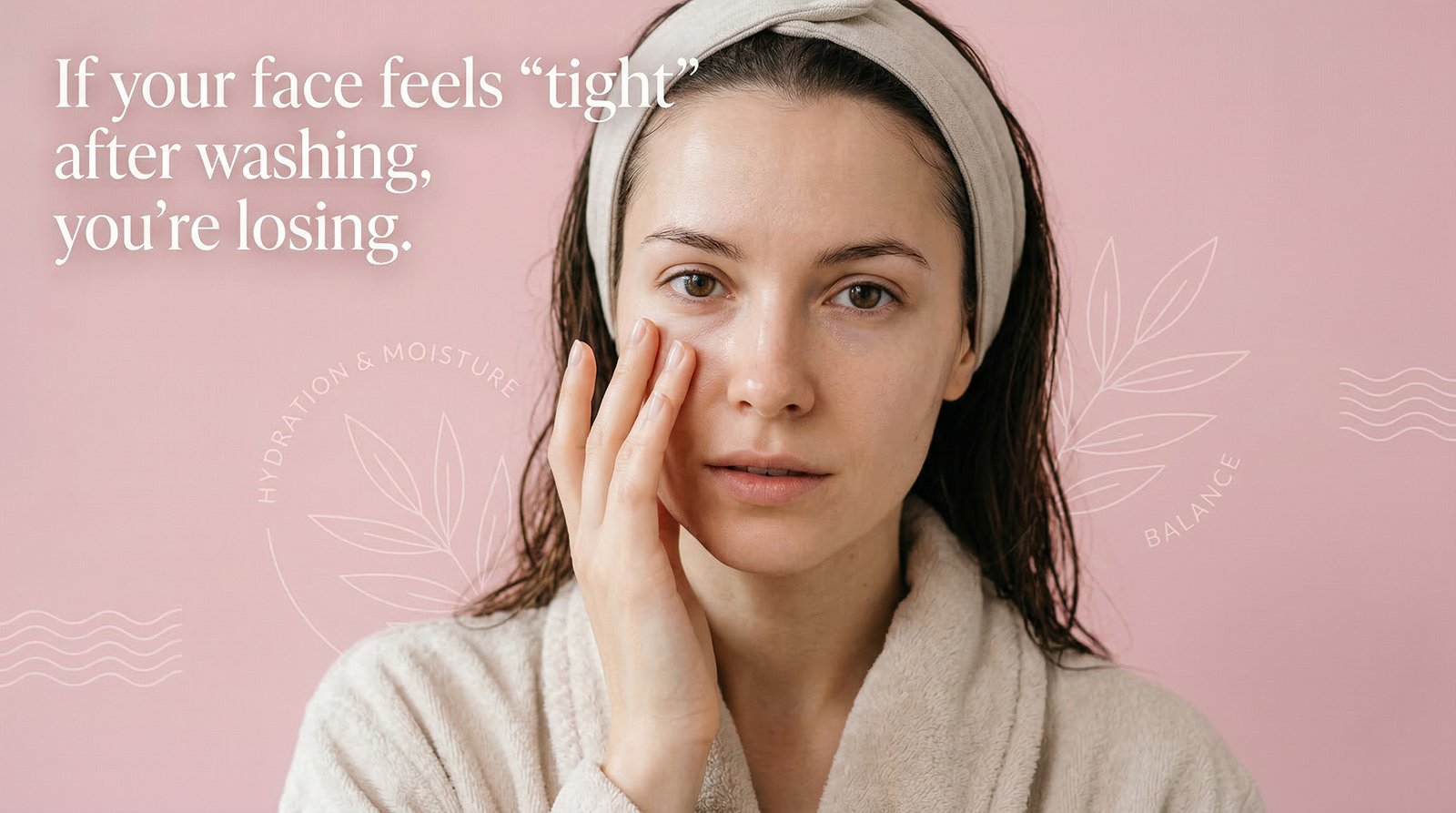
The biological truth behind “skinimalism” why cutting the chemical load gives your skin barrier the room it needs to heal itself.
The Barrier Biology.
“Less is more” sounds like something you’d cross-stitch and hang in a bathroom. But the people saying it about their skin aren’t being precious. They’re describing something real. Every time someone tells you their skin “calmed down” after cutting their routine to three products, they’re not exaggerating for content. They’re describing a barrier finally getting the chance to do its job.
Here’s the actual biology behind that not the vibes version.
Your Skin Isn't Reacting to Bad Luck. It's Reacting to Math.
Think about what your skin processes in a day. Cleanser. Toner. Serum. Exfoliant some days. Moisturizer. Sunscreen. Sometimes a mask thrown in because your feed told you to. Each product is a chemical event. Each one asks your skin to absorb, buffer, or neutralize something. Your skin can handle a few of these. It cannot handle all of them, every day, indefinitely. This isn’t a willpower issue or a “your skin is sensitive” issue.
It’s a load issue. And eventually, the math catches up with you.
The Wall You Didn't Know You Were Breaking
Your skin’s outer layer works like a brick wall. Skin cells are the bricks. Lipids ceramides, cholesterol, fatty acids are the mortar holding everything together. That extracellular lipid matrix between skin cells acts as the mortar holding the brick-like cell structure together. ScienceDirect
That wall has one job: keep water in, keep irritants out.
The technical term for water escaping through it is transepidermal water loss, or TEWL. The lower your TEWL, the more intact your barrier.
The skin barrier function sits in the outermost layer of skin, where corneocytes are embedded in a lipid matrix made mainly of ceramides, fatty acids, and cholesterol and this lipid matrix is essential for proper barrier function. PubMed Central
Every product you apply either supports that wall or chips at it. Most routines, without anyone intending it, do a lot more chipping than supporting.
"More Steps" Was Never the Same Thing as "More Effective"
Here is a rewrite that keeps that sharp, punchy rhythm while making it incredibly scannable and reader-friendly:
Here is the myth nobody questions: more products equals more control over your skin.
It feels intuitive. It feels proactive. It is also completely backwards. When you overload your skin, you risk stripping its vital lipids, like ceramides. Clinical data shows that ceramide deficiencies are directly linked to conditions like atopic dermatitis and psoriasis. A thin barrier doesn’t just feel uncomfortable it’s clinically proven to cause worse skin outcomes. Adding more products won’t rebuild that barrier. In reality, it just adds stress to a cellular structure that is already struggling to hold itself together. This is the part the “more is more” crowd misses entirely. You aren’t failing to control your skin by using fewer things. You are finally giving it the room it needs to stabilize.
The Cleansing Habit Quietly Wiping Out Your Skin's Defense System
You know the feeling: squeaky clean, tight, and completely stripped. We’ve been conditioned to think that tightness means a cleanser is working, but it’s actually the exact opposite. That feeling is the sound of your skin’s protective oils being washed away, creating a hostile environment for your microbiome the ecosystem of beneficial bacteria that fights inflammation and defends your barrier. When you aggressively scrub or wash more than twice a day, you destroy this delicate ecosystem. This triggers a brutal chain reaction of chronic dryness, irritation, and flare-ups. A stripped-down routine calms your skin so quickly because you aren’t doing less; you’re finally doing less damage.
The ultimate logic of skin minimalism comes down to product synergy. A cleanser formulated at the correct pH doesn’t need a “purifying” toner to fix the damage it just caused. You only need one well-formulated cleanser that respects your biology, not three competing ones.
Hydration and Moisture Are Not the Same Word (Wait What?)
This is the one that trips people up, even after years of consuming “skincare education” content. There is a massive difference between hydration and moisture retention. Hydration is the water content inside your skin, while moisture retention is whether that water actually stays there.
You can layer hyaluronic acid, niacinamide, and three different hydrating mists in a single routine and still end up drier than when you started. Why? Because none of them are sealing anything in. If your barrier is compromised which, statistically, it likely is if you’re using a six-plus product routine that water evaporates almost as fast as you apply it.
This is exactly why minimal routines routinely outperform maximal ones on hydration. Fewer products mean less barrier disruption, which ensures the water you do add actually has a solid structure to stay inside of. More steps were never the fix for dehydrated skin. An intact barrier is.
Why Stacking Five Actives Doesn't Multiply Results It Cancels Them
Retinol at night, Vitamin C in the morning, an acid exfoliant twice a week, and Niacinamide daily individually, each ingredient makes total sense. But together on the same face, they create what dermatology research calls an inflammation loop. Actives work by triggering a small, controlled stress response to force exfoliation and cell turnover. While a healthy barrier absorbs that stress and recovers overnight, a barrier hit by multiple actives never gets that recovery window. It just stays in a low simmer of constant irritation.
Clinical research shows that ceramide-based formulations are crucial here because they improve barrier function and promote faster recovery in compromised skin. Simply put, repair must happen before the next stressor hits. If it doesn’t, you aren’t treating your skin you are just re-injuring it on a schedule. People who simplify their routines aren’t avoiding active ingredients out of fear; they are finally giving each one the room it needs to actually finish working.
The Belief That "Natural Skin Doesn't Need Help" Is Half Right, Half Dangerous
There’s a version of the “fewer products” belief that goes too far the idea that skin should need nothing at all. That’s not minimalism. That’s neglect dressed up as purity. Your skin does need support. It needs barrier lipids replenished as you age, since natural ceramide production declines over time. It needs UV protection daily, not “when it’s sunny.” It often needs targeted actives for things like hyperpigmentation or acne that won’t resolve through restraint alone.
The actual insight isn’t “do nothing.” It’s “do less, but make each thing earn its place.” That distinction is the entire difference between skinimalism and skipping skincare altogether.
If Your Routine Feels Complicated, That's the Problem
Be honest with yourself for a second: if you need to check a spreadsheet to remember what goes on your face, you haven’t built a skincare routine you’ve built a part-time job. Complexity isn’t a sign of dedication; it’s usually a sign you’re patching up symptoms instead of fixing the root cause. Irritation from one product gets covered by a calming serum, while dryness from over-exfoliating gets buried under a heavier cream. Each “fix” just adds another layer instead of removing the original problem.
The truth is, the people who swear by fewer products aren’t lazy. They’ve just noticed something the beauty industry desperately doesn’t want you to realize: most of your routine only exists to undo the damage caused by another part of your routine.
Why "Less, But Better" Isn't a Trend It's a Correction
Skinimalism often gets framed as a mere aesthetic dewy skin, minimal makeup, and a bathroom shelf holding just four neat bottles. But underneath that clean look lies a clinical logic. Every single product you introduce is a new variable. The more variables you add, the harder it becomes to figure out what is actually working, or what is causing the breakout you keep blaming on stress. A stripped-down routine isn’t a compromise on your results. It is the only version of skincare that lets you actually see results, because you are no longer drowning the signal in noise. This approach isn’t rewarded by the algorithm because “I use three products” doesn’t film nearly as well as a 12-step vanity tour. But when it comes down to it, it is the only routine that actually holds up under a dermatologist’s questions.
The Smarter Way to Think About Layering (Most Routines Get This Backwards)
There is a simple, highly effective concept worth knowing: the moisture sandwich. You start with damp skin, add a hydrating step, and immediately follow with an occlusive layer to seal it in applied before your skin fully dries, not after. Skip that sealing step, and most of what you just applied evaporates into thin air before it can do anything useful.
This is exactly where doing less requires smarter formulation, not just fewer bottles. A serum that hydrates without sealing is only doing half the job, while a moisturizer that seals without supporting your barrier lipids creates the exact same problem from the opposite direction.
Your skin doesn’t need five separate steps to hydrate, repair, and protect. It needs a few intentional formulas that already do all of those jobs at once. That is the entire reasoning behind keeping a streamlined routine: choosing a serum and a moisturizer that are built to work together, rather than competing for space on your face.
The Routine Your Skin Actually Asked For
No spreadsheet required. Just the sequence your skin can actually keep up with.
A gentle, low-pH formula that removes the day without stripping the lipids underneath it. If your face feels “squeaky,” this step is working against you, not for you.
One active at a time. Give it weeks, not days, before judging whether it’s working most actives need four to six weeks before you can tell the difference between irritation and progress.
A ceramide-forward moisturizer that locks hydration in instead of letting it evaporate by morning. This is the step most routines skip or underdose, and it’s the one doing the most structural work.
SPF. Not optional, not negotiable the one step no amount of minimalism gets to skip.
That’s the whole list. No fifth step waiting in the wings.
Common mistakes we all make
A simple "3-Product Rule" checklist
Frequently Asked Questions
If your skin stings when you apply simple moisturizers, stays constantly red, or flakes despite oily patches, your skin barrier (the outermost layer of the epidermis) is compromised.
Yes, but not right away. If your skin is currently irritated, pause all active ingredients for 2 to 4 weeks. Once your barrier has healed and stabilized, you can slowly reintroduce one active ingredient at a time back into your basic routine.
Initially, your skin might take a few days to adjust, but doing less usually decreases breakouts. Many “purging” episodes or sudden breakouts are actually just inflammatory reactions caused by overloading your skin microbiome with too many competing products.
Look for products containing bio-identical lipids that naturally live in your skin. The top three ingredients to look for on a label are ceramides, cholesterol, and fatty acids, which actively patch up the gaps in a damaged barrier.
Absolutely. Sunscreen is non-negotiable because UV radiation is a massive external stressor that physically degrades your skin barrier. Your morning routine should be: cleanser (or water rinse), serum/moisturizer, and sunscreen.
Closing thought
The belief that fewer products mean better skin isn’t a trend or a hack. It’s what happens when you stop asking your barrier to absorb more than it can recover from. You don’t need to abandon skincare. You need products that are formulated to do their job completely, instead of five that each do part of a job and leave the rest for the next bottle to fix.
If that’s the version of skincare you’re after, the Minimals lineup is built around exactly that fewer formulas, each one finishing what it started.