
A minimalist approach to skincare that heals your barrier, cuts the clutter, and delivers real results with just the essentials.
Your 10-Step Routine Isn't Self-Care It's an Overload
You’re not under-treating your skin. You’re overwhelming it.
Every serum, every “must-have” toner, every double-cleanse you’ve added in the name of “self-care” is asking your skin to process more than it’s built to handle. And your skin is telling you. You’re just calling it something else. You call it sensitivity. Or hormones. Or “just how my skin is.” But more often than not, it’s your routine. Not your biology.
What's Actually Happening Under All Those Layers
Nobody puts this on the bottle: your skin barrier isn’t a passive wrapper, it’s a strict brick-and-mortar structure. Your skin cells are the bricks, and lipids like ceramides and fatty acids are the mortar holding them together to keep water in and irritants out.
I used to stack harsh cleansers and way too many actives, completely stripping these lipids away and causing massive water loss. When my face flared up in red, angry inflammation, I tried to convince myself my skin was just “purging” or “detoxing.” It wasn’t. That wasn’t a glow-up it was straight-up barrier damage.
The Microbiome Disruption Nobody Warned You About
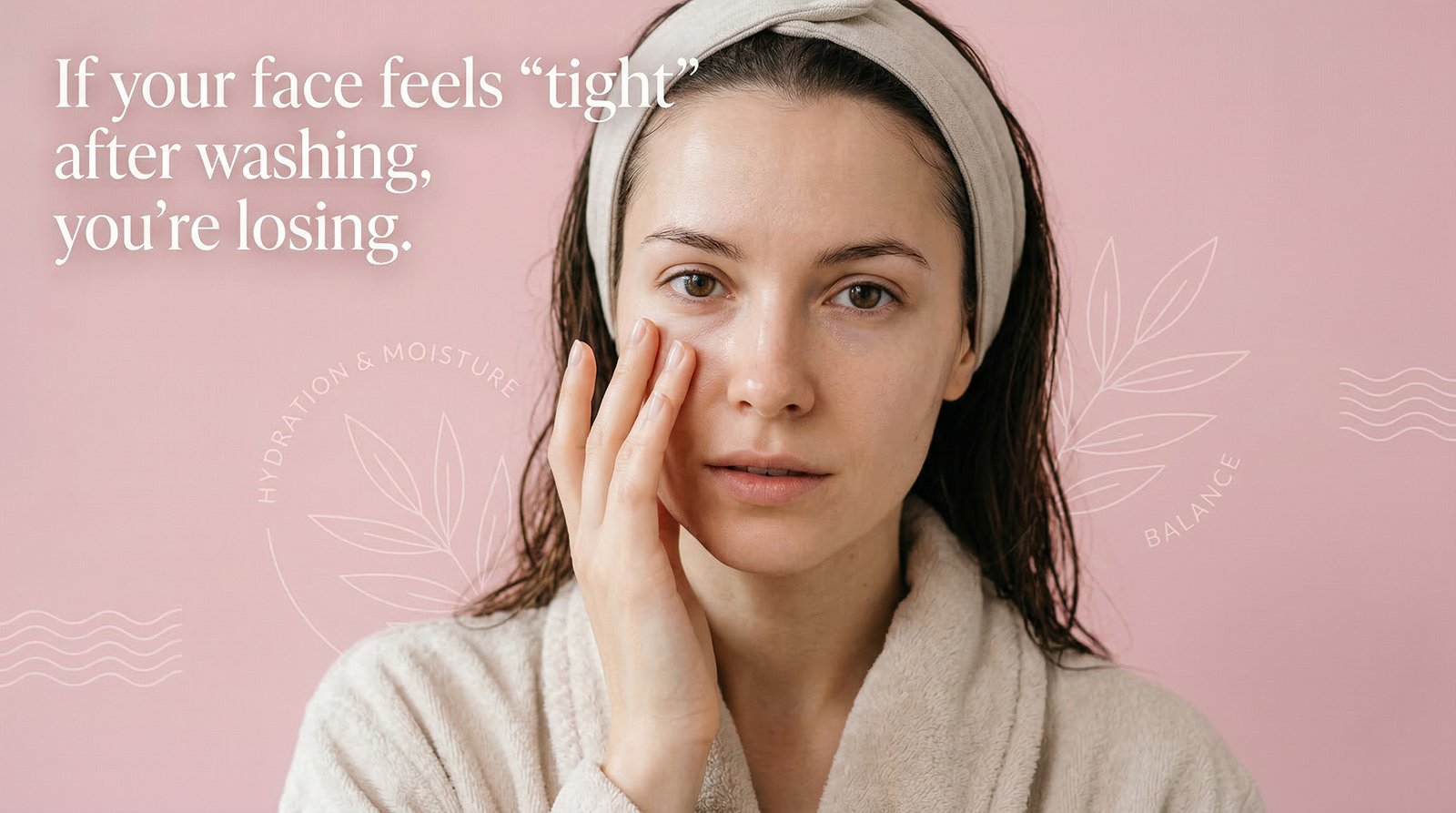
Your skin isn’t a sterile surface to be scrubbed it’s a living, breathing ecosystem where millions of microbes are working overtime right now to block pathogens, calm inflammation, and protect your barrier. That tight, squeaky-clean feeling after washing isn’t a sign of health; it’s the sound of your skin screaming as harsh, foaming cleansers strip away the essential oils and beneficial bacteria you actually need. Your skin naturally thrives at an acidic pH below 5, but traditional, highly alkaline soaps (sitting at a pH of 10 to 11) undo that chemistry on contact, causing the outer skin layer to swell and allowing harsh ingredients to penetrate too deeply. If your skin constantly overreacts to every serum or moisturizer you try, you might not actually have sensitive skin you might just be quietly sabotaging your microbiome every single time you wash your face.
"Hydrating" and "Moisturizing" Are Not the Same Thing (Wait, What?)
This one trips up even the most dedicated skincare enthusiasts because hydration and moisture retention are completely different things. Hydration is the water content inside your skin, while moisture retention is your skin’s ability to seal that water in. You can drench your face in hyaluronic acid all day, but if your skin barrier is compromised, that water will evaporate within the hour. This is exactly why your skin can feel incredibly “thirsty” and oily at the same time; it isn’t confused, it’s just compensating. When your natural barrier is damaged and lacks ceramides the mortar holding your skin cells together your skin ramps up sebum production to patch the gaps, leading to more breakouts and excess oil. Most lightweight gel moisturizers fail you here because while they feel refreshing, they don’t actually seal anything. Ultimately, your skin doesn’t need another hydrating layer; it needs a formula that locks moisture in instead of letting all that water leak right back out.
Why Layering Five Actives Is Quietly Backfiring
Retinol Monday. Vitamin C Tuesday. Acid exfoliant Wednesday. Niacinamide every day because someone said it’s “gentle.” Each ingredient, alone, is fine. Together, on a compromised barrier, they’re a pile-up.
Here’s the mechanism most routines ignore: actives work by creating a controlled, low-grade stress response in your skin. That’s how retinol stimulates turnover. That’s how acids exfoliate. A healthy barrier can absorb that stress and recover overnight. A barrier that’s already thin from over-cleansing or over-exfoliating doesn’t get the chance to recover before the next active hits it.
That’s an inflammation loop. Stress, incomplete repair, more stress, less repair until your skin is in a permanent low simmer of irritation that you’ve started calling “sensitive skin.”
It’s not that your skin became sensitive. It’s that it never got to finish healing. This is the actual reason dermatology research keeps circling back to barrier repair before anything else. Ceramides are known to improve skin hydration, reduce inflammation, and accelerate wound healing which is a fairly direct way of saying: fix the wall before you worry about what’s getting through it. PubMed Central
The Cleanser Habit That's Aging You Faster Than Sun Exposure (Slight Exaggeration, Mostly True)
You know the long, hot shower. The face wash that lathers like it means business. Both are doing more damage than your sunscreen-skipping habit on a cloudy day. Hot water exposure measurably increases transepidermal water loss and raises skin pH, while also making redness worse. Maxgreenalchemy
And the foam you associate with “deep clean”? That’s usually a high-pH surfactant doing exactly what soap does to your barrier swelling it, weakening it, leaving it more permeable to everything that comes next. The fix isn’t “stop cleansing.” Your face still needs it.
The fix is stopping the idea that cleansing should feel aggressive to be effective.
Synthetic detergents formulated at a more acidic to neutral pH of 5 to 7 minimize barrier damage and are the preferred choice for people managing sensitive or compromised skin. Practical Dermatology
A cleanser that respects your skin’s actual pH doesn’t need a second product to undo what it just did. That’s the whole point of formulating it right the first time which is exactly what “Minimals” cleanser is built around: clean skin without resetting your barrier every morning.
If Your Routine Feels Complicated, That's the Problem
Let’s be honest for a second.
If you need a spreadsheet to remember what goes on your face and in what order, you’ve built a routine designed for a content calendar, not your skin. Complexity isn’t a sign of seriousness. It’s usually a sign you’re treating symptoms instead of the cause. Redness from one product gets patched with a calming serum. Dryness from over-exfoliating gets patched with a heavier cream. Each fix adds a layer instead of removing the problem. You end up with a routine that’s solving for itself, not for your skin.
The brands selling 12-step routines aren’t wrong that your skin has needs. They’re wrong about how many products it takes to meet them.
Skinimalism Isn't a Trend. It's a Correction.
Skinimalism often gets dismissed as just another TikTok aesthetic the “clean girl” look with dewy, minimal makeup but underneath the trend lies a philosophy rooted in clinical logic: fewer ingredients, fewer disruptions, and more consistency. Your skin doesn’t reward novelty; it rewards routine. Every single time you introduce a new active ingredient, your skin has to completely recalibrate, and each of those recalibrations acts as a small stress event. If you stack enough of these changes together, your skin never establishes a stable baseline, making it impossible to actually see what is working. Choosing a smaller, more intentional routine isn’t a compromise; it’s the only version of skincare that cuts through the static and actually lets your skin show you real results.
The Smarter Way to Layer (Most People Get This Backwards)
There’s a concept worth knowing even if you never use the term out loud: moisture sandwiching. It’s simple. Damp skin, humectant, then something occlusive to seal it applied while skin is still slightly damp, not bone dry. Apply a hydrating serum onto dry skin and most of it evaporates before it does anything. Apply it onto damp skin, then seal it with a barrier-supporting moisturizer, and you’re actually trapping that water where it’s useful.
This is also where a multi-tasking formula earns its place. Your skin doesn’t need five separate steps to hydrate, repair, and seal. It needs one formula doing all three on purpose, layered correctly.
The Minimal Routine Blueprint
No 12 steps. No spreadsheet. Just the sequence your skin is actually built to use.
A gentle, low-pH formula that removes the day without stripping the lipids underneath it. If your face feels “squeaky,” this step is working against you, not for you.
One active at a time. Give it weeks, not days, before judging whether it’s working most actives need four to six weeks before you can tell the difference between irritation and progress.
A ceramide-forward moisturizer that locks hydration in instead of letting it evaporate by morning. This is the step most routines skip or underdose, and it’s the one doing the most structural work.
SPF. Not optional, not negotiable the one step no amount of minimalism gets to skip.
That’s it. That’s the whole list.
Common mistakes we all make
Messing up our skin’s pH: Washing with traditional, highly alkaline soaps (pH 10 to 11) that destroy the skin’s naturally acidic protective layer (the acid mantle).
Confusing hydration with moisture retention: Drenching the skin in water-attracting ingredients like hyaluronic acid without using a proper formula to seal that water in, leading to instant evaporation.
Relying solely on lightweight gel moisturizers: Using gels that feel nice and refreshing going on but completely fail to lock moisture in, leaving the skin “thirsty” and oily at the same time.
Overcomplicating the routine with too much novelty: Constantly introducing new active products, which forces the skin into a state of perpetual stress and recalibration instead of letting it reach a stable baseline.
A simple "Baseline" checklist
Frequently Asked Questions
If your face feels tight, dry, or “squeaky clean” right after drying it, your cleanser is too harsh. Healthy skin should feel soft, flexible, and comfortable immediately after washing.
Only if you naturally have very oily skin or live in a highly humid environment. If your skin feels dry, tight, or greasy a few hours after applying a gel, it isn’t sealing well enough and you need a cream with barrier-supporting lipids.
Give your skin at least 4 to 6 weeks. This matches your skin’s natural cell turnover cycle and allows your microbiome and barrier to fully stabilize so you can see your actual baseline results.
No, wash it less or use a gentler touch. “Thirsty” yet oily skin is usually a sign of a damaged barrier that is overcompensating with oil to replace lost moisture; stripping it further will only trigger more oil production.
Closing thought
Your skin was never asking for more steps. It was asking for a barrier that’s intact, a microbiome that’s left alone, and actives that get a chance to actually finish their job before the next one shows up. You can keep adding. Or you can start subtracting and see what your skin does when it’s finally not playing defense.
If you want to see what that looks like, the Minimals lineup is built around exactly that idea fewer products, doing more, on purpose.