
Simplify your routine and maximize efficiency by focusing only on the foundational tools that drive your day.
Your Skin Isn’t Bored, It’s Burned Out
You wake up. You cleanse, tone, essence, serum, eye cream, moisturizer, SPF. Seven steps before coffee. And your skin still looks tired. Here’s the uncomfortable part, it’s not your skin failing you. It’s your routine attacking your skin barrier, one “innovative” step at a time.
What's Actually Happening Under All That Product
Your skin barrier is a wall. Made of skin cells held together by lipids ceramides, cholesterol, fatty acids. This is called the lipid matrix. It keeps water in and irritants out. When that wall is healthy, your skin looks calm, plump, “glowy”without trying. When it’s damaged, you get dryness, redness, breakouts, sensitivity. And the wild part? Most damage isn’t from pollution or “aging.” It’s from your own routine. Every time you over-cleanse, double-exfoliate, or layer five actives, you strip lipids faster than your skin can rebuild them. The result is something dermatologists call increased TEWL transepidermal water loss. Translation: your skin is leaking moisture faster than it can hold onto it. So you slap on more moisturizer.
Which doesn’t fix the leak. It just adds another layer on top of a cracked wall.
The Microbiome Problem Nobody's Talking About
Your skin isn’t just cells and lipids. It’s home to billions of bacteria, fungi, and microbes that quietly keep things balanced. This is your skin microbiome and it’s surprisingly easy to wreck. Harsh cleansers, antibacterial washes, and “deep clean” formulas don’t just remove dirt. They strip the good bacteria too.
Research highlights that the skin’s microbiota helps shape immune responses and plays a role in conditions like atopic dermatitis, psoriasis, and acne.
When you wipe out that ecosystem daily with foaming, sulfate-heavy cleansers, you’re not “purifying.” You’re disrupting a system that was protecting you. This is why some people develop sensitivity, breakouts, or redness after starting a new skincare routine not before.
The skin was fine. The routine wasn’t.
"Hydrating" Products That Are Quietly Drying You Out
Wait, what?
Yes. Some of the most popular “hydrating” products on the market make dehydration worse. Here’s the distinction nobody explains: hydration and moisture are not the same thing.
Hydration = water content in your skin.
Moisture = the oils and lipids that seal that water in.
A product can be packed with hyaluronic acid (hydration) and still leave your skin drier an hour later because nothing is sealing that water in. The water evaporates. Taking some of your skin’s natural moisture with it. This is especially brutal in dry climates or air-conditioned rooms.
So if your “hydrating serum” leaves your skin feeling tighter by midday, that’s not your skin being “dehydrated and needing more product.”
That’s a sealing problem, not a hydration problem. At this point, your skin doesn’t need another hydrating step.
It needs a moisturizer that locks in what you’ve already applied instead of evaporating it.
Why Layering Five Actives Is Quietly Backfiring
Retinol at night. Vitamin C in the morning. AHA twice a week. Niacinamide daily. Maybe a peptide serum for good measure.
Sounds thorough, right?
It’s actually a recipe for what’s called an inflammation loop. Each active ingredient creates a small amount of controlled stress on your skin that’s how they work. Retinol increases cell turnover. Acids dissolve bonds between dead cells. Vitamin C is a mild irritant at effective concentrations. One active at a time? Your skin handles it, adapts, and benefits.
Three or four stacked together, daily? Your skin’s repair systems can’t keep up.
Studies on the skin barrier note that compromised barrier function is linked to increased inflammatory mediators and a cycle where inflammation further damages barrier integrity, making skin more reactive over time not less. This is why so many people experience “sudden sensitivity” after months of seemingly fine actives use. It’s not your skin “changing.” It’s your skin barrier finally giving out. The fix isn’t more buffering products or “skin cycling” calendars. It’s choosing fewer actives, in formulas designed to work with your barrier not against it.
Over-Exfoliating: The Mistake Disguised as "Glow"
Exfoliation feels productive. Instant smoothness, brighter tone, that satisfying “fresh skin” feeling. But here’s what’s actually happening at a cellular level. Your stratum corneum the outermost layer of skin isn’t dead weight. It’s a functional barrier made of corneocytes held together by, again, that lipid matrix. Exfoliating removes the top layer of cells. In moderation, this speeds up renewal. In excess, it removes cells before they’ve finished forming the lipid barrier underneath. Frequent or aggressive exfoliation has been associated with worsened transepidermal water loss and disrupted barrier function, leaving skin more vulnerable to irritants and moisture loss.
So that “glow” after exfoliating? It’s partly real brightness and partly your barrier being thinner and more reactive.
If you’re exfoliating 4 to 5 times a week “for glow,” you’re not maintaining skin.
You’re sanding it down faster than it can rebuild.
The Cleanser Mistake That's Quietly Causing Your Breakouts
Foaming cleanser. Squeaky-clean feeling. “My skin feels SO clean.”
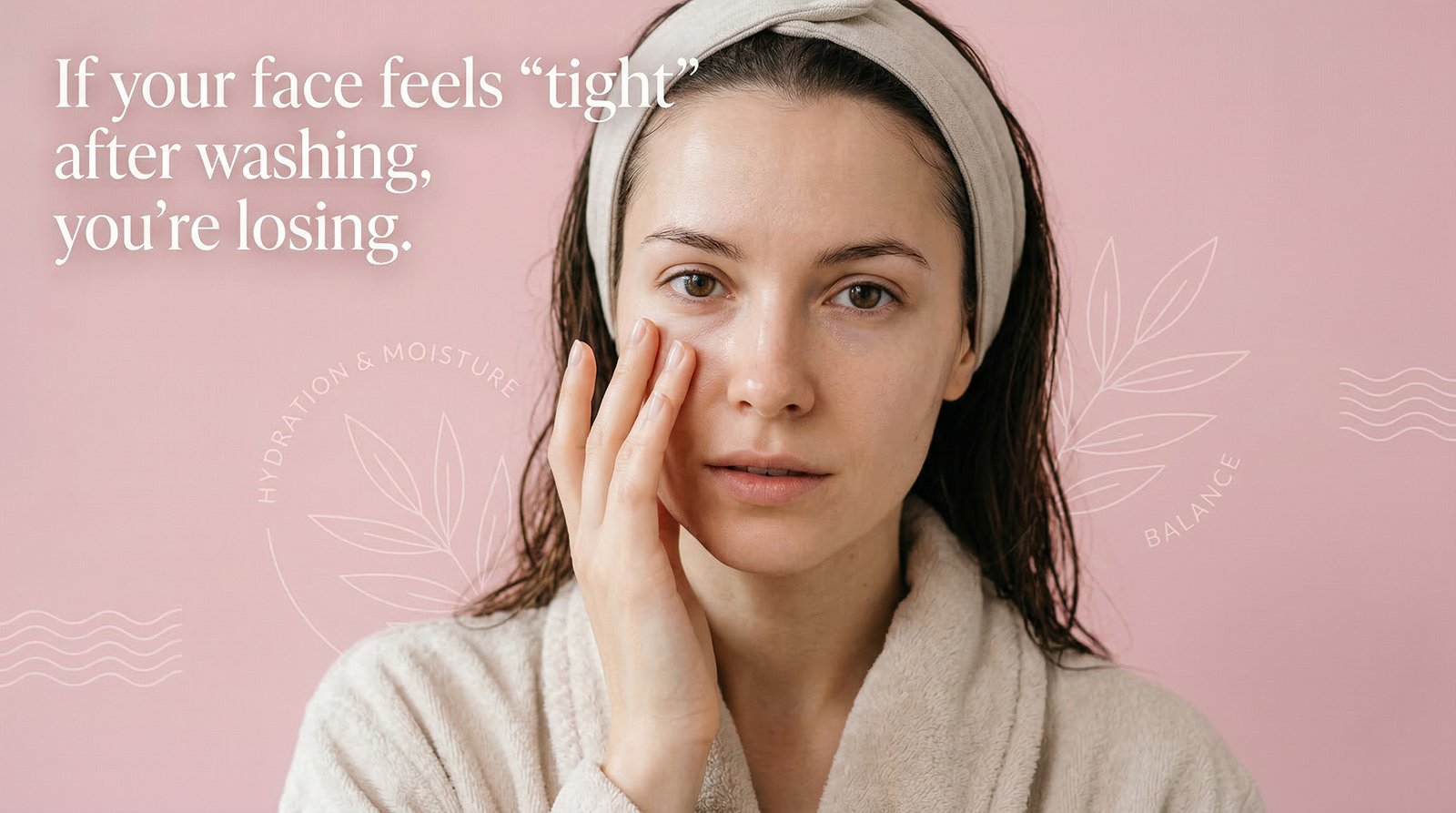
That squeak isn’t cleanliness. It’s your lipid barrier being stripped. Most foaming cleansers use surfactants that don’t discriminate they remove dirt, oil, and the lipids your skin needs to stay intact.
Strip those lipids daily, and your skin barrier weakens. A weaker barrier means more water loss, more irritation, more inflammation. And here’s the twist: inflamed, barrier-compromised skin often produces more oil not less. Your oil glands overcompensate for the dryness happening underneath. So you cleanse aggressively because your skin feels oily. Which strips your barrier. Which triggers more oil production. Which makes you cleanse more aggressively. This loop is exactly why “oily skin” routines often make oily skin worse over time.
The fix isn’t a stronger cleanser. It’s a cleanser that removes what needs to go without taking your barrier down with it.
"Clean Girl" Skin Isn't About Fewer Products. It's About the Right Few.
Skinimalism isn’t a trend. It’s a correction.
For years, the industry sold “more steps = more results.” More serums, more layers, more “innovative” textures. But your skin doesn’t reward complexity. It rewards consistency and compatibility.
A 3-step routine with formulas that actually work with your skin barrier will outperform a 10-step routine fighting against it every single time. This is barrier-first skincare: instead of asking “what can I add?”, you ask “what is my skin already struggling to maintain and how do I support that?”
Less isn’t a compromise. It’s the upgrade.
The Reality Check
If your routine feels complicated, that’s the problem.
Not your skin. Not your “skin type.” The routine. If you’re tracking which serum goes with which moisturizer, waiting between layers, avoiding combinations because they “cancel each other out” you’re not doing skincare. You’re doing damage control for a routine that was never built to work together in the first place. Healthy skin doesn’t require a spreadsheet. It requires fewer, smarter formulas that do more per step.
The Minimal Routine Blueprint
Here’s what your skin actually needs. Every day. Nothing more.
A gentle, non-stripping cleanser that removes buildup without disrupting your microbiome or lipid matrix. Morning and night, that’s it.
One targeted serum with active ingredients chosen for your concern not five concerns at once.
A moisturizer that locks hydration in and reinforces your barrier with ceramides and lipids this is “moisture sandwiching” in action: hydrate, then seal before it evaporates.
SPF. Non-negotiable. The single most effective anti-aging step that exists and the most skipped.
That’s it. Four steps, max.
You Don't Need More Products. You Need Fewer That Actually Work.
Your skin isn’t broken. It’s overwhelmed. Every extra step you add is asking your barrier to do more work at exactly the moment it needs less. The goal was never to have the longest routine on your shelf. It was always healthy, calm, functioning skin. Strip it back. Let your barrier breathe. Choose formulas that pull double duty instead of adding more layers. Your skin will tell you pretty fast whether that was the right call.
Common mistakes we all make
Layering endless products overwhelms the skin barrier, increases irritation risk, and disrupts your natural microbiome. A simple, consistent 3-4 step routine consistently outperforms a complex 10-step cycle that fights against your skin.
That “squeaky-clean” feeling means your protective oils and lipids have been washed away. Aggressive, sulfate-heavy foaming cleansers damage the barrier, leading to a vicious cycle of dryness, sensitivity, and rebound oiliness.
Combining retinol, acids, and vitamin C simultaneously triggers chronic inflammation rather than a healthy glow. Packing on too many potent ingredients weakens the skin’s defenses, causing redness and dehydration.
Water-based hydrators (like hyaluronic acid) evaporate quickly if they aren’t locked in. Without a proper moisturizer rich in ceramides and lipids to seal the surface, applied hydration escapes, leaving the skin tighter and drier than before.
A simple "Skinimalist Audit" checklist
Frequently Asked Questions
No. A damaged barrier overproduces oil and lets bacteria in. Fixing your barrier with fewer products typically calms and clears the skin.
Moisture. Hydration is water; moisture is the oil that seals it. If your skin feels tight, your hydration is evaporating because your moisturizer isn’t locking it in.
Yes, but split them up. Use Vitamin C in the morning (with SPF) and Retinol at night. Never layer them together.
Look for “milky,” “creamy,” or “non-foaming.” If your face feels tight or “squeaky” after washing, throw it out.
The barrier-repair trio: Ceramides, Cholesterol, and Fatty Acids. They physically rebuild your cracked skin wall.
Closing thought
Your skin isn’t a canvas to be painted with layers of product; it’s a living, breathing ecosystem that already knows how to protect itself. The multi-step routine craze was built to sell products, not to build health. When you strip back the noise and focus on protecting the barrier, you stop fighting your biology and start working with it.
Healthy skin doesn’t require a 10-step spreadsheet. It just requires you to get out of its way. Simplify the routine, save the barrier.