
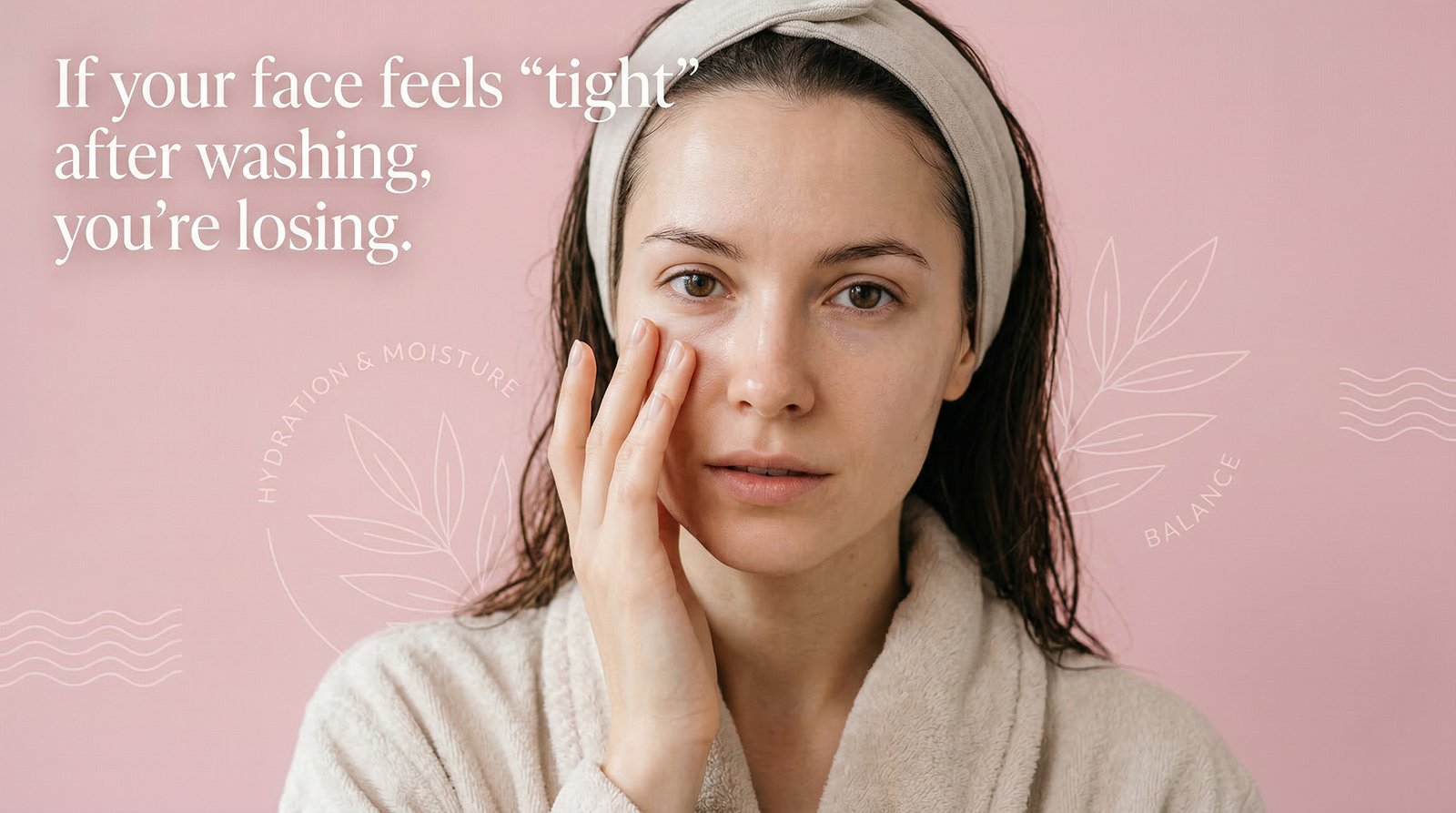
Discover how over-exfoliation can damage your skin barrier, accelerate aging, and trigger irritation and learn how to exfoliate safely for truly healthy, glowing skin.
The Blunt Wake-Up Call
Your skin isn’t “purging.”
It’s not “detoxing.” It’s not “adjusting to your new routine.” It’s inflamed, dehydrated, and quietly begging you to stop. If your face feels tight after cleansing, stings when you apply serum, and looks “glowy” but actually just feels raw that’s not progress. That’s damage with good lighting.
What's Actually Happening Under Your Skin Right Now
Here’s the part nobody puts in the Reels.
Your skin barrier is made of cells held together by a lipid matrix mostly ceramides, cholesterol, and fatty acids. Think of it like bricks (skin cells) and mortar (lipids). Exfoliate too often, and you’re not just sloughing off “dead skin.” You’re dissolving the mortar.
Once that lipid matrix breaks down, something called transepidermal water loss (TEWL) goes up your skin literally loses water through its surface faster than it can replace it. This decline shows up after age, UV exposure, overuse of acids, or harsh cleansing, leading to dehydration, inflammation, and a visible loss of smoothness, as outlined in this breakdown of ceramide function and barrier repair.
At the same time, your skin’s surface has a natural pH of around 4.5 to 5 the “acid mantle.” It’s not a buzzword. It’s a functioning ecosystem.
That slightly acidic upper layer is actively maintained by your skin’s own microbiome, creating an environment distinct from the layers beneath it, according to research on acid mantle function.
Strip that away with daily acids, harsh cleansers, or back-to-back actives, and you’re not just irritating your skin. You’re disrupting the bacterial balance that keeps it calm in the first place.
This is the part everyone skips: a damaged barrier and a disrupted microbiome create an inflammation loop. Inflammation weakens the barrier further. A weaker barrier invites more inflammation. Round and round it goes while you keep adding “treatments” for symptoms your routine is causing.
The Shift: Less, But Better
This is where skinimalism comes in and no, it’s not a trend with a shelf life. It’s a correction. The old model said: more steps, more actives, more “results.” The new model says your skin needs fewer interventions and more support. Less, but better, isn’t a compromise. It’s what your barrier has been asking for the entire time.
"But My Skin Feels Smoother After Exfoliating" Here's the Catch
That smooth, tight, “clean” feeling? That’s often your barrier being stripped down to nothing. Exfoliation removes the top layer of dead skin cells (good, in moderation). But it can also remove the lipids that hold everything together (bad, always). The smoothness you’re feeling isn’t healthy skin. It’s skin with less of its protective layer left.
Exfoliation should be approached with caution if your barrier is already compromised, exfoliating again only makes it worse, and most dermatology guidance now recommends scaling back frequency rather than increasing it, per this overview of barrier-safe exfoliation.
If your skin needs daily acids to “feel normal,” that’s not your baseline. That’s dependency.
Your Cleanser Is Probably the First Domino
Most over-exfoliation conversations skip straight to acids and scrubs. But your cleanser is often doing damage long before your serum ever gets involved. Foaming cleansers with high-pH surfactants don’t just remove makeup and oil. They shift your skin’s surface pH upward sometimes for hours after rinsing.
Frequent washing with soaps and detergents is one of the most common ways skin pH gets pushed higher than it should be, according to a review on the skin’s acid mantle.
Here’s the “wait, what?” moment: two enzymes responsible for actually building your ceramides only work in acidic conditions.
Both enzymes that convert ceramide precursors into the active ceramides your barrier needs require an acidic environment and one of them barely functions at neutral pH at all, based on this breakdown of acid mantle mechanics.
So a high-pH cleanser doesn’t just feel “stripping.” It can stop your skin from making its own ceramides on schedule. If you’re cleansing twice a day with something that leaves your face feeling “squeaky clean,” that squeak is the sound of your barrier’s mortar washing down the drain.
At this point, your skin doesn’t need a gentler cleanser and a separate barrier-repair step. It needs a cleanser formulated at the right pH that doesn’t ask for backup. That’s the entire premise behind Minimals’ cleansers clean skin without the trade-off.
The "Hydration" Step That's Quietly Drying You Out
Here’s a sentence that should be tattooed on every skincare influencer’s forearm: hydration is not the same as moisture.
Hydration = water content in the skin.
Moisture = the oils and lipids that keep that water from evaporating.
If you’re layering hydrating toners, essences, and serums but skipping anything that seals you’re pouring water into a cracked bucket. Worse: some “hydrating” formulas rely on humectants like glycerin or hyaluronic acid that pull water toward the skin’s surface. In a dry environment, with no lipid layer to lock that water in, it evaporates taking some of your skin’s own moisture with it.
This is why your skin can feel “hydrated and dry” at the same time. You’re not imagining it. You’re missing the seal step.
Why Stacking Five Actives Backfires (Even If Each One Is "Gentle")
Retinol at night. Vitamin C in the morning. AHA two times a week. BHA for “problem areas.” A new niacinamide serum because someone on TikTok swore by it.
Individually? Each of these can be fine.
Together, daily, with no recovery time? You’re not treating your skin. You’re cross-examining it. Every active ingredient creates a small amount of controlled stress that’s how it works. Retinol increases cell turnover. Acids dissolve bonds between dead cells. Vitamin C, depending on the formula, can be mildly irritating at effective concentrations.
Your skin can handle controlled stress. What it can’t handle is constant, overlapping stress with no downtime to rebuild the lipid matrix in between.
This is why people on seven-step routines often have more sensitivity, more redness, and more breakouts than people doing almost nothing. Their skin is in a permanent state of low-grade repair and repair requires resources your skin doesn’t get if it’s never allowed to finish the job.
The Myth of "My Skin Is Used to It Now"
You know that thing where your skin “got used to” a strong retinol or daily acid, and now you “need” it to feel normal?
That’s not tolerance. That’s adaptation under duress.
Your skin ramped up cell turnover and lipid production to compensate for constant disruption. Stop the actives, and your skin briefly looks worse not because it’s “detoxing,” but because it was relying on that disruption to feel functional. This is the inflammation loop again, just wearing a different outfit. The fix isn’t more product to manage the adaptation. It’s giving your barrier room to find its actual baseline which, for most people, is calmer and less reactive than they remember.
The Reality Check: If Your Routine Feels Complicated, That's the Problem
Let’s be honest for a second.
If you need a spreadsheet to track which serum goes with which night, your skin isn’t getting “personalized care.” It’s getting confused. If you’re buying products to fix problems caused by other products in your routine, you’re not solving anything. You’re funding the cycle. If your skin only looks good immediately after a facial, a peel, or a “reset” and gets worse a week later your baseline routine is the issue, not your skin.
A routine that requires constant management isn’t sophisticated. It’s unsustainable. Your skin doesn’t reward complexity. It rewards consistency, restraint, and ingredients that actually match what your barrier is made of.
What Your Skin Actually Needs (And It's Less Than You Think)
Here’s the uncomfortable truth: most people don’t need a “treatment” step at all right now.
They need their barrier back.
Ceramide-based formulations have been shown to improve barrier function, reduce inflammation, and support faster skin recovery not just in dry skin, but in skin recovering from any kind of disruption, according to this clinical research on ceramides and barrier repair.
Even in acne treatment where stripping and drying have traditionally been the default pairing active treatment with a ceramide-based cleanser and lotion improved barrier function and tolerability compared to a basic face wash, per this PubMed-listed study.
In other words: barrier support isn’t the “extra” step. For most over-exfoliated skin, it’s the only step that matters right now. At this point, your skin doesn’t need another step. It needs a formula that already does both calming inflammation and rebuilding what’s been stripped, in one layer.
Moisture Sandwiching: The One Technique Worth Keeping
If you take nothing else from this take this.
“Moisture sandwiching” means applying products from thinnest to thickest, with the goal of trapping water into the skin rather than just applying it onto the skin. Damp skin. Hydrating serum. Then immediately, a moisturizer that seals it in with lipids your barrier recognizes ceramides, fatty acids, cholesterol. That sequence matters more than the number of products you’re using. A single, well-formulated moisturizer applied correctly will outperform five “hydrating” products applied with no sealing step. Every time.
This is the entire logic behind Minimals’ moisturizers barrier-matching lipid ratios, applied as the final step that actually locks everything else in.
The Minimal Routine Blueprint (Barrier-First Edition)
If your skin is currently irritated, reactive, or just tired here’s where to start. Not forever. Just to reset.
A low-foam, pH-balanced cleanser. Once or twice daily, depending on your skin. No “deep cleansing” feeling required that feeling is usually the problem, not the goal.
One active. Not three. Not five. If your skin is currently irritated, skip this step entirely for 1 to 2 weeks. Let the barrier stabilize first.
A moisturizer with a barrier-matching lipid profile ceramides, fatty acids, cholesterol in the right ratios. This is non-negotiable, even if your skin is oily. Especially if your skin is oily.
Broad-spectrum SPF. Every morning. No exceptions, no negotiations.
That’s it. Four steps, max. Most days, three.
Don’t wait twenty minutes. Apply your moisturizer while your skin is still slightly damp to “lock in” that hydration.
A gentle way to cleanse
If your current cleanser is leaving you feeling like a drumhead, you might want to try our Triple Action Cleanser.
We made it specifically for people who are tired of that “stripped” feeling. It doesn’t foam up into a giant mountain of bubbles, because honestly, bubbles are usually just harsh detergents (sulfates) that do more harm than good. Instead, it feels more like a soft, silky lotion. It lifts away the grime and the makeup, but it leaves your “moisture cape” exactly where it belongs.
When you rinse it off, your face feels like… well, skin. Not paper. Not plastic. Just soft, clean skin.
Common mistakes we all make
Most people don’t set out to destroy their skin barrier. We do it quietly, systematically, through habits we’ve been told are healthy. If your skin is stuck in an irritation loop, you’re likely falling into one of these daily traps:
Washing with hot water: It feels amazing, but hot water literally melts the very lipids (the mortar) your skin relies on to lock in moisture. Lukewarm is the rule. Always.
The “Rough Dry”: Aggressively scrubbing your face dry with a bath towel after cleansing physically micro-exfoliates skin that is already vulnerable from being wet. Pat, don’t rub.
Waiting too long to moisturize: Leaving your skin bare for minutes after washing allows atmospheric air to instantly pull moisture out via rapid transepidermal water loss (TEWL). You have about a 60-second window to lock that hydration in.
Using SPF only on sunny days: UV rays pass through clouds and windows, subtly degrading your collagen and lipid matrix even on gray winter afternoons. If you can see your hand in front of your face, there is enough ambient light to require protection.
A simple "Stop the Damage" checklist
Frequently Asked Questions
Expect 28 to 45 days for full cellular turnover.
No. Dehydrated skin overproduces oil to compensate.
Only if removing heavy makeup or water-resistant SPF
Purging happens only where you normally breakout.
No. Pause all actives until stinging stops completely.
Closing thought
Your skin isn’t broken. It’s overworked.
Every extra step, every “just in case” serum, every acid you added because your skin “needed more exfoliation” it’s all asking your barrier to do more with less. The fix isn’t another step. It’s removing the ones that were never helping, and replacing the gaps with formulas that actually match what your skin is made of. Less isn’t a downgrade. It’s the upgrade you skipped looking for, because the industry told you “more” was the answer.