
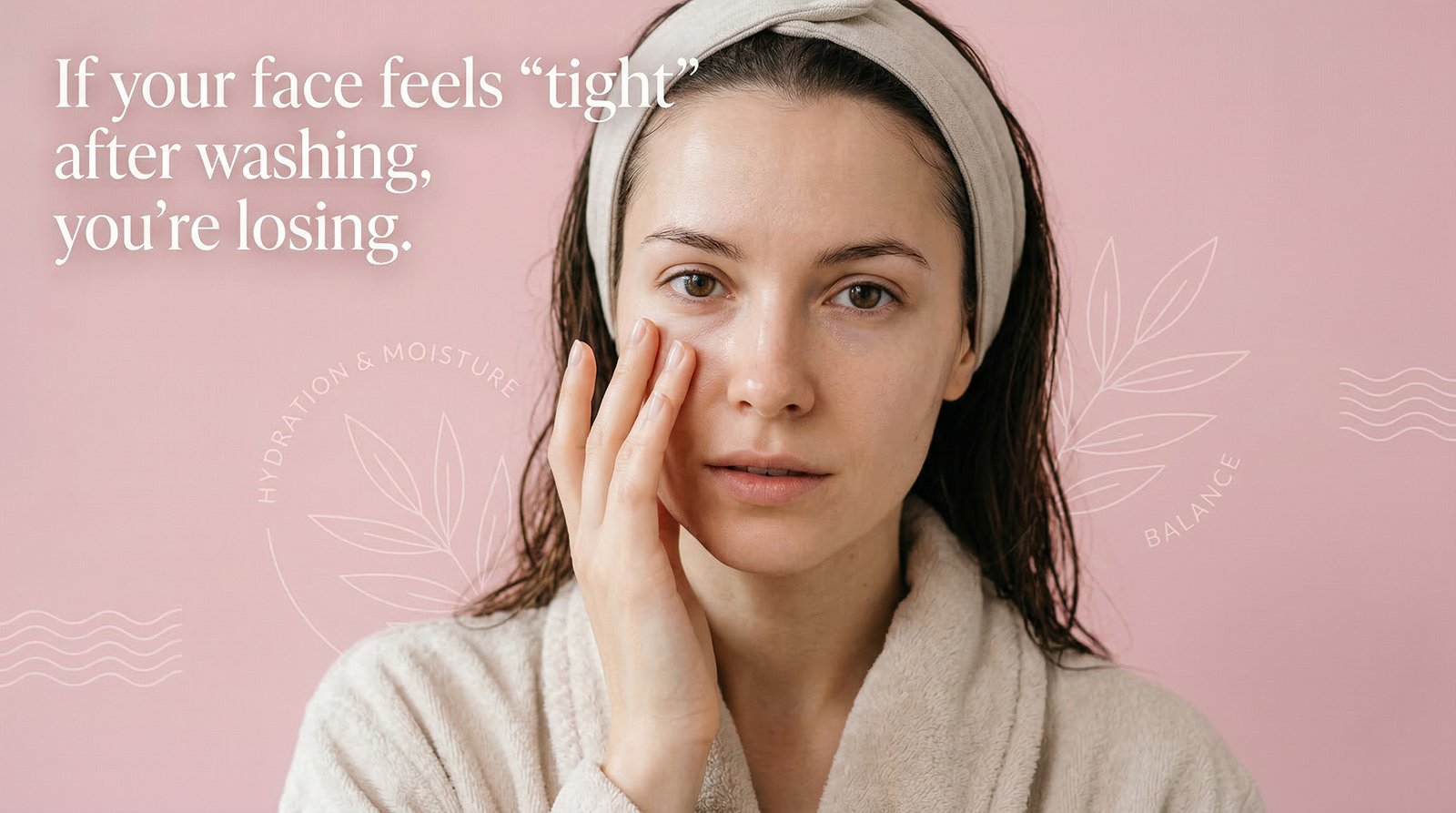
Unlock your moisturizer’s full potential with simple, science-backed techniques that lock in hydration for softer, healthier, glowing skin all day long.
Your Moisturizer Isn't Failing You. Your Routine Is.
You’ve tried three different moisturizers this year. You’ve blamed each one. Too greasy. Broke you out. Didn’t absorb. Did nothing. But here’s the uncomfortable part: the moisturizer probably wasn’t the problem.
Your skin is a biology project. And most routines are fighting it instead of working with it. The moisturizer you dismissed after two weeks might have been perfectly formulated it just never stood a chance in the environment you gave it to work in.
This is about fixing that environment. And doing it with a lot fewer steps than you think.
Your Skin Barrier Is Already Doing the Job You Just Keep Interrupting It
Before we talk about what to put on your face, you need to understand what your face is already doing.
Your skin barrier technically the stratum corneum is a layered matrix of dead cells embedded in lipids: ceramides, cholesterol, and free fatty acids. Think of it like a brick wall. The cells are the bricks. The lipids are the mortar holding everything together. This structure has one job: keep irritants out, keep moisture in.
When it’s intact, your skin looks calm, smooth, and resilient. When it’s compromised, moisture escapes through a process called transepidermal water loss (TEWL), and irritants get in. You end up with skin that feels tight in the morning, reactive to products you used to tolerate, and perpetually “dehydrated” no matter how much you moisturize.
Here’s the part nobody says out loud: a lot of skincare routines are compromising the barrier faster than it can rebuild.
The 'Hydration Doesn't Equal Moisture' Thing Is Real And It's Probably Why You're Still Dry
These two words get used interchangeably, and it’s causing real problems in real bathrooms.
Hydration means water content in the skin. You increase it with humectants ingredients like hyaluronic acid, glycerin, and urea that draw water into the skin.
Moisture refers to the lipid barrier that traps that water inside.
Research published in the Journal of Investigative Dermatology confirms that ceramide-deficient skin has measurably higher TEWL meaning it doesn’t matter how much water you push in if there’s nothing sealing it there.
This is why people who drink a gallon of water a day and layer hyaluronic acid serums still walk around with dry, tight skin. You’re not moisturizing. You’re temporarily hydrating then watching it all evaporate. The fix isn’t more hyaluronic acid. It’s sealing what you put in. Occlusives like petrolatum, squalane, or a ceramide-rich moisturizer applied on top of humectants is how you actually hold water in the skin. This is the logic behind moisture sandwiching layering a humectant, then sealing it with something occlusive or emollient before it evaporates off the surface.
The Cleanser You're Using Might Be the Most Destructive Part of Your Routine
This one genuinely surprises people.
Harsh surfactants the kind found in most foaming cleansers strip not just sebum but the ceramides and fatty acids your barrier is literally made of. Studies in dermatology journals have shown that sodium lauryl sulfate (SLS) significantly disrupts the lipid matrix and elevates skin pH, which impairs the enzymes responsible for barrier repair.
A damaged barrier can’t hold a moisturizer. It just… absorbs the product, leaks water, reacts to everything, and sends you spiraling into “my skin hates everything” territory. The other thing your cleanser is doing? Messing with your microbiome.
Your skin hosts around 1,000 bacterial species. That ecosystem regulates inflammation, crowding out pathogens, and maintaining a slightly acidic pH (around 4.5 to 5.5) that keeps your barrier enzymes functioning. Over-cleansing especially with alkaline surfactants disrupts that balance, which can trigger the exact inflammation that makes skin reactive, oily, and prone to breakouts.
That acne you’ve been blaming on hormones? Could be microbiome disruption from your twice-daily foaming cleanser.
If your cleanser leaves your skin feeling “squeaky clean,” that’s not clean. That’s stripped. A barrier-respectful cleanser should leave your skin feeling like skin calm, comfortable, not tight.
Layering Five Actives Isn't "Targeting." It's Inflammation You're Calling a Routine.
The skincare internet loves a serum stack. Vitamin C in the morning. Niacinamide at lunch (metaphorically). Retinol, AHA, BHA at night. Maybe a peptide serum somewhere in there for good measure. The problem is that actives work by doing something to skin. They exfoliate, oxidize, resurface, stimulate. That’s the point. But skin tissue has a finite repair capacity and when you’re running multiple actives simultaneously, you’re creating what can best be described as an inflammation loop: your skin is perpetually in recovery mode, never fully healing, always slightly irritated, and paradoxically more sensitive than before you started the routine.
Retinoids and AHAs used together can cause significant irritation and barrier breakdown. Vitamin C and niacinamide have been debated endlessly. High-pH and low-pH actives work against each other. And none of this is solving anything if your barrier is already compromised because active ingredients require an intact barrier to penetrate correctly and do their job without triggering reactivity.
The smarter approach is mono-active rotation: one active at a time, introduced slowly, with enough barrier-repair nights in between to let your skin actually recover. A well-formulated serum with a single targeted active applied to calm, intact skin will outperform a five-step active stack on reactive skin every single time.
You're Applying Your Moisturizer at Exactly the Wrong Time
Timing is unglamorous and almost nobody talks about it.
Your moisturizer is most effective when applied to skin that is still damp within 60 seconds of washing your face or completing your serum step. The reason is simple: humectants in moisturizers need water to bind to. If your skin is completely dry, those humectants pull from the deeper layers of the dermis instead of the environment, which can actually worsen dehydration. There’s also the occlusive function to consider. Applying a moisturizer over damp skin creates a seal while there’s still something to seal in. Over dry skin, you’re just coating the surface.
This is the whole logic of moisture sandwiching and it doesn’t require a new product. It requires better timing with what you already have. Wait a beat before drying your face completely after cleansing. Pat, don’t rub. Apply your serum. Apply your moisturizer while there’s still some moisture present. That’s it.
Your Moisturizer Needs Less Help Than You Think But Better Ingredients Than You're Getting
Most moisturizers on the market are built around one goal: feeling nice in the moment. They’re loaded with silicones for slip, fragrance for experience, and just enough active ingredients to make a claim on the label. The actual barrier-repairing work ceramides, cholesterol, fatty acids in the right ratios is either absent or present in concentrations too low to matter.
Research from Dermatology Times confirms that ceramide ratios in moisturizers matter for efficacy. A 3:1:1 ratio of ceramides to cholesterol to fatty acids most closely mimics the skin’s natural lipid matrix. Most moisturizers don’t specify ratios at all.
What your skin actually needs from a moisturizer:
Anything beyond that is often just marketing texture.
At this point, your skin doesn’t need another step. It needs a formula that already does all of this. Minimals moisturizers are built around barrier-function science, not sensory packaging which means you get actual repair, not just temporary softness.
If Your Routine Feels Complicated, That's the Problem
Let’s be honest for a second.
If you have to think about what order everything goes in, whether your actives are going to react with each other, whether it’s a “retinol night” or an “acid night” your routine has become a part-time job you’re doing to yourself. Complexity is often how the skincare industry covers up the fact that none of the individual products are doing enough on their own. When your barrier is intact, your skin handles a lot by itself. It regulates sebum. It manages hydration. It stays calm under environmental stress. You don’t need eight products for that. You need two or three good ones, applied consistently, in a way that doesn’t fight your biology.
The chronic skin issues that don’t respond to anything the persistent dryness, the sensitivity, the reactivity are frequently not conditions requiring more products. They’re signs of a barrier that’s never had enough time to fully repair.
Give it that time.
The Minimal Routine That Actually Works
Here’s what barrier-first skincare looks like in practice:
Morning
Gentle, low-pH, non-stripping. No foaming. No SLS. Something that cleans without dismantling everything your skin rebuilt overnight.
One serum, one function. Vitamin C if your concern is brightening. Niacinamide if it’s congestion or redness. Not both.
A ceramide-rich moisturizer applied to damp skin. This is your non-negotiable.
SPF 30+. Every morning. This is the one active that no minimalist argument can skip.
Evening
Same cleanser. Or a gentle oil cleanse first if you’re wearing SPF or makeup.
Retinoid, exfoliant, or whatever single active you’re using. Not every night. Not in combination.
Your moisturizer again. On nights when you’re not using actives, this is the whole routine. And that’s fine. That’s actually the goal.
No essence. No toner. No facial mist. No sleeping mask on top of a moisturizer that already occludes.
Three steps, done consistently, with products that respect your barrier will do more for your skin in eight weeks than eight products have done in the last year.
Common mistakes we all make
1. Blaming the Moisturizer Instead of Your Routine
2. Confusing Hydration with Actual Moisture
3. Using Harsh Cleansers That Destroy Your Barrier
4. Overloading on Multiple Actives at Once
5. Applying Moisturizer at the Wrong Time
6. Choosing Complexity Over Barrier-Supporting Simplicity
A simple "Barrier First" checklist
Frequently Asked Questions
In most cases, it’s not the moisturizer it’s the environment you’re giving it. Harsh cleansers, over-exfoliation, multiple conflicting actives, and applying products to completely dry skin can prevent even well-formulated moisturizers from working. The real issue is often a compromised skin barrier, not the product itself.
Hydration refers to water content in the skin (increased by humectants like hyaluronic acid or glycerin). Moisture refers to the lipid barrier that seals that water in. You can hydrate skin all day, but without a strong lipid barrier, the water evaporates through transepidermal water loss (TEWL). True moisturizing requires both water-attracting ingredients and occlusives/emollients to lock it in.
Because hydration without occlusion is temporary. If your barrier is damaged, water escapes quickly. Sealing humectants with a ceramide-rich moisturizer or occlusive (like squalane or petrolatum) on damp skin is what actually keeps moisture where it belongs.
Possibly. Foaming cleansers with harsh surfactants like SLS strip natural oils, ceramides, and disrupt the skin’s microbiome and pH. “Squeaky clean” usually means over-stripped. A good cleanser should leave skin feeling calm and comfortable, not tight or dry.
It’s usually counterproductive. Layering several actives creates chronic low-level inflammation and barrier damage. The skin has limited repair capacity. A better approach is mono-active rotation: introduce one active slowly, use it a few nights a week, and give your skin plenty of barrier-repair nights in between.
Closing thought
The skincare industry profits from your uncertainty. Every new product implies that what you have isn’t enough. Every “step” added to your routine is another product sold. The whole architecture of the 10-step routine was never built around your skin’s needs it was built around commerce.
Your skin is not a problem to be solved with more. It’s a biology to be supported with the right things, applied correctly, consistently. A barrier-replenishing cleanser. One targeted treatment when needed. A moisturizer that’s actually formulated to do the job not just feel like it is.
That’s the whole routine. Explore it here.