
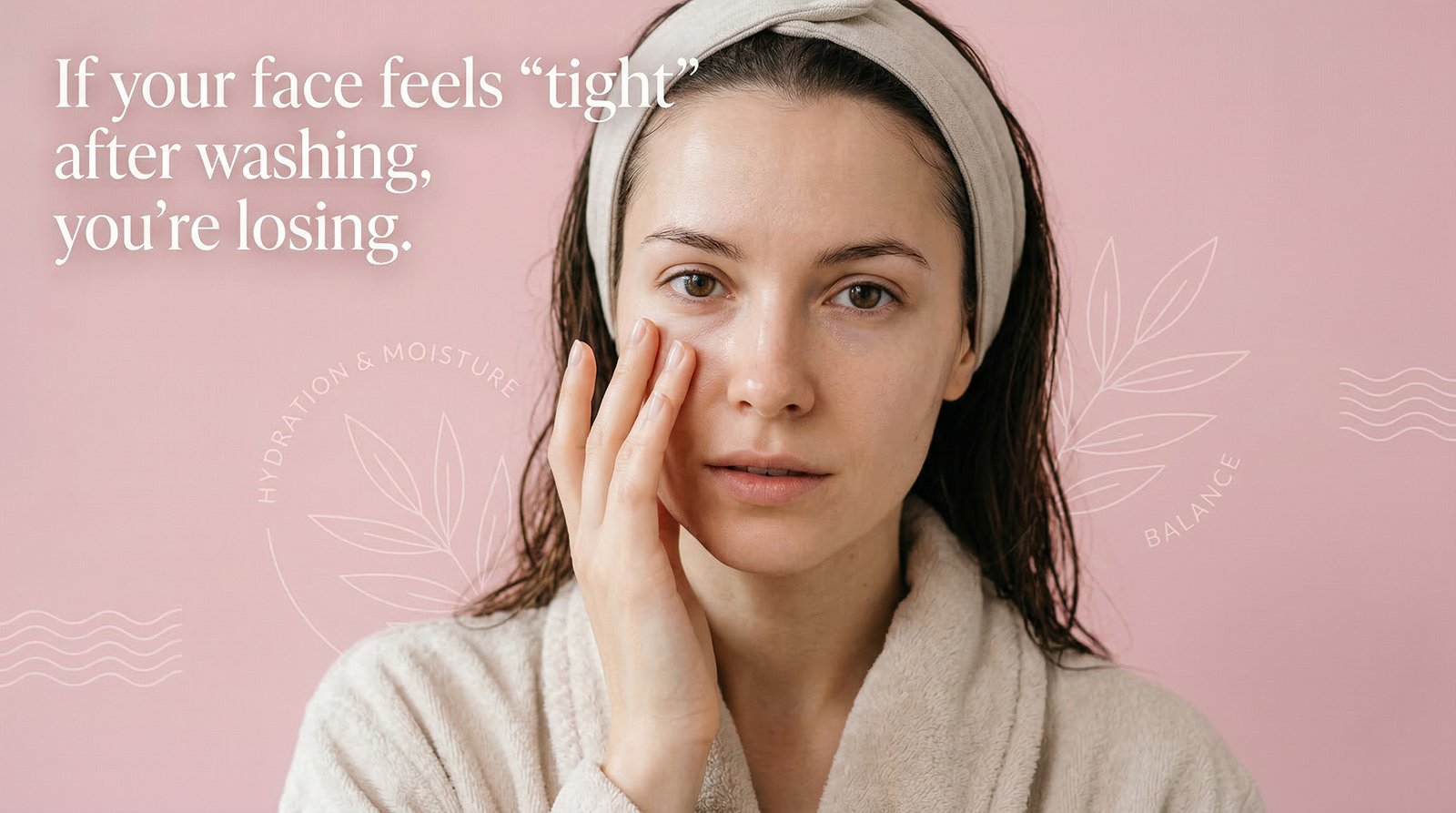
Most moisturizers fail not because they’re bad but because your routine is quietly sabotaging the skin barrier they’re trying to repair.
Your Moisturizer Isn't the Problem. But It Might Be the Last Thing You Should Fix.
You’ve switched moisturizers four times this year.
Each one did something wrong. Too heavy. Pilled under makeup. Made you break out. Sat on top of your skin like a film you couldn’t fully absorb. Left you dry by noon.
So you try another one. Read more reviews. Order a sample. Repeat. Here’s what nobody’s told you: the moisturizer you returned might have been fine. What wasn’t fine was everything that came before it the cleanser that stripped your barrier, the three actives stacked on top of each other, the toner that threw off your skin’s pH before your moisturizer even got a chance.
You’re not troubleshooting a moisturizer. You’re troubleshooting a routine. And they’re very different problems.
The Symptom You're Treating Isn't the One That's Actually There
When your moisturizer doesn’t work, it rarely means the formula is bad.
It usually means your skin is in a state where no moisturizer can do its job because the barrier it needs to penetrate, reinforce, and seal is already too compromised to cooperate.
Your skin barrier the stratum corneum is a lipid matrix built from ceramides, cholesterol, and free fatty acids. Research consistently shows that when this matrix is intact, moisture stays in and irritants stay out. When it’s damaged, moisture escapes through transepidermal water loss (TEWL), and everything you apply including your moisturizer either evaporates, irritates, or sits uselessly on top.
Most people with “moisturizer problems” actually have barrier problems.
And the cause is usually the rest of their routine.
Problem #1: Your Moisturizer Is Pilling And You're Blaming the Formula
Pilling is one of the most complained-about moisturizer issues. It’s also one of the most misdiagnosed.
You see it as a texture failure. The product balling up, rolling off, mixing weirdly with what’s under it. The instinct is to think the moisturizer is incompatible with your skin type or too thick to absorb. Almost always, that’s wrong. Pilling happens when a product can’t bond to the skin surface properly usually because of product layering conflicts, leftover product residue from previous steps, or silicone-heavy formulas that can’t adhere to each other. That serum you applied thirty seconds before the moisturizer? If it hasn’t absorbed, you’re essentially applying one wet layer on top of another. The fix isn’t a new moisturizer. It’s wait time.
Give each layer 60 to 90 seconds to sink before applying the next. Pat, don’t rub. And check whether your previous step contains heavy silicones (dimethicone, cyclopentasiloxane) these create a film that actively repels water-based products applied on top.
If pilling persists even with correct timing, the issue might be product incompatibility a serum and moisturizer that simply weren’t formulated to work together. At that point, simplifying to fewer layers almost always solves it immediately.
Problem #2: You're Still Dry Two Hours After Applying And Adding More Isn't Working
This is the one that makes people feel like their skin is fundamentally broken.
You moisturize. It feels fine. An hour later tight, parched, uncomfortable. You apply more. Same result. You start to wonder if your skin just can’t hold moisture. It can. It’s just not being sealed.
Here’s the biology: humectants glycerin, hyaluronic acid, urea attract water into the skin. But they don’t trap it there. If you’re applying a humectant-heavy moisturizer to dry skin in a low-humidity environment, those humectants pull moisture from the deeper dermis rather than the air, and it evaporates off the surface. Studies on TEWL in compromised skin show this clearly: hydration without occlusion is temporary at best, counterproductive at worst.
Hydration and moisture are not the same thing.
Hydration = water content. Moisture = the barrier that holds water in place. You need both. A moisturizer that only contains humectants without emollients or occlusives will hydrate you briefly and then let it all escape.
What to look for: a formula that combines all three a humectant to draw water in, an emollient (fatty alcohols, squalane, shea) to soften and smooth, and an occlusive or a ceramide blend to seal the barrier. Alternatively and this is the moisture sandwiching approach apply a light humectant serum to damp skin, then seal it immediately with your moisturizer before any water can evaporate. The timing is everything. Sixty seconds on a damp face does more than five minutes on a dry one.
Problem #3: Your Moisturizer Is Breaking You Out But It's Probably Not the Moisturizer
This is where things get genuinely counterintuitive. You apply a new moisturizer. Three days later, you break out. The obvious conclusion: the moisturizer is comedogenic. You check it against every pore-clogging ingredient list you can find online. You find one questionable ingredient. You return it.
But wait.
Was your skin already in an inflammatory state before you started using it? Had you been using a retinoid, or an AHA, or been over-cleansing with a harsh foaming cleanser? Because compromised barrier function creates an environment where skin is hyper-reactive and almost any new product applied to a disrupted barrier can trigger an inflammatory response that looks like a breakout.
It’s not always the formula. Sometimes it’s the timing.
There’s also the microbiome piece. Your skin hosts around 1,000 bacterial species in a finely balanced ecosystem. Over-cleansing with high-pH surfactants disrupts that balance, reducing the presence of beneficial bacteria that regulate inflammation and keep pathogenic bacteria in check. When that balance is off, skin becomes prone to breakouts that have nothing to do with pore-clogging ingredients and everything to do with a destabilised surface environment.
Before you blame the moisturizer, audit the cleanser.
If you’re using anything that foams aggressively and leaves your skin feeling “clean,” that’s the first variable to address. A low-pH, non-stripping cleanser preserves the microbiome, maintains barrier integrity, and creates conditions where your moisturizer can actually do its job without triggering reactivity.
Problem #4: Your Moisturizer Feels Great at Night But Your Skin Is a Mess by Morning
You wake up expecting recovered, rested skin. Instead: tight, dull, and somehow more dehydrated than when you went to bed. This one has a few possible explanations, and they’re worth separating.
First: your overnight environment. Low-humidity rooms particularly with air conditioning or heating running dramatically accelerate TEWL while you sleep. Your moisturizer applies fine but evaporates over eight hours. This isn’t a product failure. It’s an environment issue a humidifier would fix faster than a new moisturizer.
Second: you might be sleeping on rough cotton pillowcases that physically disrupt the thin film your moisturizer creates. This sounds minor. It isn’t.
Third and this is the one most people miss your nighttime active is undoing your moisturizer.
If you’re using a retinoid, a high-percentage AHA, or a peeling treatment at night, you’re initiating a controlled inflammatory response and then asking a moisturizer to seal it up on top. That’s not how repair works. Actives need recovery windows. Research on retinoid-induced barrier disruption confirms that consecutive nightly use of strong actives compromises the same barrier you’re trying to restore with moisturizer.
Your actives and your moisturizer are working against each other. The fix: use actives no more than three nights a week, maximum. On off nights, your entire PM routine can be cleanser plus moisturizer. Those nights aren’t lazy they’re when your barrier actually repairs itself.
Problem #5: You've Been Layering Actives on Top and Calling It a "Targeted Routine"
This is probably the most pervasive mistake in modern skincare. The logic sounds reasonable: your skin has multiple concerns, so you use multiple actives to address each one. Vitamin C for dullness. Niacinamide for pores. Retinol for texture. An AHA for exfoliation. A peptide serum for firmness.
The result is an inflammation loop skin that’s perpetually in low-grade stress mode, never fully recovering between applications, increasingly reactive to products it would have tolerated fine on a healthy barrier.
Here’s what happens biologically: actives work by doing something to skin tissue. They oxidise, exfoliate, accelerate cell turnover, or stimulate collagen. Each of these processes creates a micro-inflammatory response. In controlled doses, that response is the mechanism it’s how they work. But stack five of them simultaneously and you’re not targeting multiple concerns. You’re just inflaming your skin from five directions at once.
The other issue: many actives require specific pH ranges to function. A vitamin C serum needs a pH of around 3.5. Niacinamide is most stable around 5 to 7. A retinoid works near neutral. When these are layered in quick succession, they either cancel out, destabilise each other, or create an environment hostile to the moisturizer that follows.
One active at a time. Rotated deliberately. Separated by off nights where your skin gets to breathe, repair, and just be with a well-formulated barrier serum and your moisturizer. Nothing else.
That’s not a restricted routine. That’s a routine that actually delivers results.
Problem #6: The Ingredient List on Your Moisturizer Is Doing Almost Nothing
Most moisturizers are engineered for sensory experience first, performance second. They’re formulated to spread beautifully, absorb quickly, and feel like nothing because that’s what gets good reviews in the first ten seconds of testing.
Actual barrier repair requires specific ingredient ratios. Research published in the Journal of Investigative Dermatology established that a 3:1:1 ratio of ceramides to cholesterol to free fatty acids most closely mimics the skin’s natural lipid matrix and produces measurably better barrier recovery than single-ingredient approaches.
Most moisturizers don’t tell you the ratios. Most don’t even include all three categories. What to look for on the label: ceramide NP, ceramide AP, or ceramide EOP (multiple ceramide types perform better than one), cholesterol, and fatty acids like linoleic acid or palmitic acid. A humectant glycerin is the most reliable. And an emollient like squalane or shea to soften and support.
Fragrance, on the other hand, should not be there. Even in products marketed as “gentle,” fragrance compounds are among the most well-documented causes of contact sensitisation and barrier irritation. Evidence in dermatological literature consistently points to fragrance as a primary driver of reactive skin including reactions you’d otherwise attribute to a different ingredient.
If your moisturizer smells like anything other than nothing, that’s worth questioning.
Minimals moisturizers are built around what the barrier actually needs ceramides, fatty acids, cholesterol without the fragrance, without the filler. Not because it sounds good on a label. Because it’s what the science points to.
The Reality Check: If You're Doing This Much Work, Something Is Broken
Let’s be straight with each other.
If you’re spending twenty minutes on your skincare routine, cross-referencing ingredient lists, timing product applications, worrying about pH stacking, and still not getting results the problem isn’t that you need more information. The problem is that your routine is built around complexity instead of function. A healthy skin barrier, maintained consistently, should make skincare easy. Your skin shouldn’t need eight products to stay calm. It shouldn’t require fragrance-free everything, constant actives, and a dermatologist’s knowledge base just to avoid breaking out.
When skin is that reactive, that difficult to manage it’s almost always a barrier issue. And barrier issues don’t get solved by adding more. They get solved by stripping back, letting the skin repair, and then slowly, deliberately reintroducing what you actually need.
Simple routines feel boring. They’re also what works.
The Routine That Actually Fixes Moisturizer Problems (By Addressing What Causes Them)
Morning
Low-pH, non-foaming. If your face doesn’t feel tight or dry after washing it, you’ve found the right cleanser. If it does that’s your first problem, and it’s upstream of everything else.
One serum. One function. Not vitamin C and niacinamide and a peptide layered in sequence. Pick the one that addresses your primary concern and use that. Everything else can wait for a different morning or a different week.
Your moisturizer, applied to skin that’s still slightly damp. Pat it in don’t rub. Wait until it’s fully absorbed before anything else.
SPF 30 or higher. This is the one product with the most evidence behind it for long-term skin health, and most people apply too little, too late.
Evening
Same cleanser, or a gentle oil cleanse first if you’re removing SPF or makeup.
Your one active. Retinoid, exfoliant, vitamin C whichever, not all of them. Not tonight and tomorrow and the night after.
Your moisturizer. On nights without an active, this step is the routine after cleansing. Cleanser. Moisturizer. Done.
No essence. No facial mist. No layered sleeping masks. No additional “barrier cream” on top of a moisturizer that already contains barrier ingredients. Those steps aren’t being modest. That is the routine. The one that actually lets your barrier repair itself overnight, so your moisturizer has something functional to work with by morning.
A gentle way to cleanse
If your current cleanser is leaving you feeling like a drumhead, you might want to try our Triple Action Cleanser.
We made it specifically for people who are tired of that “stripped” feeling. It doesn’t foam up into a giant mountain of bubbles, because honestly, bubbles are usually just harsh detergents (sulfates) that do more harm than good. Instead, it feels more like a soft, silky lotion.
It lifts away the grime and the makeup, but it leaves your “moisture cape” exactly where it belongs.
When you rinse it off, your face feels like… well, skin. Not paper. Not plastic. Just soft, clean skin.
Common mistakes we all make
Over-cleansing: Using harsh, foaming cleansers that strip the skin barrier and microbiome.
Layering too many actives: Vitamin C, niacinamide, retinol, AHAs all at once → constant inflammation loop.
Skipping wait time: Not letting products absorb (30–90 seconds) before layering, which causes pilling.
Humectants without sealants: Relying only on hyaluronic acid or glycerin without emollients/occlusives → hydration evaporates.
Blaming the moisturizer for breakouts: When the real issue is a compromised barrier or disrupted microbiome.
Ignoring environment: Sleeping in dry air or on rough pillowcases that undo overnight repair.
Fragrance in formulas: Choosing “nice-smelling” moisturizers even though fragrance is a top irritant.
Complicated routines: Believing more products = better results, when simplicity actually repairs the barrier.
A simple "Moisturizer formula" checklist
Low-pH, non-foaming. If your face doesn’t feel tight or dry after washing it, you’ve found the right cleanser. If it does — that’s your first problem, and it’s upstream of everything else.
One serum. One function. Not vitamin C and niacinamide and a peptide layered in sequence. Pick the one that addresses your primary concern and use that. Everything else can wait for a different morning or a different week.
Your moisturizer, applied to skin that’s still slightly damp. Pat it in — don’t rub. Wait until it’s fully absorbed before anything else.
SPF 30 or higher. This is the one product with the most evidence behind it for long-term skin health, and most people apply too little, too late.
Frequently Asked Questions
Your moisturizer isn’t usually the problem your routine is. A damaged skin barrier from harsh cleansing, overusing actives, or poor layering prevents it from working properly.
Pilling is typically caused by layering products too quickly, silicone-heavy formulas, or residue. Wait 60 to 90 seconds between layers and simplify your routine.
You’re likely hydrating without sealing. Use humectants on damp skin then immediately follow with an occlusive or ceramide-rich moisturizer (moisture sandwiching).
Often no it’s usually a compromised barrier or disrupted microbiome from harsh cleansers and over-actives making skin reactive to almost anything.
Low humidity, rough pillowcases, or nightly strong actives (retinoids/AHAs) that undo repair. Use actives only 2–3 nights per week and add a humidifier if needed.
Closing thought
The moisturizer you’ve been blaming has probably been set up to fail.
Fix what comes before it the cleanser that’s stripping your barrier, the actives that are inflaming it, the layering order that’s making everything pill or cancel out and your moisturizer will work. Not because you found a better formula. Because you stopped sabotaging the conditions it needs. Fewer products. Better timing. Ingredients that match what your skin actually needs. That’s the whole thing.