
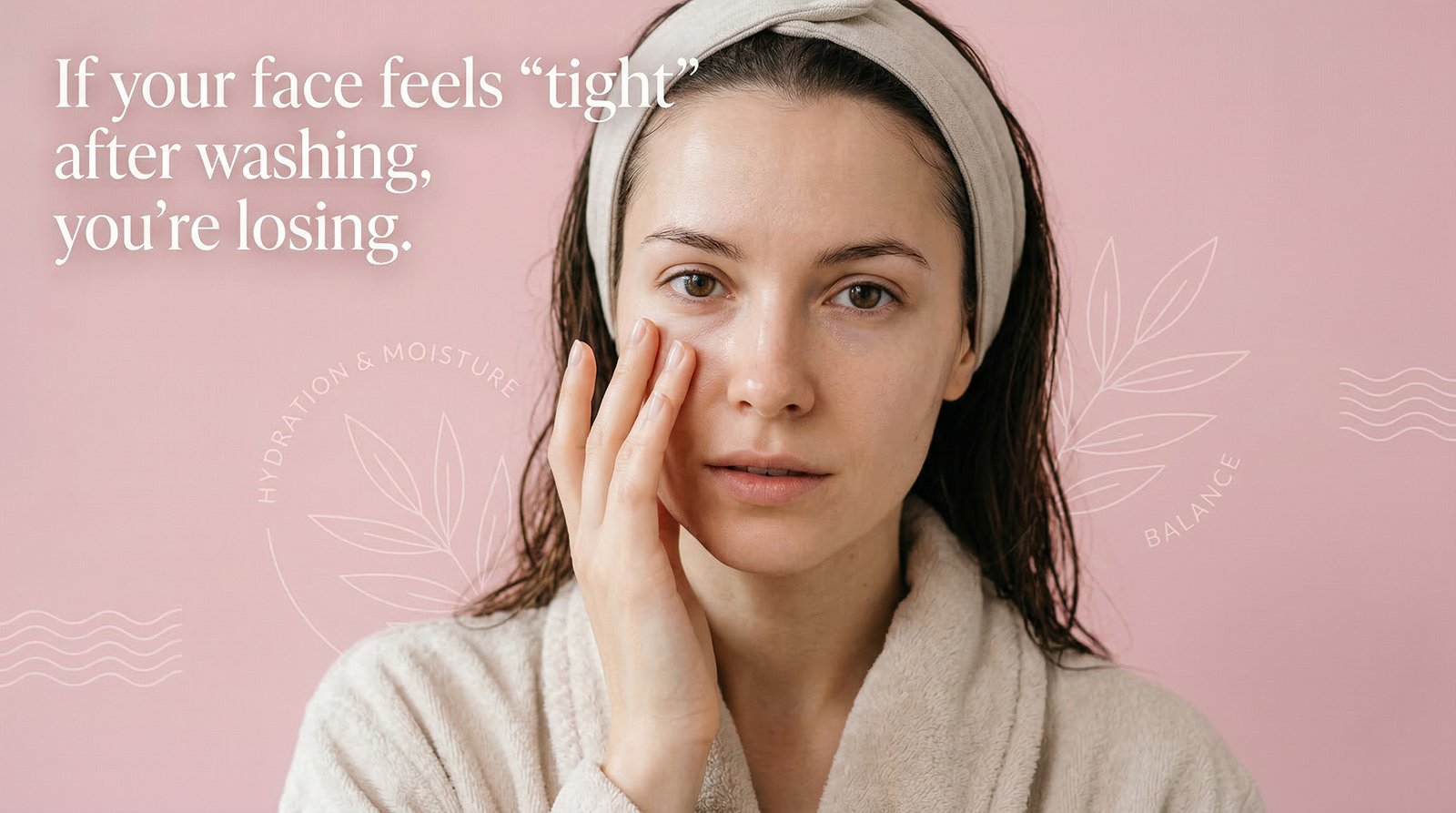
Understanding your skin type is key to selecting the perfect moisturizer that hydrates effectively without causing irritation, breakouts, or greasiness.
The Moisturizer Mistake You're Probably Making Right Now
You’ve been choosing your moisturizer based on your skin type.
That’s the problem.
Not because skin types don’t exist they do. But because the way the industry has taught you to think about them is backwards. “Oily skin? Use gel. Dry skin? Use cream. Combination? Use both and good luck.” That’s not dermatology. That’s aisle logic designed to sell you two products instead of one.
Your skin type is not a fixed identity. It’s a current condition one that changes with your climate, your hormones, your routine, and most importantly, the state of your skin barrier. And until you understand that, you’ll keep buying moisturizers that work for two weeks and then mysteriously stop.
Let’s actually fix this.
Why Your Skin Type Isn't What You Think It Is
The classic categories dry, oily, combination, sensitive, normal were designed for product marketing, not skin science.
Real skin is more dynamic than that.
Someone with “oily” skin might have a severely dehydrated barrier that’s overproducing sebum to compensate for moisture loss. Someone with “dry” skin might not lack oil they might lack the ceramide structure to hold water in. The distinction matters because the solution to each is completely different. And if you’re treating the symptom instead of the cause, your moisturizer is doing a lot of work for very little return.
Research published via the NIH’s National Library of Medicine confirms that sebum production and skin hydration are regulated by separate mechanisms zmeaning oily skin and well-moisturized skin are not mutually exclusive. You can be oily and dehydrated at the same time. Millions of people are, and they’re using mattifying gel moisturizers that are making things quietly worse.
Before you choose a moisturizer, stop asking “what’s my skin type?” and start asking: “what is my barrier doing right now?”
The Three Jobs a Moisturizer Actually Has (Most Only Do One)
Here’s where most products fall short and where most people get confused.
A moisturizer isn’t just something that makes your skin feel soft for a few hours. A properly functioning moisturizer does three distinct things: it attracts water, it retains water, and it reinforces the barrier so the work isn’t undone by morning.
These three functions map to three ingredient categories:
Humectants (hyaluronic acid, glycerin, urea) draw water into the skin from the environment or from deeper skin layers. They hydrate, but they don’t seal. In a dry climate, they can pull water up from the dermis and let it evaporate at the surface which is the “wait, what?” moment nobody warns you about.
Emollients (squalane, fatty acids, plant oils) smooth the skin and fill the gaps between skin cells. They make the texture feel better and provide some occlusion. But they don’t structurally repair the lipid matrix.
Occlusives (petroleum jelly, dimethicone, certain waxes) form a physical seal over the skin surface, slowing transepidermal water loss (TEWL). They retain what’s already there but don’t add moisture on their own.
The best moisturizers for a compromised barrier contain all three. Most moisturizers marketed to “oily” skin contain only the first and skip the sealing step entirely. So you hydrate. And then it evaporates. And your skin overproduces oil to compensate. And you blame your skin type.
You see the pattern.
What "Oily Skin" Is Often Telling You (And You're Not Listening)
Oily skin is not a character flaw or a genetic sentence.
In many cases not all, but many it’s a response. Specifically, it’s your skin trying to compensate for a disrupted barrier that can’t retain water on its own. So it does the only thing it can: produces more sebum to act as an occlusive layer.
Strip that oil with a harsh cleanser, apply a gel moisturizer that hydrates but doesn’t seal, and repeat twice daily and you’ve built yourself a sebum overproduction loop that no mattifying primer can fix.
Studies in dermatology literature available through PubMed on sebaceous gland regulation show that barrier disruption directly increases sebum secretion as a compensatory response. This is measurable. It’s not a theory it’s your skin’s biology doing exactly what it was designed to do.
What oily, dehydrated skin actually needs is a moisturizer with a small amount of occlusion, barrier-repairing lipids, and a non-comedogenic base. Not a gel. Not a watery serum. Something that gives your skin enough structure to stop overcompensating.
When your barrier works, the oil production tends to regulate itself. That’s not a sales pitch. That’s what happens when you treat the cause instead of the symptom.
Why "Non-Comedogenic" Doesn't Mean What You've Been Told
Let’s spend a moment on this label because it’s everywhere and it’s nearly meaningless.
“Non-comedogenic” means a product was tested usually in vitro or on rabbit ears, a testing method that’s been criticized for poor human relevance and found unlikely to clog pores. It does not mean pore-safe for everyone. It does not account for your specific microbiome, your skin’s current barrier state, or how the product interacts with everything else you’re applying.
The ingredient that’s breaking you out may not even be in your moisturizer. It might be the emulsifier in your SPF reacting with the silicone in your primer. But because the moisturizer says “non-comedogenic,” it never gets questioned.
What actually tends to not clog pores: a short ingredient list. Formulas built around squalane, ceramides, fatty acids, and simple emollients. Not twenty ingredients that have each been individually tested in isolation.
Fewer ingredients means fewer variables. And fewer variables means fewer unexplained reactions.
Dry Skin vs. Dehydrated Skin: You're Probably Treating the Wrong One
This distinction might be the most useful thing you read today.
Dry skin is a skin type defined by low sebum production. The sebaceous glands aren’t producing enough oil, so the skin lacks natural lipid protection. It often feels tight, looks dull, and can get flaky.
Dehydrated skin is a temporary condition not a type caused by low water content in the skin cells. It can happen to any skin type, including oily skin. It looks dull, feels tight after cleansing, shows fine lines more easily, and often feels like it “drinks up” product quickly without ever feeling satisfied.
The fix for dry skin: lipid replenishment. Ceramides, fatty acids, cholesterol. You’re rebuilding the mortar between the skin cells the lipid matrix that’s been underperforming since birth.
The fix for dehydrated skin: humectants followed immediately by occlusion. Pull water in, then lock it down before it leaves. What you don’t want to do is apply hyaluronic acid without anything to seal it especially in a dry climate because you’re pulling moisture up and handing it straight to the air.
Research in the Journal of Investigative Dermatology on the role of natural moisturizing factors (NMFs) in the stratum corneum confirms that skin dehydration is closely tied to NMF depletion which is accelerated by harsh cleansers, over-exfoliation, and low-humidity environments. Fix the routine first. Then pick the moisturizer.
If you’re not sure which one you’re dealing with: gently pinch the skin on your cheek. If it bounces back slowly or looks slightly crepey when released, dehydration is likely at play. If your skin has always felt tight and rough regardless of how much water you drink or how many serums you layer, that’s more likely a dry skin type.
Two different problems. Two different solutions.
The 'Moisture Sandwich' Actually Works If You Do It Right
There’s a reason “moisture sandwiching” keeps coming up in skin science conversations it’s one of the few social media skincare trends that has legitimate biology behind it. The concept: apply a humectant to damp skin, then immediately seal with an emollient or occlusive moisturizer before the water evaporates.
The science: humectants bind water molecules. If you apply them to damp skin immediately after cleansing, before the surface dries you’re giving them something to bind to. Then, the moisturizer on top creates the seal that keeps those water molecules from escaping as TEWL.
What people get wrong: waiting two minutes between steps because they read that somewhere. Or applying the humectant serum, then going to do something else, coming back to apply the moisturizer, and wondering why their skin feels tight anyway. The window matters. The seal has to follow the hydration.
The other thing people get wrong: thinking this technique replaces barrier repair. It doesn’t. If your lipid matrix is structurally compromised, moisture sandwiching is like mopping a floor with a hole in it. You need the ceramides and fatty acids to actually rebuild the structure not just manage the symptoms.
Minimals’ Barrier Repair Moisturizer is built to do both in one step: a ceramide-cholesterol-fatty acid base that repairs structure, with a humectant layer that hydrates and an occlusive component that seals. The moisture sandwich, compressed into a formula you apply once. No technique required.
The Seasonal Moisturizer Swap You're Probably Not Making
Your skin in July is not your skin in December.
Humidity drops in winter sometimes dramatically which means the environment is actively pulling water from your skin’s surface. The same moisturizer that felt perfect in summer can feel completely inadequate by November. Not because the formula changed, but because the context did. Most people respond to this by adding more steps: an extra serum, a facial oil on top, a heavier night cream. And sometimes that works. But more often, it creates new problems pilling, congestion, and a routine that takes twenty minutes and still doesn’t feel like enough.
The smarter response is switching moisturizer base weights, not adding steps.
In summer: a lighter emollient-humectant base, possibly with minimal occlusion. In winter: a richer ceramide-occlusant base that compensates for the moisture the environment is stealing.
One product. Different formulas. No extra steps.
If you’re in a year-round humid climate, your baseline might stay consistent—but if you travel, if you use indoor heating in winter, or if your skin feels different at different times of year for reasons you’ve never been able to explain: this is probably why.
If You're Still Layering Four Products Where One Would Do—Read This
Let’s talk about the real cost of routine complexity.
Every additional product is an additional variable. More potential irritants. More ingredient conflicts. More potential for the wrong pH interaction to make your actives inert. More opportunities for your microbiome to get disrupted by something it didn’t need to encounter.
Research published via PubMed on cumulative irritant dermatitis shows that repeated low-level exposure to multiple irritants even ones individually below the irritation threshold creates additive skin damage. Your routine doesn’t have to contain one obviously bad ingredient to be damaging your skin. It just has to have too many.
This isn’t an argument for doing nothing. It’s an argument for doing less, with more precision.
One well-formulated moisturizer that addresses humectancy, emolliency, occlusion, and barrier repair is more effective than four separate products attempting to do each thing independently because the combined application works in concert rather than in competition. And practically: it’s cheaper. It’s faster. And your skin isn’t being subjected to a twelve-ingredient onslaught twice a day.
If your current routine has you feeling confused about what’s doing what that confusion is meaningful. Simplify until you know what works, then only add back what actually earns its place.
The Reality Check: Your Moisturizer Can't Fix a Broken Routine
Here’s the uncomfortable part.
If you’re cleansing with a high-pH, sulfate-heavy formula, then applying an alcohol-based toner, then layering three actives, then wondering why your moisturizer isn’t making your skin feel better the moisturizer is not your problem.
It’s the last step in a routine that’s actively working against itself.
A barrier-disrupting cleanser raises your skin’s pH, strips lipids, and compromises its structural integrity. No moisturizer ceramide-packed or otherwise can fully compensate for damage that’s being re-inflicted every morning and every night. This is the loop that keeps people buying new moisturizers every six weeks. The moisturizer feels amazing for the first few days because it’s patching the damage. Then it stops working because the damage is being reapplied faster than the moisturizer can repair.
The fix starts earlier in the routine. Specifically: with a gentle, pH-balanced cleanser that isn’t stripping the lipid layer your moisturizer is trying to rebuild.
Fix the cleanse. Then watch how much better everything after it performs.
The Minimal Moisturizing Blueprint (That Actually Works)
The right moisturizer for your skin type is, in the end, less about the label on the front and more about what the formula does across these three criteria:
Does it match your barrier’s current need? If your barrier is compromised reactive, tight, flaky, or over-producing oil start with a ceramide-rich formula before anything else. Barrier-first is always the right starting point.
Does it seal, not just hydrate? Check for occlusives in the formula. If the entire moisturizer is humectant-forward with no lipid component, it’s a halfway measure.
Is the ingredient list honest? Under fifteen ingredients and you can probably identify what each one is doing. Over twenty and you’re playing ingredient roulette.
The routine:
Four steps. Three steps. Nothing more until your barrier proves it can handle more.
A gentle way to cleanse
If your current cleanser is leaving you feeling like a drumhead, you might want to try our Triple Action Cleanser.
We made it specifically for people who are tired of that “stripped” feeling. It doesn’t foam up into a giant mountain of bubbles, because honestly, bubbles are usually just harsh detergents (sulfates) that do more harm than good. Instead, it feels more like a soft, silky lotion.
It lifts away the grime and the makeup, but it leaves your “moisture cape” exactly where it belongs.
When you rinse it off, your face feels like… well, skin. Not paper. Not plastic. Just soft, clean skin.
Common mistakes we all make
A simple "Moisturizer" checklist
Frequently Asked Questions
Yes. Oily skin can still be dehydrated, and skipping moisturizer may encourage your skin to produce even more oil.
Dry skin lacks oil, while dehydrated skin lacks water. You can have oily, dehydrated skin at the same time.
Slightly damp skin is ideal, as it helps lock in hydration more effectively.
Sometimes, but many people benefit from lighter formulas in humid weather and richer formulas during colder, drier months.
Your skin should feel comfortable, hydrated, and less reactive throughout the day without excessive tightness or dryness.
Closing thought
You don’t need a different moisturizer for every room in your house.
You don’t need a separate day cream, night cream, eye cream, neck cream, and “zone-specific” formula for your T-panel. You need one well-formulated product that understands what skin actually requires and does it without twelve steps of supporting cast.
Minimals’ moisturizer range is built around this: formulas that function at the barrier level first, with textures appropriate to different skin states rather than different marketing categories.
No hype about skin types. No “tailored solutions.” Just formulas with the right ingredients, in the right ratios, that do what they’re supposed to do. Your skin isn’t complicated. Your routine has been. Start with less. Stay consistent. Let your barrier do what it was built to do.
That’s it. That’s the whole thing.