
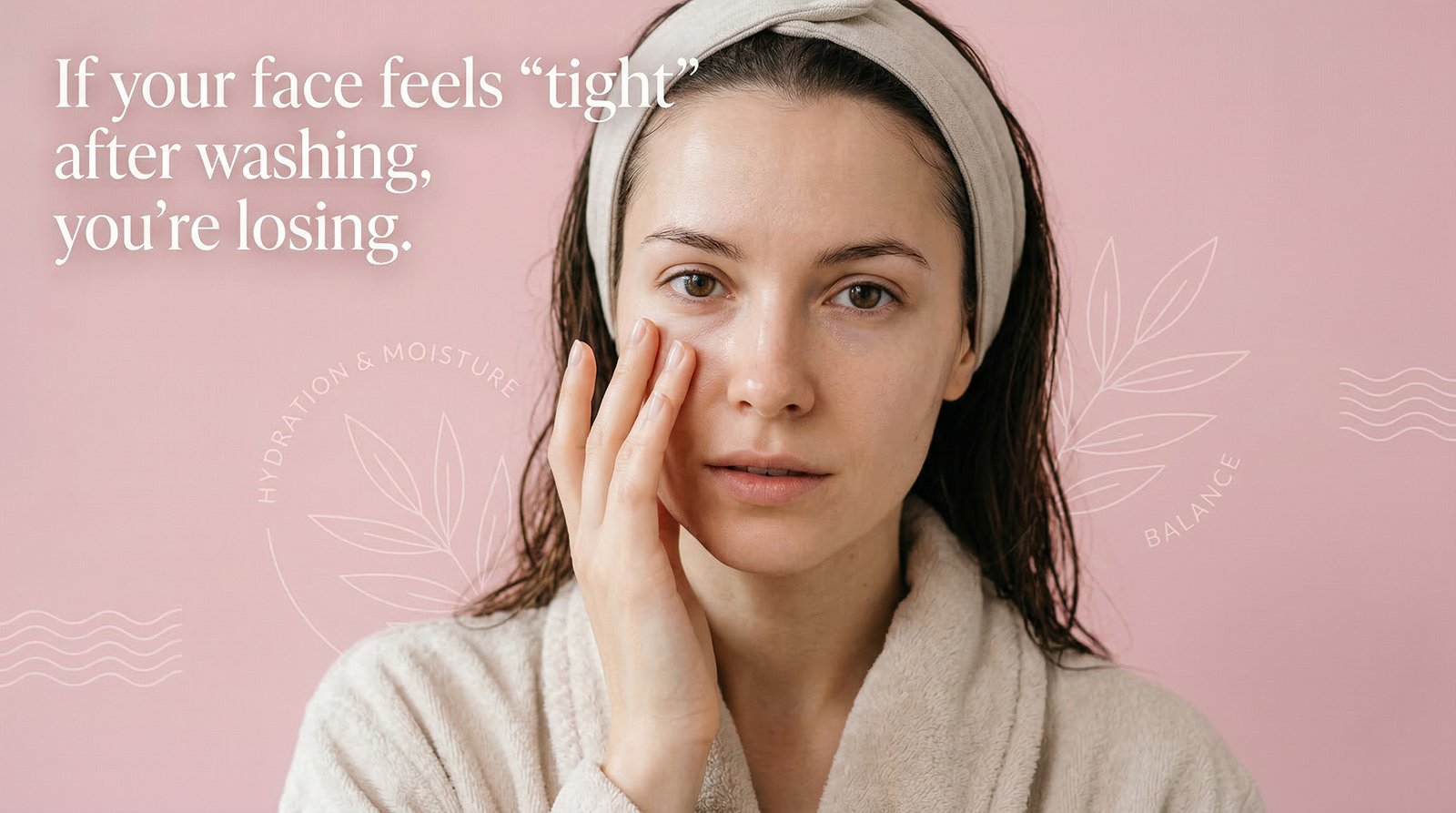
Your skin barrier is your body’s first line of defense, helping retain moisture, block irritants, and maintain a healthy, balanced complexion that can better withstand everyday stressors.
The Foundation of Every Healthy Skin Routine
You’ve probably heard “skin barrier” thrown around enough that it’s started to sound like just another buzzword.
It isn’t.
Your skin barrier is the difference between skin that handles stress, weather, and a bad week without falling apart and skin that reacts to everything, stays perpetually dull, and never quite responds to the products you keep buying for it.
Every skin concern you’re trying to fix dryness, sensitivity, breakouts, redness, uneven tone has one thing in common: a damaged barrier makes all of them worse. Often, a damaged barrier is the reason they exist in the first place. So before you add another serum to your routine, it’s worth understanding what’s actually going on under the surface.
The Barrier Isn't a Metaphor It's a Structure You Can Break
When dermatologists talk about the skin barrier, they mean something specific.
The outermost layer of your skin the stratum corneum is made up of flattened, dead skin cells called corneocytes, held together by a lipid matrix. That matrix is composed of ceramides, free fatty acids, and cholesterol, arranged in a precise lamellar structure. Think of it as mortar between bricks. This structure does two things simultaneously: it keeps moisture in and keeps irritants out.
When the lipid matrix is intact, water stays where it belongs inside your skin. When it’s compromised, water escapes through the surface in a process called Transepidermal Water Loss (TEWL). The higher your TEWL, the more dehydrated and reactive your skin becomes regardless of how much water you’re drinking or how many hydrating serums you apply.
The barrier isn’t something you build. It’s something you maintain. And most routines are quietly dismantling it.
Tight Skin After Cleansing Isn't "Clean" It's Stripped
This is one of the most damaging myths in skincare, and it’s still being sold to you by every “deep clean” face wash on the shelf. That tight, squeaky-clean feeling after washing? That’s your acid mantle your skin’s naturally acidic protective surface being stripped away. It’s not freshness. It’s damage.
Most foaming cleansers rely on harsh surfactants (sodium lauryl sulphate is the famous one, but it has plenty of relatives) that don’t distinguish between the grime you want to remove and the lipids your barrier needs to function. They take everything. Your skin then has to spend the next several hours trying to rebuild what you just washed off.
Research published in the International Journal of Cosmetic Science demonstrated that even a single wash with certain surfactant-heavy cleansers can measurably alter skin pH and barrier function and that recovery can take up to six hours.
Six hours. Twice a day. Every day. Do the maths.
The cleanse is the foundation of everything. If it’s wrong, nothing else in your routine has a fair chance.
“Minimals” Gentle Cleanser is built around this: a low-pH, non-stripping formula that removes what actually needs removing without touching the structure underneath.
Your Microbiome Is a Living Part of Your Barrier and You're Probably Killing It
Your skin is not sterile. It hosts roughly 1,000 species of bacteria, fungi, and viruses most of them doing exactly what they should: regulating pH, protecting against pathogens, and supporting the physical barrier. This ecosystem is called your skin microbiome, and it is not separate from your barrier health. It is part of it.
When you over-cleanse, use alcohol-heavy toners, apply daily physical scrubs, or reach for anything labelled “antibacterial” without a clinical reason, you’re not just removing bacteria. You’re shifting the balance of your entire microbial community toward one that works against you.
A landmark study in Nature Reviews Microbiology confirmed that disruption of the skin microbiome is directly linked to conditions like acne, eczema, rosacea, and chronic sensitivity not as a side effect, but as a cause.
So when your skin is constantly breaking out despite a “clean” routine, or when it’s red for no obvious reason, it’s worth asking: is your routine more disruptive than the problems you’re trying to solve?
The microbiome doesn’t need intervention. It needs preservation. Less is genuinely more.
The Real Reason Sensitive Skin Is Getting More Common
Here’s something the industry doesn’t want you to sit with too long.
The dramatic rise in “sensitive skin” diagnoses over the past two decades isn’t primarily genetic. It isn’t pollution, though that plays a role. It isn’t diet.
It’s routines.
A review in Dermatology Times documented a significant increase in what researchers call iatrogenic skin damage that is, skin damage caused by skincare itself. Patients presenting with reactive, sensitised skin overwhelmingly had one thing in common: complex routines with multiple actives, high-frequency exfoliation, and little to no barrier support.
Their skin wasn’t inherently sensitive. It had been made sensitive. When your barrier is compromised, active ingredients penetrate deeper and faster than they’re designed to. Retinol that should work at a surface level reaches tissue that isn’t prepared for it. Acids that should gently resurface instead irritate layers that were never supposed to see them.
The result looks like sensitivity. It is, in fact, a routine that has outpaced your skin’s ability to cope. And the instinct to add a calming serum, a barrier cream, a repair product often just adds more to an already overloaded surface.
Hydration and Moisture Are Not the Same Thing and Mixing Them Up Is Costing You
This is the counterintuitive one.
Most people chase hydration: hyaluronic acid, water-based essences, gel creams. Their skin feels plump for 20 minutes and then goes straight back to feeling tight and dry.
Here’s why: hydration refers to water content in the skin. Moisture refers to your skin’s ability to retain that water. You can pour water into a cracked bowl all day. If you don’t fix the crack, the water goes straight through.
Without a functioning lipid matrix specifically adequate ceramide levels your skin cannot hold onto the water you’re feeding it. Research in the Journal of Investigative Dermatology has shown that individuals with compromised barriers have measurably lower ceramide concentrations, and that topical ceramide replenishment directly reduces TEWL and restores moisture retention capacity.
Translation: a ceramide-rich moisturiser isn’t just sealing in moisture. It’s rebuilding the structure that makes moisture possible.
This is what “moisture sandwiching” is really about not just layering products, but understanding that each layer only works if the one beneath it is structurally sound.
“Minimals” Barrier Moisturiser is formulated around this logic: ceramides and lipids that rebuild the matrix, not just sit on top of it.
The Inflammation Loop Your Routine Is Probably Stuck In
Chronic inflammation is the quiet driver behind almost every skin concern that won’t resolve. It works like this: a compromised barrier lets irritants and bacteria past the first line of defence. Your immune system responds. Inflammatory cytokines flood the area. That inflammation further degrades the lipid matrix. More irritants get in. The immune response continues.
This is an inflammation loop and once you’re in one, adding more products doesn’t break it. It often makes it worse.
The National Institute of Arthritis and Musculoskeletal and Skin Diseases has studied this cycle extensively in the context of atopic dermatitis, but the mechanism isn’t exclusive to clinical skin conditions. Mild barrier dysfunction creates the same loop at a lower intensity one that shows up as persistent dullness, slow-healing breakouts, and skin that never quite settles.
The only way out of an inflammation loop is to stop feeding it. That means removing the products that are contributing to barrier disruption, simplifying your routine, and giving your skin the structural support it needs to close the gap.
Not more treatments. Fewer, better ones.
If Your Routine Has More Than Five Steps, Your Skin Is Working Against Itself
Let’s be direct about this.
There is no clinical evidence that a 7, 9, or 12 step skincare routine produces better outcomes than a well-formulated 3 or 4 step one. None. The complexity is a marketing construct, not a dermatological recommendation. What multi-step routines do produce is ingredient conflict, barrier overload, and the very sensitivity they’re often designed to address. Think about what you’re actually asking your skin to do: absorb multiple actives, each with different pH requirements, each competing for penetration pathways, all applied to a surface that may already be functionally compromised. Some combinations actively work against each other vitamin C and niacinamide at high concentrations, retinol and AHAs applied together, multiple exfoliants across morning and evening routines.
Your skin isn’t a chemistry experiment.
If your routine requires a spreadsheet, a schedule, or a mental checklist before bed, that’s not discipline. That’s a sign you’ve been sold something unnecessarily complicated. The shift isn’t about doing less for the sake of minimalism. It’s about understanding that skin repair is a biological process and biology works better with support than with interference.
The Barrier-First Routine That Actually Makes Sense
This is what skin health looks like when you strip it back to what works.
A low-pH cleanser that respects your acid mantle. No aggressive surfactants, no antibacterial agents unless clinically indicated, no “deep pore” anything.
Your skin should feel comfortable immediately after cleansing. Not tight. Not slippery. Comfortable.
If it doesn’t, change the cleanser first. Fix this before you change anything else.
One active. Chosen for your primary concern, applied to intact skin that’s been moisturised first if your barrier is compromised.
If your skin is reactive, inflamed, or consistently sensitive: no actives for two to four weeks. Just cleanse, moisturise, and protect. Let the structure rebuild. You’ll be surprised how much improves before you’ve added anything.
When you’re ready: one thing at a time, introduced slowly.
This is not optional, and it is not vanity.
A ceramide-rich moisturiser is the step that determines whether your cleanser did damage or simply cleaned, whether your active penetrated appropriately or too aggressively, whether your skin starts tomorrow in a better position than it’s in today.
Apply it while skin is slightly damp. Let it absorb fully before the next step.
Broad-spectrum SPF, every morning.
UV damage is the most consistently documented driver of barrier degradation, chronic inflammation, and structural breakdown in skin. It is not a nice extra. It is the single most evidence-backed step in any skincare routine.
If you’re serious about skin health, this is non-negotiable. Everything else you do is better protected by this one step.
Common mistakes we all make
Washing too often can strip away the lipids that keep your barrier strong.
Layering acids, retinoids, and treatments together often causes irritation instead of faster results.
Frequent scrubbing or peeling can weaken the barrier and increase sensitivity.
Even oily skin needs moisture to maintain a healthy protective barrier.
Daily UV exposure is one of the biggest contributors to barrier damage and premature aging.
Skin needs time to adjust, and constantly switching products can keep it in a state of irritation.
A simple "Routine Is Working" checklist
Frequently Asked Questions
The skin barrier is the outermost layer of your skin that helps retain moisture and protect against irritants, pollutants, and bacteria.
Common signs include tightness, dryness, redness, sensitivity, flaking, stinging, and breakouts that seem harder to control.
Yes. Overloading your routine with multiple actives, exfoliants, and treatments can weaken your barrier and increase irritation.
Mild damage can improve within a few weeks, while more significant barrier disruption may take several weeks to a few months to fully recover.
In many cases, reducing or temporarily pausing strong actives can help your skin recover. Focus on cleansing, moisturizing, and sun protection first.
Closing thought
Healthy skin is not glass skin. It’s not poreless. It’s not what you see on a filtered photo. Healthy skin is skin that’s calm. That doesn’t react to environmental changes the way it used to. That bounces back from stress and illness without staying broken. That doesn’t need three products just to feel normal.
It takes time to get there usually longer than the time it took to compromise it. But the path is straightforward: stop disrupting the barrier, give it what it needs to rebuild, and then stay out of its way.
The beauty industry profits from the belief that skin is a problem to be solved with an ever-expanding product collection. It isn’t. It’s a structure that functions well when supported, and poorly when overwhelmed. Your skin barrier is not a feature of good skin. It is good skin. Everything else the texture, the tone, the resilience, the way your skin looks on a bad sleep week follows from whether that barrier is intact.
You don’t need more products. You need fewer that actually work.