
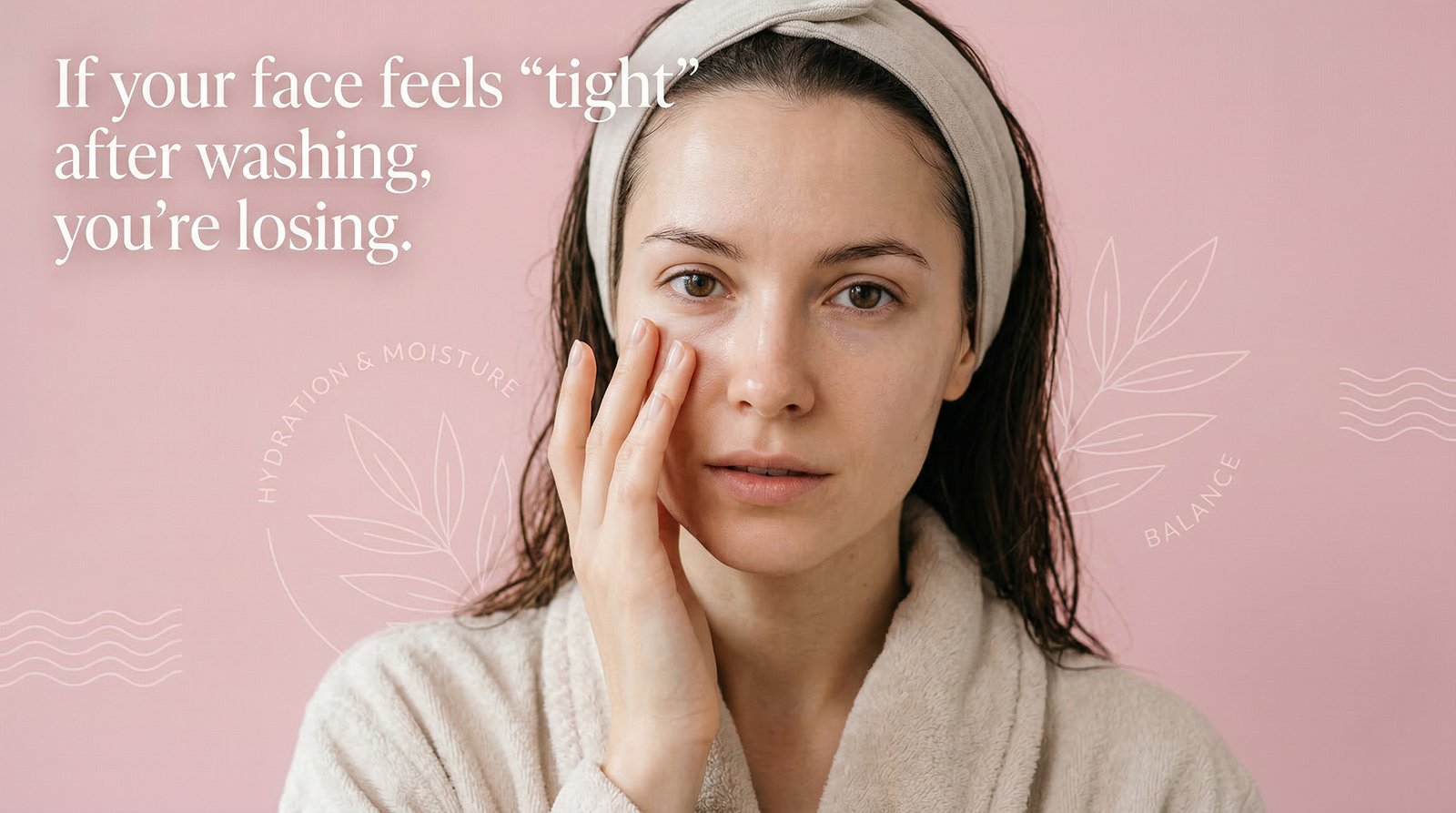
A healthy skin barrier determines how well every product performs without it, even the best serums can struggle to deliver results.
Your Skin Barrier Is Crying for Help
Your 10-step routine isn’t helping your skin. It’s exhausting it. And the worst part? The very products you bought to fix your skin might be the reason it keeps breaking down.
Redness that “comes and goes.” Breakouts you’ve blamed on stress, hormones, diet, your pillowcase. Skin that feels tight after cleansing but oily by noon. Moisturizer that absorbs in 30 seconds and leaves nothing behind.
This isn’t bad luck. This is a damaged skin barrier and no serum is going to save you if you don’t fix it first.
What the Skin Barrier Actually Is (And Why Everyone Gets It Wrong)
Most people think of the skin barrier as a metaphor.
It’s not.
Your skin barrier is a physical structure a tightly organised layer of dead skin cells (corneocytes) held together by a lipid matrix made up of ceramides, fatty acids, and cholesterol. Think of it like a brick wall: the cells are the bricks, the lipids are the mortar. When that mortar breaks down, water escapes. Irritants get in. And your skin starts behaving in ways that look a lot like other problems sensitivity, oiliness, breakouts so you keep treating the wrong thing.
The technical term for water escaping through a damaged barrier is Transepidermal Water Loss (TEWL), and it’s one of the most studied markers in dermatology. High TEWL = compromised barrier. And high TEWL is far more common than the skincare industry will admit because most routines are quietly causing it.
The "Hydration" Step That's Slowly Drying Your Skin Out
Here’s a counterintuitive one: hydration and moisture are not the same thing. Hydration refers to water content. Moisture refers to the ability to retain that water. When you layer a hyaluronic acid serum on dry skin in a dry room and then stop there, you’ve pulled water to the surface but without an occlusive or lipid-rich moisturiser on top, that water evaporates. Your skin ends up drier than before you started.
This is called the hydration trap. You’ve added water without fixing the barrier that was letting it escape in the first place.
Real moisture retention comes from intact lipids. Ceramides especially. Research published in the Journal of Investigative Dermatology has shown that individuals with compromised skin barriers have significantly lower ceramide levels and that ceramide replenishment directly reduces TEWL and improves skin function.
So if your HA serum isn’t doing much for you, it’s not the serum’s fault. It’s that you’re filling a leaking bucket.
Your Cleanser Might Be Causing the Breakouts You Blame on Hormones
Raise your hand if you’ve used a “purifying” or “deep cleansing” face wash because your skin felt oily. That instinct makes sense. Oily skin means you need to remove oil, right?
Wrong.
Most foaming cleansers especially those marketed for oily or acne-prone skin use surfactants that strip not just excess sebum but also the natural lipids your barrier needs to function. The result is a skin microbiome in chaos and a lipid matrix that’s been sandblasted clean. Your skin responds to this stripping by producing more oil. The breakouts continue. You wash more aggressively. The cycle worsens.
Studies on the skin microbiome have confirmed that over-cleansing disrupts the delicate bacterial balance on your skin’s surface particularly the ratio of Cutibacterium acnes to other commensal organisms. When that balance tips, you don’t just get breakouts. You get chronic low-grade inflammation that makes every other product in your routine work less effectively. The fix isn’t a better acne treatment. It’s a gentler cleanser.
A low-pH, non-stripping cleanser that removes what needs to go without touching what needs to stay.
Minimals’ Gentle Cleanser is formulated around this exact principle: effective cleansing without surfactant overload, because your barrier deserves to exist after you wash your face.
Why Layering Five Actives Isn't Ambitious It's Self-Sabotage
The skincare internet will tell you to use retinol, vitamin C, AHAs, niacinamide, and a BHA just not at the same time, and definitely in the right order, and only on alternate nights, except when the moon is in retrograde.
Here’s the honest version: most people who layer multiple actives are doing measurable damage to their skin.
Not because actives are bad. But because a disrupted barrier doesn’t process actives the way intact skin does. When your lipid matrix is compromised, actives penetrate deeper and faster than they should. Retinol that should be working at a surface level hits deeper skin layers. Acids that should be gently exfoliating end up irritating tissue that isn’t designed to handle them. The result is sensitised, reactive skin that you then try to fix with more actives.
A review in Dermatology Times found that patients presenting with “sensitive skin” increasingly have iatrogenic that is, routine-induced barrier damage. The sensitivity wasn’t a skin type. It was a consequence of their routine. One well-chosen active, applied to a functioning barrier, will always outperform five actives fighting each other on compromised skin.
At this point, your skin doesn’t need another step. It needs a formula that already does the work of several.
The Inflammation Loop Nobody's Talking About
Here’s the thing about chronic low-grade inflammation: it’s invisible until it isn’t.
You don’t always feel inflamed skin. You just notice that your skin looks a bit dull. That it doesn’t respond to products the way it used to. That it gets red more easily. That breakouts take longer to heal.
This is what we call an inflammation loop and most 5-step routines are stuck in one.
It works like this: barrier disruption → irritants enter → immune response → inflammation → further barrier disruption → repeat.
The loop doesn’t break from adding a new serum. It breaks when you stop contributing to the damage.
Research from the NIH’s National Institute of Arthritis and Musculoskeletal and Skin Diseases on atopic dermatitis the most studied form of barrier dysfunction consistently shows that barrier repair comes first, and inflammation resolves as a consequence. Not the other way around.
Your skin is not inflamed because it needs more products. It’s inflamed because it needs fewer of the wrong ones.
The Microbiome Is Not a Buzzword
Every cosmetic brand now talks about the skin microbiome. Most of them mean nothing by it. It’s just another way to make you buy a probiotic-infused serum. But the science underneath is real and it’s relevant to what you’re doing every morning.
Your skin hosts roughly 1,000 species of bacteria, fungi, and viruses. Most of them are doing exactly what they should: protecting you from pathogens, regulating pH, supporting the barrier. This ecosystem took years to establish. You can disrupt it in a few weeks with the wrong routine. Stripping cleansers remove the acid mantle your skin’s slightly acidic surface layer and shift pH in a direction that favours pathogenic bacteria over beneficial ones. Alcohol-heavy toners do the same. So do physical scrubs used daily, fragrance-heavy products, and anything labelled “antibacterial” that isn’t being used for a clinical reason.
A 2021 study in the British Journal of Dermatology found that patients who simplified their routines and switched to microbiome-supportive formulations showed measurable improvements in barrier function within four weeks without adding a single new active ingredient.
The skin you’re trying to fix might just need you to stop interfering.
If Your Routine Feels Complicated, That Is the Problem
Let’s be direct for a moment.
If you need a spreadsheet to track which actives can be used on which nights, you’ve gone too far. If you own more than one “barrier repair” product but still have reactive skin, the products aren’t the issue the volume is. If you’ve been moisturising twice a day for years but still feel dry, you’re not moisturising wrong. You’re missing the structural repair that makes moisturiser work. Complicated routines don’t produce better skin. They produce better-looking bathroom shelves. The reality is that your skin has one job: maintain itself. It is extraordinarily good at that job when you give it the right building blocks and stop stripping away what it’s trying to hold onto.
Every unnecessary step is friction. Every over-processed product is a disruption. Every active you add without a functioning barrier to receive it is a wasted investment. Your routine should be hard to explain because it’s simple not because it’s sophisticated.
The Minimal Routine Blueprint
This is what a barrier-first routine actually looks like.
A low-pH, non-stripping cleanser. No foaming agents that leave your face feeling “squeaky clean.” Squeaky clean is stripped clean.
If your skin feels tight after washing, your cleanser is wrong for you — not your skin type.
One active. One.
Choose based on your primary concern — not based on what every influencer is using simultaneously. If your barrier is compromised, start with nothing but ceramides for two to four weeks. Let the structure rebuild before you ask it to do anything else.
When you’re ready to introduce an active: apply it to intact, moisturised skin. Not dry, tight, post-cleanse skin.
This is the most skipped step — and the one that determines whether everything else was worth doing.
A ceramide-rich moisturiser does two things: it replenishes lipids your barrier has lost, and it forms an occlusive layer that prevents TEWL. Without this step, your hyaluronic acid evaporates, your active never quite settles, and your barrier slowly continues to degrade.
The moisturiser isn’t optional. It’s the whole point.
SPF. Broad-spectrum. Every morning.
UV radiation is the single most documented cause of barrier degradation, collagen breakdown, and chronic skin inflammation. It’s not a nice-to-have. It’s the step that protects everything else you’ve done.
If you’re only going to do one thing for your skin, this is it.
Common mistakes we all make
Most of us damage our skin barrier without realizing it. We over-cleanse when our skin feels oily, layer too many active ingredients, skip moisturizer because we’re acne-prone, or chase every trending product on social media. Many of us also neglect daily sunscreen and mistake irritation for a sign that a product is “working.” The result is often the same: a weakened barrier, increased sensitivity, and skin that struggles to stay healthy.
A simple "Less Is More" checklist
Frequently Asked Questions
The skin barrier is the outermost layer of your skin. It helps retain moisture, protects against irritants, and keeps harmful bacteria and pollutants out.
Common signs include persistent dryness, redness, tightness after cleansing, increased sensitivity, stinging from products, unexpected breakouts, and flaky patches.
Yes. Overusing exfoliants, acids, retinoids, and other active ingredients can weaken the barrier, leading to irritation and increased water loss.
Most people notice improvements within 2 to 4 weeks of following a gentle, barrier-focused routine, though severe damage may take longer.
In many cases, reducing or temporarily pausing strong actives can help. Focus on cleansing, moisturizing, and protecting the skin while the barrier recovers.
Closing thought
You’ve been sold the idea that better skin requires more steps, more products, more targeted treatments for every micro-concern.
That idea benefits the industry. It doesn’t benefit your skin.
The truth is simpler and, honestly, cheaper: your skin barrier is a biological structure with known needs. Ceramides. A stable pH. A functioning microbiome. Protection from UV. And the space to do its job without constant interference.
Fix the barrier first. Everything else the texture, the tone, the resilience follows. You don’t need more products. You need fewer that actually work.