
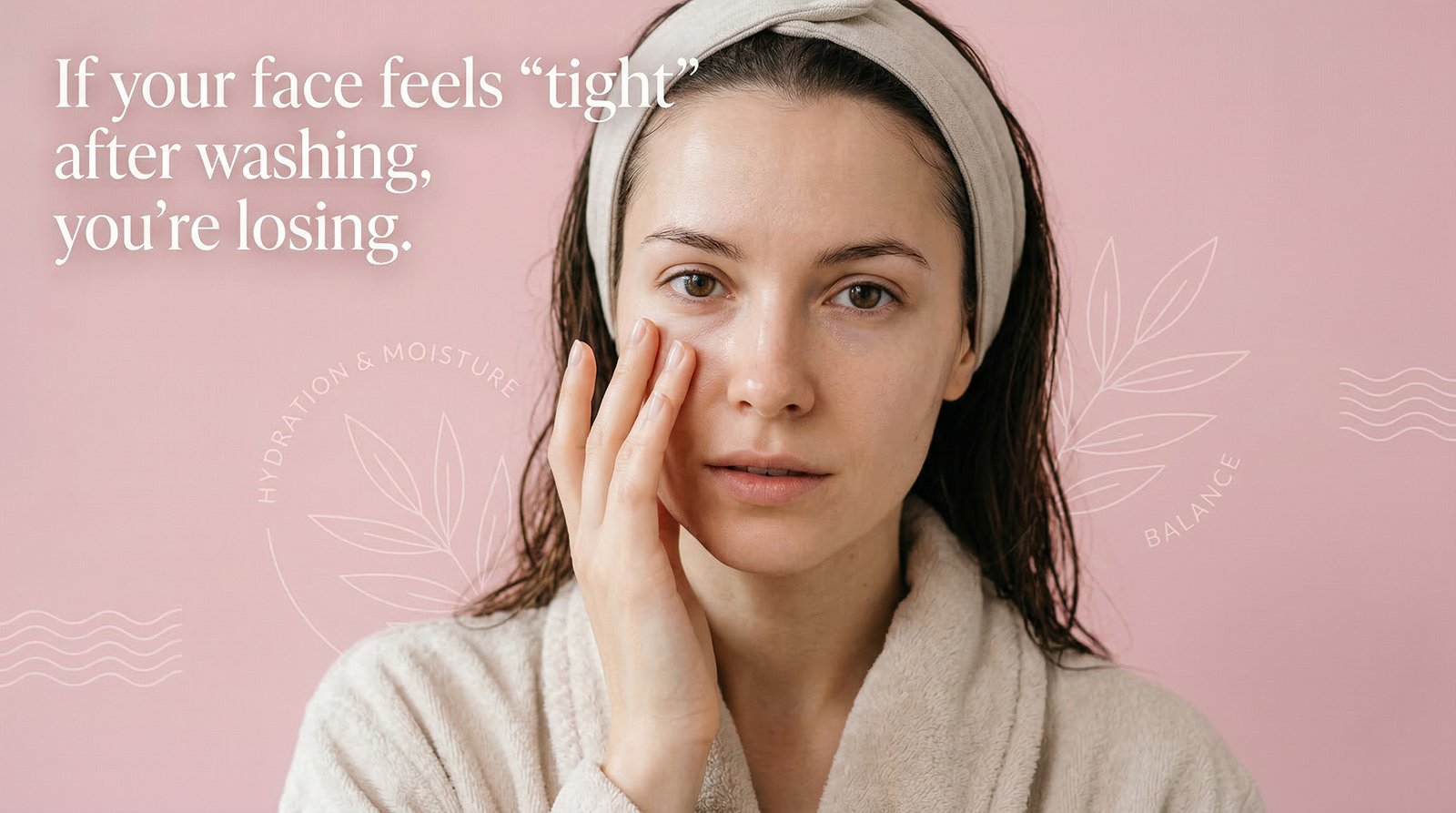
Strong fragrances can irritate your skin barrier, trigger sensitivity, and cause hidden inflammation especially when using actives like retinol.
Why That Spa-Smelling Moisturiser Might Be Harming Your Skin
That moisturiser that smells like a spa? It’s not a treat for your skin.
It’s a trade-off you didn’t agree to.
The skincare industry has spent decades conditioning you to associate scent with quality. A product that smells like roses or sandalwood or fresh linen feels more luxurious than one that smells like nothing. It feels more premium, more intentional, more like it’s doing something. But your skin doesn’t have a nose. It has a barrier. And fragrance synthetic or natural is one of the most common, most quietly destructive things you can put on it.
The question isn’t whether you like how your moisturiser smells. The question is what it’s doing to your skin while you enjoy the scent.
The Ingredient Hiding in Plain Sight on Every Label
“Fragrance” or “parfum” on an ingredient list is not one ingredient. It’s a legal loophole.
In most countries, fragrance formulas are protected as trade secrets, which means a brand can list “fragrance” and contain anywhere from a handful to hundreds of individual chemical compounds underneath that single word. The European Commission’s Scientific Committee on Consumer Safety has identified over 80 fragrance ingredients as known or suspected allergens and the vast majority of them don’t require individual disclosure.
You can read every label carefully and still have no idea what you’re actually applying. This matters because sensitisation to fragrance chemicals isn’t like a food allergy it doesn’t always announce itself as a rash or hives. It can look like persistent redness, a vague tightness after cleansing, skin that reacts to everything without any obvious reason, or “sensitive skin” that appeared seemingly out of nowhere. That sensitivity often isn’t your skin type. It’s the accumulated result of years of fragrance exposure.
"But It's Natural Fragrance" The Myth That's Costing Your Barrier
Natural fragrance is one of the most effective pieces of marketing in modern skincare. The assumption is that if something comes from a plant, it’s gentle. Your skin doesn’t agree.
Citrus oils, lavender, rose, eucalyptus, ylang-ylang these are among the most common fragrance allergens in skincare, and they’re all natural. Research published in the Journal of Investigative Dermatology consistently shows that plant-derived fragrance compounds like linalool and limonene found in lavender and citrus respectively are significant contact allergens that cause measurable skin inflammation even at low concentrations.
Linalool, in particular, is insidious. It’s in hundreds of “clean” and “natural” products. It oxidises on contact with air, making it more allergenic over time meaning a product that seemed fine when you opened it may become more irritating as it ages. Natural doesn’t mean safe. It means it came from a plant. Those are different things.
What Fragrance Actually Does to Your Skin Barrier (This Is Where It Gets Real)
Your skin barrier is a lipid matrix ceramides, cholesterol, and free fatty acids organised in a lamellar structure that sits in the uppermost layers of your skin. This isn’t just about keeping moisture in. It’s an active immunological interface that regulates inflammation, controls transepidermal water loss (TEWL), and prevents environmental triggers from penetrating into living skin tissue.
When you apply fragrance compounds repeatedly, a few things happen.
First, some fragrance molecules are lipophilic they dissolve in lipids and can disrupt the very ceramide-fatty acid arrangement your barrier depends on. This increases TEWL, meaning your skin loses water faster than it should. You apply your “hydrating” moisturiser and wonder why your skin still feels tight by midday. Second, fragrance compounds trigger a low-grade inflammatory response in the skin not always visible, but detectable at a cellular level. This inflammation loop doesn’t reset cleanly between applications. Apply a fragranced product twice a day, every day, and you are running a low-level immune activation in your skin continuously.
Over time, that chronic subclinical inflammation degrades collagen, compromises barrier repair, and trains your skin’s immune response to become hyperreactive. Skin that used to tolerate everything starts reacting to things it shouldn’t.
Sound familiar?
The Microbiome Connection Nobody's Talking About
Fragrance doesn’t just affect your lipid barrier. It affects what lives on it.
Your skin microbiome the community of bacteria, fungi, and other organisms on your skin’s surface is not decoration. It produces antimicrobial peptides, competes with pathogenic bacteria for resources, and actively calibrates your skin’s immune response. Studies published via the NIH have shown that disruption of the skin microbiome is directly linked to conditions like eczema, rosacea, acne, and generalised skin sensitivity.
Many fragrance compounds are antimicrobial it’s actually part of why they smell the way they do in nature. Plants produce these volatile compounds partly as defence mechanisms.
On your skin, that antimicrobial activity isn’t selective. It doesn’t preserve the good bacteria while eliminating the bad. It just disrupts the balance indiscriminately, reducing microbial diversity and creating conditions where opportunistic species can take hold. The breakout you blamed on stress last month? The redness you’re attributing to humidity? It might be your fragranced toner doing more damage than you realised.
When the Risk Goes From Low to Certain
Fragrance in skincare isn’t equally dangerous in every product or for every person. Context matters enormously.
Leave-on products are riskier than rinse-off. A fragranced body wash that spends 30 seconds on your skin before being rinsed is categorically different from a fragranced moisturiser that sits on your skin for 12 hours. The longer the contact time, the greater the exposure and the greater the risk of sensitisation.
Concentration matters, but tolerance is cumulative. You might tolerate one fragranced product fine. Add two more, and the total fragrance load across your routine crosses your skin’s threshold. This is why people often develop sensitivity “suddenly” it’s not sudden. It’s an accumulation that finally tipped.
Compromised skin is a different conversation entirely. If you’re dealing with eczema, rosacea, perioral dermatitis, post-procedure recovery, or any condition where your barrier is already impaired fragrance in your routine isn’t a risk factor. It’s a near-certainty for making things worse.
The eye area, neck, and décolletage are thinner-skinned and more permeable. A fragrance your cheeks can tolerate may cause persistent irritation in these zones. The skin isn’t uniform. Your fragrance exposure isn’t either.
Your "Sensitive Skin" Might Just Be a Fragranced Routine
Here’s the uncomfortable reframe.
Most people who describe their skin as “sensitive” don’t have a skin type. They have a damaged barrier often caused, at least in part, by their routine.
Sensitive skin has become a catch-all self-diagnosis that the industry uses to sell you more products: the gentle range, the calming line, the soothing serum. But if you remove fragrance from your routine across every product, consistently, for 8 to 12 weeks a significant number of people find that their “sensitive skin” dramatically improves.
A large-scale patch testing study published in Dermatitis found fragrance mix to be one of the top five most common contact allergens in adults presenting with skin reactions above nickel in some demographics.
Fragrance is in your cleanser, your toner, your moisturiser, your sunscreen, your body lotion, and your laundry detergent. The total exposure is enormous. Cutting it from your skincare is the easiest place to start seeing whether it’s been the problem all along.
The Layering Problem: Fragrance + Actives Is a Particularly Bad Combination
If you’re using retinol, AHAs, BHAs, or vitamin C, adding fragrance to your routine is adding fuel to an already sensitive situation.
Active ingredients work by altering skin cell behaviour speeding turnover, stimulating collagen, dissolving dead skin. In doing so, they temporarily increase permeability. Your skin is more open to what you put on it.
Apply a fragranced moisturiser after a retinol serum and you’re not just applying it to your skin. You’re applying it to skin that has a temporarily lowered barrier threshold meaning fragrance compounds penetrate deeper and trigger a stronger response than they would on untreated skin. This is why people using “strong” actives often report sensitivity they never had before. The retinol gets the blame. The fragranced moisturiser they’ve been using for years escapes suspicion entirely.
At this point, your skin doesn’t need another active added in. It needs a formula that removes the problem. The Minimals Barrier Repair Moisturiser is fragrance-free and built with the ceramide profile your barrier needs to repair itself overnight—without adding another variable into an already reactive routine.
A Reality Check: If Multiple Products in Your Routine Contain Fragrance, You're Not Treating Sensitive Skin. You're Causing It.
There’s no gentle way to say this.
If your cleanser has a light floral scent, your essence smells like jasmine, your moisturiser has “natural fragrance” in the ingredients, and your face oil contains lavender your routine is the irritant. You are not someone who needs the sensitive skin range. You are someone who needs to remove fragrance from the equation and see what your skin actually does. No serum no matter how well-formulated can repair a barrier that’s being disrupted by fragrance twice a day.
How to Audit Your Routine for Fragrance (It's More Everywhere Than You Think)
Go to your bathroom shelf. Pick up every product. Look for any of the following on the label:
These are the flagged ingredients. Not banned universally, but worth knowing about especially in leave-on products, especially if your skin isn’t behaving the way it should.
If your cleanser has several of these, start there. A low-pH, fragrance-free cleanser that doesn’t strip your microbiome is the foundation everything else depends on. The “Minimals” Gentle Cleanser was formulated without fragrance specifically because the first step shouldn’t also be the first insult.
The Fragrance-Free Minimal Routine That Gives Your Skin a Real Chance
This is what a barrier-first, fragrance-free routine actually looks like in practice.
Fragrance-free, low-pH, gentle surfactant formula. Morning and evening. Rinse with lukewarm water. Pat dry. Don’t skip this step and don’t overthink it. Clean skin is just the baseline.
A targeted, fragrance-free serum addressing your actual concern whether that’s vitamin C in the morning or retinol at night. One active. Not three. If your barrier is already compromised, skip actives entirely for 2 to 4 weeks and just focus on repair. The Minimals Vitamin C Serum and Retinol Serum are both fragrance-free because putting fragrance in an active serum is one of the more inexplicable things the industry routinely does.
A ceramide-rich, fragrance-free moisturiser. Apply while skin is slightly damp to support moisture sandwiching layering hydration under an occlusive to trap it in rather than letting it evaporate off. This is barrier-first skincare in its simplest form: give the lipid matrix what it needs to rebuild.
SPF 30 minimum. Fragrance-free if possible there are excellent options now that don’t feel like sunscreen from 2003. UV damage is the single largest contributor to visible skin aging. Everything else in your routine is maintenance. SPF is prevention.
Four steps. No scent. Consistent for 8 weeks. Your skin will tell you whether fragrance was the variable you needed to eliminate.
A gentle way to cleanse
If your current cleanser is leaving you feeling like a drumhead, you might want to try our Triple Action Cleanser.
We made it specifically for people who are tired of that “stripped” feeling. It doesn’t foam up into a giant mountain of bubbles, because honestly, bubbles are usually just harsh detergents (sulfates) that do more harm than good.
Instead, it feels more like a soft, silky lotion.
It lifts away the grime and the makeup, but it leaves your “moisture cape” exactly where it belongs. When you rinse it off, your face feels like… well, skin. Not paper. Not plastic. Just soft, clean skin.
Common mistakes we all make
Avoid these mistakes and your skin will recover faster. Start simple: audit + switch to fragrance-free.
A simple "Fragrance-Free Skincare" checklist
Frequently Asked Questions
It’s a legal trade-secret loophole. Under that one word, brands can hide dozens or even hundreds of individual chemicals. Most countries do not require full disclosure of fragrance components, even though many are known or suspected allergens.
No. Many of the most common allergens in skincare (linalool, limonene, geraniol, citronellol, etc.) come from plants like lavender, citrus, rose, and ylang-ylang. Natural fragrance can still disrupt the skin barrier, oxidise over time, and trigger inflammation. “Natural” refers to origin, not safety.
Common signs include persistent redness, tightness, random sensitivity, “reactive” skin that appeared out of nowhere, or conditions that never quite settle (eczema-like flares, rosacea worsening, perioral dermatitis). Many people who call their skin “sensitive” actually have fragrance-induced barrier damage.
Give it a consistent 8 to 12 weeks. Skin barrier repair and microbiome rebalancing take time. You may notice improvement in 3 to 4 weeks, but the full difference often shows after two to three months.
They are lower risk because contact time is short. However, if you already have a compromised barrier or use multiple fragranced products throughout the day, even rinse-off fragrance adds to your total daily load and can contribute to sensitisation.
Closing thought
That’s it. That’s the whole argument. Scent in skincare is for you for the sensory experience, for the ritual feeling, for the pleasure of something that smells nice. None of that is wrong or frivolous. But it comes with a biological cost that the brands selling you scented products are not particularly motivated to discuss.
Fragrance-free doesn’t mean clinical. It doesn’t mean boring. It means your routine is working for your skin instead of against it while smelling pleasant. The brands that load their formulas with fragrance are optimising for your first impression of the product that moment in the store or when you open the bottle. They are not optimising for your skin six months from now.
You don’t need more products. You need products that don’t quietly undermine everything else you’re doing.
Start with fragrance-free. Give your barrier the quiet it needs. Everything else gets easier from there.