
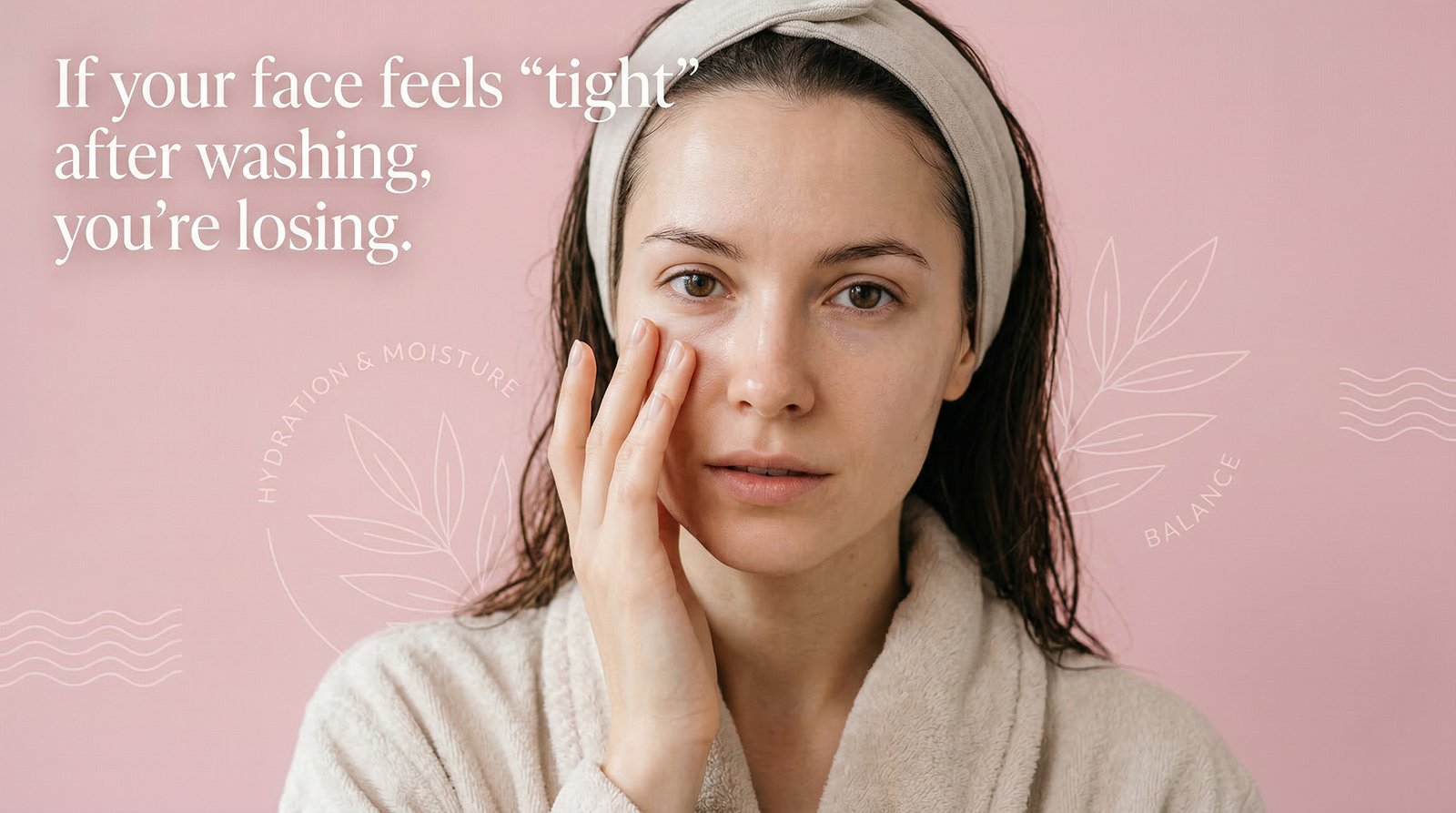
The moisture barrier is the most misunderstood thing in skincare and the most abused. A guide to stopping the damage and letting your skin do its job.
Your 10-Step Routine Is Destroying Your Skin Barrier
Your 10-step routine isn’t helping your skin. It’s exhausting it. Not because effort is bad. Because your skin is a self-regulating organ and when you layer product after product, active after active, twice a day, every day you’re not helping it. You’re overriding it.
The result is skin that looks perpetually irritated, never quite calm, always needing something. And here’s the part the industry won’t tell you: the products you’re using to fix the problem are often causing it.
This is the moisture barrier. And it deserves your full attention.
What the Moisture Barrier Actually Is (And Why Everyone Gets It Wrong)
The moisture barrier technically your stratum corneum is the outermost layer of skin. Think of it as a brick wall: the skin cells are the bricks, and the lipid matrix around them is the mortar. That mortar is made of ceramides, free fatty acids, and cholesterol. When it’s intact, water stays in. Irritants stay out. Your skin looks calm, plump, and unremarkable in the best possible way. When it’s damaged from over-exfoliation, harsh surfactants, or simply too many products competing that mortar starts breaking down. Water evaporates faster than it should. This is called transepidermal water loss (TEWL). Your skin feels tight, looks dull, reacts to things it never used to.
Studies published in the Journal of Investigative Dermatology confirm that ceramide deficiency directly correlates with elevated TEWL and increased sensitivity two of the most common complaints in modern skincare routines. The lipid matrix isn’t decorative. It’s structural.
And yet, the solution most routines reach for more moisturiser, more serum, more of everything doesn’t fix the structure. It just temporarily masks what’s missing.
Hydration and Moisture Are Not the Same Thing. Confusing Them Is Costing You.
This is the one most people get wrong, including people who’ve been into skincare for years.
Hydration is water content in your skin cells. Moisture is your skin’s ability to hold onto that water. You can flood your skin with hyaluronic acid the most hyped hydrating ingredient in the industry and still have a deeply dehydrated complexion by the next morning.
Why? Because hyaluronic acid (HA) draws water to the surface of your skin. If there’s no intact lipid barrier to trap that water in, it evaporates. You’ve essentially just pulled moisture to the surface and handed it to the air.
“Flooding your skin with HA without sealing it is like filling a leaking bucket. The problem isn’t the water. It’s the hole.”
The smarter move: hydrate first, then seal. A humectant (HA, glycerin, panthenol) followed by a barrier-supportive moisturiser that contains ceramides, squalane, or fatty acids. That sequence matters. It’s called moisture sandwiching and it actually works.
Your Cleanser Might Be Causing the Breakouts You're Blaming on Hormones
The cleanser is where most barrier damage begins. Not with the fancy actives you bought with the thing you use twice a day, every day, and never question. Foaming cleansers that use sodium lauryl sulphate (SLS) or sodium laureth sulphate (SLES) strip not just makeup and SPF they strip the lipids that hold your barrier together. Your skin’s natural pH is between 4.5 and 5.5. Many cleansers sit around 7 to 9. That alkaline shift disrupts the acid mantle, destabilises your microbiome, and triggers the kind of low-grade inflammation that looks exactly like hormonal acne.
Research from the NIH (PubMed, 2019) links disrupted skin microbiome driven by over-cleansing and harsh surfactants with increased colonisation of acne-associated bacteria and compromised barrier recovery. The microbiome isn’t a bonus feature. It’s part of the barrier defence.
So you blame dairy. Or stress. Or your cycle. And you might not be entirely wrong but the cleanser you’re using twice a day, every single day, deserves at least as much scrutiny.
At this point, your skin doesn’t need a stronger cleanser. It needs one that respects what it’s cleaning. A gentle, pH-balanced formula that removes without stripping like the Minimals Gentle Cream Cleanser is not a downgrade. It’s the foundation everything else depends on.
Why Layering Too Many Actives Backfires Even When Each One Is "Good"
Here’s what nobody tells you about actives: they work by causing a controlled disruption. Retinoids speed cell turnover. AHAs dissolve the bonds between dead cells. Vitamin C generates some oxidative activity. Niacinamide affects sebum regulation. Each of these, used well and in isolation, can genuinely improve skin. Combined, without strategy, they create something called an inflammation loop. Your skin reacts to the disruption. You interpret that as sensitivity or dryness. You add a soothing serum. That serum has more actives. Your skin reacts again. You add more product. Your skin gets worse. You buy more stuff.
Sound familiar?
A review in Dermatology Times highlighted that combining multiple leave-on actives particularly at low pH significantly increases the risk of barrier compromise, irritant contact dermatitis, and paradoxical increased sensitivity with continued use. More is not a strategy.
The smarter approach: pick one active that solves your primary concern. Use it consistently. Wait six to eight weeks before deciding it’s not working. That’s not minimalism as a lifestyle choice. That’s just how skin biology works.
The 'Hydrating' Step That's Quietly Drying Your Skin Out
Facial mists. The skincare world loves them. They photograph well. They feel refreshing. And if you’re using them wrong which most people are they’re actively dehydrating your skin. When you spray water or a water-based mist onto your face and let it evaporate, it takes moisture with it. This is the same principle that makes you feel cold when you’re wet in the wind. Evaporation is a drying force. A mist is only useful if it contains humectants (something to draw moisture in) and you seal it immediately with a moisturiser. Used alone, mid-day, in a dry environment, it makes things worse.
This extends to over-washing your face with water. Long, hot showers. Steam rooms. All the things that feel like self-care can be steady, low-level barrier damage if your skin doesn’t have the lipids to recover quickly.
If Your Routine Feels Complicated, That's the Problem
Let’s be direct with each other for a moment. If you’re applying six or more products every morning, patting and pressing and waiting for layers to absorb, and your skin still doesn’t feel like it’s working the routine is the diagnosis. Your barrier doesn’t need ten things. It needs three or four things that actually do what they claim, applied in the right order, and given time to work. There is no serum that can undo the damage caused by the other four serums. There is no moisturiser rich enough to compensate for a stripping cleanser used twice a day. The fix isn’t additive. It’s subtractive.
“The most advanced thing you can do for your skin is stop doing so much to it.”
A 2021 study in Journal of Investigative Dermatology found that simplified two- to three-step routines with barrier-focused formulations outperformed complex multi-step regimens in both ceramide recovery and TEWL reduction over an eight-week period. Less, done consistently, wins.
The Microbiome: The Piece Everyone's Ignoring
Your skin hosts about a billion bacteria per square centimetre. That’s not a flaw in the design. That’s the design. Your microbiome the community of bacteria, fungi, and other microorganisms living on your skin directly influences inflammation levels, barrier integrity, sebum balance, and how well your skin tolerates environmental stressors.
When you over-cleanse, use antibacterial agents aggressively, or create a pH environment where beneficial bacteria can’t survive, you don’t just damage the surface. You destabilise the ecosystem. The result is skin that swings between oily and dry, is prone to fungal flares, reacts to new products easily, and never quite settles. This isn’t skin type. It’s a microbiome that’s been disrupted and never given the stability to recover.
The fix isn’t a probiotic serum (though some help). It’s removing the things that are disrupting it in the first place: harsh cleansers, excessive exfoliation, alcohol-heavy toners, constant product rotation.
The Minimal Routine Blueprint
Four steps. That’s it. Everything else is optional, and most of it is unnecessary.
That’s it. That’s the routine. It sounds reductive because it is. Your skin will thank you for the boredom.
Common mistakes we all make
We overcomplicate everything. Most of us damage our skin barrier with these everyday habits: using harsh foaming cleansers twice daily, layering multiple actives without breaks, spraying facial mists and letting them evaporate, over-exfoliating, and skipping proper sealing after hydration. We chase quick fixes with more products instead of giving our skin space to recover. The result? Chronic irritation, sensitivity, and a never-ending cycle of “fixing” what we keep breaking. Simplicity is the real glow-up.
A simple "Skin Barrier" checklist
Frequently Asked Questions
It’s your skin’s outermost layer (stratum corneum) made of skin cells and a lipid “mortar” of ceramides, cholesterol, and fatty acids. It keeps moisture in and irritants out.
Common signs include tightness after cleansing, redness, flakiness, increased sensitivity, dullness, or skin that reacts to products it used to tolerate.
Yes, but only one at a time. Use it consistently for 6 to 8 weeks and always pair it with strong barrier support (gentle cleanser + ceramide moisturiser).
Hydration is water content. Moisture is your skin’s ability to retain that water. Hyaluronic acid hydrates but needs a good barrier (moisturiser with lipids) to lock it in.
Many foaming cleansers with SLS/SLES strip essential lipids and disrupt pH. Switch to a gentle, pH-balanced cream cleanser for better skin health.
Closing thought
Your skin doesn’t need more products. It needs fewer interruptions. The beauty industry has convinced us that perfect skin comes from doing more. The truth is, healthy, calm, resilient skin usually comes from doing less and doing it consistently.
When you strip away the noise, simplify your routine, and finally support your moisture barrier instead of constantly fighting it, something beautiful happens. Your skin stops reacting. It starts behaving. It looks more like you and less like a problem that needs fixing.
Start small. Replace your cleanser. Drop the extra actives. Be patient for a few weeks. The results won’t be loud or instant, but they’ll be real. Less overwhelm. More balance. Better skin.
You’ve got this. Your skin has been waiting for permission to do its job.