
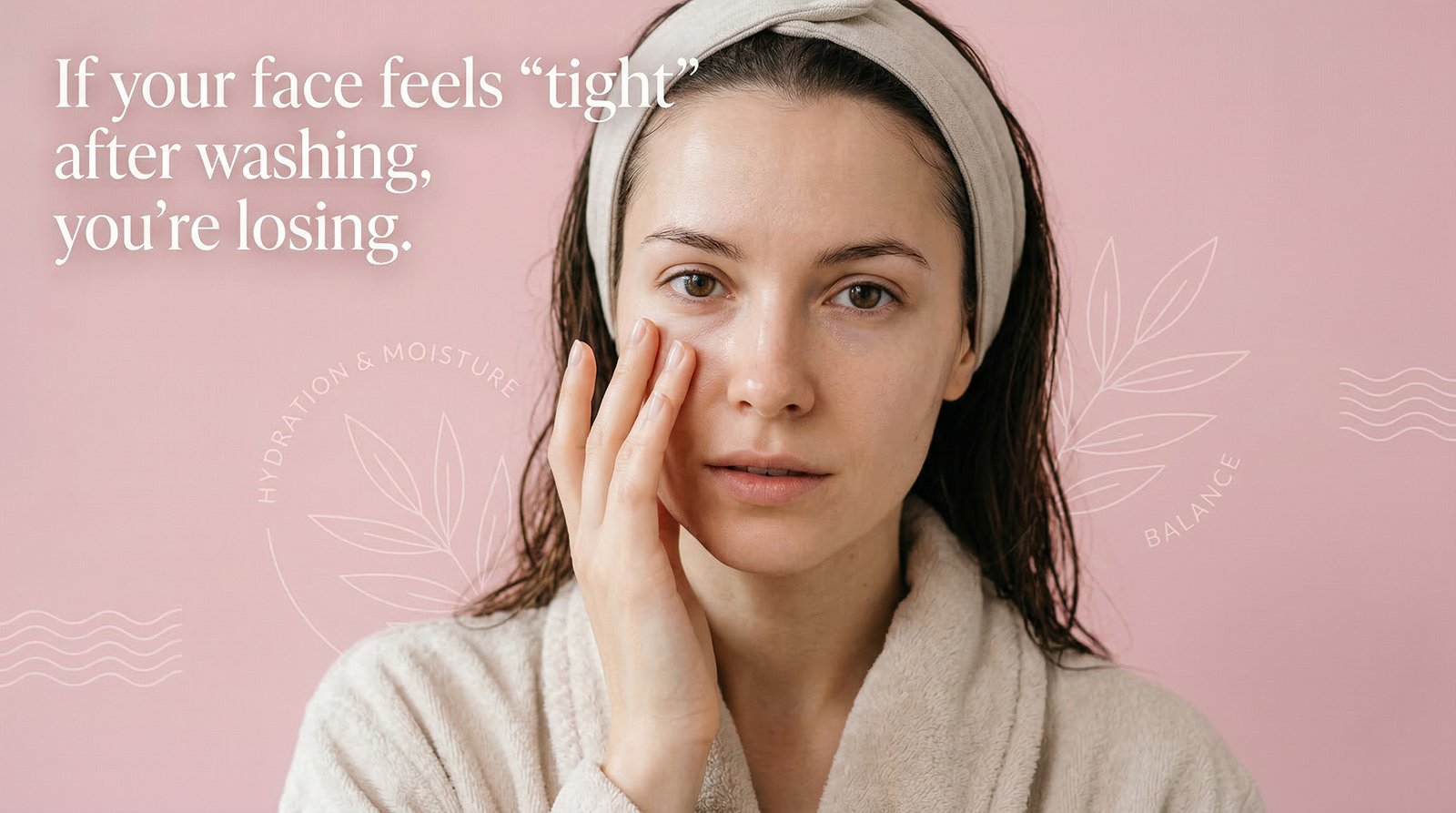
When your skin plateaus, you don’t need more products you need a stronger foundation.
When Your Routine Becomes the Problem
Your skin isn’t bored. You are. And the way most people respond to that boredom is by adding more more steps, more actives, more trending serums until their skin stops functioning and starts reacting.
Here’s the uncomfortable truth: most “bored skin” isn’t under-stimulated. It’s over-treated, barrier-damaged, and stuck in a low-grade inflammation loop that more products will only deepen. If your skin feels dull despite a full routine, breaks out randomly, oscillates between oily and tight, or just looks… flat that’s not boredom. That’s your barrier asking you, very politely, to stop. This is what’s actually happening inside your skin. And what a real reset looks like.
The Problem Isn't Your Skin It's the Routine You Built Around Novelty
Most skincare routines aren’t built on logic. They’re built on boredom cycles. You get a good result, plateau, add something new. The new thing irritates you slightly, you add something to fix the irritation, that something conflicts with your existing acid, and now your skin is doing something you’ve never seen before.
Sound familiar?
The beauty industry depends on this cycle. It repackages the same ingredients in new formats, coins new terms for old processes, and keeps you chasing results that a simpler, calmer routine would have delivered months ago. Bored skin isn’t a skin type. It’s a pattern of behavior.
Your Cleanser Is Doing More Damage Than You Think
Start here, because most people skip it. Cleansing is the most repeated step in your routine once or twice daily, every single day which means if your cleanser is wrong, every other product you apply afterward is working against a compromised foundation.
Research published in a review on cleansers and the skin microbiome found that high-pH cleansers cause stratum corneum swelling, which allows unwanted deeper penetration of surfactants into the skin, triggering irritation, dryness, and tightness. And then your oil glands overcompensate. And then you reach for a stronger cleanser. That’s the loop.
Soap-based, high-pH cleansers don’t just dry your skin they disrupt the acid mantle, the slightly acidic environment your beneficial bacteria need to survive.
A 2025 PMC study on skin microbiome dynamics confirmed that strong surfactants with alkaline pH remove natural lipids and components of the natural moisturizing factor, resulting in barrier damage and reduced diversity of commensal microbiota the very bacteria responsible for keeping your skin calm and resistant to pathogens.
The “squeaky clean” feeling is not clean. It’s stripped. What you want is a gentle, low-pH cleanser that removes what needs to go without sending your microbiome into crisis. The Nourish Calm Face Wash is built on exactly this principle sulfate-free, non-stripping, and formulated to preserve your skin’s natural pH range so the barrier you cleanse doesn’t have to rebuild itself from zero every single morning.
Hydration and Moisture Are Not the Same Thing and Confusing Them Is Why Your Skin Is Always Thirsty
This is the counterintuitive part most routines get completely wrong. Hydration refers to water content in the skin cells the role of humectants like hyaluronic acid and glycerin, which pull water into the upper layers of the skin.
Moisture refers to the lipid barrier that keeps that water from evaporating transepidermal water loss (TEWL) is the technical term for when your barrier fails to hold it.
Here’s where it breaks down: you can layer hyaluronic acid on dry skin and watch it do nothing or even make dryness worse if the barrier isn’t intact enough to trap the water being drawn in.
A foundational study in the Journal of Lipid Research found that the skin’s lipid matrix in the stratum corneum is composed of approximately 50% ceramides, 25% cholesterol, and 15% free fatty acids, in a precise ratio that forms the tightly packed lamellar structure responsible for controlling TEWL. When that ratio is disrupted by over-cleansing, aggressive exfoliation, or actives used too frequently the structure loosens, and water escapes faster than you can put it back.
You’re not dehydrated because you’re not using enough hyaluronic acid. You’re dehydrated because you’ve damaged the seal. The fix isn’t more humectants. It’s restoring the lipid matrix first, then hydrating into a repaired barrier. This is what “moisture sandwiching” actually means when done correctly: apply your water-based hydration, then seal it immediately with a lipid-rich moisturizer before evaporation can start. Sequence matters more than product count.
What Over-Exfoliation Actually Does to Your Barrier (It's Not Pretty)
Exfoliating makes your skin look brighter temporarily. So you do it more.Then it looks dull again a few days later partly because barrier disruption causes low-grade inflammation that dulls the complexion so you exfoliate again. That’s not a skincare routine. That’s an inflammation loop.
Research from the International Journal of Cosmetic Science identified that ceramide levels in the stratum corneum are directly linked to barrier quality and that topical disruption of the SC lipid lamellae (the kind that happens with daily acid use, mechanical scrubbing, or over-cleansing) directly reduces TEWL control.
In practical terms: the more aggressively and frequently you exfoliate, the more you erode the ceramide content of your barrier. A momentary glow costs you days of compromised protection. This doesn’t mean don’t exfoliate. It means exfoliation is a tool, not a daily ritual. Once or twice a week, after your barrier has had time to recover. Never on top of a barrier that’s already inflamed. If your skin is red, reactive, or sensitized that’s not the time to add a chemical exfoliant. That’s the time to stop, feed the barrier, and let it rebuild.
You're Layering Too Many Actives, and They're Canceling Each Other Out
The skincare industry sold you the idea that more ingredients = more results.
The reality is closer to the opposite.
Different actives work at different pH ranges. Vitamin C (L-ascorbic acid) performs best at pH 2.5 to 3.5. Niacinamide works across a broader range. Retinol functions at roughly pH 5 to 6. Chemical exfoliants like AHAs require an acidic environment to work. When you layer them in the wrong order, or in combinations that create a pH conflict, some of them stop working entirely. And when you layer too many simultaneously, you’re not multiplying results you’re creating conditions for over-exfoliation and barrier compromise.
Wait, but what about all the people using 7-step routines without visible irritation?
Here’s the thing: barrier damage isn’t always immediate. It’s cumulative. Skin that “tolerates” layered actives for months can shift suddenly which is when people say their skin “changed” with no explanation. It didn’t change. The threshold finally broke. The smarter approach: one active at a time, applied consistently, for long enough to actually measure results. Most actives need 8 to 12 weeks of consistent use before any meaningful change in skin structure is visible. If you’ve been switching serums every three weeks because nothing “works,” the problem isn’t the serums.
Your Routine Is Boring Because It's Inconsistent Not Because It Needs More Products
Here’s the honest diagnosis of bored skin: you don’t have a consistency problem because your routine is wrong. You have a consistency problem because your routine is too complicated to repeat. A 10-step routine is one you’ll skip the moment you’re tired. Then you’ll feel guilty, overcompensate the next morning, and repeat. Simple routines survive real life. Complicated ones don’t.
A review on skin barrier function from the British Journal of Dermatology showed that consistent topical application of lipid-restoring formulas even simple emollients produced measurable improvements in TEWL and barrier cohesion over time. Consistency mattered more than ingredient complexity.
You want results? Pick a routine you can repeat without thinking. Four steps, max. Same products, every day, for at least two months. That’s the actual discipline of skincare. Not the product research. Not the ingredient stacking. The repetition.
If Your Routine Feels Complicated, That's the Problem
Let’s be clear about something.
Skincare doesn’t need to be a project. It doesn’t need its own shelf, its own tab in your Notes app, or a morning time-block. If you’re spending more than five minutes on your face twice a day, you’re either dealing with specific medical concerns or you’ve been convinced by an industry that profits from your complexity that your skin needs all of it. It doesn’t. The brands that get this right build multi-functional formulas that do the work of several steps in one product not because simplicity is a “trend,” but because fewer application steps means a more consistent routine and a less agitated barrier. The Pure Cleanse Cleansing Milk at “Minimals” does exactly this: it cleanses and conditions simultaneously, so you’re not stripping with one product and scrambling to restore with two more. At some point, your skin doesn’t need another serum. It needs a formula that already does both.
The Real Reason "Barrier Repair" Products Work When Everything Else Doesn't
You’ve probably heard “barrier repair” thrown around a lot lately. Here’s what it actually means and why it works when your arsenal of actives hasn’t. Your stratum corneum is structured like a brick wall: corneocytes are the bricks, and the lipid matrix ceramides, cholesterol, free fatty acids is the mortar.
Research from the NIH is clear that when ceramide composition is disrupted, particularly the ratio of long-chain ceramides, the lamellar structure of the lipid matrix loosens from its optimal orthorhombic packing to a less protective hexagonal form. TEWL increases. Sensitivity increases. Anything you apply penetrates more than intended.
Barrier repair products work because they replace the mortar specifically, topical ceramides, cholesterol, and fatty acids in the ratios that mimic what’s already in healthy skin. They don’t “treat” your skin in the way actives do. They restore function so your skin can treat itself. This is barrier-first skincare: not a trend, not a marketing category. It’s the correct order of operations. You don’t renovate the windows before you fix the roof.
The Calm & Soothe Soothing Lotion is built on this logic a formula focused on restoring and calming rather than layering new actives onto a barrier that hasn’t been given the chance to recover first.
The Minimal Routine Blueprint That Actually Works
Four steps. Non-negotiable. Everything else is optional.
Gentle, low-pH, sulfate-free. Remove what needs to come off without disrupting what needs to stay. The Nourish Calm Face Wash or the Triple Action Cleanser choose one, use it consistently. No rotating cleansers.
One active, chosen for your primary concern. Not three. One. Apply it consistently for 8 weeks before deciding it’s not working. If you’re barrier-compromised right now, skip this step entirely until your skin has had two weeks of just cleanse and moisturize.
A lipid-containing moisturizer that locks in hydration and feeds the barrier. This is not optional. Even if you’re oily. Especially if you’re oily dehydrated skin overproduces sebum as a compensatory mechanism. Seal the barrier and the excess oil often resolves on its own. The Calm & Soothe Soothing Lotion works as both a calming treatment and a barrier-sealing moisturizer in one step.
Broad-spectrum SPF, every morning, regardless of the season or whether you’ll be outside. UV damage is the primary external cause of ceramide degradation and barrier thinning. If you’re going to invest in any part of this routine, make it sun protection.
That’s it.
The Consistency You're Looking for Doesn't Come From More Products
If your current cleanser is leaving you feeling like a drumhead, you might want to try our Triple Action Cleanser.
We made it specifically for people who are tired of that “stripped” feeling. It doesn’t foam up into a giant mountain of bubbles, because honestly, bubbles are usually just harsh detergents (sulfates) that do more harm than good. Instead, it feels more like a soft, silky lotion. It lifts away the grime and the makeup, but it leaves your “moisture cape” exactly where it belongs.
When you rinse it off, your face feels like… well, skin. Not paper. Not plastic. Just soft, clean skin.
Common mistakes we all make
Most “bored skin” issues stem from these repeated errors: using harsh, high-pH cleansers that strip the barrier, over-exfoliating daily instead of 1 to 2x weekly, confusing hydration with moisture and piling on humectants without sealing, layering multiple conflicting actives, and building overly complicated routines that we can’t stay consistent with. The result? Inflammation, dullness, and endless product hopping. Simplicity and patience beat novelty every time. (68 words)
A simple "Skincare Reset" checklist
Frequently Asked Questions
A: “Bored skin” isn’t real it’s usually a sign of an over-treated, damaged skin barrier from too many products, harsh actives, and inconsistency. Dullness, random breakouts, tightness, and flat texture are symptoms of low-grade inflammation, not lack of stimulation.
Common signs include tightness after cleansing, redness, reactivity, random breakouts, excessive oiliness or dryness, and skin that looks dull despite using many products.
Actually, it’s worse for you. When you strip oily skin, you trigger “reactive seborrhea”, your skin overproduces oil to protect itself. A gentle wash will actually help balance your oil production over time.
Maximum 4 steps. Cleanse → Treat (optional) → Moisturize → SPF (morning). Simpler routines are easier to stay consistent with and kinder to your skin.
Yes. If your skin is reactive, strip back to just gentle cleanser + moisturizer for at least 2 weeks to repair the barrier before reintroducing any actives.
Closing thought
Every time you add a new step, you reset the clock.
Your skin needs roughly 28 days to complete one full cell turnover cycle. Any meaningful structural improvement collagen shifts, ceramide replenishment, pigmentation changes takes longer. Three months, minimum. The problem with bored skin isn’t that nothing is working. It’s that you’ve never given anything long enough to work. Pick your four steps. Repeat them. Stop troubleshooting a routine that hasn’t had time to prove itself. You don’t need more products. You need fewer that you’ll actually stay committed to.
The brands worth your money are the ones that take steps off your shelf not add them. Minimals was built on that exact premise. Fewer products. Better results. No noise.
Start there.