
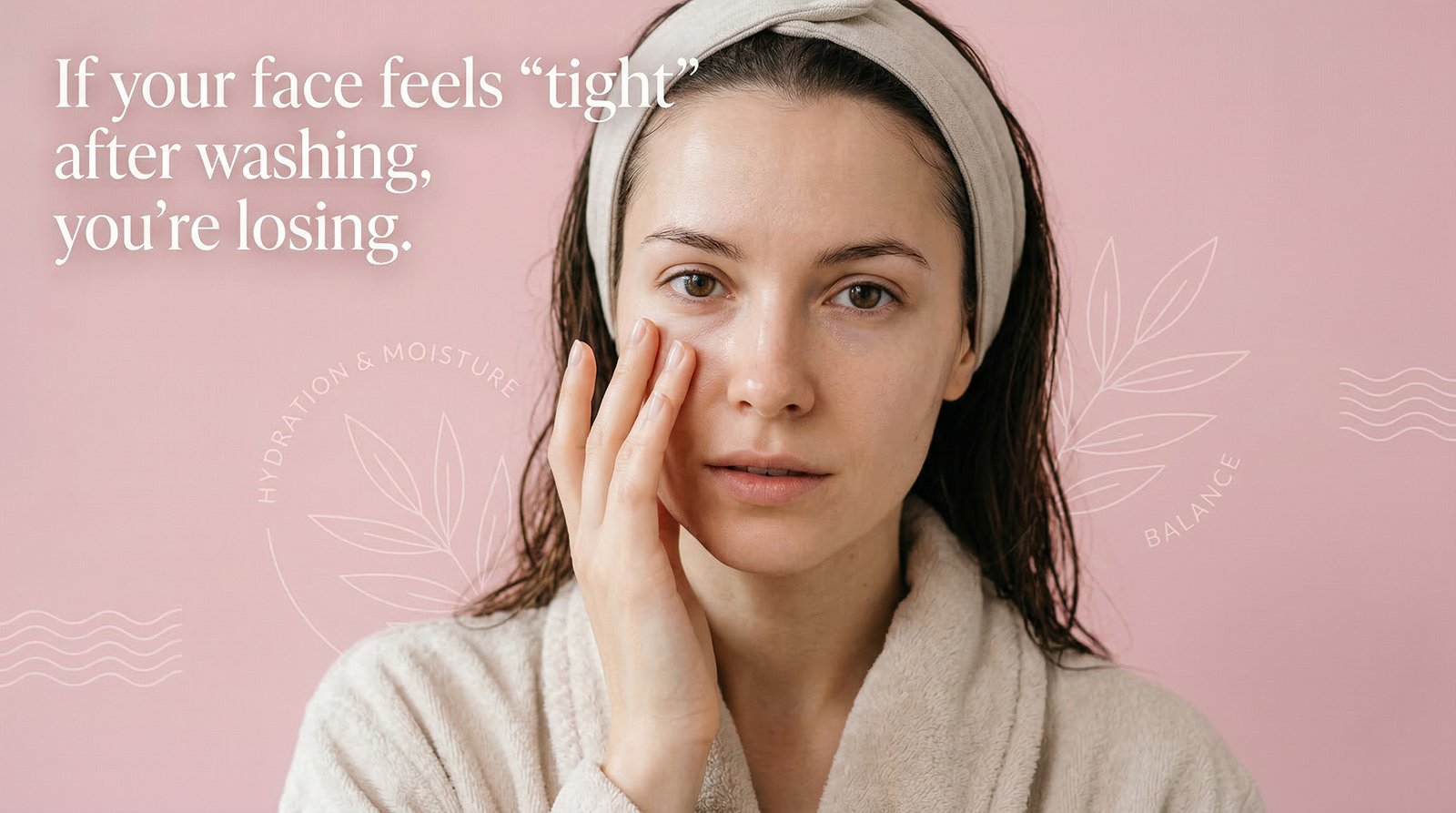
The real conversation about fragrance, inflammation loops, and why cutting your routine in half might be the most advanced thing you can do for your skin.
Why Your Skin Is Still Sensitive After Trying Everything
You’ve tried every “gentle” product on the shelf. You’ve swapped out your cleanser three times. You’ve gone fragrance-free, alcohol-free, paraben-free. And your skin is still reacting.
Here’s what nobody’s saying out loud: sensitivity is rarely one ingredient’s fault. It’s what happens when your barrier has been slowly, quietly dismantled by the routine you built to fix it.
This is that conversation.
The Ingredient You Keep Blaming Isn't the Problem
Fragrance gets a lot of heat in the skincare world and some of it is deserved. But pinning all your redness, tightness, and reactivity on one parfum listing is a little too convenient. It lets the actual cause off the hook.
The truth is messier. Fragrance does have legitimate sensitizing potential studies published in PubMed research on contact dermatitis consistently show that certain fragrance compounds like linalool, limonene, and cinnamal are among the most common contact allergens in cosmetics. But “fragrance can cause reactions” and “fragrance is what’s causing your reaction” are two very different statements. If your skin is reacting to almost everything fragrance-free included then the barrier is already compromised. And a compromised barrier doesn’t need a new villain. It needs a reason to rebuild.
“Is my skin reacting to fragrance or is my skin just too damaged to tolerate anything right now?”
What Your Skin Barrier Actually Does (And Why You Keep Breaking It)
Your skin barrier isn’t a wall. It’s a living, breathing structure a lipid matrix made up of ceramides, fatty acids, and cholesterol, organized in lamellar layers between your skin cells. Its entire job is to keep moisture in and irritants out. When it’s intact, your skin stays calm. When it’s not, everything gets through pollution, fragrance molecules, preservatives, even water in the wrong concentrations. That burning sensation when you apply your “soothing” serum? That’s not sensitivity. That’s transepidermal water loss (TEWL) at work, a sign that your barrier has enough microscopic damage that even gentle products feel like assault.
Research in the Journal of Investigative Dermatology has demonstrated that disrupted barrier function directly correlates with increased cytokine activity meaning a broken barrier doesn’t just let irritants in, it actively triggers an inflammatory response every time something touches your skin.
Barrier Science
Ceramides make up roughly 50% of the lipid matrix in your stratum corneum. When ceramide levels drop through over-cleansing, harsh actives, or environmental damage TEWL increases, skin pH rises, and the microbiome shifts toward pro-inflammatory bacteria. This is the domino effect most routines never address.
Most people respond to a damaged barrier by adding more products. More hydration. More actives. More steps. But every additional product is something else your compromised skin has to process, filter, and react to. You’re not rebuilding anything. You’re asking a sprained ankle to run a marathon.
The "Fragrance-Free" Swap That Still Irritates Your Skin
You made the switch. Fragrance-free everything. And your skin is… still irritated. Welcome to the part of skincare nobody wants to talk about.
Fragrance-free doesn’t mean reaction-free. It means no added fragrance. But that same “gentle” formula might still contain essential oils (which carry fragrance compounds), high concentrations of niacinamide (which can cause flushing in certain people), or witch hazel and denatured alcohol both of which are documented barrier disruptors. The label tells you what’s not in the product. It doesn’t tell you what your skin can actually tolerate right now.
Wait, What?
Some “natural” fragrance-free products contain more potential irritants than a well-formulated product with a small amount of skin-safe fragrance. The category is not the formula.
Minimals Note
If you’re in reactive skin territory, your cleanser matters more than almost anything else. Not because cleansing is complicated but because the wrong formula sets your pH off balance before your routine even starts. A truly gentle cleanser respects both your barrier and your microbiome from the first step.
Hydration Is Not Moisture. This Mistake Is Quietly Wrecking Your Skin.
Here’s the one that surprises people every time: hydration and moisture are not the same thing. Not even close.
Hydration = water content in your skin cells. Moisture = your skin’s ability to hold onto that water. Humectants like hyaluronic acid pull water into the skin. But if there’s no occlusive layer sealing it in, that water evaporates and it sometimes takes your skin’s own moisture with it.
This is why people who use hyaluronic acid serums in dry environments report their skin feeling tighter afterward. The humectant drew water to the surface, found none in the air, and started pulling from deeper layers instead. You hydrated your skin and made it drier. The fix is embarrassingly simple: always seal a humectant with something occlusive. Even a light moisturizer with ceramides and squalane. This is what “moisture sandwiching” actually means not ten layers of serums, but a deliberate sequence where you layer hydration, then lock it down.
The Biology
Transepidermal water loss (TEWL) can increase by up to 75% when the lipid matrix is disrupted. NIH-published research on barrier function shows that ceramide-dominant formulations measurably reduce TEWL within 24 to 48 hours but only when applied correctly, in the right sequence, with sufficient occlusion.
Your Actives Are Competing. And Your Skin Is Losing.
Layering actives feels productive. AHA in the morning, retinol at night, vitamin C somewhere in between, a BHA twice a week. It looks like a thorough routine on paper. What it looks like on your skin is chronic low-grade inflammation. Actives don’t just work on your skin they shift its pH, alter its enzyme activity, and affect how subsequent products penetrate. When you layer too many, you don’t get a cumulative benefit. You get interference. Retinol’s efficacy drops when layered over certain acids. Vitamin C oxidizes faster in unstable pH environments. Niacinamide and certain forms of vitamin C can form niacin in high heat, causing flushing.
More importantly: your barrier can only repair itself when it’s not constantly being exfoliated, dissolved, or acid-adjusted. Active-heavy routines are essentially pausing your skin’s natural recovery cycle every single night.
Inflammation Loop
Damaged barrier → irritant penetration → inflammation response → more barrier damage → more irritant penetration. This is why reactive skin often gets worse the more you try to treat it.
This is the inflammation loop. And fragrance, in a barrier-compromised skin, is just one more thing that keeps it spinning. Not because fragrance is uniquely toxic but because a skin stuck in an inflammation loop can’t tolerate much of anything.
What Over-Cleansing Does to Your Skin's Microbiome (It's Not Pretty)
Your skin is home to roughly a trillion microorganisms. Most of them are doing something useful producing antimicrobial peptides, competing with pathogenic bacteria, supporting immune signaling. This is your skin microbiome, and it’s significantly more fragile than anyone’s marketing copy will admit.
Surfactant-heavy cleansers don’t distinguish between the oil you want to remove and the protective lipids your barrier depends on. They strip both. And when your acid mantle the slightly acidic pH environment that keeps your microbiome stable is disrupted, the balance shifts. Research published in the Journal of Investigative Dermatology found that microbiome dysbiosis is directly linked to conditions like atopic dermatitis, acne, and rosacea all of which are commonly misread as “sensitivity.”
Cleansing twice daily with a harsh formula, using micellar water that requires rubbing, or double-cleansing when you didn’t wear sunscreen or makeup all of it quietly depletes the microbial ecosystem that keeps your skin self-regulating. qwThe counterintuitive fix: cleanse less aggressively, not more frequently. One gentle cleanse at night. Water or the lightest possible rinse in the morning. Your skin does not need to squeak.
If Your Routine Feels Like a Chore, That's the Diagnosis
If you’re scheduling your skincare around ingredient conflicts, tracking which actives can’t be layered, worrying about whether today is a “retinol night” or an “acid night” your routine is running you. That’s not optimization. That’s anxiety with a moisturizer on top. The most advanced skincare philosophy isn’t about knowing more ingredients. It’s about needing fewer of them. Barrier-first skincare what we’d call skinimalism isn’t about being lazy or minimalist for the aesthetic. It’s about understanding that your skin has extraordinary repair capacity when you stop getting in its way.
Three well-chosen products will outperform nine mediocre ones. Every single time.
Remove every product that you added because you “thought it might help” and couldn’t explain exactly why. What’s left? That’s your actual routine.
Not All Fragrance Is the Same. Here's How to Actually Read a Label.
Blanket fragrance avoidance is one approach. A smarter one is understanding what you’re actually looking at.
“Parfum” or “Fragrance” on a label is a catch-all term that can contain anywhere from one compound to several hundred. It tells you almost nothing. What you want to look for is whether specific fragrance allergens are disclosed EU regulations require disclosure of 26 allergens above certain concentrations. If a brand voluntarily lists them, that’s transparency worth respecting.
Natural fragrance is not automatically safer than synthetic. Citrus oils, certain florals, and plant extracts are among the most common contact sensitizers. Synthetic fragrance molecules, when well-researched and used at appropriate concentrations, can actually be more predictable and less irritating than their natural counterparts.
Fragrance in rinse-off vs. leave-on products is a meaningful distinction. A fragrance in a cleanser that’s on your skin for thirty seconds is a very different exposure than the same compound sitting on your face in a serum for eight hours. Leave-on products deserve more scrutiny especially if your barrier is already compromised.
Dose Matters
The Dermatology Times has reported that fragrance sensitivity in the general population affects roughly 1 to 4% of people when properly patch-tested. The number is not zero but it’s also not “everyone with reactive skin.” Concentration, exposure duration, and barrier status determine actual risk far more than the mere presence of fragrance.
The Routine That Actually Works. (It's Four Steps.)
This isn’t about cutting corners. It’s about choosing the right corners.
A low-surfactant, pH-balanced cleanser that removes what needs removing without stripping your lipid matrix. No fragrance in leave-on products is smart; fragrance in a rinse-off cleanser is a much smaller concern. See cleansers →
One targeted serum. Not five. If your skin is reactive right now, skip the actives entirely and use a ceramide or niacinamide serum to rebuild before you resurface. Skin can’t do both simultaneously.
A moisturizer that contains ceramides, squalane, or fatty acids to form an occlusive layer over your hydration. This is the step most people skip when their skin “doesn’t feel dry.” But moisture retention isn’t about how your skin feels it’s about what your barrier can hold. See moisturizers →
SPF is non-negotiable if you’re using any actives or trying to repair hyperpigmentation. But it’s also the most disruptive product for reactive skin if formulated poorly. Chemical filters can irritate a compromised barrier. Mineral-first formulas are a safer default while you rebuild.
That’s it. Cleanser, treatment, moisturizer, SPF. Everything else is optional at best and counterproductive at worst until your barrier is intact.
Common mistakes we all make
A simple "Healthy Skin Habits" checklist
Frequently Asked Questions
Common signs include persistent redness, stinging when applying products, tightness after cleansing, increased sensitivity, dry patches, and breakouts that seem to appear without a clear cause. If products that never bothered you before suddenly start irritating your skin, your barrier may be compromised.
Fragrance itself does not automatically damage the skin barrier. However, certain fragrance compounds can trigger irritation or allergic reactions, especially if your barrier is already weakened. Barrier health often determines how well your skin tolerates fragrance.
Mild barrier damage may improve within a few days, while more significant damage can take several weeks. Consistency, gentle cleansing, adequate moisturization, and reducing unnecessary actives are key factors in recovery.
If your skin is highly reactive, temporarily reducing or pausing strong actives such as retinoids, AHAs, and BHAs can help your barrier recover. Once your skin is stable, you can gradually reintroduce them one at a time.
Not necessarily. Fragrance-free products can still contain ingredients that irritate compromised skin. The overall formulation matters more than a single label claim.
Closing thought
Fragrance can be a problem. It’s a real sensitizer for some people, a non-issue for others, and a legitimate concern for anyone whose barrier is already struggling. But it’s not the story. It’s a character in a longer one about what happened before. Reactive skin is almost always the result of accumulated barrier damage. Too many products. Too many actives. Over-cleansing. Microbiome disruption. TEWL that nobody addressed because they were too busy adding a new serum. Fragrance in that context is the last straw, not the root cause. Rebuild the barrier first. Then and only then reassess what your skin can actually tolerate. You might find the “sensitivity” you’ve been managing for years quietly disappears once your lipid matrix is intact and your microbiome is stable.
Or you might discover you do have a genuine fragrance sensitivity, and cutting it from your leave-on products makes a real difference. Either way, you’ll know because you started from a place of repair, not restriction.
The goal was never a fragrance-free routine. It was skin that doesn’t need one.