
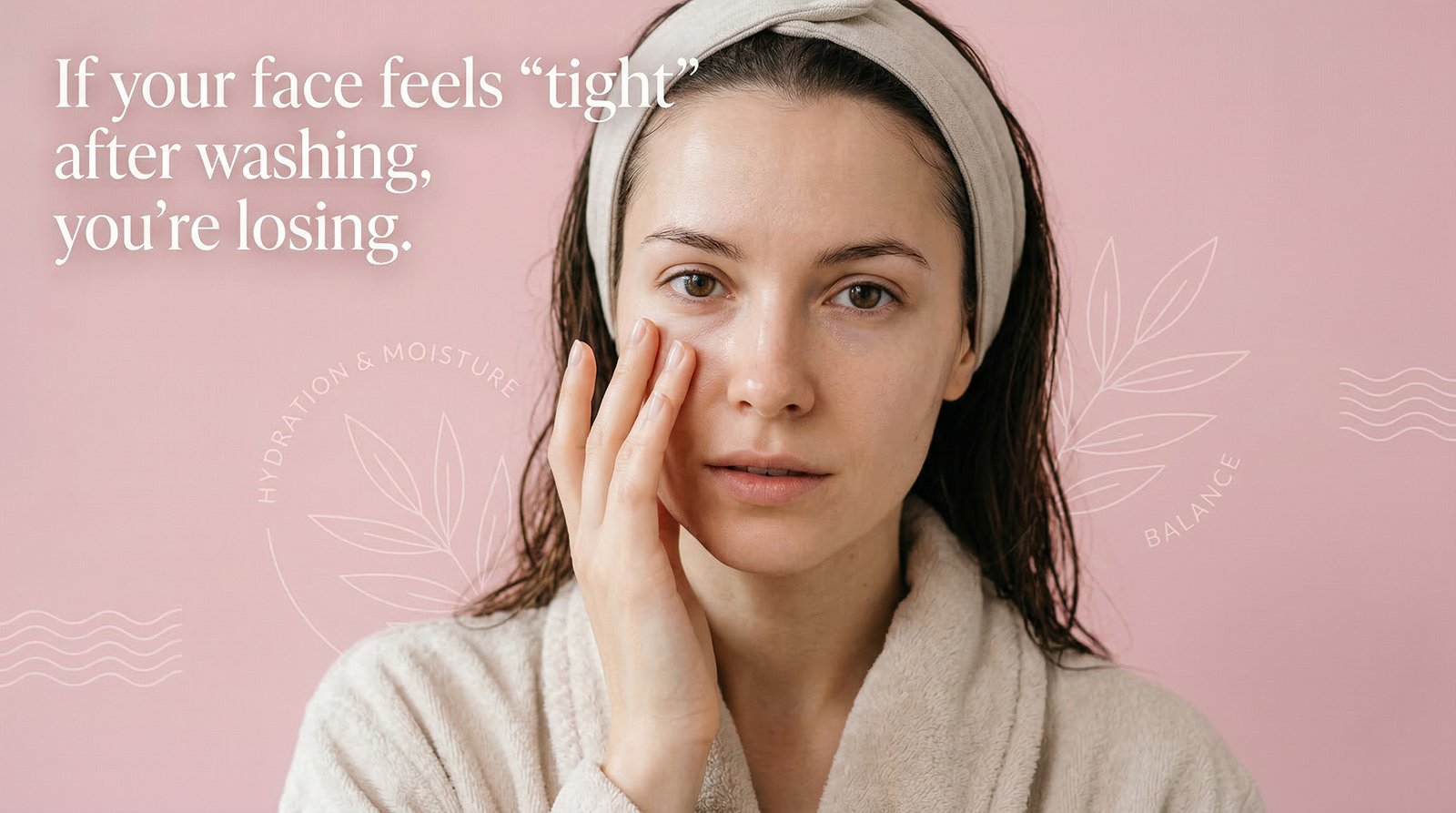
Glowing skin shouldn’t cost a fortune here is how to build an affordable, high-performing routine without breaking the bank.
How to Achieve Effective Skincare on a Budget (Without Compromising Your Barrier or Your Intelligence)
The most effective skincare routine most dermatologists would recommend costs less than your last takeout order. Not because cheap is always better. Because the ingredients that are actually proven to work retinol, niacinamide, ceramides, azelaic acid are not expensive to produce. They never were. What’s expensive is the frosted glass packaging. The brand story. The celebrity partnership. The shelf space at a department store. The elaborate serum that costs $95 and contains 0.1% of its star ingredient, buried on the label after seventeen filler emollients you’ll never pronounce.
You’ve been paying for theatre.
Your skin doesn’t care about theatre. It cares about ceramides. And ceramides cost pennies per gram.
The Price-Efficacy Myth That the Industry Runs On
Here’s the thing nobody in prestige beauty wants you to know.
There is no clinical study none that proves a $200 moisturizer outperforms a well-formulated $15 one when the active ingredients, concentrations, and base are equivalent. Not one.
What studies do show is that consumers perceive expensive products as more effective. That perception is so powerful it’s been documented in neuroscience: higher price literally changes how your brain registers the sensation of using a product. It’s called the price-placebo effect, and research published in the journal PLOS ONE confirmed that people report more relief from products they believe cost more even when the formula is identical.
So yes. Your luxury moisturizer might be working. But part of why it feels like it’s working is because it cost you a lot of money. That’s not skincare science. That’s psychology.
Why Budget Skincare Fails (And It's Not Because of the Price Tag)
Before we talk about what to buy, let’s be honest about why cheap skincare has a bad reputation.
Most budget skincare fails not because the active ingredients are poor quality, but because of how the rest of the formula is constructed. High fragrance loads to mask the base smell. High alcohol content to extend shelf life on the cheap. Underdosed actives technically present, legally nameable on the packaging, but in concentrations too low to do anything measurable. Preservative systems that are functional but harsh on sensitive skin. The problem isn’t the price. The problem is where the savings are made. A brand can formulate a genuinely excellent budget cleanser by using the right surfactant system at the right pH and cutting costs by using simple, clean packaging. Or it can formulate a cheap cleanser by underdosing actives, maxing out fragrance, and using stripping sulfates that make it foam dramatically so you feel like it’s working.
Both cost $8. Only one is worth your skin.
This is the real skill in budget skincare: knowing what the formula is actually doing not what the marketing claims it does.
Your Expensive Serum Might Be Less Active Than the Label Suggests
Here’s a quiet industry secret that should make you genuinely annoyed.
Ingredient lists in skincare are listed in descending order of concentration until you hit 1%. Everything below 1% can be listed in any order the brand chooses. This is a legal, standard practice. And it means that a “ceramide-infused serum” can legally feature ceramides somewhere in the bottom third of its ingredient list at a concentration of 0.01% while leading with water, glycerin, and a handful of emollients.
You paid for the ceramide story. You got trace amounts of ceramides.
Research from the National Institutes of Health on ceramide efficacy indicates that meaningful barrier repair requires ceramides present at concentrations sufficient to integrate into the stratum corneum’s lipid matrix not decorative quantities listed for label appeal.
When you’re shopping on a budget, this is the first thing to interrogate. Not the price. The ingredient list. Specifically: is the active you’re paying for in the top five to seven ingredients, or is it window dressing?
If it’s below the preservatives, it’s not doing much. Move on.
Over-Cleansing Is the Most Expensive Mistake You're Making for Free
The cheapest product in your routine is often the one doing the most damage.
Harsh cleansers stripping sulfates, high-pH foaming formulas, “deep clean” products marketed at oily skin cost very little to make and very little to buy. And they are quietly destroying your skin barrier with every wash. Your skin’s outermost layer, the stratum corneum, is a lipid matrix of ceramides, cholesterol, and free fatty acids. This isn’t moisture in the aesthetic sense it’s a physical shield. It controls transepidermal water loss (TEWL), regulates what gets in and what stays out, and maintains the slightly acidic pH (around 4.7 to 5.5) that keeps your microbiome balanced and your barrier intact.
A stripping cleanser disrupts all three simultaneously.
It removes the lipid matrix. It raises the pH. It disrupts the commensal bacteria your skin’s resident microorganisms that actively protect against acne-causing pathogens. And studies from the International Journal of Cosmetic Science show that barrier disruption from surfactants is not immediately repaired. It can take six to eight hours for your skin’s natural repair mechanisms to restore baseline barrier function.
That means if you’re double-cleansing with a foaming sulfate cleanser morning and night, your barrier is spending most of the day in a compromised state absorbing irritants, losing moisture, and mounting a low-grade inflammatory response that you’re interpreting as “sensitive skin.”
Your skin isn’t sensitive. Your cleanser is aggressive.
The fix is not expensive. A pH-balanced, low-surfactant cleanser the kind Minimals built their gentle daily cleanser around costs less than the fancy foaming wash you’re currently using and does significantly less damage. That’s not a trade-off. That’s just a better formula.
The One Active Worth Every Rupee (Even If It Costs Almost Nothing)
If you could only spend money on one active ingredient, dermatology has a pretty clear answer.
Niacinamide.
It’s not glamorous. It doesn’t have the cultural cachet of vitamin C or the prestige association of retinol. But niacinamide vitamin B3 has one of the most robust evidence profiles of any topical skincare ingredient, particularly for budget-conscious routines. At 5%, it reduces sebum production. At 10%, it visibly improves hyperpigmentation. It strengthens the barrier by stimulating ceramide synthesis. It reduces transepidermal water loss. It has an established anti-inflammatory profile that makes it useful for acne, rosacea, and general sensitivity. And critically it’s stable, plays well with almost every other ingredient, and is genuinely inexpensive to formulate at clinically relevant concentrations.
A study in the British Journal of Dermatology found that topical niacinamide at 4% was as effective as 1% clindamycin in reducing acne inflammatory lesions without the antibiotic resistance implications.
You’re reading that right. A stable, inexpensive, non-prescription B vitamin performed comparably to a clinical antibiotic in an acne study. And yet somehow the industry keeps steering you toward $80 “brightening serums” with less evidence behind them.
The 'More Is More' Logic That's Keeping Your Skin Stuck in a Loop
Let’s talk about the inflammation loop, because this is where a lot of budget routines quietly implode.
You notice a problem dryness, breakouts, dullness. You add a product to address it. The product causes mild irritation. Your skin mounts a defensive response more sebum, more redness, more sensitivity. You interpret that response as the original problem getting worse, so you add another product.
Round and round.
The dermatological term for what’s happening in your barrier is a cytokine cascade a chain of inflammatory signals triggered by repeated disruption. Research published in the Journal of Investigative Dermatology has documented how chronic low-grade barrier disruption upregulates pro-inflammatory cytokines, creating a persistent sensitized state that makes your skin reactive to products it should be able to tolerate.
In plain language: the more you do to a compromised barrier, the worse it gets. And budget routines often accelerate this because the temptation to try everything is higher when everything is affordable. Restraint is the most underrated skincare strategy. And it costs nothing. Pick fewer products. Use them consistently for longer. Give your barrier time to actually repair before you decide something isn’t working. Eight weeks minimum. Most active ingredients don’t produce visible results before six weeks of daily use and most people have abandoned them by week three.
Moisturiser Is Not Optional, Even If Your Skin Feels Fine
This is the one that budget skincare routines cut first and it’s the one that costs you the most in the long run.
“My skin isn’t dry, I don’t need a moisturiser.”
You’re confusing the sensation of dryness with the physiological state of your barrier. These are different.
Oily skin can have a compromised barrier. Combination skin can have an impaired lipid matrix. Even skin that produces excess sebum can have insufficient ceramide levels because sebum and ceramides are not the same thing. Sebum is produced by your sebaceous glands. Ceramides are produced by lamellar bodies in the epidermis and are part of an entirely separate mechanism. High TEWL is not something you feel clearly until it becomes significant. By then, your barrier has been operating under stress for weeks or months, and that stress shows up as increased reactivity, slower healing, and ironically more oiliness as your sebaceous glands overcompensate for a barrier that isn’t doing its job.
A simple, well-formulated moisturiser with ceramides, cholesterol, and free fatty acids in ratios that approximate the skin’s natural lipid profile is the most reliable, evidence-backed intervention for barrier repair you can find. Research in the Journal of Drugs in Dermatology found that emollient moisturisers containing physiological lipids produced measurable improvements in TEWL and barrier function within two weeks of consistent use.
Two weeks. Not two months. Two weeks of applying a ceramide moisturiser twice a day.
“Minimals” barrier-repair moisturiser is built on exactly this evidence base ceramides, squalane, and cholesterol in a fragrance-free, non-comedogenic base that works across skin types. It costs a fraction of what you’d pay for a luxury equivalent with the same active profile. The difference is: there’s no glass jar, no heavy retail markup, and no ingredient list padded out with botanicals that have no barrier function.
What you’re paying for is what goes on your skin. That’s the whole point.
The Reality of Retinol on a Budget (It's More Accessible Than You Think)
Retinol has a reputation problem on two fronts.
First: people think it’s only for aging skin. It isn’t. Retinol a vitamin A derivative supports cell turnover, manages acne, improves texture, and has one of the strongest long-term evidence profiles of any topical ingredient in dermatological history.
Second: people think effective retinol is expensive. It doesn’t have to be.
Prescription tretinoin the gold standard retinoid is available in many markets at very low cost through a dermatologist. Over-the-counter retinol, while slower-acting, is effective at 0.1% to 0.5% concentrations in a stable base. The key word is stable. Retinol degrades in light and air, which is why packaging matters more for this ingredient than almost any other.
Tube packaging. Opaque container. No jar.
Start at 0.1%, two to three nights per week, buffered by applying your moisturiser first. Increase frequency over six weeks, not concentration. This approach the “retinol sandwich,” applying moisturiser before and after significantly reduces irritation without reducing efficacy, according to clinical guidance from the American Academy of Dermatology.
Budget tip: if your skin is already reactive, skip retinol for six to eight weeks and focus on barrier repair first. A disrupted barrier will absorb retinol unevenly and react badly. Repair first. Treat second. This order matters more than the product itself.
If Your Budget Routine Has More Than Five Products, Reconsider the Budget
Here’s the reality check.
Four products at Rs. 600 each is Rs. 2,400 spent. Ten products at Rs. 400 each is Rs. 4,000 spent and you’re probably getting worse results. More products means more potential points of irritation. More interactions between formulas. More fragrance exposure. More competing pH levels. More variables to manage, and more complexity to troubleshoot when something goes wrong.
Budget skincare done well is about surgical precision, not volume.
You need: a cleanser that doesn’t strip, one targeted active at a meaningful concentration, a barrier-repairing moisturiser, and SPF in the morning. That’s the whole routine. For most people, that’s all their skin will ever actually need.
Everything else the toners, the essences, the eye creams (which are almost always just moisturiser in smaller packaging at triple the price) is optional. Nice, sometimes. But not necessary. If your skincare spending is going up but your skin isn’t improving, that’s not a coincidence. More products is not more care. In most cases, it’s more interference.
The Budget-Proof Minimal Routine (Works. Full Stop.)
This isn’t aspirational. This is functional.
Unless you sweat heavily at night or have a medical condition, your face does not need to be cleansed twice daily with a surfactant-based product. Water in the morning. A gentle, pH-balanced cleanser at night to remove SPF and pollution. This single shift cuts product cost, reduces barrier disruption, and gives your skin’s repair mechanisms a full night to operate without interference.
Minimals’ gentle daily cleanser: no sulfates, no fragrance, pH 4.5 to 5.5. Use once. Let it work.
Choose based on your primary concern:
Apply to clean, slightly damp skin. Use for a minimum of eight weeks before evaluating. Don’t add a second active until you’ve confirmed the first is tolerated.
Non-negotiable. Even if your skin is oily. Even if it feels fine. Apply a ceramide-containing moisturiser every morning and every night. This is what rebuilds your barrier over time, reduces TEWL, and allows every other product in your routine to function properly.
Minimals’ barrier-repair moisturiser: ceramides, squalane, cholesterol. No fragrance. Fragrance-free isn’t a nice-to-have for a barrier product it’s a requirement.
Unambiguously the best anti-aging, anti-pigmentation, anti-inflammation investment in skincare. Chemical or mineral both work if applied correctly. Apply last. Apply generously. Reapply if you’re outside for more than two hours. SPF is not optional. It doesn’t matter what actives you’re using at night if you’re undoing them every morning by skipping sun protection.
Four steps. Four products. Every day. That’s the budget routine. That’s enough.
Common mistakes we all make
Here are the most frequent (and costly) mistakes that sabotage even the best budget routines:
Fix these 6 mistakes and your skin will improve dramatically even on a tight budget. Simplicity and consistency beat expensive complexity every single time.
A simple "Budget Skincare Checklist" checklist
Frequently Asked Questions
Yes. The most proven ingredients (niacinamide, ceramides, retinol, azelaic acid) are inexpensive to produce. What you’re usually paying for in luxury products is fancy packaging, marketing, and brand prestige not better formulas. A well-made budget product with proper concentrations often outperforms an expensive one with trace actives.
Only 4 products maximum:
Anything more usually creates irritation and wastes money.
Not with a cleanser. Water is enough for most people. Over-cleansing, especially with foaming or sulfate products, damages your skin barrier and causes more oiliness and sensitivity.
Absolutely. Oily skin can have a damaged barrier. A lightweight ceramide moisturizer helps regulate oil production and prevents rebound oiliness. Skipping moisturizer is one of the biggest mistakes people make.
Niacinamide 10% is the best starter for most people. It’s gentle, stable, improves acne, pigmentation, oil control, and barrier strength. It works for almost all skin types and concerns.
Closing thought
Good skin doesn’t require an expensive routine. It requires an honest one. Honest about what your barrier actually needs. Honest about what ingredients are proven versus merely popular. Honest about the fact that the tightness and irritation you’ve normalised might be a product problem, not a skin problem.
The budget wins are hiding in plain sight: the low-pH cleanser that doesn’t strip, the niacinamide serum with actual concentration, the ceramide moisturiser that costs less than your coffee habit.
You don’t need to spend more. You need to spend smarter.
Explore everything “Minimals” formulates barrier-first, filler-free, priced for real life at minimals.com.co.