
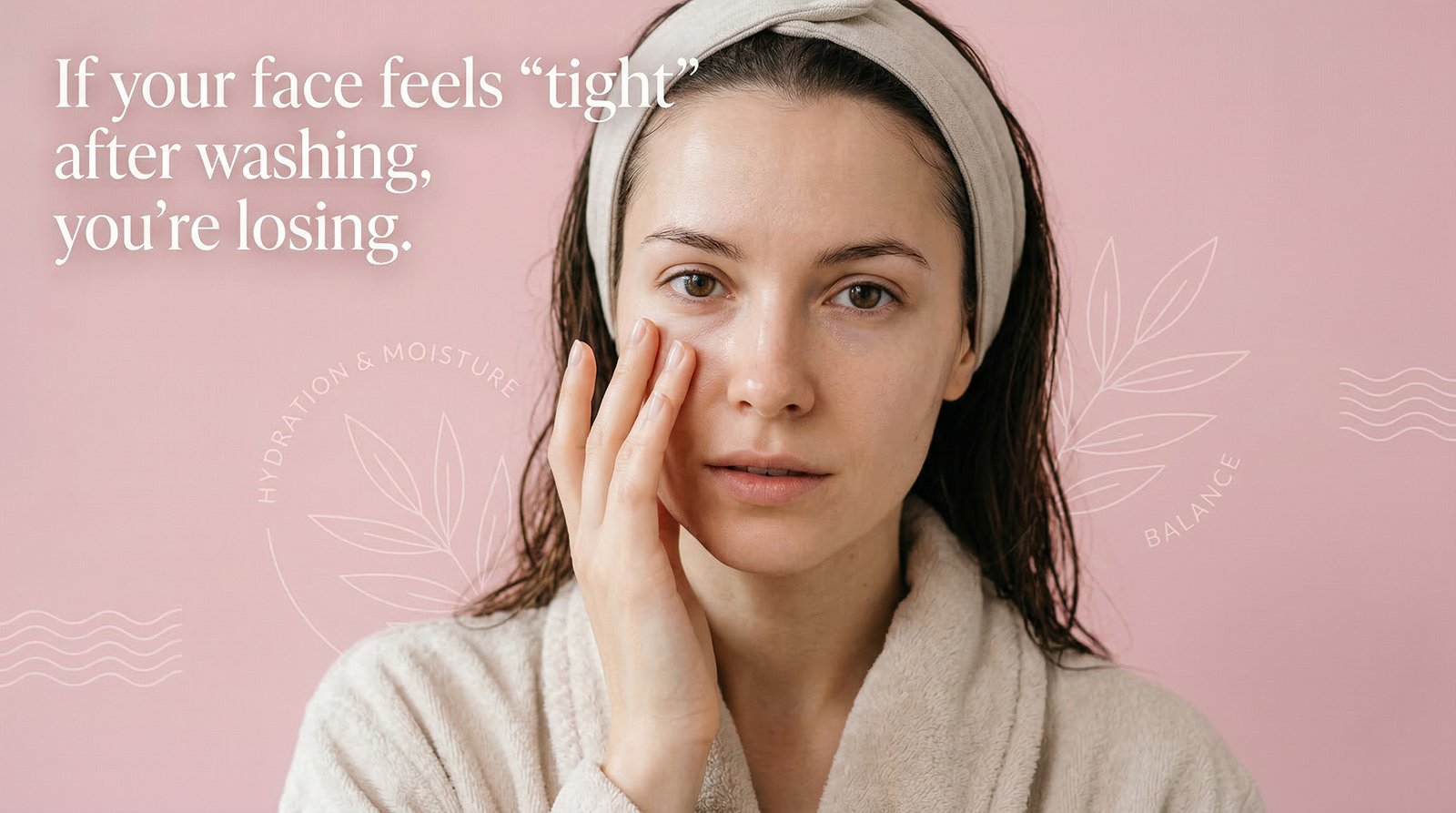
A guide to shifting focus from cosmetic marketing and sensory appeal to clinical efficacy, ingredient transparency, and scientifically proven formulations in skincare.
Your expensive skincare routine is probably making your skin worse.
Not because the ingredients are fake. But because most of it is built on noise heavy fragrances marketed as “luxury,” layers upon layers of actives, and the myth that more steps equal better results. You’ve felt it. That tight feeling after cleansing. The random breakouts. The redness that won’t quit. You blame hormones, pollution, or “sensitive skin.”
It’s often simpler: your skin barrier is damaged, and you’re feeding the problem with more products. I’m not here to shame your shelf. I’m here to cut through the nonsense so you can finally stop guessing.
The real cost of chasing “luxury” skincare
Luxury often means strong scent. That signature fragrance? It’s usually a mix of synthetic compounds that sit on top of your skin like an unwelcome guest. They don’t repair anything. They just smell expensive while quietly irritating the barrier. Your skin doesn’t need to smell like a boutique. It needs to function like healthy skin.
What’s actually happening to your skin
The outer layer of your skin the stratum corneum works like a brick wall. Corneocytes are the bricks. The mortar is a precise mix of ceramides, cholesterol, and free fatty acids. When that lipid matrix gets disrupted, transepidermal water loss (TEWL) increases. Your skin loses moisture faster than it can hold it. Inflammation kicks in. You reach for more products. The cycle continues. This isn’t theory. Studies show that impaired ceramide profiles directly correlate with higher TEWL and visible irritation. Over-cleansing makes it worse. Harsh surfactants strip natural oils and shift your skin microbiome the community of bacteria that actually helps protect you.
Suddenly your “normal” skin feels reactive. You add more steps. The inflammation loop tightens.
Why layering actives is quietly destroying your progress
You’ve seen the routines: vitamin C in the morning, retinol at night, acids three times a week, plus whatever influencer trend is hot this month.
Here’s the counterintuitive truth: hydration ≠ moisture.
Hydration pulls water into the skin (humectants like hyaluronic acid or glycerin). Moisture refers to the oils and lipids that prevent that water from escaping. Most “hydrating” serums give you the first part but do nothing for the second. Without a solid lipid barrier, that water evaporates and takes more of your natural moisture with it. Layering too many actives compounds the issue. Exfoliants thin the outer layer. Strong ingredients increase permeability. Your barrier gets overwhelmed instead of supported.
The result? Redness, sensitivity, and the feeling that nothing works anymore.
Your cleanser might be the biggest culprit
Most cleansers prioritize that “squeaky clean” feeling. That squeak? It’s your barrier screaming. Harsh formulas disrupt the acid mantle and microbiome, leading to overproduction of oil as your skin tries to compensate. Then comes the dryness, more cleansing, more irritation.
Wait what if your breakouts aren’t hormones but residue from stripping your skin twice a day?
Gentle cleansing that respects the lipid matrix isn’t a downgrade. It’s the foundation everything else depends on.
“Minimals approach here is straightforward: a cleanser that removes what needs to go without torching what needs to stay.
The fragrance trap most people ignore
“Luxury” fragrances often hide potential irritants. Even “natural” essential oils can trigger immune responses in compromised skin. Your skin doesn’t care about smelling pretty while it’s busy repairing. Unscented or minimally scented formulas let the functional ingredients do their job without interference. This isn’t about being boring. It’s about being effective.
The myth of “more is better” in skincare
Every new serum feels like progress. Until your skin rebels. Barrier-first skincare flips the script. Instead of attacking perceived problems with actives, you first make sure the barrier can handle them. When the lipid matrix is intact, your skin handles environmental stress better. Inflammation decreases. You need fewer products, not more.
This is skinimalism in practice: less noise, more repair.
If your routine feels complicated, that’s the problem
Be honest for a second.
How many products are you using right now? How many times have you changed your routine in the last year because something stopped working? Complicated routines create dependency. They train your skin to expect constant intervention instead of learning to maintain itself. The smartest move isn’t adding one more corrective serum. It’s simplifying to what actually supports barrier function and microbiome balance.
Building a routine that actually works
You don’t need ten steps. You need a few that hit the right targets.
You don’t need spinning brushes or rough washcloths. Your clean fingertips are the gentlest tool you own.
Smarter choices beyond the marketing
Stop buying based on packaging or influencer claims. Start asking:
Look for formulas with skin-identical lipids. Avoid known disruptors when possible. Prioritize repair over constant correction.
One “wait, what?” moment: sometimes the best treatment for reactive skin is doing less for a few weeks. Let the barrier recover. Then reintroduce things slowly.
The Minimals difference (without the sales pitch)
At some point, your skin doesn’t need another hero ingredient. It needs a formula that respects how skin actually works.
Minimals builds around barrier repair and skinimalism. Cleanse, treat, seal. No filler. No overwhelming fragrance. Just high-performance basics that make sense. (Check their lineup at minimals.com.co when you’re ready to simplify.)
A simple "Beyond Luxury Fragrances" checklist
Frequently Asked Questions
Mostly yes. It adds zero repair value and often irritates a compromised barrier. Skip it.
Tightness after washing, random redness, stinging products, or constant dryness. These are your skin asking for help.
Hydration brings water in. Moisture locks it there with lipids. Most people only do the first part and wonder why they stay dry.
Yes. Most skin gets better when you stop overwhelming it. Less noise usually means faster results.
AM: Gentle cleanse → Treatment (if needed) → Moisturizer → SPF PM: Gentle cleanse → Treatment → Richer moisturizer.
Closing thought
It’s not broken. It’s responding exactly as biology predicts to the routine you’ve given it. The path forward isn’t another 10-step haul. It’s understanding the biology, cutting the noise, and choosing fewer products that actually align with how your skin functions. You don’t need more skincare. You need better information and better choices. Start small. Swap one harsh product for a gentler alternative. Drop the unnecessary layers. Watch how your skin responds when you stop fighting it and start supporting it.
The results aren’t instant Instagram glow. They’re quieter, more sustainable: less redness, better texture, skin that feels calm and resilient.
That’s the real luxury.