
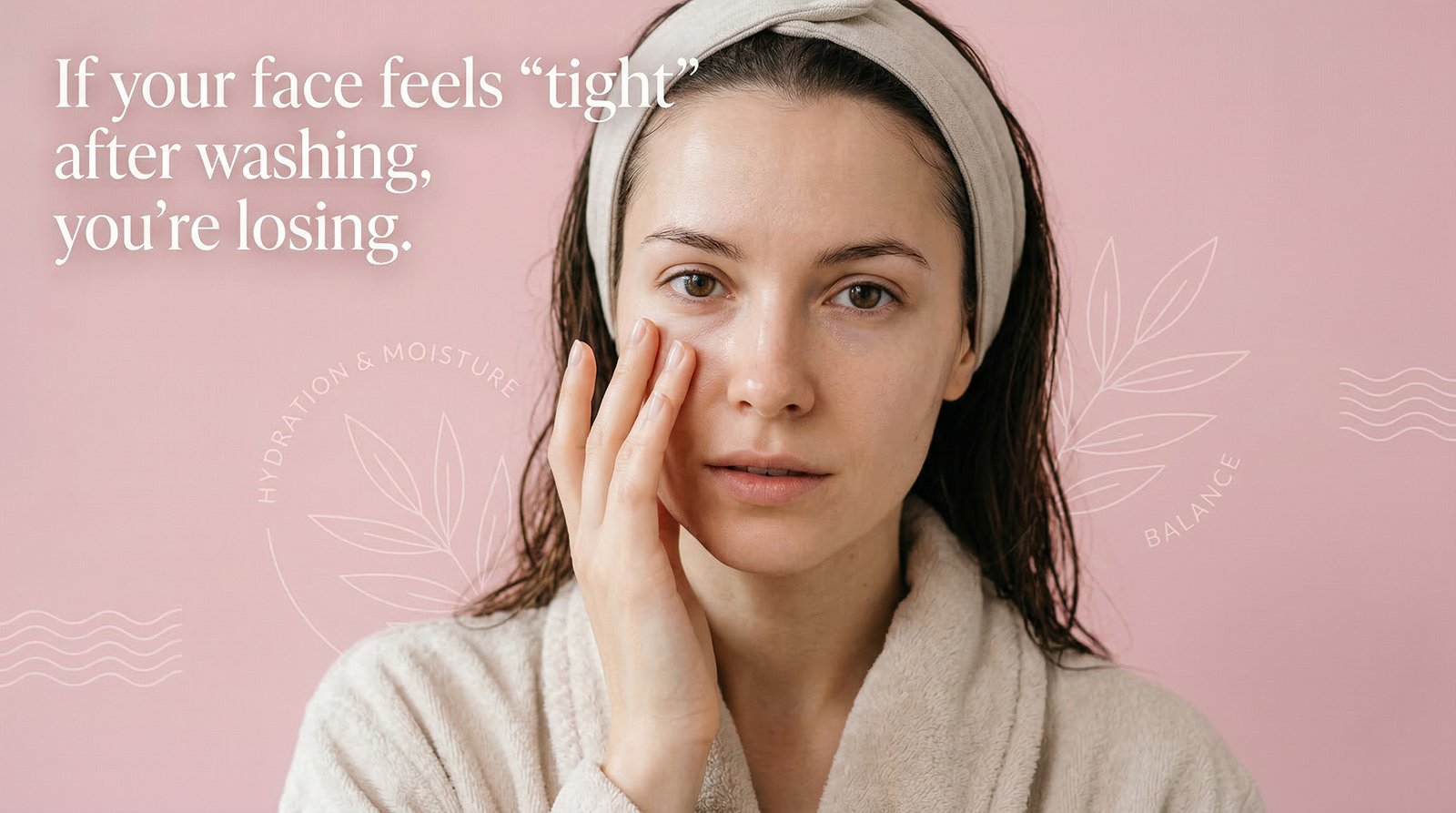
Master the art of layering and pairing hyaluronic acid to lock in deep hydration without dehydrating your skin.
Your hyaluronic acid routine is probably making your skin thirstier.
You slather it on, chase it with more layers, and still wake up with that tight, flaky feeling. Or worse plump one day, reactive the next. The industry sold you “hydration hero,” but forgot to mention the fine print. Hyaluronic acid (HA) is powerful, yet easy to misuse. Balance it wrong and you’re quietly sabotaging your skin barrier.
I’ve seen it too many times. People chasing that dewy look with five HA products stacked like a bad sandwich. Their skin looks “hydrated” for an hour, then pays the price. Here’s the uncomfortable truth: hydration isn’t just about adding water. It’s about keeping it where it belongs without pissing off your barrier, your microbiome, or your inflammation response.
Let’s cut through the noise.
The myth that’s quietly wrecking your skin
You’ve heard it: HA holds 1,000 times its weight in water. Sounds amazing on paper. In reality, that humectant power can backfire hard if you don’t understand the difference between hydration and moisture.
Hydration is water content in your skin. Moisture is your skin’s ability to retain that water thanks to your lipid matrix, ceramides, cholesterol, and fatty acids.
Slap pure HA on a damaged barrier in low-humidity air (hello, Karachi AC or dry winters) and it pulls water from deeper layers or the environment inefficiently. Result? Surface dehydration, tightness, and a compromised barrier that lets more water escape. Transepidermal water loss (TEWL) goes up. Inflammation follows.
Your skin doesn’t need another drink. It needs a smart way to hold onto what it already has.
Why your barrier is the real boss
Your stratum corneum the outermost layer acts like brick-and-mortar. The “bricks” are corneocytes. The “mortar” is the lipid matrix packed with ceramides. When that mortar cracks from over-cleansing, harsh actives, or environmental stress, TEWL spikes. Your microbiome gets thrown off. Inflammation loops start. HA alone can’t fix that. It might even highlight the problem.
Studies show proper barrier support improves hydration and reduces TEWL for hours after application. That’s the foundation everything else builds on. Over-exfoliating or layering too many actives? You’re creating micro-tears and stripping lipids faster than your skin can repair. Then you throw HA on top like a band-aid. It’s not working the way influencers promised.
Different HA sizes: Not all heroes wear the same cape
This is where most people (and most products) screw up.
The counterintuitive part? More penetration isn’t always better. Your skin has natural limits. Bombarding it with tiny molecules can disrupt the microbiome or spark low-grade inflammation, especially if your barrier is already cranky.
Wait what? Yes. That “super hydrating” lightweight serum you love might be the reason your skin feels sensitive lately.
The inflammation loop nobody talks about
You add more HA because skin feels dry. Skin reacts with subtle inflammation. Barrier weakens more. You need even more “hydration.” Round and round. Over-cleansing plays a starring role here. Stripping your skin morning and night kills off good bacteria, raises pH, and damages lipids. Your microbiome hates it. Inflamed skin holds less water, no matter how much HA you throw at it. Layering too many actives (retinoids, acids, vitamin C, plus HA serums) creates the same mess. Your skin spends all its energy defending itself instead of repairing.
The shift to skinimalism: Less, but actually intelligent
This is where Minimals thinking comes in. Not zero products. Not ten. A focused routine that respects your barrier first. You don’t need a 10-step ritual that exhausts your skin and your wallet. You need steps that work with your biology instead of against it.
Barrier-first skincare means:
No more chasing trends. Just consistent support for what your skin already knows how to do.
Why “more HA” is usually the wrong answer
At this point, your skin doesn’t need another pure HA serum. It needs a formula that balances humectancy with barrier lipids and calming support. Pure HA in dry conditions or on compromised skin can highlight the gap. A well-designed moisturizer that pairs different molecular weights of HA with ceramides or soothing agents does both jobs draws in hydration and prevents loss.
That’s why throwing standalone HA on top of everything often fails. It evaporates or pulls without sealing. Your skin ends up paying the difference.
Moisture sandwiching done right
The technique works when you do it intelligently.
Apply your treatment (HA-balanced serum) on slightly damp skin. Follow immediately with a moisturizer that supplies lipids. This traps water where it belongs instead of letting it escape. But here’s the mistake most make: they sandwich multiple watery layers without enough occlusive or lipid support. Result? Temporary plumpness followed by rebound dryness.
A single smart layer that already combines humectants with barrier ingredients often outperforms a complicated sandwich.
If your routine feels complicated, that’s the problem
Be honest for a second.
How many products are you using right now? How many contain “hydration” claims? Does your skin feel calmer or more reactive after your full routine? Complicated routines create invisible stress on your skin and your patience. They increase chances of ingredient conflicts, pH disruption, and microbiome imbalance. The fix isn’t adding one more corrective product. It’s stripping back to what actually moves the needle.
Your minimal barrier-first routine
Keep it to 3 to 4 steps max. Morning and night, with tiny adjustments.
Evening (repair mode):
Something that removes the day without nuking your lipids or microbiome. No tight squeaky-clean feeling. Your skin should feel soft, not stripped.
A serum that delivers multi-weight HA thoughtfully, paired with barrier-supporting ingredients. Not pure HA that needs babysitting. Apply to damp skin for better acceptance.
A moisturizer rich in ceramides or natural lipids that reinforces your mortar. This is where real moisture retention happens.
Morning:
Same base, plus lightweight protection if heading out. No heavy actives that increase sensitivity to sun.
Optional: A simple antioxidant step if your skin tolerates it, but never at the expense of barrier repair. That’s it. Consistency beats complexity every single time. Your skin will tell you within a couple weeks if it’s working less tightness, fewer random red patches, better texture even without makeup.
Common mistakes that sabotage HA balance
Fix the foundation first. Then HA becomes an ally instead of a wildcard.
What real balance looks like
Balanced HA use supports your skin’s natural hyaluronic acid production and retention without overwhelming it. It works alongside ceramides to lower TEWL. It respects the microbiome. It delivers visible plumpness that lasts because the water stays put. No dramatic before-and-after in one week. Just skin that looks quietly healthier month after month.
You stop chasing. You start maintaining.
A simple "HA Checklist" checklist
Frequently Asked Questions
Not exactly. HA is a powerful humectant, but it doesn’t automatically lock water in. On a damaged barrier or in dry air, it can pull moisture without sealing it, leaving your skin tighter than before. Balance matters more than quantity.
Tight, flaky, or shiny skin after cleansing. Random sensitivity. Red patches that come and go. Products that used to work suddenly sting. These are your skin screaming for repair, not more actives.
Usually no. One well-formulated product with a smart mix of sizes often works better than stacking three separate ones. Less risk of irritation, fewer conflicts, and your skin isn’t overwhelmed.
Yes if it’s balanced properly. Daily use is fine when paired with barrier-supporting ingredients. The problem starts when you treat it like the main event instead of one supporting player.
On damp skin, always. Then follow quickly with a moisturizer that supplies lipids. This “moisture sandwich” actually traps water instead of letting it evaporate. Applying on bone-dry skin is mostly wasted effort.
Closing thought
The skincare industry profits when you stay confused and keep buying the next “solution.” Your skin thrives when you simplify and support its core functions. Focus on barrier repair. Use HA intelligently within a minimal routine. Give your skin the space to do what it’s built for. At this point, your skin doesn’t need another step. It needs a formula that already understands both hydration delivery and retention.
Start there. Strip back. Observe. Adjust only when needed. Your skin will thank you probably by needing less intervention overall.
That’s the quiet confidence of skinimalism. Not perfect skin. Just skin that functions better with less drama.