
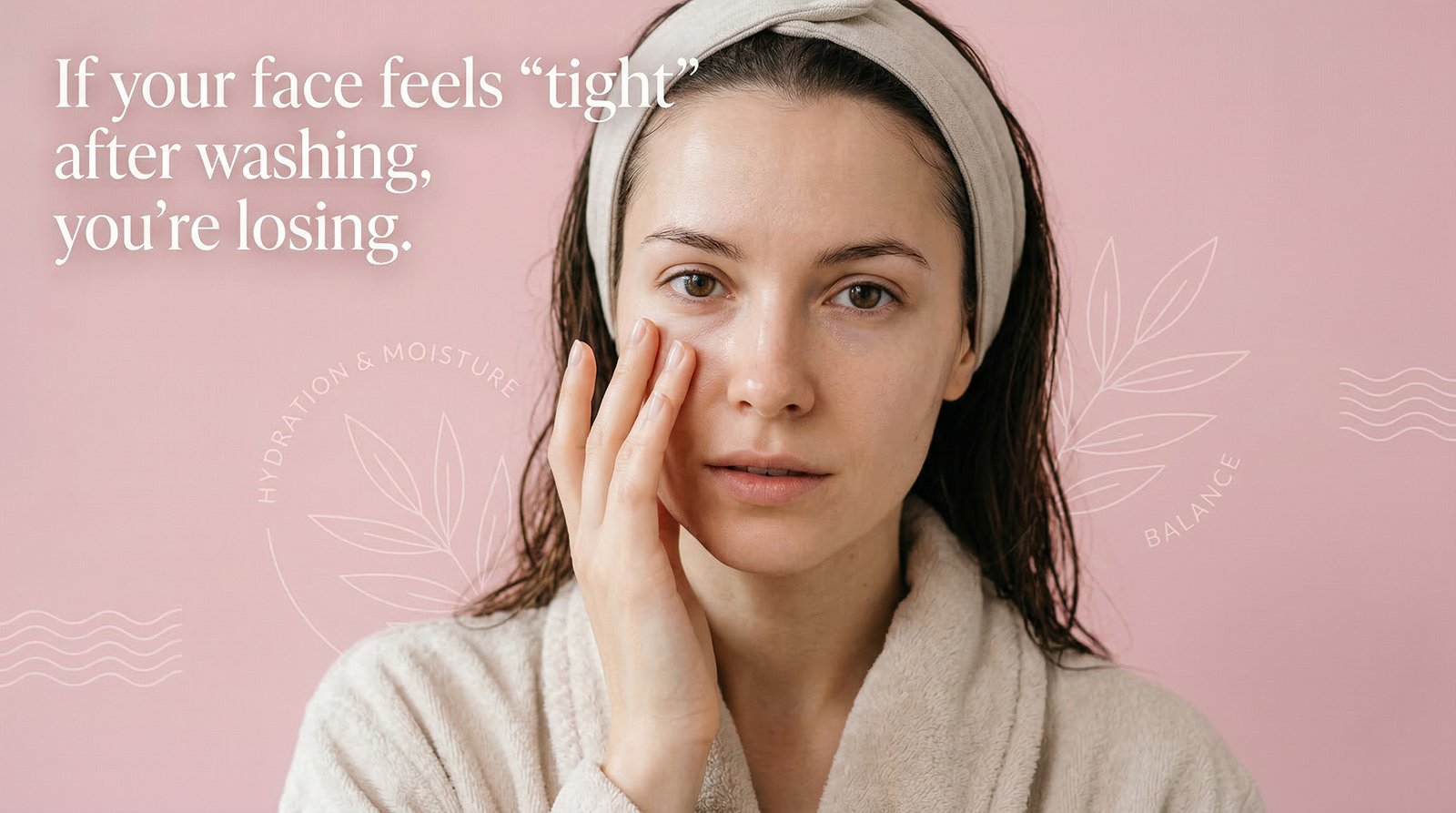
Protect your skin from sneaky indoor UV rays that penetrate windows and cause long-term damage.
The Silent Skin Killer Hiding by Your Window
You work from home. You sit by a window. You skip sunscreen because you’re not going outside. And your skin is still aging quietly, consistently, in ways that won’t show up on your face today but will absolutely show up in five years.
This is the indoor UV conversation nobody is having loudly enough. Not because the information doesn’t exist it does, it’s well-documented but because SPF marketing has conditioned you to think about sun protection only in terms of beaches and summer holidays.
The reality is more uncomfortable than that.
UV radiation doesn’t stop at your front door. And the damage it does indoors is slower, subtler, and in some ways more insidious than the burn you’d get lying on a beach because at least then, you’d know it was happening.
The Window You Sit Next to Is Not Protecting You
Let’s deal with the glass myth first, because it’s the one most people are quietly relying on.
Standard window glass the kind in your home, your car, your office blocks most UVB rays. UVB is the wavelength responsible for sunburn and the one your SPF number is primarily rated against.
What glass does not block is UVA. UVA rays make up approximately 95% of the UV radiation that reaches Earth’s surface. They penetrate deeper into the skin than UVB reaching the dermis, where your collagen lives, where your elastin fibres are, where the structural integrity of your skin is maintained.
Research published on the NIH National Library of Medicine has documented that UVA radiation passes through standard window glass at significant levels enough to cause measurable photoaging with consistent, daily, long-term exposure.
The driver who only tans on the left side of their face. The office worker with asymmetric sun damage. These aren’t anomalies they’re the predictable outcome of years of unprotected UVA exposure through glass. If you’re sitting within two metres of a window for more than an hour a day, you’re getting UV exposure. Whether or not the sun is directly on your face.
UVA Does Something Worse Than Burn You
Here’s the part that should make you put down whatever you’re doing and listen.
UVB burns. UVA ages. And the aging it causes operates completely below the threshold of sensation.
You don’t feel UVA. There’s no warmth, no redness, no immediate feedback signal. It just penetrates, generates free radicals, and begins breaking down collagen and elastin in your dermis silently, every single day you sit unprotected near a light source.
This is called photoaging, and studies in the Journal of Investigative Dermatology have estimated that UV exposure accounts for approximately 80% of visible facial aging. Not genetics. Not stress. Not diet.
Eighty percent. And the majority of that UV exposure especially for people who work indoors isn’t happening on holidays. It’s happening incrementally, in small daily doses, through windows and during the commute to get coffee. The cumulative effect of low-level, unprotected UVA exposure is indistinguishable from the cumulative effect of repeated high-level exposure. Your skin doesn’t grade the source. It just records the damage.
Visible Light Is Also in the Room With You Right Now
Wait there’s more.
UV radiation is only part of the electromagnetic spectrum hitting your skin indoors. The other part the one your SPF does almost nothing about is high-energy visible light, or HEV. You’ll see it marketed against as “blue light protection.” HEV light is emitted by your laptop screen, your phone, your LED lighting, and yes, sunlight through windows.
Research cited by dermatology researchers and available through PubMed has found that HEV light can trigger oxidative stress in skin cells, exacerbate hyperpigmentation particularly in deeper skin tones and potentially disrupt the skin’s natural repair processes.
This doesn’t mean your screen is as dangerous as the sun. It isn’t.
But it does mean that the working assumption of “I’m indoors, I’m protected” is more wrong than most people realise. You’re in a room full of light sources, some of which are doing low-level, cumulative damage that your current skincare routine is almost certainly not addressing.
Your Skin Barrier Is the First Line and You're Leaving It Exposed
Here’s where this connects to barrier function, because indoor UV exposure doesn’t just cause cosmetic aging it actively damages the structural integrity of your skin.
UVA radiation generates reactive oxygen species free radicals that attack the lipid matrix of your stratum corneum. The same ceramide-cholesterol-fatty acid structure that keeps your skin hydrated, resilient, and protected from external irritants is being degraded at the molecular level by UV radiation you can’t see or feel.
Studies on UV-induced barrier disruption have documented measurable increases in transepidermal water loss TEWL following UV exposure, even at sub-erythemal doses. Sub-erythemal means below the level that causes redness or burning.
In plain language: UV exposure that doesn’t burn you is still depleting your ceramides and increasing your skin’s water loss.
Which means that if you’re skipping SPF indoors and wondering why your barrier feels reactive, sensitised, or chronically dehydrated despite doing “everything right” this is a very likely contributing factor you haven’t accounted for. Your barrier repair routine means almost nothing if you’re exposing unprotected skin to daily, cumulative UV radiation and calling it safe because you didn’t go outside.
The SPF You're Using Indoors Might Not Be Doing the Full Job
Let’s talk about what “broad spectrum” actually means because not all SPFs are equal, and indoor protection has a different requirement profile than beach protection.
The SPF number on your sunscreen is primarily a measure of UVB protection. SPF 50 means it takes 50 times longer for UVB to cause a sunburn on protected skin than unprotected skin. UVA protection is measured separately and in most markets, it’s the part of the label that’s least regulated and least standardised. For indoor use, where UVB is largely blocked by glass anyway, UVA protection is the only thing that matters. And for that, you need a sunscreen with a high PA rating (the system used to measure UVA protection) or one formulated with broad-spectrum filters specifically shown to absorb or reflect UVA wavelengths. Chemical filters like avobenzone, mexoryl, and tinosorb S and M offer strong UVA coverage. Zinc oxide, a physical filter, offers broad-spectrum protection across both UVA and UVB.
What you don’t want for indoor-specific use is an SPF 50 that’s UVB-heavy, photounstable, and doing almost nothing against the wavelength that’s actually reaching you through your window.
The formulation matters as much as the number.
Minimals’ SPF-containing moisturiser is formulated with broad-spectrum filters that address UVA specifically because a barrier-first brand understands that the protection your skin needs daily is fundamentally different from what you’d reach for on a beach.
Reapplication Indoors Is a Conversation Nobody Is Having
You’ve heard that SPF needs to be reapplied every two hours in direct sun. You probably don’t do it even then.
But indoors, what does reapplication actually look like and does it matter?
Here’s the honest answer: if you’re not in direct sunlight, not sweating, and not rubbing your face, a single morning application of a stable, broad-spectrum SPF offers reasonable protection for a standard working day indoors. The “every two hours” rule applies primarily to outdoor situations where SPF is being degraded by direct UV intensity, sweat, and physical contact.
Indoors, the more important habit is simply: apply in the first place. Every morning. Regardless of your plans. Because you will pass a window. You will sit near one. The commute exists. And your skin has no way of distinguishing between the days you “planned” to have UV exposure and the ones where it happened anyway.
Consistency is the variable that actually moves the needle here not the sophistication of your reapplication schedule.
The Antioxidant Step You're Probably Skipping
SPF is not a complete indoor UV defence on its own. And this is the part most routines are missing.
UV radiation and HEV light both generate free radicals that SPF doesn’t fully neutralise particularly in the case of visible light, which most sunscreen filters don’t address at all.
Antioxidants are the second line of defence.
Vitamin C specifically L-ascorbic acid or its more stable derivatives neutralises free radicals before they can damage cellular DNA and break down collagen. Research on topical vitamin C and photoprotection has shown that applying antioxidants before SPF provides additive protection against UV-induced oxidative damage beyond what SPF alone achieves.
Niacinamide, which you’ve probably already encountered in the oiliness and barrier conversation, also has documented antioxidant and anti-inflammatory properties that make it a functionally useful ingredient in an indoor photoprotection routine. The practical application: apply your antioxidant serum before your SPF, not after. The serum neutralises the free radicals that penetrate despite your SPF. The SPF reduces the total UV load reaching your skin in the first place. Together, they cover the gaps each one leaves on its own.
If Your Morning Routine Doesn't End in SPF, It Isn't Finished
This is the reality check.
You can use the best ceramide moisturiser. The most carefully chosen actives. The most barrier-conscious cleanser. All of it. And if you’re not finishing with SPF every single morning, indoors or out you’re leaving the most significant driver of skin aging entirely unaddressed. Not partially addressed. Not mostly covered.
Entirely open.
The research on this is not nuanced. UV radiation is the primary extrinsic cause of skin aging, collagen degradation, hyperpigmentation, and at higher cumulative doses skin cancer. No serum, no moisturiser, no antioxidant alone compensates for consistent, unprotected UV exposure.
SPF isn’t the final step of a complicated routine. It’s the baseline beneath which everything else is optional. If you’re doing ten steps and skipping this one, you’ve got your priorities precisely backwards.
The Minimal Indoor UV Routine That Actually Covers You
Four steps. Morning only. Under five minutes.
Low-pH, gentle, fragrance-free. Your skin accumulated nothing dangerous overnight clean it without stripping the barrier you spent your evening rebuilding. “Minimals” gentle cleanser is the reset your skin needs before anything else goes on.
Vitamin C, niacinamide, or both applied to clean skin before any other layers. This is your free-radical defence. It goes on first because it needs direct contact with your skin to work, not filtered through three other products.
Ceramide-containing, lightweight, non-comedogenic. Your barrier needs lipid replenishment to stay structurally sound especially given that UV exposure is actively depleting it. Don’t skip this step in the name of “less layers.” The ceramides are load-bearing.
The last thing on your skin before you start your day. UVA-focused, stable, and applied generously. On your face, your neck, the backs of your hands if they’re near a window. This is not optional and it is not negotiable.
That’s it. Four steps, every morning, regardless of your plans.
Common mistakes we all make
Skipping SPF because the plan was to stay home.
Your skin doesn’t know your schedule. The window does.
Using SPF with strong UVB protection and weak UVA coverage.
The number on the bottle is measuring the wrong threat for indoor exposure. A high SPF rating with poor UVA filters is doing almost nothing against the wavelength coming through your glass.
Applying antioxidants after SPF.
The order matters. Your antioxidant serum needs direct contact with your skin to intercept free radicals. Layering it on top of SPF is like putting the net above the goal.
Treating cloudy days as UV-free days.
Up to 80% of UV radiation passes through cloud cover. The absence of sunshine is not the absence of damage.
Stopping SPF at the jawline.
Your neck ages. Your chest ages. The backs of your hands sit near windows and on steering wheels all day. If the skin is exposed, it needs protection not just the oval in the mirror.
Assuming a good moisturiser is enough.
Ceramides repair your barrier. They don’t block UV. Conflating “my skin feels protected” with “my skin is protected” is one of the most common and quietly costly mistakes in a morning routine.
Skipping reapplication entirely because you’re indoors.
A single morning layer holds reasonably well indoors but only if it went on in the first place, only if it was applied generously, and only if you haven’t been rubbing your face all day. Most people are failing at least one of those three.
A simple "Indoor UV " checklist
Frequently Asked Questions
Yes and the window next to your desk is the reason why. Standard glass blocks UVB but lets UVA through almost entirely. UVA is the wavelength responsible for collagen breakdown, hyperpigmentation, and deep structural aging. If you’re within two metres of a window for more than an hour, you’re getting meaningful UV exposure. Working from home doesn’t change that.
Not the way UV does but it’s not nothing either. HEV light from screens has been linked to oxidative stress and pigmentation changes, particularly in deeper skin tones. It won’t age you the way a window will, but it’s a reason to have antioxidants in your morning routine rather than skipping them because you’re “just at home.”
The number matters less than the formula. Indoors, UVB is largely blocked by glass so a sky-high SPF rating means very little. What you need is a broad-spectrum formula with strong UVA coverage look for a high PA rating or filters like zinc oxide, avobenzone, or tinosorb. SPF 30 with excellent UVA coverage beats SPF 50 with weak UVA protection every time.
If you’re not sweating, swimming, or rubbing your face constantly, a single well-applied morning layer holds reasonably well indoors. The two-hour rule is designed for direct outdoor sun exposure where SPF degrades faster. Indoors, the bigger issue is simply applying it in the first place which most people skip entirely.
No and this framing is worth resisting. Antioxidants neutralise free radicals that UV and HEV light generate after they’ve already reached your skin. SPF reduces the UV load hitting your skin in the first place. They work at different points in the damage process. One does not substitute for the other. You need both antioxidant serum first, SPF last.
Closing thought
Most people reading this already have a morning skincare routine. Cleanser, maybe a serum, a moisturiser. The gap isn’t complexity. It’s the last step the one the industry somehow made feel optional for people who work indoors, drive with the windows up, and tell themselves they’re “not really in the sun. You are in the sun. Just slowly. And slow, cumulative damage is exactly the kind your skin can’t recover from the way it can a single burn. The fix isn’t dramatic. It’s just consistent. Cleanse, treat, seal, protect. Every morning. Whether you leave the house or not.
Browse Minimals’ full routine if you want formulations built specifically for this approach barrier-first, antioxidant-supported, and finished with SPF that actually addresses the UV reality of a life lived mostly indoors.
Your skin is recording every unprotected day. Give it fewer to count.