
Stop treating your skin’s natural protection like a biological error.
Your skin is currently drowning in a sea of "solutions" it never asked for.
You’ve been told that oil is the enemy. You’ve been told to strip it, scrub it, and dissolve it. The industry wants you to fear your own biology. Because if you’re afraid of your natural lipids, you’ll keep buying their “oil-free” mattifiers that inevitably break your barrier.
It’s time we stop treating your skin like a chemistry experiment and start treating it like a living organ.
Your Obsession with "Squeaky Clean" is Killing Your Microbiome
Most of you are over-cleansing.
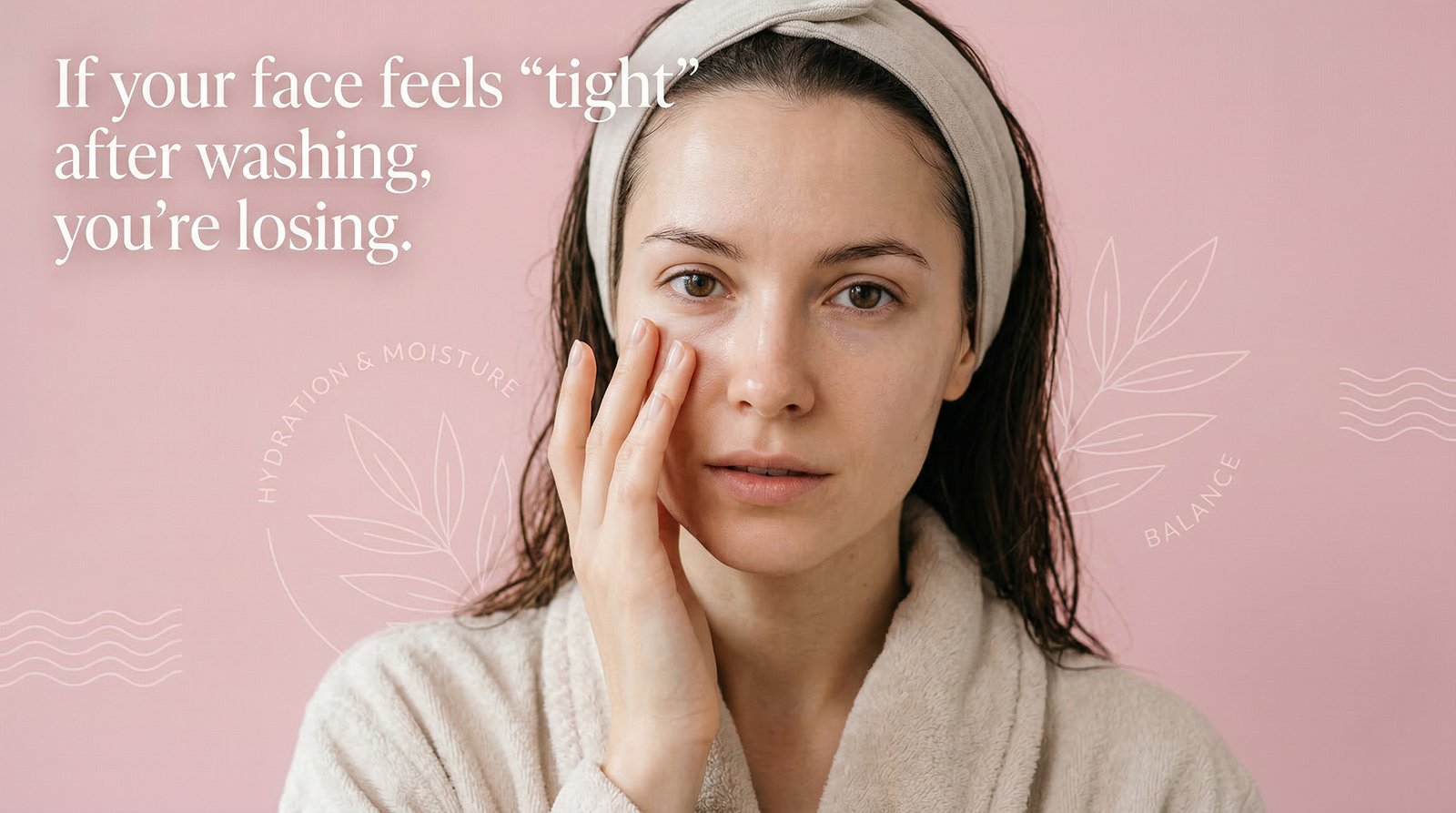
If your face feels tight or “shiny-dry” after washing, you haven’t achieved purity. You’ve achieved a wound. Your skin surface is a delicate ecosystem of beneficial bacteria and lipids. When you use harsh surfactants to “banish oil,” you aren’t just removing debris. You’re nuking the neighborhood. This triggers an inflammation loop. When the barrier is compromised, your skin overcompensates by producing more oil to protect itself. You then wash more aggressively to combat the oil.
It’s a race to the bottom, and your skin is losing.
Oil Isn't a Flaw; It’s the Infrastructure of Your Face
Let’s talk about the lipid matrix.
Your skin isn’t a flat surface. It’s more like a brick-and-mortar wall. The skin cells (corneocytes) are the bricks, and the lipids oils, ceramides, and fatty acids are the mortar. Without that “oil,” the mortar crumbles.
This leads to Transepidermal Water Loss (TEWL). Research in the Journal of Investigative Dermatology confirms that when these lipids are depleted, water literally evaporates out of your face.
No amount of “hydrating” mist will fix this if you don’t have the oil to seal it in. Hydration is about water. Moisture is about oil. You need both, but the industry has tricked you into thinking they are interchangeable.
The "Hydration" Step That’s Quietly Drying You Out
You’ve probably been told to load up on Hyaluronic Acid.
Here’s the problem: HA is a humectant. It pulls moisture from the environment into your skin. But if you live in a dry climate or an air-conditioned office and your barrier is weak, HA will pull water out of your deeper dermis and let it evaporate. You’re literally dehydrating yourself from the inside out.
At “Minimals”, we don’t believe in adding steps to fix problems created by your other steps.
If your serum requires a “lock-in” cream just to function, the serum isn’t doing its job. Our serums are formulated to respect the lipid barrier, not bypass it.
Why "Oil-Free" is a Marketing Scam
The term “non-comedogenic” is largely unregulated.
It’s based on testing done on rabbit ears in the 1970s. You are not a rabbit. When a brand screams “Oil-Free,” they are usually replacing natural, skin-compatible lipids with synthetic polymers or silicones. These might feel “silky,” but they don’t integrate into your skin’s biology. They just sit on top, suffocating the microbiome.
Real skin needs real fatty acids.
Stigmatizing oil has led to a generation of people with “adult acne” that is actually just chronic perioral dermatitis caused by irritation.
Your Skin Doesn't Need a 10-Step "Tapestry" It Needs a Break
The “Glass Skin” trend has a lot to answer for. Layering five different actives Retinol, Vitamin C, AHAs, BHAs, and Niacinamide is a recipe for a chemical burn. When you over-exfoliate, you thin the stratum corneum. You might look “glowy” for a week, but that’s just light reflecting off a raw surface. Eventually, the barrier-first approach wins because it prevents the “inflammation aging” caused by constant irritation. If your routine takes more than five minutes, you’re likely doing more harm than good.
The "Moisture Sandwich" is Just Common Sense
Social media treats “moisture sandwiching” like a radical discovery.
It’s actually just basic physics.
Dampen the skin.
Apply a humectant.
Seal with an emollient/occlusive.
But you shouldn’t need three separate bottles to achieve this.
A well-engineered moisturizer should contain the humectants, emollients, and occlusives in a single, stable ratio.
Stop buying three products to do the job of one. That’s not skincare; it’s a subscription model.
If Your Routine Feels Complicated, That’s the Problem
Let’s have a heart-to-heart.
Are you buying that new “miracle” balm because your skin needs it?
Or are you buying it because an influencer with a ring light and a filter told you it would “fix” your pores?
Pores aren’t doors. They don’t open and close. They are openings for hair follicles and sebaceous glands. If you stop stripping your skin, your pores will stop looking “clogged” because the oil flow will finally regulate itself. You cannot scrub your way to smoothness. You can only nourish your way there.
The Minimalist Blueprint: Three Steps to Sanity
If you’re ready to stop the cycle of irritation, here is your exit ramp.
Stop using foaming cleansers that feel like dish soap. Use a cleanser that removes dirt but leaves the lipid barrier intact. Your face should feel soft after washing, not tight.
Pick one goal. If it’s texture, use a gentle acid. If it’s aging, use a retinoid. Do not use both on the same night.
Apply it to a skin barrier that is actually healthy enough to handle it.
Use a moisturizer that mimics the skin’s natural sebum. Look for ingredients that reinforce the lipid matrix. This is the “security guard” for your face. It keeps the water in and the irritants out.
You Don’t Need More Products. You Need Fewer That Actually Work.
The industry thrives on your insecurity. It wants you to think your skin is a problem to be solved.
At “Minimals”, we think your skin is a high-performance system that just needs you to get out of its way.
We don’t do “hype.” We don’t do “drops.” We make the essential tools your skin needs to repair itself. Maybe it’s time you stopped fighting your face and started listening to it.
Common mistakes we all make
That texture isn’t a lack of scrubbing; it’s usually a cry for lipids. When you over-exfoliate to find “smoothness,” you’re just thinning your skin until it’s too weak to hold onto moisture.
Dehydrated skin is desperate skin. If you don’t provide a sealing layer, your pores will pump out more low-quality sebum to do the job for you. You aren’t oily; you’re unprotected.
Using Vitamin C, Retinol, and Acids simultaneously isn’t “comprehensive” it’s an assault. You are keeping your skin in a state of permanent trauma, which leads to chronic inflammation and premature aging.
If your face feels tight, your cleanser is too harsh. Most of the “repair” serums you buy are just trying to fix the damage your $30 face wash did ten minutes ago.
Stop overcomplicating it. Your skin knows how to be skin if you just get out of the way.
A simple "Skinimalist " checklist
Frequently Asked Questions
Yes. Oily skin is often a symptom of dehydration. When you strip your surface, your skin panics and overproduces low-quality sebum to compensate. A lightweight sealing layer tells your skin it’s safe to stop the oil production.
No. Unless you enjoy chronic inflammation. Using both simultaneously destabilizes the formulas and nukes your barrier. Use your C in the morning for defense and your Retinol at night for repair.
You’re likely looking at light reflecting off a damaged, uneven surface. Over-exfoliation causes “micro-swelling,” which looks smooth for an hour then turns dull and red. Put the acid down and focus on barrier repair for 14 days.
Only with specific actives like retinoids or acids that speed up cell turnover. If your new “hydrating” balm is giving you bumps, that’s not a purge. That’s a breakout. Listen to your skin, not the marketing copy.
Under five minutes. If you’re spending twenty minutes layering “essences” and “boosters,” you’re just increasing the statistical probability of an allergic reaction. Keep it simple. Get out of the bathroom.
Closing thought
Stop trying to “perfect” your skin.
It’s an organ, not an ornament. The industry wants you to believe your face is a project that is never finished. But the most radical thing you can do for your skin is to trust it. Provide the basic infrastructure cleanse gently, treat specifically, and seal the barrier then step away. Your skin isn’t looking for a miracle it’s looking for a break.
Less steps. More skin.