
You’ve been sold the idea that more ingredients means better skin. Here’s what’s actually happening under your barrier and what to do instead.
The Affordable Clean Skincare Myth Nobody's Telling You About
That stings a little, doesn’t it?
Here’s the thing nobody in the skincare industry wants to say out loud: the problem was never parabens versus phenoxyethanol, or synthetic fragrance versus “natural” essential oils. The problem is volume. Complexity. The slow, compounding assault of too many steps, too many actives, and a barrier that’s been quietly waving a white flag for months.
Affordable clean skincare is, on paper, a great idea. In practice, it’s become a category crowded with pretty labels, vague certifications, and formulas that smell like a spa but perform like a middling moisturizer. And you’re the one paying for it with money, yes, but also with skin that’s perpetually reactive, a little dehydrated, maybe breaking out in places it never used to.
Let’s actually fix that.
Your Skin Barrier Isn't a Buzzword It's the Whole Point
Before we get into products, ingredients, or what “clean” even means anymore, you need to understand one thing: your skin barrier is not a feature. It’s the foundation everything else sits on. The skin barrier technically the stratum corneum is a brick-and-mortar structure. The bricks are dead skin cells (corneocytes). The mortar is a precisely engineered lipid matrix made up of ceramides, cholesterol, and free fatty acids in a roughly 3:1:1 ratio. When that ratio is intact, your barrier does two things flawlessly: it keeps irritants out, and it keeps water in.
That second part is measured as Transepidermal Water Loss, or TEWL. When your TEWL numbers climb, your skin isn’t just dry it’s structurally compromised. It becomes more permeable. More reactive. More likely to flush, itch, and break out in ways that feel maddeningly random.
The Science A landmark study published in the Journal of Investigative Dermatology found that ceramide deficiency is a primary driver of barrier dysfunction across multiple skin conditions including eczema, acne, and even premature aging. You don’t fix that with more actives. You fix it by stopping the damage and rebuilding the lipid matrix.
So, when someone tells you to add a fourth acid to your routine for “brighter skin,” what they’re not telling you is that each acid application carries a measurable barrier cost. A cost your skin may or may not be able to pay depending on what else you’re asking of it.
"Clean" Doesn't Mean What Your Skin Needs It to Mean
The clean beauty movement started with a legitimate concern: questionable ingredients, lax regulation, and a lack of transparency in formulation. Those concerns were valid. But somewhere along the way, “clean” became aesthetic rather than functional. It became minimalist packaging, botanical names on INCI lists, and certifications that tell you more about a brand’s marketing budget than a product’s actual performance.
Here’s the counterintuitive part most clean beauty brands won’t admit: some of the most barrier-damaging ingredients are naturally derived. Citrus essential oils can be phototoxic. Many plant extracts are potent allergens. “Natural” preservative systems using high concentrations of alcohol or dehydroacetic acid can disrupt your microbiome just as aggressively as synthetic alternatives sometimes more so.
“Clean” is a marketing category. Barrier-safe is a formulation standard. They are not the same thing, and confusing them is costing your skin.
What your skin actually needs from an affordable clean product is simple: no unnecessary irritants, effective concentrations of active ingredients, and a formula that doesn’t destabilize the lipid barrier it’s supposed to be supporting. Most products clean or otherwise fail on at least one of those.
Your Cleanser Might Be Causing the Breakouts You're Blaming on Hormones
Raise your hand if you’ve blamed your diet, your cycle, your stress levels, or the air quality in your city for persistent breakouts while using the same stripping cleanser twice a day.
Surfactants are the cleansing agents in your face wash. They’re what makes a cleanser actually clean. The problem is that not all surfactants are created equal, and many affordable cleansers clean-marketed or not rely on high concentrations of anionic surfactants like Sodium Lauryl Sulfate or certain sulfate alternatives that aggressively strip your skin’s natural oils. When you strip those oils, you trigger two things simultaneously.
First, your sebaceous glands compensate by producing more sebum. More oil. Which you then try to remove with more cleanser. You see the loop forming. Second and this is the part that gets less attention you disrupt your skin microbiome. Your skin hosts a complex ecosystem of bacteria, fungi, and viruses. The dominant organism in healthy skin is Cutibacterium acnes (the bacteria we used to just call P. acnes), but it coexists with dozens of other species in a carefully maintained balance.
Microbiome Research Research from the NIH National Human Genome Research Institute confirms that over-cleansing significantly alters skin microbiome composition, reducing diversity and creating conditions where opportunistic bacteria thrive. Less microbial diversity = more reactivity, more breakouts, more sensitivity that wasn’t there before.
What does a good cleanser actually do? It removes excess oil, SPF, makeup, and environmental debris without altering your skin’s natural pH (ideally 4.5-5.5) or stripping your lipid matrix.
Mild, pH-balanced cleansers with gentle amphoteric or non-ionic surfactants can do this without the collateral damage. That’s not a premium feature. That’s just responsible formulation.
Worth Considering
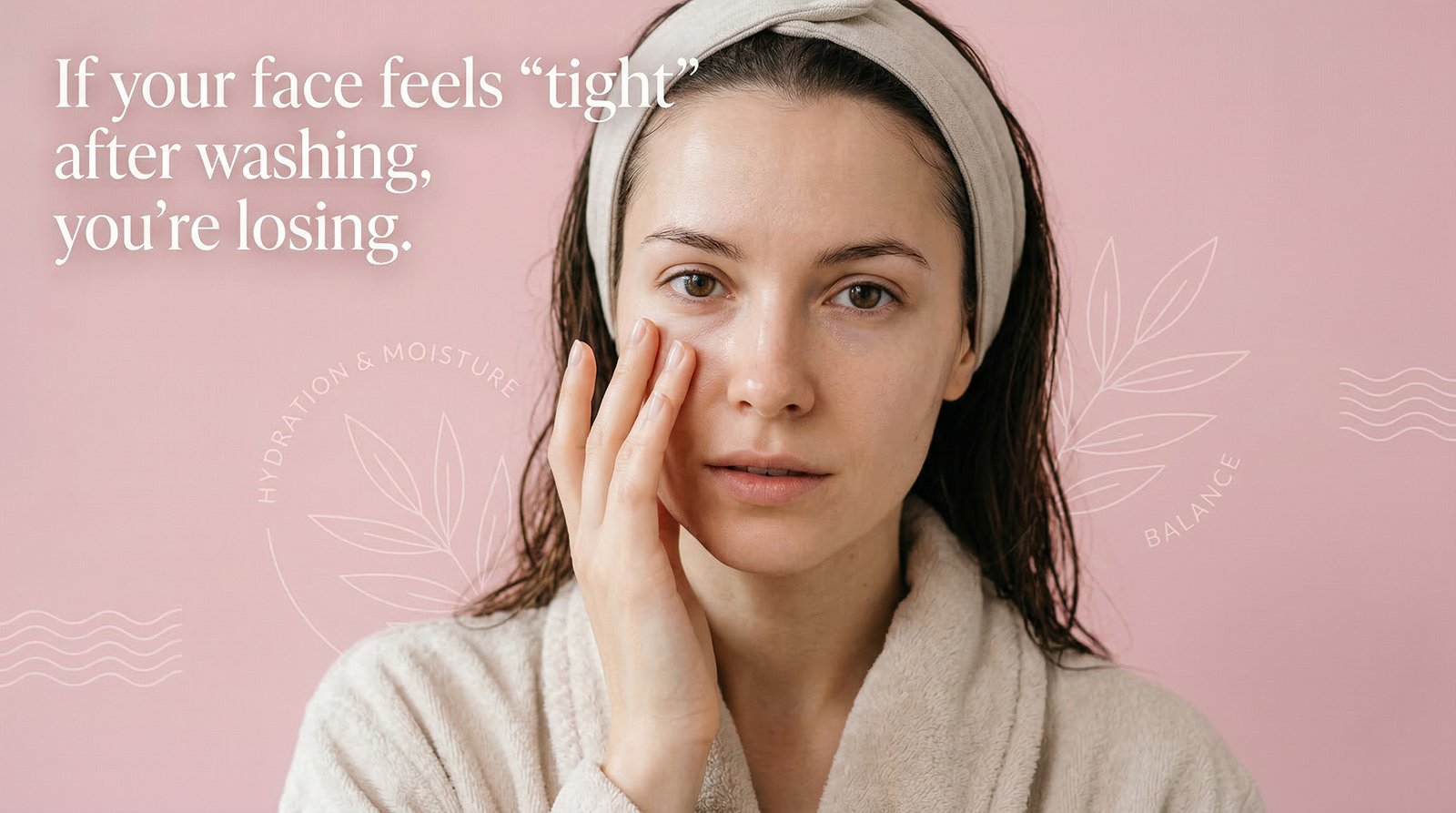
If your skin feels tight, “clean,” or slightly uncomfortable after washing that’s not clean. That’s stripped. A well-formulated cleanser should leave your skin feeling neutral: neither squeaky nor greasy. That sensation of tightness is your barrier signalling distress.
Explore Minimals Cleansers →
The "Hydration" Step That's Quietly Drying Your Skin Out
Wait what?
Here’s one of those “wait, what?” moments: hydration and moisture are not the same thing. This is not a technicality. Confusing them is one of the most common reasons people feel perpetually dehydrated no matter how many serums they layer.
Hydration refers to water content in the skin. Moisture refers to the skin’s ability to retain that water. Humectants ingredients like hyaluronic acid, glycerin, and urea draw water into the skin. But without occlusive and emollient ingredients to seal that water in, it evaporates. Sometimes it pulls water from deeper layers of your skin to do it. This is especially relevant if you live in a low-humidity environment, run the AC constantly, or apply a hyaluronic acid serum and nothing else on top. You may literally be making your skin drier. The smarter approach is moisture sandwiching: apply your humectant on damp skin, then immediately seal it with an emollient or occlusive a ceramide moisturizer, a light facial oil, or a balm depending on your skin type. You trap the water before it can escape.
TEWL & Occlusion A 2017 study published in PubMed examining TEWL rates found that humectants applied without subsequent occlusion can actually increase water loss in low-humidity conditions. The takeaway: always seal your hydration. Always.
Your skin doesn’t need seven layers of essence, toner, and ampoule. It needs water and something to hold it there. That’s it.
Layering Actives Isn't Advanced Skincare. It's a Gamble.
There is a version of skincare content on the internet that treats your face like a chemistry experiment. Vitamin C in the morning, retinol at night, AHA on Tuesdays, BHA on Thursdays, niacinamide with everything except wait, not with vitamin C, except actually maybe yes, except the pH timing issue
Stop.
When you layer multiple actives, a few things happen. Some ingredients genuinely conflict at the molecular level ascorbic acid (vitamin C) and certain forms of niacinamide can convert to niacin and flush the skin. Some actives require specific pH windows to function, and the product you applied before them may have shifted your skin’s pH enough to render them inert. And then there’s the inflammation question. Each active ingredient creates a micro-inflammatory response as it works. One at a time, your skin handles it. Multiple actives simultaneously creates what you might call an inflammation loop: a state of low-grade, chronic irritation that doesn’t look red or feel particularly wrong, but quietly degrades your barrier function over weeks.
Inflammation & Barrier According to research in Dermatology and Therapy (NIH), chronic subclinical inflammation the kind you don’t see but your skin feels is a significant driver of barrier degradation, accelerated aging, and post-inflammatory hyperpigmentation. The goal is always to minimize inflammatory load, not maximize ingredient count.
The smartest active routine is the one with the fewest moving parts. Pick your priority concern. Use one targeted active. Let your barrier rebuild around it. You’ll see more results from one ingredient applied consistently than from five ingredients applied chaotically.
The Smarter Move
Rather than a drawer full of single-ingredient serums, look for formulas that combine barrier-supportive ingredients with their actives. Fewer steps means less room for conflict, less irritation potential, and a routine you’ll actually maintain.
Affordable Doesn't Have to Mean Compromise But Here's What to Actually Check
Price is not a reliable proxy for quality in skincare. A $12 cleanser can outperform a $60 one. A $90 serum can cause more barrier damage than a $15 alternative. The price point tells you about positioning, not formulation.
What actually matters when you’re navigating affordable clean skincare options:
Active ingredient concentration. An ingredient listed near the bottom of an INCI list is present in trace amounts often well below the threshold where it produces any measurable effect. If a brand is leading with a hero ingredient, it should appear in the top half of the list. If it doesn’t, the marketing is doing more work than the formula.
Fragrance. Fragrance synthetic or natural is the leading cause of cosmetic contact dermatitis. A “clean” product that’s heavily fragranced with essential oils or parfum isn’t actually serving your skin. It’s serving your nose. For a compromised or sensitive barrier, fragrance-free or genuinely minimal fragrance is the only smart choice.
Preservative system. Products need preservatives. The question is which ones, at what concentrations. Look for broad-spectrum systems like phenoxyethanol combined with ethylhexylglycerin rather than alcohol-heavy preservation that compromises barrier integrity.
Ingredient Intelligence A review in the International Journal of Cosmetic Science (via PubMed) found that fragrance components including those derived from essential oils are responsible for the largest percentage of allergic contact sensitization reactions in cosmetic users. “Natural” fragrance is not inherently safer for reactive skin.
The best affordable clean products don’t hide behind their origin story. They lead with what they actually do for your skin and they deliver it without drama.
Reality check If your skincare routine feels like a part-time job, that’s not dedication. That’s a sign the routine isn’t working and you’re compensating with more products instead of better ones. Skin that’s functioning well doesn’t require constant intervention. It doesn’t need to be managed morning and night with nine different products. When your barrier is intact, your microbiome is balanced, and your actives are appropriate, your skin mostly takes care of itself.
The complexity isn’t a sign of sophistication. It’s usually a sign of a problem that’s being addressed at the symptom level rather than the source.
The Barrier-First Approach: What "Less, But Better" Actually Looks Like
Skinimalism isn’t a trend. It’s a return to what skin science actually supports.
The premise is straightforward your skin has intrinsic repair mechanisms. Given the right environment minimal disruption, appropriate support, targeted actives where genuinely needed it can resolve most concerns on its own. What it cannot do is repair itself while simultaneously managing the assault of a 10-product routine.
Barrier-first skincare means you prioritize integrity over aggression. Every product you add to your routine should be earning its place by either supporting barrier function or addressing a specific, measurable concern not just because a review said it changed someone’s skin.
Here’s the simplest version of what this looks like in practice.
The Minimal Routine Blueprint
A moisturizer that combines humectants (glycerin, hyaluronic acid) with emollients and barrier-supportive ceramides. Applied on slightly damp skin to maximise water retention. This step isn’t optional it’s the step that makes everything else work.
Complete the Routine
At this point, your skin doesn’t need another step. It needs formulas that already do more with less designed for barrier repair, not ingredient stacking.
What Affordable Clean Skincare Should Actually Cost You
Not confusion. Not a spreadsheet of ingredient interactions. Not a rotating cast of products you’re not sure are helping or hurting.
The real cost of a good affordable skincare routine is a little time spent reading labels, a little resistance to the next viral product, and a willingness to give your barrier the quiet space it needs to do its job. Clean skincare that actually earns the label isn’t about what’s been removed from the formula. It’s about what’s been thoughtfully included, at concentrations that matter, in a formula your barrier can work with rather than against.
That exists at every price point. You just have to know what you’re looking for.
And now, you do.
Common mistakes we all make
Even the most well-intentioned people fall into these traps:
These mistakes are so common because the industry profits when you stay confused and keep buying more.
A simple "Less, But Better" checklist
Frequently Asked Questions
It can be very effective but only if you choose the right products. Many affordable clean brands (like The Ordinary, The Inkey List, Good Molecules, and Naturium) offer excellent formulas. The problem isn’t price. It’s buying into hype, long ingredient lists, and unnecessary “clean” claims instead of focusing on barrier-friendly formulations.
Common signs include tightness after cleansing, redness, stinging or burning from products that never bothered you before, flaky patches, increased sensitivity, or breakouts that won’t calm down. If your skin feels constantly reactive, your barrier is likely compromised.
Yes, but only one at a time, and only after your barrier is healthy. Start slow (1–2 times a week), always patch test, and pair it with strong barrier support (ceramides + niacinamide). Never layer multiple strong actives while your skin is recovering.
A gentle, pH-balanced formula (around 5.0-5.5) without sulfates, harsh surfactants, or heavy fragrance. It should clean without leaving your skin feeling tight or squeaky clean. Ceramide-based or micellar cleansers are excellent options.
It can if you don’t seal it properly. Always apply hyaluronic acid (or any humectant) on damp skin and follow immediately with a moisturizer or face oil to lock in the hydration. In dry climates, this step is especially important.
Closing thought
Great skin isn’t complicated it’s just been made to look that way.
The biggest lie in affordable clean skincare isn’t that it doesn’t work. It’s that you need more of it to see results. In reality, your skin is begging for the opposite: fewer products, fewer actives, and far more respect for its barrier. When you stop chasing trends, stop layering irritants, and start listening to what your skin is actually telling you, something powerful happens. It stops reacting. It stops breaking out. It stops looking tired and inflamed. And it finally starts to glow naturally, consistently, and without a 10-step ritual. You don’t need another serum. You don’t need a prettier label. You don’t need to spend more. You need to do less, but do it better. Your skin has an incredible ability to heal and repair itself give it the quiet space, the right support, and the consistency it deserves, and it will reward you more than any complicated routine ever could.
Start simple. Stay consistent. Trust the process.
Your barrier and your skin will thank you.