
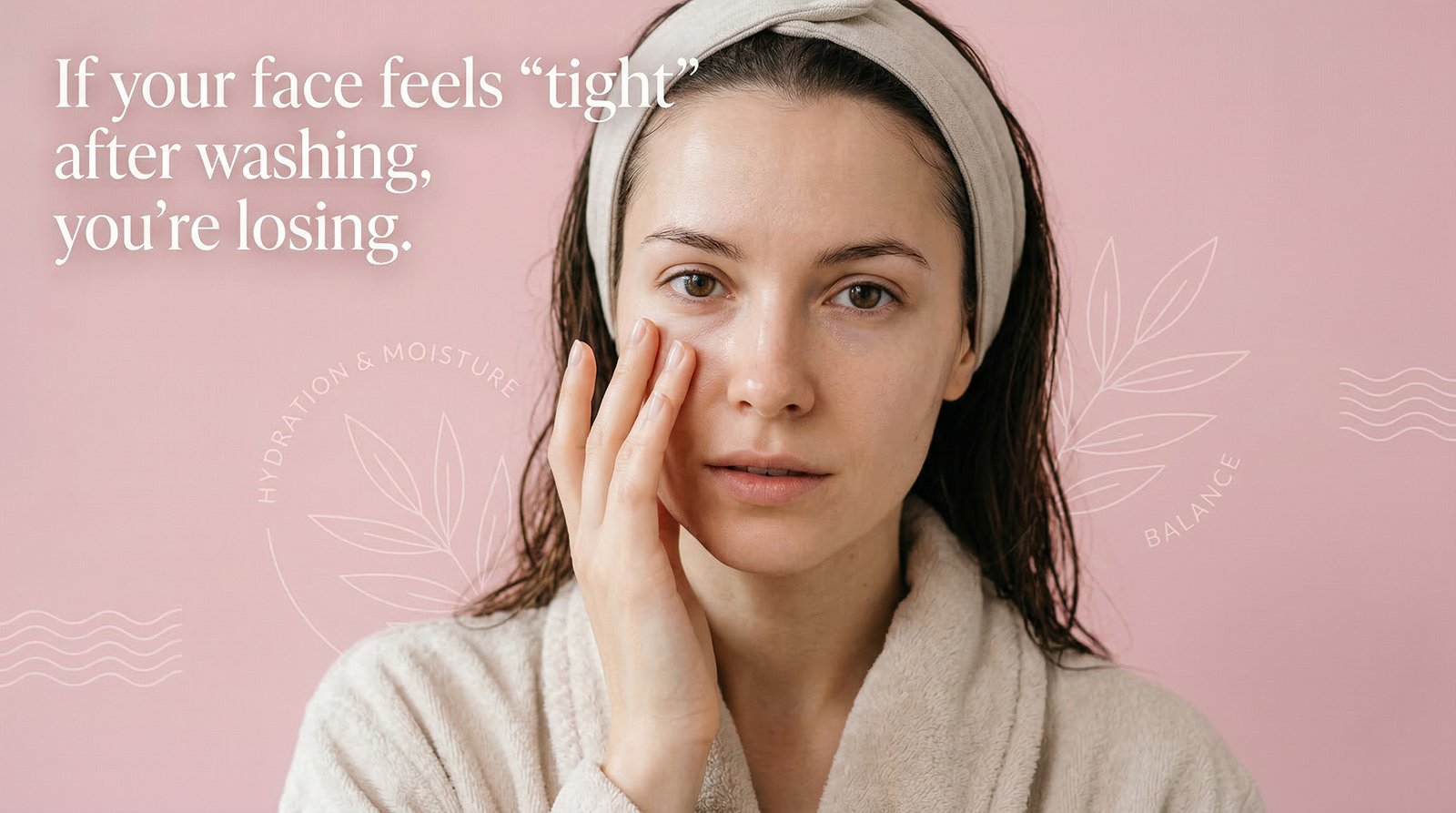
In skincare, “supple” skin is more than just soft it’s skin that successfully traps and holds water in the upper layers before it evaporates. This delicate balance relies on the science of humectants, occlusives, and the skin’s natural barrier, turning hydration into lasting plumpness and elasticity.
The Hydration Trap Most Routines Miss
Your skin feels tight after washing. It looks dull by 3 p.m. You slap on another serum, another cream, chase that plump look everyone promises. And tomorrow it’s tight again.
That’s not “normal dry skin.” That’s your barrier waving a white flag while you keep attacking it with routines designed to sell you more stuff.
Supple skin isn’t about flooding it with water. It’s about trapping what’s already there before it sneaks out through tiny gaps in your defenses. Most of what you’ve been taught about hydration misses this completely.
Why your skin keeps losing the water it needs
The outer layer of your skin the stratum corneum works like bricks and mortar. The bricks are dead skin cells. The mortar is a precise mix of ceramides, cholesterol, and fatty acids. When that mortar cracks, water evaporates faster. Dermatologists call this TEWL: transepidermal water loss.
High TEWL means your skin looks dehydrated even if you drink gallons of water. It feels rough, shows fine lines quicker, and gets irritated easier. The inflammation loop starts: barrier breaks → more water loss → more inflammation → weaker barrier.
You’ve probably felt it after a week of travel, harsh weather, or that “deep clean” phase.
The hidden damage happening every day
Harsh cleansers strip the lipids along with dirt. Your skin microbiome the good bacteria that help regulate inflammation and barrier repair gets thrown off. Over-cleansing creates the exact conditions bad bacteria like.
Then you pile on actives. Acids. Retinoids. Vitamin C at 20%. Each one demands more from an already compromised barrier. Your skin gets red, reactive, “sensitive.” You blame hormones or the weather. Often it’s just cumulative barrier fatigue.
Hydration ≠ moisture.
Hydration is water content. Moisture is the ability to hold onto it. You can push water in with humectants, but without something to trap it, most evaporates and pulls more out with it. That’s why some people feel drier after layering hyaluronic acid in low-humidity environments.
The hidden damage happening every day
Harsh cleansers strip the lipids along with dirt. Your skin microbiome the good bacteria that help regulate inflammation and barrier repair gets thrown off. Over-cleansing creates the exact conditions bad bacteria like.
Then you pile on actives. Acids. Retinoids. Vitamin C at 20%. Each one demands more from an already compromised barrier. Your skin gets red, reactive, “sensitive.” You blame hormones or the weather. Often it’s just cumulative barrier fatigue.
Hydration ≠ moisture.
Hydration is water content. Moisture is the ability to hold onto it. You can push water in with humectants, but without something to trap it, most evaporates and pulls more out with it. That’s why some people feel drier after layering hyaluronic acid in low-humidity environments.
The myth of “more steps = better skin”
Layering seven products sounds thorough. Biologically it’s often counterproductive. Each new layer risks disrupting pH, overwhelming the microbiome, or creating a film that suffocates repair. Your skin doesn’t need a 10-step ritual. It needs fewer interruptions so it can do its actual job.
This is where skinimalism stops being a trend and becomes the only rational approach.
What “supple” actually means at the cellular level
Supple skin has low TEWL, intact lipid matrix, and balanced water binding. It bounces back when pinched. It reflects light evenly. It tolerates real life cold air, long flights, occasional late nights without freaking out.
Ceramides are the stars here. Research shows specific ceramides (like 1 and 3) work synergistically to improve hydration and reduce water loss. Your body makes them naturally, but age, environment, and bad habits slow production. Topical versions that match your skin’s own can help rebuild the mortar.
Why most “hydrating” products fail you
They focus on humectants glycerin, hyaluronic acid, etc. that draw water in. Great in theory. But without occlusives and barrier lipids to lock it down, you’re pouring water into a leaky bucket. Some formulas even increase TEWL long-term by disrupting natural lipids.
The industry loves this cycle. Dry skin sells more moisturizer.
The counterintuitive fix: stop feeding the inflammation loop
Barrier repair often feels slower than aggressive exfoliation at first. That’s normal. You’re breaking an addiction to constant stimulation. Your skin has to relearn how to regulate itself.
Quiet confidence beats constant intervention. A strong barrier means fewer reactions, less redness, and skin that actually holds onto the water you give it.
Moisture sandwiching done right
Apply a humectant-rich layer on damp skin, then immediately follow with something that seals. Not three different serums. One thoughtful step that does both. Your skin doesn’t need another hero ingredient. It needs chemistry that mimics its own lipid matrix. At this point, your skin doesn’t need another step. It needs a formula that already understands both sides of the equation.
“Minimals” approach skips the noise. Their moisturizers pair ceramide precursors with the right occlusives so you trap water instead of chasing it.
If your routine feels complicated, that’s the problem
Count your steps right now.
More than four on a normal day? You’re probably in maintenance mode for damage you’re creating yourself.
Complicated routines create dependency. Simple ones create resilience. Your skin barrier isn’t a project that needs constant tinkering. It’s a living system that thrives with minimal competent support.
The minimal routine that actually builds supple skin
Evening Repair mode
Use something that removes the day without nuking your lipids or microbiome. Minimals cleansers respect the barrier instead of stripping for that fake “squeaky clean” feel.
One serum max. Maybe a barrier-focused one with niacinamide or ceramides. No mixing acids and retinoids every night unless your skin is bulletproof.
A moisturizer that replenishes lipids and reduces TEWL. This is where you trap the water. Apply on slightly damp skin for maximum effect.
Morning Protect mode
Same cleanse if needed (many people can skip or use just water). Treatment if using. Moisturizer. Then mineral sunscreen physical blockers add another layer of protection against water loss.
That’s it. Three or four products total. Consistency beats complexity every single time.
What to expect when you switch
Week 1-2: Skin might feel different as it adjusts. Some notice temporary tightness while the barrier recalibrates.
Week 3-4: TEWL starts dropping. Skin feels calmer, looks more even.
Month 2+: True suppleness. The kind where people ask what you’re doing differently even though you’re using fewer products.
This isn’t magic. It’s just respecting biology instead of fighting it.
The ingredients worth obsessing over
Avoid high concentrations of single actives that scream for attention on ingredient lists but ignore the bigger picture.
Real talk about expectations
No product gives you 18-year-old skin at 45. But you can have skin that looks healthy, feels comfortable, and functions well for your age. That’s the quiet win most people actually want once they stop chasing impossible filters.
Stop leaking water. Start trapping it.
Your skin already knows how to be supple. You’ve just been interrupting it.
Ditch the 10 products. Repair the barrier. Use formulas that understand lipid science instead of marketing trends. Watch what happens when water stops escaping so easily.
You don’t need more products. You need fewer that actually work with your skin instead of against it.
Ready to simplify? Check what “Minimals” offers at minimals.com.co cleansers that don’t destroy, serums that support, moisturizers that seal. No nonsense. Just results that make sense once you understand the science.
Your barrier will thank you. Your mirror will show it.
Common mistakes we all make
You’re not alone. These feel smart, but they’re quietly drying you out and breaking your barrier.
Foaming cleansers and harsh surfactants strip your natural lipids and ceramides. Your skin feels “clean” for 10 minutes, then tight and reactive the rest of the day.
Hyaluronic acid, glycerin, multiple hydrating serums you pile them on, but in real air they pull water in then let it evaporate fast. Skin ends up drier than before.
Adding water is easy. Keeping it trapped is the hard part. Most “hydrating” creams only do half the job and ignore your lipid mortar.
Retinol + acids + vitamin C in the same week. Your barrier can’t keep up. Inflammation rises, TEWL increases, and skin gets sensitive.
Dehydrated skin often overproduces oil to compensate. Skipping cream keeps the problem alive.
Barrier repair needs consistency. Jumping around resets progress every time. Real suppleness shows after 3 to 4 weeks, not 3 days.
Humectants and treatments work better on damp skin. Dry application stresses the barrier and wastes product.
Your skin doesn’t need a 7 product routine. It needs fewer interruptions so it can repair itself. Most of these mistakes come from the same place: thinking skin needs constant fixing instead of protection. Fix the leaks first. Repair the barrier. Use fewer products that actually work. Your skin will feel supple faster than you expect once you stop working against it.
A simple "Supple " checklist
Frequently Asked Questions
It means skin that feels soft, smooth, and flexible because it’s well-hydrated and protected.
Through a process called transepidermal water loss water naturally evaporates from the surface.
Use humectants to pull water in, then seal it with moisturizers that form a protective barrier.
Yes, hot water strips natural oils, making it harder for skin to hold moisture.
Drinking water helps overall hydration, but topical care is needed to keep skin soft and prevent evaporation.
Closing thought
Supple skin isn’t built by chasing endless hydration hacks it’s sustained by respecting your barrier. When you stop overloading it and start protecting what’s already there, water stays put, inflammation quiets down, and resilience replaces fragility. The real secret isn’t more steps, it’s smarter ones.
Less noise, stronger barrier, lasting suppleness.