
Your skin is not being dramatic. It’s asking a question. And your concealer is not the answer.
What Your Redness Is Actually Trying to Tell You
Your skin has been sending you a signal for months. Maybe years. And every morning, you’ve been responding to it with a layer of green color-corrector and a prayer. That’s not a skincare routine. That’s a negotiation. And you’re losing. Redness is not a cosmetic problem. It’s a biological one. And until you stop treating the symptom and start reading the signal, nothing in your shelfie is going to fix it.
Let’s talk about what’s actually happening.
Your Skin Has a Barrier. You've Probably Broken It.
The outermost layer of your skin the stratum corneum isn’t just a passive wall. It’s an active, intelligent structure made up of dead skin cells embedded in a lipid matrix of ceramides, fatty acids, and cholesterol. Think of it as a brick wall: the cells are the bricks, and the lipids are the mortar.
When that mortar starts breaking down through over-cleansing, over-exfoliating, using too many actives, or just using the wrong products for too long water escapes faster than your skin can hold it. This is called transepidermal water loss (TEWL), and it’s one of the first signs your barrier is in trouble.
Redness follows. Sensitivity follows. Sometimes breakouts follow which is deeply unfair, because by then you’ve already thrown a vitamin C serum and a retinol at your face and made everything worse. A compromised barrier doesn’t just lose moisture. It allows environmental irritants, allergens, and bacteria to penetrate more easily triggering an immune response that shows up on the surface as inflammation. What you’re calling “sensitive skin” is often just a damaged barrier doing its best.
The Cleanser You're Using Twice a Day Might Be the Culprit
Here’s something nobody in the skincare industry wants you to think too hard about: the very first step in your routine might be the one destroying everything else.
Foaming cleansers especially anything that makes your skin feel “squeaky clean” after washing almost certainly contain surfactants aggressive enough to strip the lipids right out of your skin barrier. Sodium lauryl sulfate is the most obvious offender, but even “gentle” formulas can do real damage when used morning and night, every day, for years.
A study published in the Journal of Investigative Dermatology found that repeated surfactant exposure significantly elevated skin pH and disrupted barrier function outcomes directly linked to inflammation and increased TEWL.
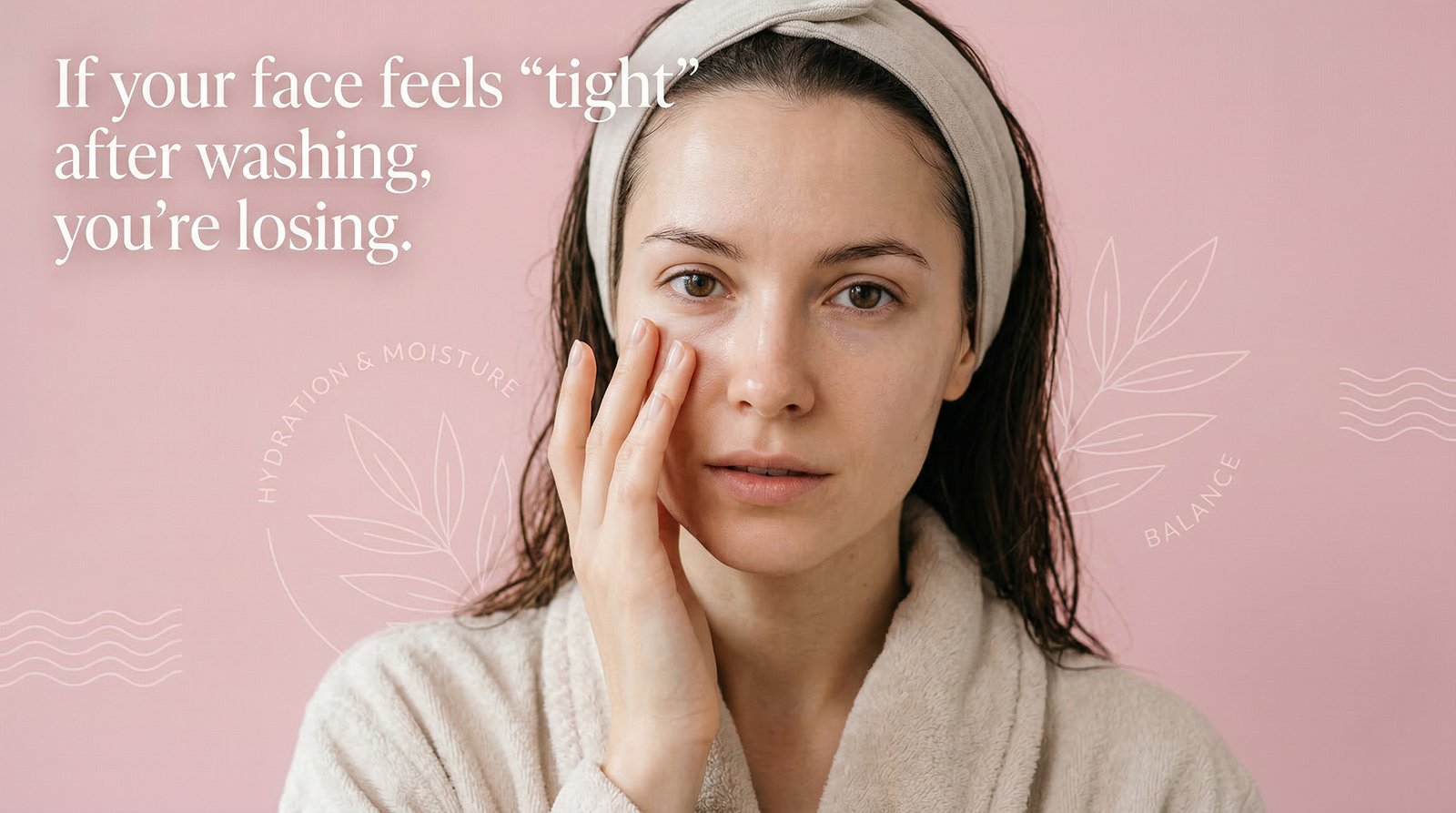
That tight, clean feeling? It’s not clean. It’s stripped. There’s a difference.
“If your face feels tight after washing, your cleanser has done too much not enough.”
A low-pH, non-stripping cleanser removes what your skin doesn’t need without touching what it does. It doesn’t foam aggressively. It doesn’t leave you squeaky. It just cleans, and leaves the rest intact.
At this point, your skin doesn’t need another step. It needs a first step that doesn’t undo everything after it. “Minimals” barrier-friendly cleanser is formulated to work at skin-compatible pH so your microbiome and lipid matrix stay intact from the moment you touch your face.
Your Microbiome Is Not a Marketing Word. It's an Ecosystem You've Been Disrupting.
Your skin is home to trillions of microorganisms bacteria, fungi, viruses that live in careful balance on its surface. This is your skin microbiome, and it plays a direct role in keeping inflammation down, pathogens out, and your barrier functioning properly.
When you over-cleanse, you don’t just remove makeup and SPF. You remove the commensal bacteria that hold everything together. What’s left is an open ecosystem where opportunistic bacteria and yeast can overgrow and your immune system responds with inflammation. Redness. Reactivity. That mystery “sensitivity” that appeared from nowhere in your late twenties and never left.
Research from the NIH’s Human Microbiome Project has linked disrupted skin flora to conditions including rosacea, eczema, and acne conditions often blamed entirely on genetics or hormones, when the real driver is a routine that’s never given the skin’s ecology a chance to stabilize.
This is where most “sensitive skin” regimens fail. They pile on more products to manage the inflammation they caused by disrupting the microbiome in the first place. It’s a loop with no exit unless you change the first step.
Layering Actives Doesn't Multiply Benefits. It Multiplies Damage.
The skincare industry has convinced an entire generation that more ingredients mean better results. Niacinamide at 10%. Retinol at 1%. AHA exfoliant three times a week. Vitamin C in the morning. Peptides at night. And a hyaluronic acid serum between every step because hydration, allegedly.
Wait let’s talk about that last one for a second.
Hydration refers to water content in the skin. Moisture real moisture refers to the lipid barrier’s ability to hold that water in. Hyaluronic acid is a humectant: it pulls water toward the skin, but if your barrier lipids are compromised, that water evaporates right back out.
So, your “hydrating” step might be doing absolutely nothing or worse, it might be increasing TEWL if it’s pulling environmental moisture that then escapes through your broken barrier. You’re essentially watering a pot with no soil. Real moisture repair means restoring ceramides, cholesterol, and fatty acids in ratios that match your skin’s own lipid profile. That’s barrier-first skincare. And it works differently and better than stacking seven actives and hoping for the best.
The Counterintuitive Part
When your skin is red, reactive, and angry, it doesn’t need more actives. It needs less. One study found that even low concentrations of commonly used topical actives triggered measurable inflammation in compromised skin the same inflammation you’re trying to treat. Doing less is not giving up. It’s the actual fix.
Back to the layering problem. When you apply multiple actives especially acids, retinoids, and vitamin C you’re stacking pH-sensitive ingredients that can interact, irritate, and destabilize each other. You’re also applying them to a barrier that may already be too compromised to tolerate any of them.
Dermatology Times has covered this extensively: the more aggressive the routine, the more likely you are to create what’s called an “inflammation loop” a state where your skin is chronically reactive because your routine constantly re-triggers the damage it’s trying to repair.
The exit from that loop isn’t a new serum. It’s subtraction.
SPF Is Not Optional. But the Way You're Using It Might Be Making Things Worse.
UV radiation is one of the most well-documented drivers of skin inflammation, collagen breakdown, and barrier degradation. Studies in photobiology consistently show that chronic low-level UV exposure not just sunburns contributes to persistent redness, dilated vessels, and impaired barrier repair.
So yes, SPF is non-negotiable. But if your sunscreen is alcohol-heavy, fragrance-heavy, or formulated with physical irritants, you’re trading UV damage for direct chemical irritation. The outcome on your skin looks almost identical: redness, sensitivity, and a barrier that never quite heals.
Mineral filters zinc oxide in particular sit on top of the skin rather than absorbing into it. For a compromised, reactive barrier, this matters. You want a sunscreen that protects without creating another entry point for inflammation.
If Your Routine Feels Complicated, That's the Problem
This is the reality check nobody wants to hear: complexity is not sophistication. In skincare, it’s usually just noise.
Every product you add to your routine is a potential irritant. Every active is a potential trigger. Every extra step is another variable between you and knowing what’s actually working or what’s causing the redness you’re trying so hard to fix. If you can’t tell whether your skin is reacting to your retinol, your AHA, your vitamin C, or the fragrance in your night cream that’s not a data problem. That’s a routine problem. You’ve built something too complicated to troubleshoot. Skinimalism is not a trend. It’s a clinical reality. Fewer, better-chosen ingredients applied consistently to a skin barrier that’s actually intact that outperforms twelve steps every time, in every skin type, at every age.
“The goal isn’t a shorter routine for its own sake. It’s a routine that your skin can actually use without fighting it.”
What Persistent Redness Is Actually Telling You
Red skin is inflamed skin. And chronic inflammation even low-grade, “I’ve just got sensitive skin” inflammation is not benign background noise. It accelerates collagen breakdown. It slows barrier repair. Over time, it contributes to the visible aging and hyperpigmentation that your current routine is trying to prevent.
So, when you cover redness with makeup, you are not solving a cosmetic problem. You are delaying the resolution of a biological one. And every day you delay it, the inflammation loop tightens. The fix isn’t complicated. But it requires you to stop adding and start listening. Strip the routine back. Repair the barrier. Let the microbiome rebalance. Give your skin four to six weeks of not being assaulted, and watch what happens.
A ceramide-based moisturizer from Minimals is built around this exact principle: replenish what the barrier needs, in the ratios it recognizes. No fragrance. No unnecessary actives. Just the lipids your skin is asking for so it can stop screaming and start healing.
The Minimal Routine Blueprint
Low-pH, no-foam, no-fragrance. Remove what your skin collected during the day. In the morning, rinse with water. That’s it. Your barrier will thank you within a week.
Not three. One. If you’re in a repair phase, skip this entirely for 2 to 4 weeks. When you return to actives, introduce them one at a time, with at least two weeks between additions.
Ceramides, fatty acids, cholesterol. These are the three compounds your barrier needs. Apply while skin is still slightly damp for moisture sandwiching hydration locked in before the lipid layer seals it. This is where most of your skin’s recovery actually happens.
Non-negotiable. But make it the only thing between your skin and the outside world. Not a base for seven more layers. A final, clean seal.
You Don't Need More Products. You Need Better Ones and Fewer of Them.
The skincare industry’s business model depends on you believing that your skin is one new ingredient away from transformation. A new serum. A better formula. A hero product you haven’t tried yet.
But the research doesn’t support that. Skin that’s chronically red, reactive, and sensitive doesn’t need novelty. It needs consistency, simplicity, and a routine designed around repair rather than performance.
“Minimals” was built on exactly this: the idea that your skin isn’t broken your routine might be. And that the answer is not a longer shelf, but a smarter one.
Redness is a conversation. Your skin is asking: can you please stop?
It’s time to listen.
Common mistakes we all make
Here are the biggest ones keeping redness alive:
Most of us aren’t lazy we’re just doing too much, too aggressively, for too long. The fix starts with doing less, but better.
A simple "Barrier Reset" checklist
Frequently Asked Questions
Most people notice calmer skin and reduced redness within 7 to 14 days. Significant barrier repair usually takes 4 to 6 weeks of consistency. Be patient healing isn’t instant.
Pause all actives for at least 2 to 4 weeks during the reset. Once your skin feels calm and less reactive, reintroduce one active at a time, waiting 2 weeks before adding another.
Switch to a low-pH, non-foaming, fragrance-free cleanser immediately. Tightness means your barrier is being stripped. Morning cleansing is optional water rinse is enough.
You can use it, but it works best after your barrier is stronger. On a damaged barrier, humectants like HA can increase water loss. Prioritize ceramide moisturizers first.
Choose a mineral sunscreen with zinc oxide. Avoid alcohol-heavy or heavily fragranced formulas. It should feel soothing, not irritating.
Closing thought
Redness is not your skin’s flaw it’s its loudest cry for help.
For too long, we’ve been taught to silence it with color correctors, heavier makeup, and more products. But real healing doesn’t come from covering up the signal. It comes from finally listening to it. Your skin doesn’t need another hero ingredient or a 10-step routine. It needs safety, simplicity, and consistency. It needs you to stop negotiating with it and start supporting it.
Commit to the Barrier Reset for the next 4-6 weeks. Strip away the noise. Repair what’s broken. Protect what’s healing.
You’ll likely discover that the most beautiful version of your skin isn’t hidden under layers of makeup it’s the calm, resilient one that finally feels at peace.
Less really is more. Your skin has been waiting for this.
Now go give it the reset it deserves.