
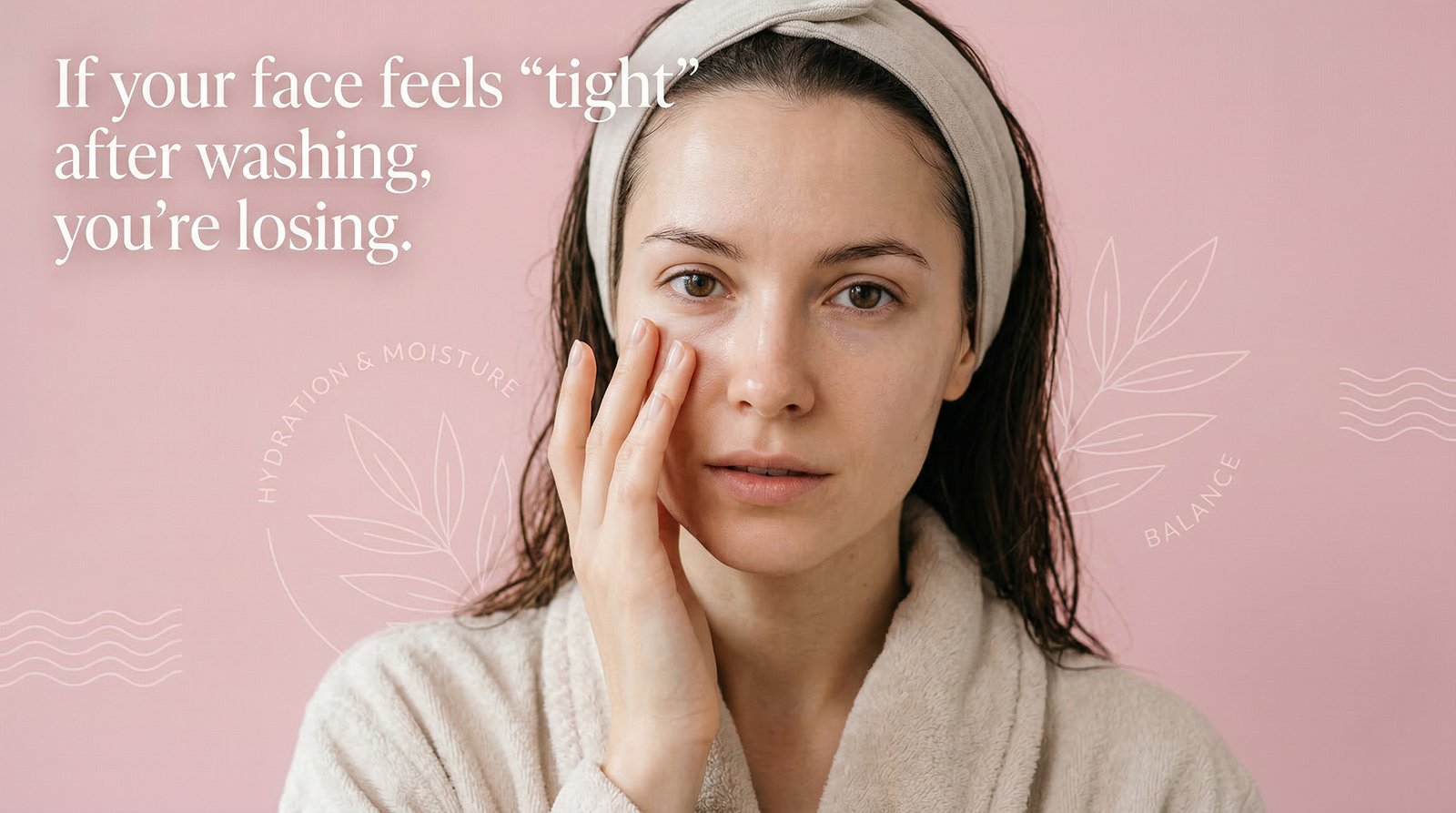
That pilling is your skin’s way of saying the foundation is broken, and more layers won’t fix it.
The Hook: That White Flake Isn’t “Absorption”
You smooth on your moisturizer, wait for it to sink in, and suddenly tiny white balls roll off your face. It looks like dead skin. It feels like product waste. And it makes you wonder if your skincare is even working.
Here’s the uncomfortable truth: pilling isn’t your skin rejecting product. It’s your routine rejecting itself.
Why your “good” moisturizer keeps pilling anyway
You pat it on, rub gently, and suddenly there are tiny flakes gathering like dandruff. Frustrating as hell.
Pilling happens when products don’t spread or absorb properly. They sit on the surface, interact badly with what’s already there, and clump up under friction.
Drier skin with lower sebum, slightly higher pH, or rough texture makes it worse. Your skin’s natural lubrication is missing, so formulas drag instead of melt in.
It’s not always the moisturizer’s fault. It’s often everything that came before it.
The real culprit: a damaged skin barrier
Your skin barrier is a lipid matrix think bricks (skin cells) held together by mortar (ceramides, cholesterol, fatty acids). When that mortar cracks, transepidermal water loss (TEWL) goes up. Skin gets dehydrated even if you’re slathering on humectants.
A compromised barrier doesn’t just lose water. It becomes rough and uneven. Products can’t sink in smoothly. They ball up instead.
Over-cleansing, harsh actives, and constant layering destroy this matrix faster than you realize. You end up in an inflammation loop: barrier breaks → more sensitivity → more products to “fix” it → more damage.
Hydration ≠ moisture.
Humectants like hyaluronic acid pull water in. Without enough lipids to seal it, that water evaporates and takes more with it. Your skin feels tight again by afternoon. The moisturizer you apply next has nothing solid to grip.
Your layering habit is quietly sabotaging everything
You’ve been told more steps equal better skin. Serum, essence, toner, treatment, moisturizer, oil, SPF. Each layer changes the skin’s surface pH and texture. Water-based on oil-based creates separation. Too much product leaves a film that never fully dries. Friction from rubbing the next layer rolls it all into pills. Silicones and certain polymers (like poorly neutralized carbomers) are common offenders. They feel nice at first but don’t play well with others.
The counterintuitive part? Sometimes less exfoliation causes pilling too. Dead skin buildup creates a bumpy canvas. But over-exfoliating strips lipids and makes the surface even more hostile to creams.
The microbiome angle nobody talks about
Your skin isn’t a sterile surface. It’s an ecosystem. Harsh cleansers and over-washing wipe out beneficial bacteria that help regulate pH, inflammation, and barrier repair.
Disrupted microbiome → more inflammation → weaker barrier → more pilling.
It’s a cycle most 10-step routines feed directly into.
The myth of “more hydration fixes everything”
You see dry patches and reach for another hydrating serum. Your skin drinks it up fast because the barrier is leaky. Then the rich moisturizer on top can’t bond properly.
This is where skinimalism makes sense. Stop throwing more at the problem. Repair the foundation first so fewer products actually work.
If your routine feels complicated, that’s the problem
Be honest. How many products are you using before that moisturizer pills?
If the answer is more than two or three, you’re probably creating the exact conditions for failure. Complicated routines exhaust your skin and your patience.
The industry pushes variety because it sells. Your barrier doesn’t care about trends. It wants consistency, compatibility, and respect.
Why most “barrier repair” moisturizers still fail
Many creams throw in ceramides but ignore the full lipid ratio or use forms your skin can’t use efficiently. Others feel heavy because they’re loaded with occlusives that sit on damaged skin instead of integrating. You don’t need another thick cream that pills by lunchtime. You need a formula that works with what’s left of your barrier light enough to absorb, rich enough to repair. At this point, your skin doesn’t need another step. It needs fewer products that actually do both jobs without conflict.
“Minimals” focuses on exactly that: minimal ingredients, maximal barrier support. Their moisturizers are designed for real skin, not perfect lab conditions.
How to actually stop the pilling (without adding more junk)
Ditch the foaming, stripping cleansers. Use a gentle, pH-balanced one that doesn’t leave your skin squeaky or tight. Over-cleansing is enemy number one for both barrier and microbiome.
Let each product absorb fully before the next. Better yet reduce to the essentials. Cleanse, treat (if needed), seal.
Don’t layer heavy oils under water-based creams. Order matters: thinnest to thickest, water-based before oil-based when possible.
Cut actives if your skin is angry. One or two targeted treatments max. Focus on repair.
Use less product. Press, don’t rub aggressively. Warm it between fingers first.
Chemical exfoliation a couple times a week can smooth the canvas so products sit better but never on already irritated skin.
Your minimal routine blueprint
Keep it stupidly simple. That’s the point.
Morning:
Evening:
That’s it. Three to four steps. Your skin recovers. Pilling stops. You stop wasting money and time.
The quiet truth
Pilling isn’t just annoying. It’s feedback. Your skin is rejecting the approach, not the individual product. Stop chasing the perfect 10-step stack. Build a barrier-first routine where every product has a clear reason to exist and they actually work together. You don’t need more products. You need fewer that respect how skin actually functions lipid matrix intact, microbiome balanced, inflammation low. When the foundation is solid, even a good moisturizer stops rolling off and starts working like it should.
Your skin has been trying to tell you this. Maybe it’s time to listen.
common mistakes we all make
Here are the ones that quietly wreck your barrier and turn your moisturizer into little pills:
Fix these and most pilling disappears without buying anything new.
A simple "Stop Your Moisturizer from Pilling" checklist
Frequently Asked Questions
Price has nothing to do with it. Expensive formulas often contain more silicones, polymers, or thick textures that don’t play well with damaged barriers or multiple layers. The cost doesn’t fix compatibility.
No. Pilling itself isn’t harmful, but it’s a clear sign your barrier is compromised and products aren’t absorbing. Ignoring the signal usually makes things worse over time.
Almost never. It usually means the skin underneath isn’t ready for it. Fix the barrier and cleansing first the same moisturizer often works perfectly after.
Most people see big improvement in 3-7 days once they simplify their routine and switch to a gentler cleanse. Full barrier repair can take 2-4 weeks.
Pause the strong ones if your skin is pilling and irritated. Introduce them slowly, once or twice a week max, only after your barrier feels stronger.
Closing thought
Pilling isn’t random bad luck. It’s your skin’s clearest way of telling you the routine isn’t working with it it’s working against it. You don’t need a dozen products or complicated fixes. You need to stop breaking down your barrier and start respecting it. That means gentler cleansing, fewer layers, smarter order, and giving your skin the breathing room to repair.
When your barrier is strong, even a simple moisturizer sinks in smoothly. No pills. No flakes. No morning frustration. The industry wants you buying more steps. Your skin just wants fewer that actually work. Start simple. Stay consistent. Listen to what your skin is actually telling you. You’ll not only stop the pilling you’ll finally build skin that stays calm, resilient, and healthy long-term.
That’s the real glow. Not the 10-step kind. The quiet, “my skin just feels good” kind.