
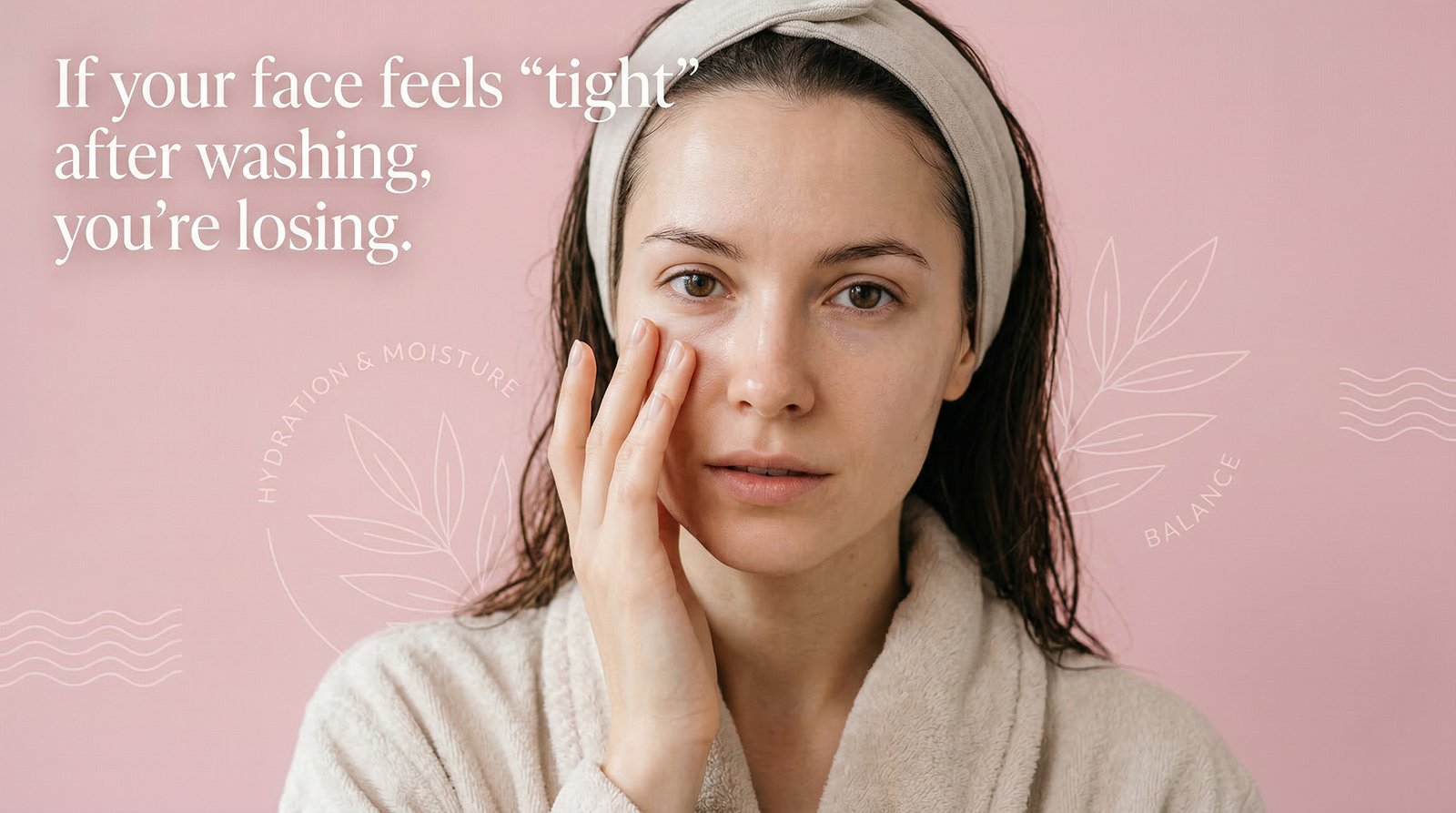
“You’re Not Washing Your Face You’re Disrupting It”
“You’re Not Washing Your Face You’re Disrupting It”
Stop rinsing your money down the drain.
Literally.
Most of you are using your cleanser like a drive-thru car wash. Splash, scrub for five seconds, rinse. Then you wonder why your $80 serum isn’t “working.”
The truth? Your expensive actives never stood a chance.
You aren’t cleaning your skin. You’re just moving the dirt around and calling it a day. Or worse, you’re stripping your barrier so fast that your skin spends the rest of the night in emergency repair mode.
It’s time we talk about the 30-second rule. And why your current “thorough” routine is actually a slow-motion wreck for your acid mantle.
Your Cleanser Isn't a Magic Wand It's a Chemical Reaction
Let’s get one thing straight.
Cleansing is the most violent thing you do to your face. Every time you wash, you are physically and chemically disrupting the delicate balance of lipids and proteins that keep you from looking like a piece of parchment paper.
The goal isn’t “squeaky clean.” Squeaky is the sound of a damaged barrier.
When your skin feels tight after washing, that isn’t “firmness.”
It’s your stratum corneum screaming because you’ve dissolved its natural moisturizing factors (NMFs).
According to research in the Journal of Investigative Dermatology, maintaining the integrity of the lipid matrix is the only way to prevent Transepidermal Water Loss (TEWL). If you mess this up in the first 60 seconds of your routine, no moisturizer on earth can fix it.
The 30-Second Rule: Why You’re Rushing the Best Part
Most people treat cleansing as a chore to get over with. You spend 10 minutes obsessing over which retinol to use, but 5 seconds actually washing your face. That’s backwards. Surfactants the molecules in cleansers that lift oil and dirt need time to work. If you rinse too fast, the pollutants, SPF, and oxidized sebum stay trapped in your pores. But if you scrub for two minutes with a harsh, foamy soap? You’re inviting an inflammation loop that leads to “mystery” breakouts and premature aging.
The “30-Second Rule” is the sweet spot.
It’s long enough for the formula to emulsify debris, but short enough to keep your microbiome intact. Anything less is ineffective. Anything more is an assault.
Your "Hydrating" Cleanser Might Be a Liar
I see it every day. Brands slap the word “Hydrating” on a bottle filled with harsh sulfates and cheap fragrances. Hydration is about water content inside the cells. Moisture is about the oils that seal that water in. Most cleansers fail because they try to do too much or too little. They either strip everything (including the good stuff) or leave a film of wax that prevents your next steps from penetrating.
At “Minimals”, we don’t believe in “squeaky.”
We believe in biocompatibility. If your cleanser doesn’t respect your skin’s pH, it’s not a skincare product. It’s a detergent.
Our Cleansing Complex was designed for the 30-second rule.
It lifts the day’s grime without forcing your skin into a state of cellular panic.
The Myth of the Deep Pore Cleanse
“I need to feel the tingle so I know it’s working.”
No, you don’t.
That tingle is your nerves reacting to irritation. The idea that you need to “deep clean” your pores every night is a marketing scam. Your pores aren’t windows that need Windex. They are part of a living, breathing organ. When you over-cleanse, you trigger a feedback loop. Your skin senses the dryness, panics, and overproduces sebum to compensate. Now you’re oily AND dehydrated. So, you buy a “matte” product to fix the oil, which dries you out further.
Congratulations. You’ve just entered the cycle that keeps the beauty industry profitable and your skin miserable.
The Microbiome: You’re Evicting Your Best Friends
Your skin is covered in billions of beneficial bacteria. This microbiome is your first line of defense against acne-causing pathogens and environmental stress. When you use aggressive, high-pH cleansers, you’re basically firebombing a city to catch one criminal.
A disrupted microbiome leads to sensitivity, redness, and “random” patches of dermatitis.
As noted in Dermatology Times, a stable skin pH is non-negotiable for microbial health.
If you aren’t protecting your flora, you aren’t doing skincare. You’re just performing chemistry experiments on your face.
Why Your 10-Step Routine is Actually a 10-Step Setback
Let’s be brutally honest.
You don’t need a double cleanse, an essence, three serums, and a sleeping mask. You’re layering so many actives that your skin doesn’t know what to do with them.
In fact, layering too many products can cause “occlusive interference.” One product blocks the next, and suddenly you have a $200 layer of expensive sludge sitting on top of your dead skin cells. This is why we preach Skinimalism. It’s not about doing less because you’re lazy. It’s about doing less so your skin can actually function. When you strip back the noise, your barrier has the bandwidth to heal itself. Your routine shouldn’t feel like a full-time job.
It should feel like a reset.
The Moisture Sandwich: The Only "Trend" Worth Following
If you want to maximize the 30-second rule, you need to understand the moisture sandwich. It’s simple: apply your products to damp skin. When your skin is slightly wet, it’s more permeable.
This allows your Minimals Barrier Serum to sink in rather than evaporating into the air.
Cleanse (30 seconds).
Rinse with lukewarm water (never hot).
Do NOT bone-dry your face.
Apply your treatment while your skin is still “glowy” with moisture.
This prevents TEWL and ensures you’re actually getting what you paid for.
If Your Routine Feels Complicated, That’s the Problem
The industry is obsessed with novelty because novelty sells bottles. But your skin doesn’t care about what’s trending on TikTok. It cares about ceramides, fatty acids, and cholesterol. It cares about a pH of roughly 5.5. It cares about not being poked and prodded every twelve hours. If you’re spending thirty minutes in front of the mirror, you’re likely over-processing. Complexity is usually a mask for poor formulation. A well-engineered product doesn’t need five sidekicks to do its job.
The Minimal Routine Blueprint
Ready to stop the madness?
Here is the only routine you actually need. No fluff. No filler.
Use a non-stripping, pH-balanced cleanser.
Massage for 30 seconds.
Focus on the areas where you actually get congested nose, chin, forehead.
Rinse.
Apply one high-performance serum to damp skin. Look for ingredients that support the barrier, not just “attack” problems. Our Active Serums are built to multitask so you don’t have to layer.
You need a moisturizer that mimics the skin’s natural lipid structure. If it feels heavy or greasy, it’s likely just sitting on top. A good moisturizer should disappear into the skin, leaving it soft, not shiny. Check out our Barrier Repair Cream.
In the morning, SPF.
Every single day. Even if it’s cloudy. Even if you’re staying inside.
UV damage is the #1 cause of barrier degradation.
Stop Solving Problems You Created
Half the “skin concerns” people email me about are self-inflicted.
The “dryness” is usually over-cleansing.
The “sensitivity” is usually over-exfoliation. The “breakouts” are often a reaction to a product that shouldn’t be in the routine in the first place. Before you add another step to “fix” your skin, try taking three steps away. Give your skin 28 days one full cellular turnover cycle with a minimal routine. Use the 30-second rule. Stop using hot water. Stop scrubbing like you’re trying to remove a stain from a rug. You might find that your skin isn’t “difficult” or “sensitive.”
It was just tired of you.
The "Less is More" Manifesto
Skinimalism isn’t just a trend.
It’s a return to biological common sense. The more ingredients you put on your face, the higher the statistical probability of an adverse reaction. It’s math. By choosing fewer, higher-quality products, you reduce the “chemical load” on your barrier. You allow your microbiome to flourish. And you save a hell of a lot of time and money.
At “Minimals”, we don’t want you to have a shelf full of our bottles.
We want you to have three bottles that you actually finish.
Because they work. And because they respect the fact that your skin is an organ, not an accessory.
You Don’t Need More Products. You Need Better Habits.
The 30-second rule is a habit.
Buying another serum is a distraction. Focus on the mechanics of your routine before you obsess over the ingredients. If the foundation is cracked, the house won’t stand no matter how expensive the paint is. Start tonight. Slow down your cleanse.
Listen to your skin.
If it feels tight, you’ve gone too far. If it feels refreshed, you’re exactly where you need to be. Your skin knows how to take care of itself. Your job is simply to get out of the way.
Ready to strip back the noise?
Explore the Minimals Essentials.
High performance. Zero fluff. Just skin.
The Simple "30-Second Rule" Checklist
Frequently Asked Questions
If you’re wearing water-resistant SPF or full-coverage foundation, 30 seconds with a single water-based cleanser might not cut it. In this specific case, use a cleansing oil or balm first to break down the wax and silicone, followed by your 30-second water-based cleanse. For “skin-only” days, 30 seconds is your sweet spot.
You start moving into “over-cleansing” territory. After about 60 seconds, most cleansers begin to strip away the essential lipids (ceramides and cholesterol) that hold your skin cells together. This leads to increased TEWL (Transepidermal Water Loss) and a compromised barrier.
Strictly speaking, your skin isn’t “dirty” in the morning it just has some sweat and leftover nighttime products. Many people with dry or sensitive skin find that a quick lukewarm rinse is enough in the AM. Save the focused 30-second massage for your PM routine to clear the day’s environmental pollutants.
You can, but you probably shouldn’t. Your fingertips provide enough tactile feedback to tell you where your skin is congested or irritated. Tools often provide too much mechanical exfoliation, which, when combined with surfactants, can lead to micro-tears and inflammation.
This is likely “reactive seborrhea.” If your cleanser is too harsh or you’re scrubbing too long, you’re stripping the surface oils. Your sebaceous glands overcompensate by pumping out more oil to protect the surface. Slowing down and using a barrier-safe cleanser usually recalibrates this within two weeks.
Closing thought
The skincare industry is built on the idea that your skin is fundamentally broken and needs a dozen products to fix it.
It isn’t.
Your skin is a self-regulating, highly sophisticated organ. It evolved over millennia to protect you, hydrate itself, and shed dead cells without any help from a laboratory. Most of the “problems” we spend billions trying to solve dryness, sudden sensitivity, adult acne are actually just the skin’s way of protesting against a routine that’s too loud, too harsh, and too crowded. The 30-second rule isn’t just about timing your face wash. It’s a metaphor for the entire Minimals philosophy: intentionality over intensity. When you stop rushing and stop over-complicating, you give your skin the one thing it actually needs to thrive: space. Space to repair its own barrier. Space to balance its own microbiome. Space to breathe. If you’re ready to stop the cycle of over-processing, start with the basics. Cleanse properly, protect the barrier, and ignore the rest of the noise. Your skin has the answers. You just have to stop drowning them out.
Do less. Better. Shop the Minimals Collection